
Grain Keeper — Prose Draft
#On the Nature of the Offence
"To hoard food is theft against Heaven." — Bureau of Doctrine, Ration Catechism, Third Revision
The fifth of the eight proscribed heresies bears a name so domestic it ought to embarrass the Bureau of Purity to prosecute it. Grain Keepers. Farmers and millers who defy ration decrees, keeping secret stores of grain for themselves and their kin. They claim to resist hunger, but in truth — and the Bureau's truth is the only truth that survives audit — they rob their neighbours of holy discipline. So reads the entry in the Index of Known Heresies, filed between the Crimson Concord and the Ashen Circle, as though a woman hiding a sack of barley beneath her stairs belonged in the same ledger as scholars trafficking in banned histories and blasphemers who propose alliance with demons.
She does. The Synod has said so. I have stamped the requisite documents.
The Grain Keeper is the person who stands between the Bureau of Tithes' ration ledger and the open mouth of a child. This is a heresy. The Bureau has declared it so, and the Bureau's declarations carry the weight of canon, and canon carries the weight of the Concordat, and the Concordat carries the weight of the Creator Himself, and the Creator — as the Bureau is fond of reminding us — does not negotiate over wheat.
Food is liturgy. Every loaf passes through the hands of the Synod, sanctified with seal and sigil, stamped with the mark of the Covenant so that even chewing becomes worship. The ration-station is a chapel of mercy. The queue is a procession. Hunger is discipline, and discipline is the path to holiness. This is doctrine. The Grain Keeper's sin is not that he steals grain — theft has its own statutes, its own tribunals, its own punishments — but that he steals the discipline. He feeds a family that was meant to fast. He fills a belly that was meant to ache. He substitutes calories for catechism, and in doing so he robs his ward of the sharpening that starvation provides.
#On the Origin of the Practice
"No one audits a famine." — Grain Keeper proverb, proscribed under Standing Order 22-H
The Grain Keepers did not emerge from ideology. They emerged from arithmetic. The ration system — that glorious machine of stamps, chits, scales, and queues — was designed in Strasbourg by men who had never missed a meal, calibrated by clerks who weighed grain against reliquary fragments and declared the exchange rate sanctified, and administered by Wardens whose own allotments were triple the civilian standard. The system functions. The numbers balance. The ledgers reconcile. The only flaw, if flaw is the word, is that the numbers do not correspond to mouths.
Transport losses are blamed on sin. Spoilage is classified as "providential correction." Convoys that arrive light are logged as having departed light, and the discrepancy is filed under "doctrinal adjustment, no action required." The Ration Parliament of Wexel — that magnificent Hessian engine of counted joy and weighed obedience — demonstrated the principle with the clarity of a geometry proof: grain enters; obedience exits; and the exchange rate holds steady because the alternative is admitting that the rate was invented by a committee that confused hunger with holiness.
The first Grain Keepers arose in the years following the Concordat, when the Bureaus standardised ration chits across the western provinces and created — with the precision of master engineers — a system so predictable that any clerk with a wax knife and a pocket scale could exploit it. Procurator Hildegarde of Mainz ordered the razing of forty villages during the Grain Tithe Riots, and was later canonised as a Defender of Stability. The villages burned. The grain did not. Someone hid it. Someone always hides it.
The turning points are instructive. The First Ration Reforms of A.S. 104 standardised chit design across eight provinces, creating a currency of hunger so uniform that counterfeiting became a cottage industry within the year. The Weevil Year — A.S. 157, the same winter that emptied the Hospices of Departure across three zones — saw official grain stores rot in their silos while hidden caches kept entire districts alive. The Synod quietly stopped asking questions. It resumed asking questions in A.S. 158, by which time the caches had been moved, the ledgers had been rewritten, and the districts in question had developed a sudden and convenient amnesia regarding who, precisely, had fed them.
Earlier editions of this Codex attributed the Weevil Year to "meteorological misfortune and logistical delay."
This classification has been revised. The Weevil Year was caused by the Bureau of Agriculture's insistence on storing grain in facilities designed by the Bureau of Engineering, maintained by the Bureau of Rites, and inspected by the Bureau of Records — four Bureaus, none of whom considered ventilation to be within their jurisdiction. The Bureau of Agriculture was dissolved in A.S. 158. Its dissolution was unrelated.
The trenchline surge winters completed the transformation. When the Sagittal Line demands men, the cities that supply them must also supply food. Troop feeding becomes priority. Civilian allotments shrink. The ration chit that bought a loaf in autumn buys a heel in winter and a prayer in spring. The Grain Keeper — who was a parish embarrassment in peacetime — becomes a local government. The one who decides who eats when the bellies talk louder than the bells.
#On the Apparatus of Concealment
"Count sacks like sins." — Bureau of Tithes, Granary Inspection Manual
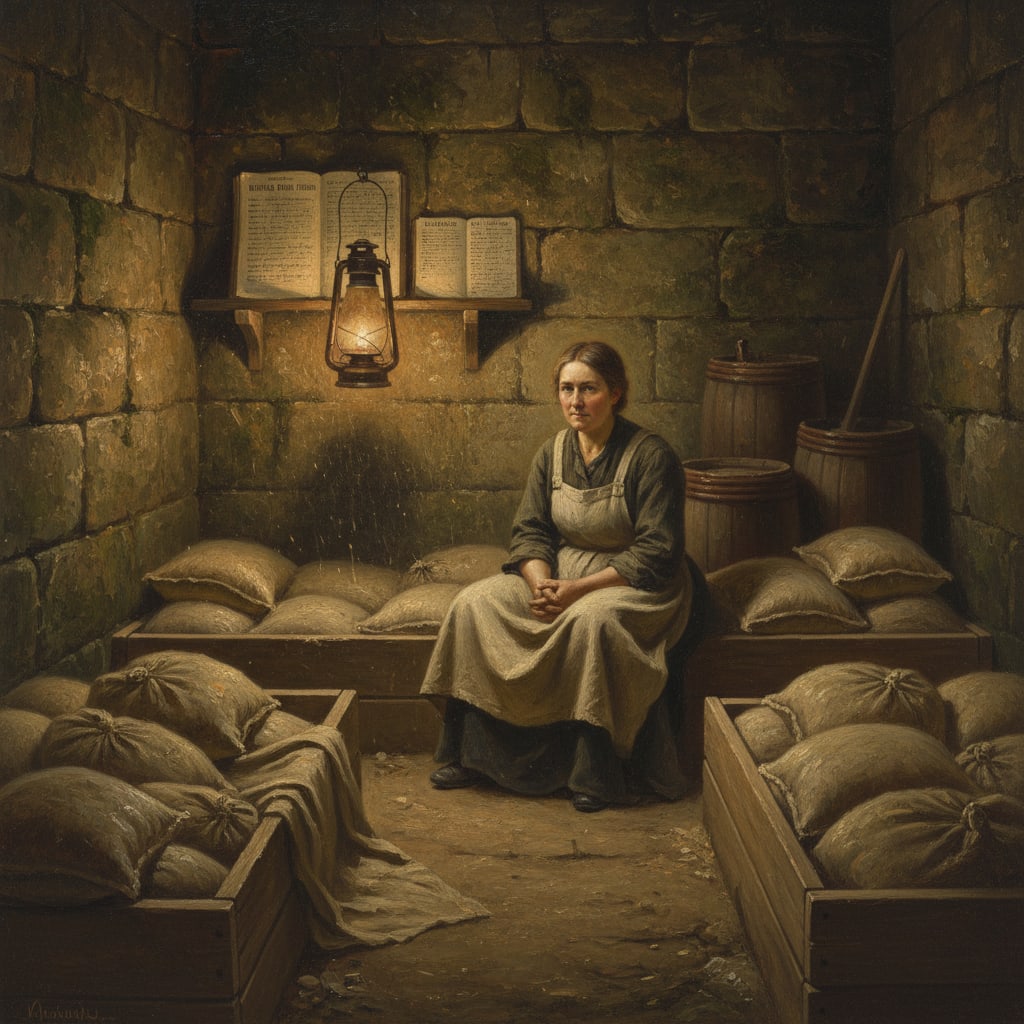
The Grain Keeper works in a cellar, a false-bottomed bin, a crawlspace above a mill, a parish "alms room" whose charity is suspiciously caloric, a bone-dry ossuary vault where the dead no longer need the shelf-space. The smell is sweet rot, mouse musk, damp straw, and the grain dust that coats the lungs like a slow confession. Lantern light turns every mound into something body-shaped.
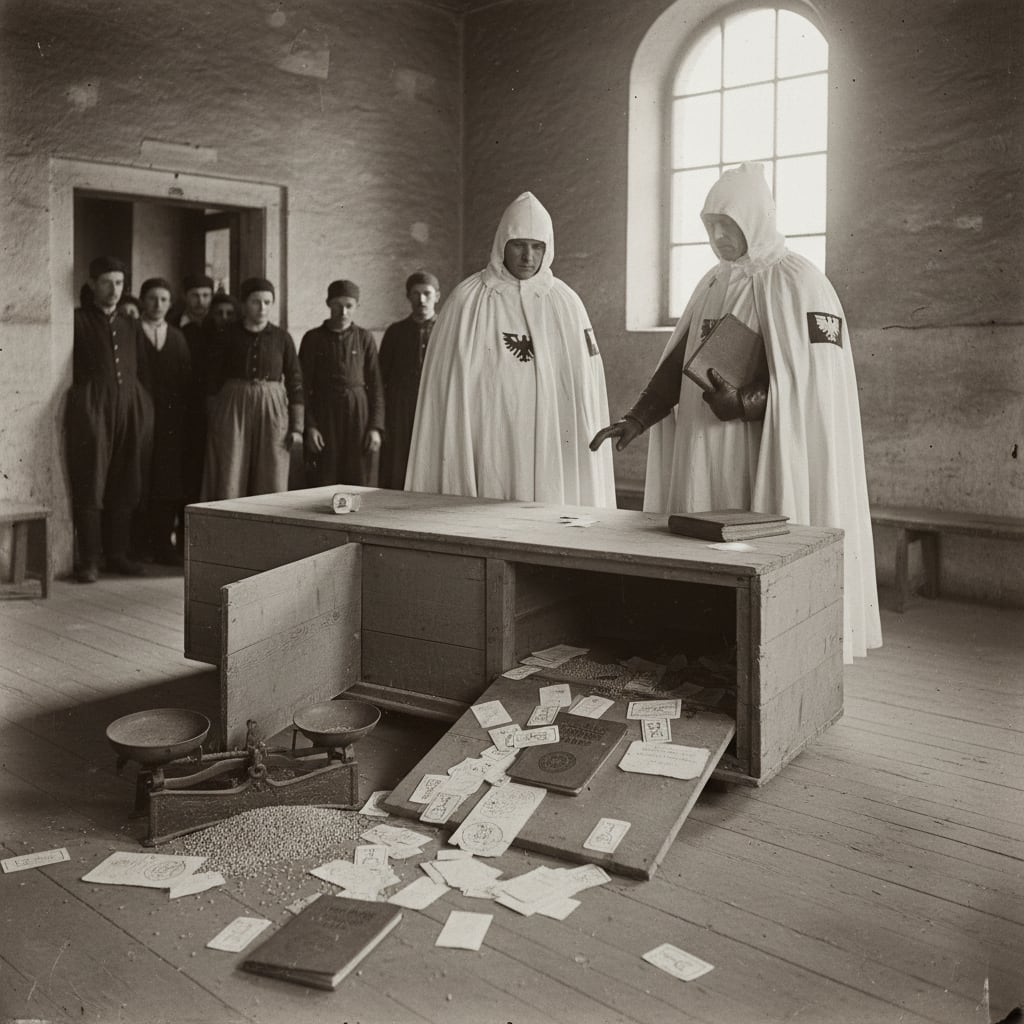
The tools divide cleanly. The issued kit — scales, stamp blocks, ration ledgers, seal twine, fumigation powders — belongs to the official granary where the Keeper maintains cover as an Auxiliary Store Warden, a title so bureaucratically bland that even the Bureau of Shadows loses interest halfway through reading the personnel file. The contraband kit — false-bottom bins, waxed cloth sacks, counterfeit chits, bribe salt, and the "clean" weevil jars kept for framing rivals — lives elsewhere. Always elsewhere. Caches in threes: one found, two survive.
The process is five steps, repeated until the Keeper dies, is caught, or becomes indistinguishable from the system he exploits:
Skim — small amounts, constant. A sack here. A half-measure there. The difference between what arrives and what is counted, laundered through the margin of error that every scale permits and every auditor ignores because pursuing it would require admitting that the scales are imprecise, and admitting that the scales are imprecise would require admitting that the ration system is imprecise, and admitting that the ration system is imprecise would require a committee, and the committee would require a budget, and the budget would require a tithe, and the tithe would require grain, and the grain is already in the cellar.
Hide — distributed. A Keeper who hoards in one location is a Keeper who has decided to be caught. The veteran maintains six to twelve cache sites across a ward: behind altars, under stairwells, inside ossuary walls, in the false floors of licensed granaries, beneath the bell-tower steps that nobody climbs because the bell-tower steps are haunted, which is to say the Keeper pays a boy to make noises on the landing after dark.
Launder — convert grain to bread, bread to "church alms," alms to charity, charity to anonymity. Provenance dies in an oven. A sack of stolen barley is evidence. A basket of donated loaves is sainthood.
Trade — grain for favours, medicine, protection, silence, passage. The Keeper who feeds a patrol sergeant's children does not get inspected. The Keeper who feeds an inquisitor's children does not exist, because the inquisitor does not have children, because the inquisitor's children do not eat bread from a cellar that does not appear on any map.
Erase — rewrite ledgers, burn old chits, fabricate spoilage reports. The most sacred step. A ledger that tells the truth is a ledger that kills.
#On the Internal Order
"A clean ledger is a dead ward." — Keeper proverb
The Grain Keeper is not a lone operator. The profession breeds hierarchy as inevitably as grain breeds mice.
The Sack-Hand is the bottom — a carrier, a runner, a boy who learns to identify rye from wheat by smell in darkness, who carries sacks on routes he is not told the ends of, who understands that the weight on his back is someone's life and the weight of a purity probe is his own. Sack-Hands are recruited from orphanages, baker's apprenticeships, and the particular species of desperate family whose arithmetic has concluded that heresy is cheaper than hunger.
The Scale Clerk handles the numbers — the spoilage shuffle, the chit reconciliation, the creative ledger-work that transforms theft into administrative error. Scale Clerks develop the ink-stained thumb, the persistent cough, the ability to misread a scale on command while reciting the ration catechism for the benefit of watchers. They are the profession's accountants, and like all accountants they are either indispensable or incriminating, with no middle ground.
The Cache Runner handles the routes — the night transfers, the curfew deliveries, the back-door movements that keep grain flowing from cellar to cellar under the fog. Cache Runners pay Curfew-Fog Tavern Runners in bread for safe passage, bribe patrol sergeants in salt, and navigate the bell-schedule with the precision of Bellwardens — which is to say, imperfectly, but with greater personal consequences for error.
The Cellar Warden controls a district's hidden stores. A senior position. The Cellar Warden knows every cache site, every bribed patrol, every parish canon who looks the other way because looking the other way costs less than looking directly at the number of children who would die if the cellars were emptied. Cellar Wardens develop the paranoia of men who carry keys to rooms that must never be found, and the exhaustion of men who have decided that sleep is a luxury they cannot afford because sleep requires trusting someone else to count.
The Keeper-of-Keys sits above them all — one per ward, sometimes one per district, the person who decides who eats in crisis. The title is not official. It is not written. It carries no seal, no stamp, no Bureau endorsement. It carries only the weight of the keys on the ring — real keys and decoys, status and burden indistinguishable — and the knowledge that every family fed is a family you might have to deny later.
#On the Factions and Their Quarrel
Three factions contest the soul of every Grain Keeper operation, and the quarrel is older than the profession itself.
The Mercy Keepers feed children first, ask no questions, take no payment, and die broke. They are the profession's saints, which is to say they are beloved by everyone who eats their bread and despised by everyone who must clean up after their generosity. A Mercy Keeper who feeds a resistance cell draws a purity probe onto the entire ward. A Mercy Keeper who feeds a dying grandmother draws nothing but grief. The difference between the two is a single knock on the wrong cellar door.
The Quota Men keep the system running — skim modestly, hide carefully, launder meticulously, and ensure that the official granary functions well enough that nobody looks beneath it. They are the profession's pragmatists. They understand that the ration system cannot be overthrown, only parasitised, and that a parasite that kills its host dies with it. Quota Men survive audits because their official ledgers are impeccable. Their unofficial ledgers are also impeccable, which is the problem — two sets of perfect books, each telling a different truth, each requiring a different set of lies to maintain.
The Hunger Brokers use grain as recruitment, blackmail, leverage, and law. They are the profession's tyrants, the ones who discovered that the power to feed is the power to govern, and that a ward whose children eat at your discretion is a ward that belongs to you in every way that matters. The Black Ledger recruits from their ranks. The Bureau of Shadows monitors their ranks. The distinction between the two is, at certain altitudes of the hierarchy, academic.
#On the Present Condition
"Bread is obedience made edible." — Ration Catechism, opening line
The Grain Keepers endure because the arithmetic endures. The ration system feeds the Line. The Line feeds the war. The war feeds the Synod. The Synod feeds the Bureaus. The Bureaus feed themselves. What remains feeds the population, and what remains of what remains is counted, stamped, blessed, queued, distributed, and insufficient. The gap between the stamp and the stomach is where the Grain Keeper lives.
The Bureau of Purity prosecutes them with the regularity of a bell-schedule. The Bureau of Tithes tolerates them with the pragmatism of an institution that understands revenue better than theology. The Bureau of Shadows monitors them with the professional interest of an agency that recognises in the Grain Keeper network a parallel intelligence apparatus — distributed, cell-structured, loyalty-bound, and operationally invisible to every Bureau except the one whose business is invisibility.
Estimates vary. The Bureau of Purity claims to have "eliminated seventy per cent of organised grain diversion in the western provinces." The Bureau of Tithes' own revenue figures suggest that grain diversion in the western provinces has increased by eleven per cent over the same period. Both figures were presented at the same quarterly assessment. Both were accepted without comment. The assessment was adjourned for lunch.
The Grain Keeper endures because hunger endures, and hunger endures because the system that administers it was designed to produce obedience, and obedience requires scarcity, and scarcity requires that someone, somewhere, is not eating. The Keeper fills the gap the Synod requires but cannot acknowledge. He is heresy in an apron, sin with flour on his sleeves, and the only reason three-quarters of the civilian population west of the Sagittal Line survived the last four winters.
The Bureau has classified this assessment as "unsubstantiated."
The Bureau has classified the four winters as "seasons of spiritual refinement."
The bread, at least, was real.