
#On the Bread-Wick
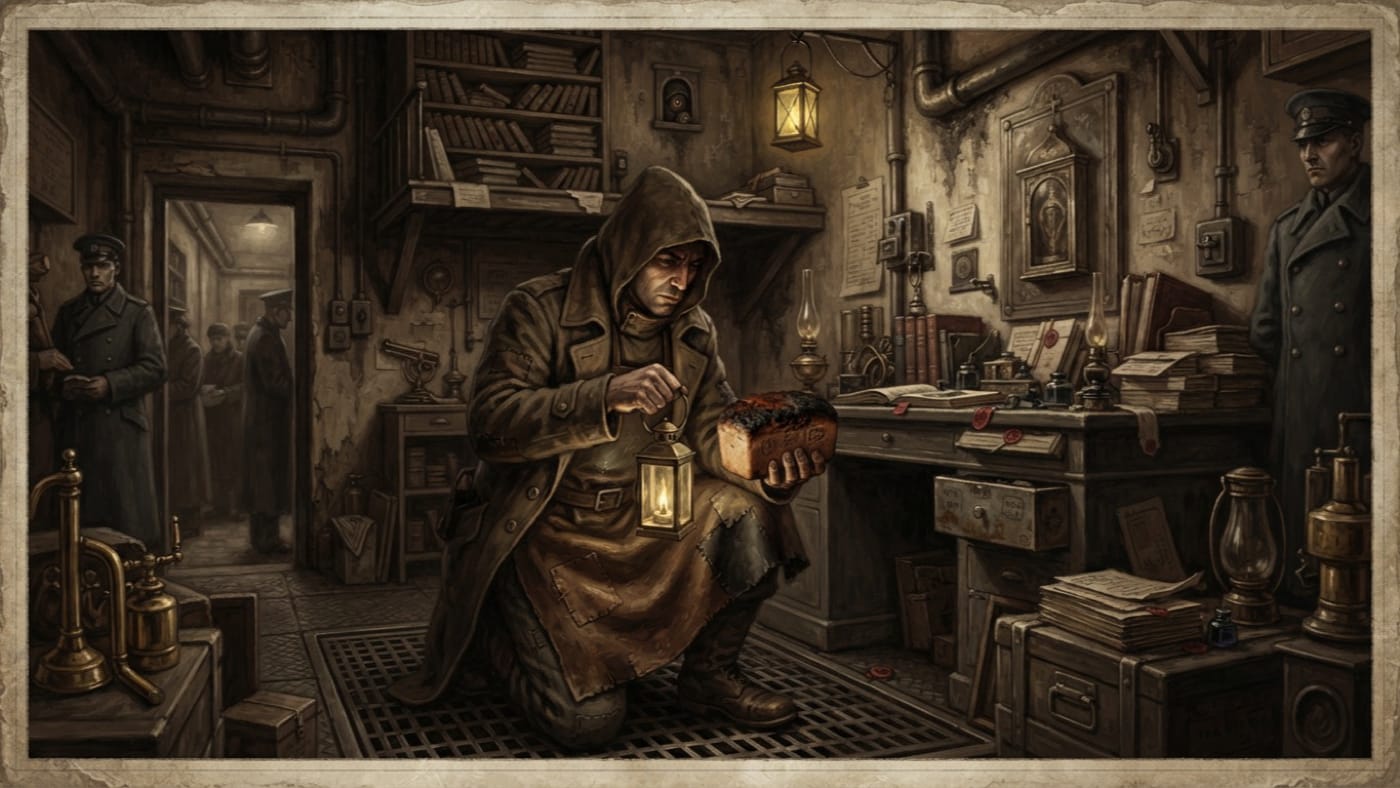
The Circle of Nine Wicks admits its Ember-Pages by means of a loaf.
The charter states the whole rite in one sentence, and I copy it with the reverence owed to any instruction short enough to be obeyed: an Ember-Page must hold a flame over a ration loaf until the crust blackens without igniting. That is two conditions, and both must hold at once. The crust must darken and the loaf must not burn. An initiate who manages the first and forgets the second has made a fire, a cinder and an enemy of the bread-hall clerk. An initiate who manages the second and neglects the first has warmed a loaf in public, which in a ration ward is an act of provocation.
The charter writes the lesson directly beneath the test: pressure, not fire. Burn the edge; keep the system intact. I have sat through longer catechisms that taught less.
Nine Wicks is the market Circle of the Lantern Brotherhood. It keeps the ration lanes, market courts, bread halls and the stalls that crowd against the docks. Its mandate is that crowds stay obedient and contraband stays discoverable. Read that word again. The Circle has no instruction to eliminate anything, and the Bread-Wick is where a recruit first learns why elimination would ruin the trade.
The charter does not trouble itself with who devised the rite, in what year, before whom, or for how long the flame must be held. Neither shall I. A rule with no author cannot be appealed to its author, and the Circle seems to have understood this better than several Bureaus I could name.
#On the Ration Loaf
The test object is a ration loaf because in the Dominion bread is never only bread. Doctrine preaches it as obedience baked and stamped. The Bureau of Tithes weighs it, issues it and enters it in the ledger. The faithful queue for it before dawn in a silence that some kitchens enforce with cudgels. Hunger is holy. I have signed pamphlets saying so, and the pamphlets were very well received by persons who had eaten.
The loaf over the Ember-Page's flame belongs to that system and has no virtue of its own. I have examined several such loaves in my career. They contained flour, water, grit and the faint smell of a receipt. No relic-light lives in the crumb. Whatever is sacred about the ration loaf was put there by the issuing office, and it can be taken away again in the same manner.
That is the point of using one. A burnt loaf is a lost ration: a line struck from a tally, a shortfall someone must explain, and a hungry family arriving at the counter to find their portion gone to ash. A scorched loaf is still a loaf. It can still be counted and handed across the board. It can even be eaten, by anyone whose hunger outranks their dignity, which in a ration ward means everyone. The blackened crust shows that the flame was applied, and the intact loaf shows that the system survived the application.
What becomes of the loaf afterwards, the charter does not record. Nor does it record what becomes of an Ember-Page who sets one alight. I have learned not to fill a charter's silences with my own appetite.
#On Pressure in the Queue
The Circle recites its doctrine at the bread-hall door: "A queue is a prayer. A shove is heresy." After the loaf, the Ember-Page is put to work on a line of people.
A queue is a loaf with legs. It will take heat at its edge for a long time without complaint. It will grumble, shuffle and pray. If the heat reaches the middle, it ignites, and a market that has caught fire is a riot. A riot yields no dues, no counts and no orderly reports, and the Circle would then be explaining itself to men with far better keys. Nine Wicks therefore applies its flame at the margin.
The crowd-hook is the Bread-Wick turned into a tool. It is a short shepherd's crook that draws a single offender out of the line without breaking the line itself. The edge blackens and the loaf remains. The nine chalk wick-strokes on a stall "under lantern" do the same work more quietly. The stall stays open and trading, and the whole lane knows it is being watched.
The light permit is the rite turned into revenue. A stallholder pays a small fee and receives a wax permit-dot certifying a properly lit window and a stall left "unselected" for inspection. One who refuses discovers how strictly the shutters can be judged. One who offends further may suffer Permit Revocation and lose light for seven nights, which for a market stall is an economic death sentence carried out with a candle-snuffer.
Nine Wicks sells its light permits under Bureau licence and approved schedule.
Corrected. The permits have no Bureau standing. The Circle operates under local toleration, revocable without notice or appeal. The schedule is approved by whoever is holding the citation slate.
Then there is the Triangle of Witness, which I hold to be the Bread-Wick performed on a street. The charter does not say so. I say so, and I possess a seal. The Anchor stands at the choke-point as a visible lantern, so that the queue knows the heat is near. The Blade moves through the line in pairs, searching and touching and asking questions at the distance of a breath. The Echo never intervenes. The Echo writes, recording names and marking the seizures that will come later, when they are needed. The flame is placed, the edge darkens, and the record is kept so that tomorrow's crust can be found in the same place.
None of the three positions is required to attend the Bread-Wick itself, so far as any charter records. They have no need to attend. They are what the rite becomes once the initiate has learned it.
#On the Permit-Chapel
The Circle's home is the Permit-Chapel of Saint Varr. It is a shuttered side-shrine wedged between the ration hall and the market court, smelling of lamp oil and old bread. The altar is a desk. The saint's reliquary is a locked drawer holding permit dots, confiscation tags and confessions written out before anyone has confessed. A narrow loft above holds the Echo's ledgers and a peephole that looks down on the queue lines.
Whether every Bread-Wick is held under this roof the charter does not say. I place the reader here only because it is the Circle's one address. Here also the products of the lesson come to rest, in the drawer and the loft and the ledger that tallies what the market paid to stay lit.
My earlier article on the Circle records that Saint Varr's official recognition is disputed. The dispute continues. The drawer stays locked, and the money under the saint's image keeps arriving every night regardless.
#On Conditional Toleration
The Circle descends from the toleration clauses of the Curfew Ordinance of Quiet Hours, which made auxiliary vigil personnel a deniable instrument of the night. That ordinance is the Circle's legal precedent. The Bread-Wick's own birth is not recorded there or anywhere else I have been permitted to read, and I have been permitted to read a great deal.
As of A.S. 201, Nine Wicks remains conditionally tolerated under the observation of the Bureau of Purity. Each office takes its part of the loaf. Tithes values a counted market, because a counted market pays. Purity values unrest kept small enough to file, because market wards without the Circle breed louder sermons, bolder bread theft and more whispered sympathy for the Mercy Preachers. The Bureau of Records keeps the forms. The Bureau of Shadows watches the Circle that watches the queue. The Wardens hold the power to end the arrangement in an afternoon and have not yet found a reason to give up the afternoon.
Every one of those tolerances rests on the lesson of the loaf. A Circle that singes the edge and keeps the system whole is useful. A Circle that sets the bread alight is merely a gang with lanterns.
The danger is kept in the chapel drawer. The Confession Closet holds blank confessions and pre-signed citations, so that guilt can be supplied when a night proves too honest to fill its quota. Here the crust is no longer being scorched. Here the loaf is replaced outright, and a forged one is handed across the counter. If the Wardens or the auditors ever open that drawer, Nine Wicks becomes a criminal gang before breakfast, and the Circle will learn too late that it had stopped applying pressure and begun to burn.
No such opening is recorded. The drawer remains shut. The Ember-Pages still hold their flames over the bread, and the Brotherhood still sends its initiates out to apply heat to the city's edges.