
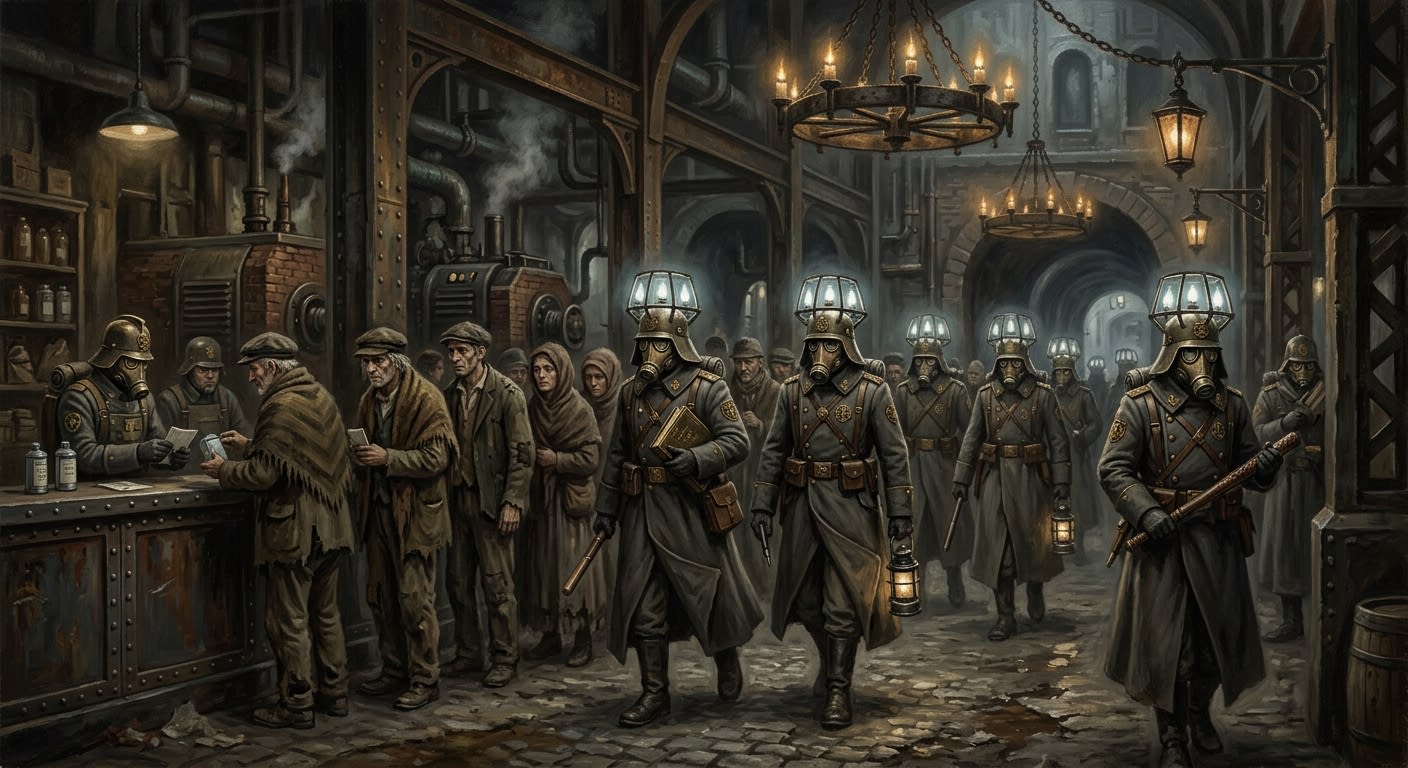
#On the Market Vigil
The Circle of Nine Wicks holds the places where hunger learns arithmetic.
Market courts, ration lanes, bread halls, dock-adjacent stalls: these are their chapels. They do not guard palaces, reliquaries, bastion gates, or the stately avenues where Wardens may display authority without stepping in cabbage water. Nine Wicks keeps the queue. It watches the hands near the scale, the eyes near the sack, the clerk near the receipt box, the child near the dropped crust. It understands that a market riot begins long before anyone throws the first stone. It begins when the line discovers it is a crowd.
Within the Lantern Brotherhood, Nine Wicks is classified as a market Circle: tolerated auxiliary vigil personnel operating under local licence, subject to revocation without notice or appeal, descended from the Curfew Ordinance of Quiet Hours and its useful little sin of subordinate permission. The Circle's public mandate is crowd obedience and contraband discoverability. Observe the wording. The contraband need not vanish. It need only remain findable at the correct hour.
#On Light Permits and Other Sacred Frauds
Nine Wicks' tolerated sin is extortion by illumination. The mechanism is vulgar, stable, and almost admirable. A stallholder pays a small fee — always voluntary in the same sense a confession under tongs is voluntary — and receives a wax permit-dot certifying that his window is properly lit, his scales sufficiently visible, his sacks available for inspection under scheduled rather than sudden conditions. The certificate has no Bureau standing. The payment has immediate standing. Reality, unlike law, is prompt.
A butcher who pays keeps his stall classified as “orderly.” A grain-woman who pays finds her sacks inspected after business rather than during the dawn rush. A candle-seller who refuses discovers that the exact angle of his shutters violates local curfew-lighting custom, a custom helpfully invented six minutes before citation.
The Bureau of Tithes disapproves in principle and appreciates in consequence. Calm markets yield counts. Counts yield dues. Dues yield reports in which no one writes the phrase “paid vigilante racketeering” because the ink would make everyone sad. The Bureau of Purity tolerates the arrangement because market wards without Nine Wicks produce more illicit sermons, more bread theft, more whispered sympathy for Mercy Preachers, and more citizens saying, aloud, that hunger is badly administered. That last offence spoils an entire parish faster than mildew.
#On the Triangle at the Bread-Hall
The Circle patrols by the Triangle of Witness. The Anchor stands visible at the choke-point, lantern hood half-open, shepherd's crook across the wrist, citation slate displayed like a minor relic. The Blade moves through the queue in pairs, asking polite questions with impolite proximity. The Echo watches from a stall awning, loft vent, shutter crack, or shrine alcove and writes the first report before the accused has finished understanding the accusation.
Truth is not the product. Testimony is the product. Three lights, three positions, three signatures: sufficient geometry to satisfy a tired clerk.
The favoured tool is the crowd-hook, a short shepherd's crook used to draw offenders out of a line without breaking the line itself. The favoured mark is nine small wick-strokes chalked near a stall “under lantern.” The favoured punishment is Queue Penance (Unregistered): an offender placed at the front of the line and made to recite a scripted confession until the crowd accepts it, or until exhaustion makes acceptance administratively convenient.
INCIDENT REPORT — RHINELAND BREAD HALL 17, A.S. ███ Subject placed under Queue Penance after accusation of flour dilution. Crowd response exceeded approved murmuring thresholds. Nine Wicks Anchor authorised chant-containment. By dawn ███████████████ had confessed to offences not listed in citation. Three families relocated. One loaf retained as evidence. The loaf is missing.
#On the Bread-Wick and the Permit-Chapel
Initiates enter by the Bread-Wick. An Ember-Page holds a flame over a ration loaf until the crust blackens without igniting. Pressure, not fire. Singe the edge; preserve the commodity. This is better instruction in Synod governance than half the sermons preached at Strasbourg, and I say that as the author of several of the better ones.
The Circle's home is the Permit-Chapel of Saint Varr: a shuttered side-shrine wedged between ration hall and market court, smelling of lamp oil, stale bread, wet wool, and the old panic that clings to places where people have waited too long while hungry. The altar is a desk. The saint's reliquary is a locked drawer of permit dots, confiscation tags, and pre-written confessions. A narrow loft holds the Echo ledgers and a peephole view of the queue lanes. Piety has had worse architecture.
Their daily order has the beauty of a noose tied by a professional. Dusk: oil measure and wick trim. First bell: Anchors placed where the city can see itself being watched. Early night: queue sweeps and permit-dot sales. Midnight pressure: one public seizure, one private payoff. Late night: rumour maps, names, and an example if the market got loud. Pre-dawn: scrap notes burned, confiscation totals reconciled to match the story.
#On the Confession Closet
Every tolerated sin has a limit. Nine Wicks keeps its limit in a locked drawer.
The Confession Closet is the Circle's toleration-killer: a cache of blank confessions and pre-signed citations used when proof quotas prove spiritually uncooperative. A night may pass without contraband. A week may pass without heresy. The Bureau's forms possess no column for “the city behaved itself.” The Circle solves this theological defect with foresight, stationery, and the handwriting of men who have learned that guilt is easier to manufacture before dawn.
Prior Nine Wicks reports describe all submitted confessions as “spontaneous citizen recognitions of error.”
Amended pending audit. Several recognitions appear to have been spontaneous in the same way a mousetrap spontaneously closes after someone places a mouse in it.
If Wardens open the drawer, Nine Wicks becomes a criminal gang before breakfast. If Purity opens it, Nine Wicks becomes a heretical apparatus. If Records opens it, the forms will be examined for procedural adequacy first, because Records has priorities and none of them are mercy.
#On Civic Usefulness
Nine Wicks survives because it works. Bread halls remain open. Ration lines move. Contraband appears when the city requires an example. Crowds learn that the lantern at the choke-point has memory. Stallholders curse, pay, and unlock at dawn. The market breathes through a cloth held by dirty hands.
The Bureau of Shadows watches the Circle. The Bureau of Records counts it at thirty members, like every Circle that has learned the upper limit of a licence. The Bureau of Purity keeps a file and pretends the file is a leash. Nine Wicks keeps the queue.