
#On the Surviving Record
“Hunger is heresy’s first sermon.” — ration-hall proverb
This is a survey, conducted in A.S. 201, of what remains of Breadfire Week and of the office that came out of its ashes with a guard at each elbow. I state the scope at the outset because the subject attracts liars. Every bread court in the Synod has a matron who will tell you that her grandmother’s sister watched the flames, and every one of those matrons gives a different year.
The accepted record is short. Ration halls burned during riots in three bastion cities. Among the things burned were the records. The dates have been disputed ever since, and the dispute has outlived everyone competent to settle it. In the aftermath the Mothers of Plenty, an office already at work in the halls, received enforcement authority and guards. That is the whole of it. It would fit on one side of a ration chit with room left for the seal.
Here is what does not survive in any form I would certify: the names of the three cities, any person who lit anything, a count of the dead, a count of the halls, and the order in which they burned. I have seen every one of these supplied in pamphlets, in homilies and in queue-yard gossip. Each version is confident and none of them agrees with another. The Bureau of Records holds the consequence in good order. It cannot produce the chronicle.
The name is no help either. “Week” is what later mouths called it. Nothing in the surviving record proves seven days, or one calendar week, or that the three fires shared a season. The Mothers’ formal constitution belongs to A.S. 94 in the normalized chronology. Breadfire belongs to no year at all, and I decline to calculate one from its neighbours. Clerks who date an event from the institutions around it end up dating their own guesses.
#On the Burning of the Halls
Hold the event in its proper frame. In the hard ration decades after the Sundering, bread went to whoever stood nearest the storehouse with a key or a cudgel. Midwives, parish kitchens and military depots each kept their own rolls, and the rolls contradicted one another. The surviving professional lore speaks of repeated ration panics and of war emptying the population. Breadfire was the panic that got written into the institutional histories. It was not the first.
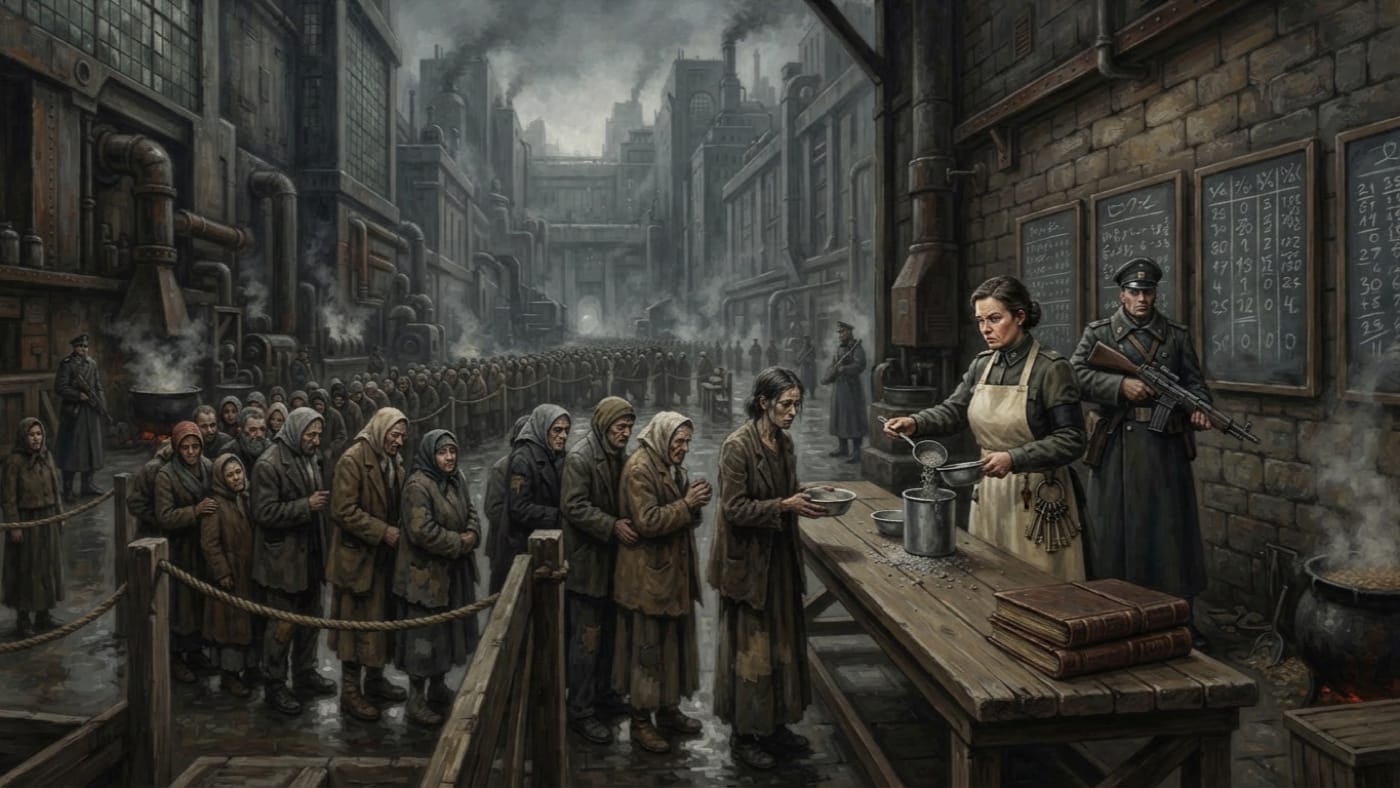
A ration hall is easy to describe because they have barely changed. It has a queue yard roped into lanes, a bread court for disputes, measure cups on a scrubbed table, a reserve store under lock, and ledgers listing every household, what it was owed and what it had already eaten. It smells of steam, sour grain, lye soap and wet wool. When the crowd begins to turn, the murmur sharpens toward a chant.
Three such halls, or three cities’ worth of them, burned during riots. I can tell you no more about the burning than that, and anyone who tells you more is selling something. The record does not say who struck the first light. It does not say whether the ledgers were the target or simply happened to be in the building, as ledgers always are. I will not call their destruction policy, and I will not call it accident, because no surviving page lets me call it either.
Nor does any account I accept put Saint Halva of the Warm Ladle in any of the three halls. Her broth and her swapped ledgers belong to the office’s patron myth and to some other, undated panic. Pilgrims mix the stories together, and pilgrims are not my concern.
#On the Settlement of the Queue
The aftermath is better documented than the fire, as is usual with Synodal events. Ash leaves no record, but the committees that follow it leave a great deal.
Each Bureau asked for what its portfolio required. War requested guards. Tithes requested stricter discipline over the measure and the queue. Mercy requested language that would make both requests sound compassionate. The institutional account preserves these requests by their results. It does not preserve a meeting, a signatory or a proclamation, so I supply none of them.
Doctrine supplied the explanation that joined the three. The Mothers of Plenty would be the public face of quota discipline, a mercy layer over hard policy, and the hand at the ladle would be maternal so that nobody looked too closely at the guard standing behind it. The Mothers were already measuring, registering and certifying. After Breadfire they could enforce. Their authority and their guards came with the consolidation, and from then on the Synod could deny bread in a smiling face.
The Codex entry on the Mothers of Plenty stated that, after Breadfire Week, Doctrine “created the Mothers of Plenty as a public-facing mercy layer over quota discipline.”
Corrected: Breadfire Week was the turning point at which an existing Mothers of Plenty gained enforcement authority and guards. Doctrine’s mercy layer explains the public role of the consolidated office and does not record its first creation. The formal constitution of the office is a separate matter, with a separate date.
The arrangement suited everyone except the queue. War had its guards without having to stand in the bread line. Tithes had its discipline without having to take the blame for it. Mercy had its vocabulary. The crowd had a woman in a cream apron, a cord of keys at her hip, and a guard at her shoulder whose orders came from somewhere else.
#On Bread and the Womb Ledger
Authority and guards would mean nothing without knowing what the Mothers already held. They held hunger and birth, and they had joined the two into a single calculation.
Their process runs in a fixed order, and the order is the policy. They measure incoming food, separating what arrived from what was reported. They allocate rations by household category and by compliance. They register pregnancies and tie each one to an allotment and a debt. They certify births and assign identities. They forecast the levy yield and send the forecast up to the levy offices. They enforce through control of the queue, through denial, and through placement in a Plenty House.
Each step pays for the one after it. A pregnant household can receive more food, but only after declaring the pregnancy. The declaration brings inspection, the inspection brings registration, and the registration enters a ledger that someone further up the corridor reads for future sons. The extra flour is real and the extra broth has kept real women alive. Both are also a loan. The trade’s own lore records that mothers owe the system for their prenatal allotments, and that the system turns the debt into labour or into future compliance with the levy.
The Plenty classifications sort women into fit mother, weak mother and debtor mother. A woman can also be sent to the Plenty House. These are pregnancy dormitories. They have regulated meals, inspections, a locked store, guards and a place to give birth. The care is genuine, and so is the custody. A woman placed there eats on the Mothers’ terms, sleeps under their count and gives birth inside their paperwork.
A certified birth puts the infant on the record. A boy receives a future levy designation before anyone in the room says the word aloud. The trade has a rule that keeps “plenty talk” apart from “levy talk,” so that no mother hears the whole machine at once. The guards Breadfire gave the Mothers stand on the plenty side of that division, where she can see them.
Breadfire did not invent this ledger, and the sources do not show that every function began at once. What the fire did was put a guard beside the denial. Before Breadfire a Mother could refuse a bowl. Afterwards she could refuse it and have the refusal stick.
#On What Survived
The Mothers now work in every major bastion and in most supply cities. Their guards are as ordinary a sight at the queue rope as the rope. The office’s own history, in the order the institution tells it, goes on to the Empty Cradle Accord, which brought fertility incentives and turned miscarriages into audited statistics, and then to the Sons-For-Heat Program, which tied winter fuel to birth compliance and pledges to the levy. I give neither a year, and I do not count the interval from Breadfire to either one. Whoever writes their histories may take on that burden. I treat them here as descendants of Breadfire and not as clauses in a settlement that never left a page behind.
Some of the inheritance is smaller. Mothers carry charms, and one of the approved kinds is a strip of sackcloth from a riot day, kept as a warning. The trade’s status symbols include a clean apron, a silver-rimmed ladle and an unburned ledger book. I do not claim that the fashion for unburned ledgers began in three burning halls. I note that Records has never been asked to explain it.
The Bureau of Conscription now receives the forecasts that the rear offices compile. The Mercy Ward-Sisters are called to the queue when someone collapses and one of them can be spared. The Grain Keepers feed people in secret, which has always been the clearest sign that the public ladle is not enough. None of these arrangements tells us which three cities burned or when. All of them stand where the halls stood.
At dawn the measure cup is tapped three times against the table. The quota goes up on the slate in chalk, a guard takes up his place at the end of the rope, and the women step forward holding their papers.