
#On Her Legend
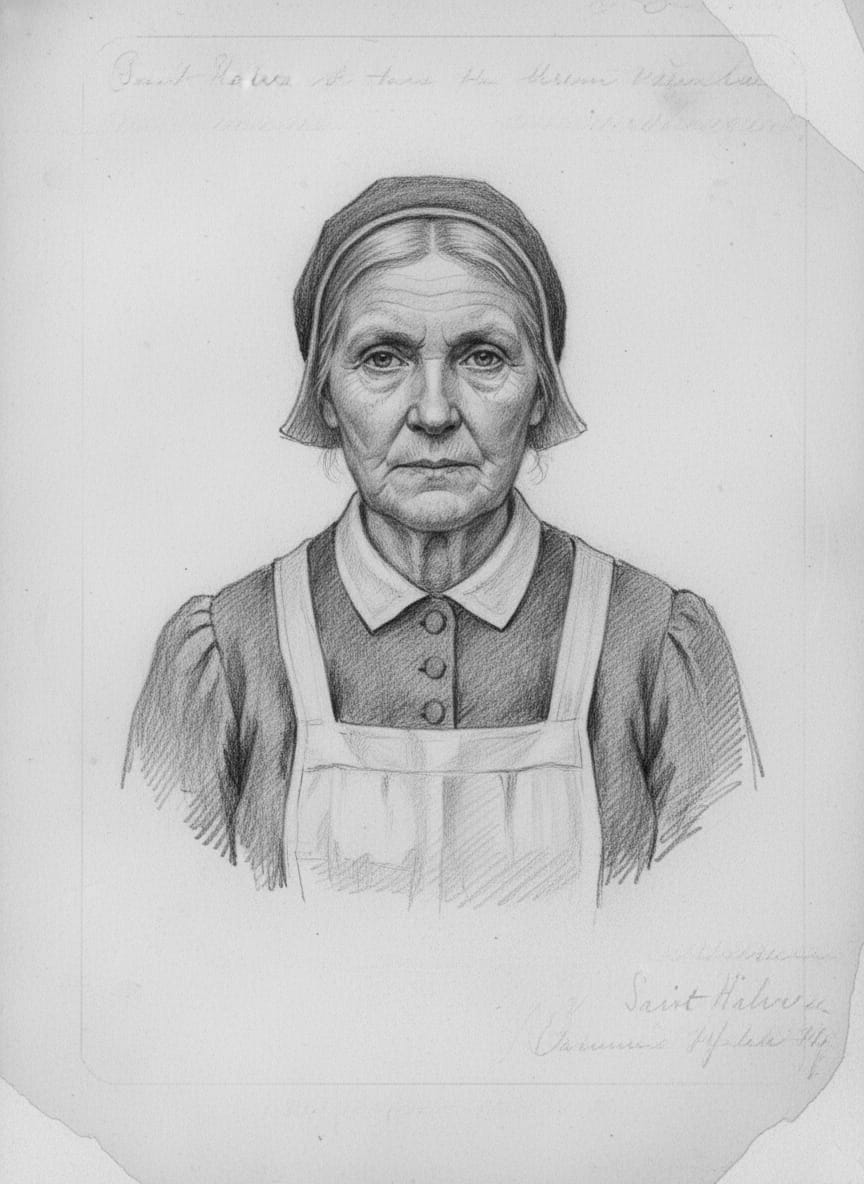
Every institution requires a saint the way every soup requires salt — something added early, forgotten quickly, and missed only when absent. The Mothers of Plenty have Saint Halva. She is their salt, their justification, their cracked copper excuse for existing. That she may never have existed is, by now, a question only the Bureau of Relics is qualified to mishandle.
The official hagiography is brief and efficient and smells of propaganda in the way good propaganda always smells — faintly, sweetly, like bread baked over a fire that happens to be burning books. Here it is:
During the ration panics of the post-Sundering decades — those years when the Great Retreat had emptied half of Europe westward and left the other half as dinner for what came through the cracks — a widow of uncertain province stood between a crowd and a locked storehouse. She had no weapon, no writ, no authority, and no food to speak of. She had a ladle and a pot of broth that should have fed twelve and somehow fed two hundred. While the crowd ate, she exchanged ration ledger packets behind the storehouse wall, buying her district another month of allocation. The crowd dispersed. The month was gained. The widow died.
How she died depends on which account you read, and which account you read depends on which office wrote it.
#On the Three Deaths
The Mothers tell three stories and believe all of them simultaneously, which is theologically permissible under the Bureau's Doctrine of Concordant Multiplicity — a ruling that states, in essence, that contradictions between approved narratives are "complementary facets of a truth too large for a single account." I drafted that ruling. I am not proud of it. I am proud of the word "facets," which made it sound geological rather than fraudulent.
The Death by Hunger. In this version — favoured by the Plenty Houses of the northern bastions, where winters are long and moral instruction is delivered alongside thin porridge — Saint Halva gave away all food in her possession, including her own ration, and starved to death within sight of the storehouse she had saved. Her body was found seated upright, hands folded, expression peaceful. The ladle was in her lap. This version is popular because it permits the lesson: she who gives all receives Heaven. It is also popular because it permits the Mothers to guilt their apprentices during lean months. Both uses are sanctioned.
The Death by Trampling. In this version — told quietly in the eastern bastions, where crowds are larger, tempers shorter, and the memory of the Great Retreat still stinks of smoke — Saint Halva was crushed beneath the very crowd she saved. They did not know her. They did not care. They wanted bread and she was between them and the bread, and when the broth ran out they became the crowd again. Her bones were found in the mud the next morning. The ladle was bent around her wrist. This version is popular among Ward-Sisters and Mercy clerks because it teaches what the other version does not: the crowd does not love you. Serve it anyway. But keep the door at your back.
The Death Official. Bureau of Doctrine, Approved Account, Sealed A.S. 94. Saint Halva died reciting the Ration Psalm (Unregistered) with one hand upon a cradle and one hand upon the storehouse key. She was found at dawn by the first queue, positioned as if she had simply completed her duties and elected not to breathe further. The ladle rested across her knees. A child slept in the cradle — whose child is not specified, because the specification would require a natal registration writ, and no such writ exists, and the Bureau of Records has opinions about children who lack writs.
This is the version the Bureau approved because it contains the correct objects: ladle, cradle, key, psalm. All four are present in the Mothers' iconographic standard. All four appear on the feast-day banners. All four are sold as devotional tokens at the chapel in Mainz where the relic sits. The death may be invention; the merchandise is real.
#On the Relic
The relic attributed to Saint Halva is a cracked copper ladle kept in a chapel at Mainz. I have seen it. I have held it — briefly, by dispensation, wearing the gloves the Bureau of Relics insists upon for authenticated artefacts of Tier III designation.
It is the wrong ladle.
The copper is too late by eighty years. The dimensions exceed domestic use — this is a cauldron ladle, suitable for a garrison kitchen or a brewery, and no widow of "uncertain province" stirred broth for two hundred souls with an instrument this size unless she had arms like a blacksmith and a pot the dimensions of a baptismal font. The foundry stamp on the handle reads Essen, which places its manufacture in a city that did not produce copper household goods until well after the Sundering. The handle has been re-riveted twice, once poorly.
The Bureau of Relics classifies the ladle under "devotional sufficiency" — a term I have seen applied to fourteen relics across the Synod's holdings, and which means, translated from the Bureau's proprietary euphemism into honest speech: the object is almost certainly wrong, but the faithful believe it is right, and their belief generates revenue, pilgrimage traffic, and doctrinal compliance, and the Bureau is not in the business of correcting beliefs that pay their own upkeep.
I have filed this observation in the appropriate ledger. The ledger is in my desk. My desk is locked. The Bureau of Relics has not requested access. This is how we coexist.
#On the Canonization
Saint Halva was canonized in A.S. 94, four years after the Concordat of Strasbourg formalized the Synod, and in the same administrative season that created the Mothers of Plenty as a formal office. The coincidence is not a coincidence. The Bureau of Doctrine required a patron for its new institution. The institution required a saint with the correct symbolic properties: female, maternal, associated with food distribution, dead under circumstances that could be rendered both inspirational and obedient.
Halva fit. Or was made to fit — the distinction is, again, theological.
An earlier doctrinal pamphlet (Bureau of Doctrine, Tract Series 44, "On the Antiquity of the Mothers") asserted that Saint Halva was canonized "in the first century of the Faith" and that her cult predated the Concordat by "many generations."
Corrected: canonization occurred A.S. 94, during the same administrative session that formalized the Mothers' charter. The cult postdates the office it was created to sanctify. Antiquity was, as is customary, applied retroactively.
The canonization process was irregular even by the Bureau's generous standards. No miracles were attested. No body was produced. No witnesses were interviewed — or rather, the witness statements in the file are unsigned, undated, and written in a single hand that paleographers have identified as belonging to a Bureau of Doctrine clerk named Aldous Crenn, who was at the time responsible for processing seven other canonizations in the same fiscal quarter. Crenn's handwriting appears in all seven files. His productivity was commended. His accuracy was not examined.
#On the Feast
The Feast of Saint Halva falls on 14 Brumaire and is observed in every Plenty House, ration hall, and maternity ward across the Synod's territory. It is, by tradition, the one day per year when ration portions are increased by a quarter-measure — a gesture the Bureau of Tithes approves because the increased allocation is offset by reduced fuel rations the following week, and because the feast generates sufficient devotional compliance to justify the expenditure under the Synod's "Spiritual Return on Investment" formula, which I am told exists and which I have declined to read.
The day's liturgy begins with the Ration Psalm — a twelve-verse composition attributed to no author, set to no melody, and recited in a monotone that the Bureau of Orison calls "appropriately functional." The psalm lists the virtues of sufficiency: enough bread, enough water, enough warmth, enough children, enough faith. Enough, always enough. The word appears forty-three times. I have counted.
At midday, a senior Mother of Plenty processes through the ration hall carrying a copper ladle — polished, oversized, ceremonial, and useless for actual service. She taps the ladle against each queue-post as she passes, and the queue advances one pace per tap. This ritual is called the Stirring (Unregistered). Its origins are unclear. Its purpose, the Bureau of Festivals assures me, is "affirmation of order through rhythmic repetition," which is also the Bureau's description of most things it cannot explain.
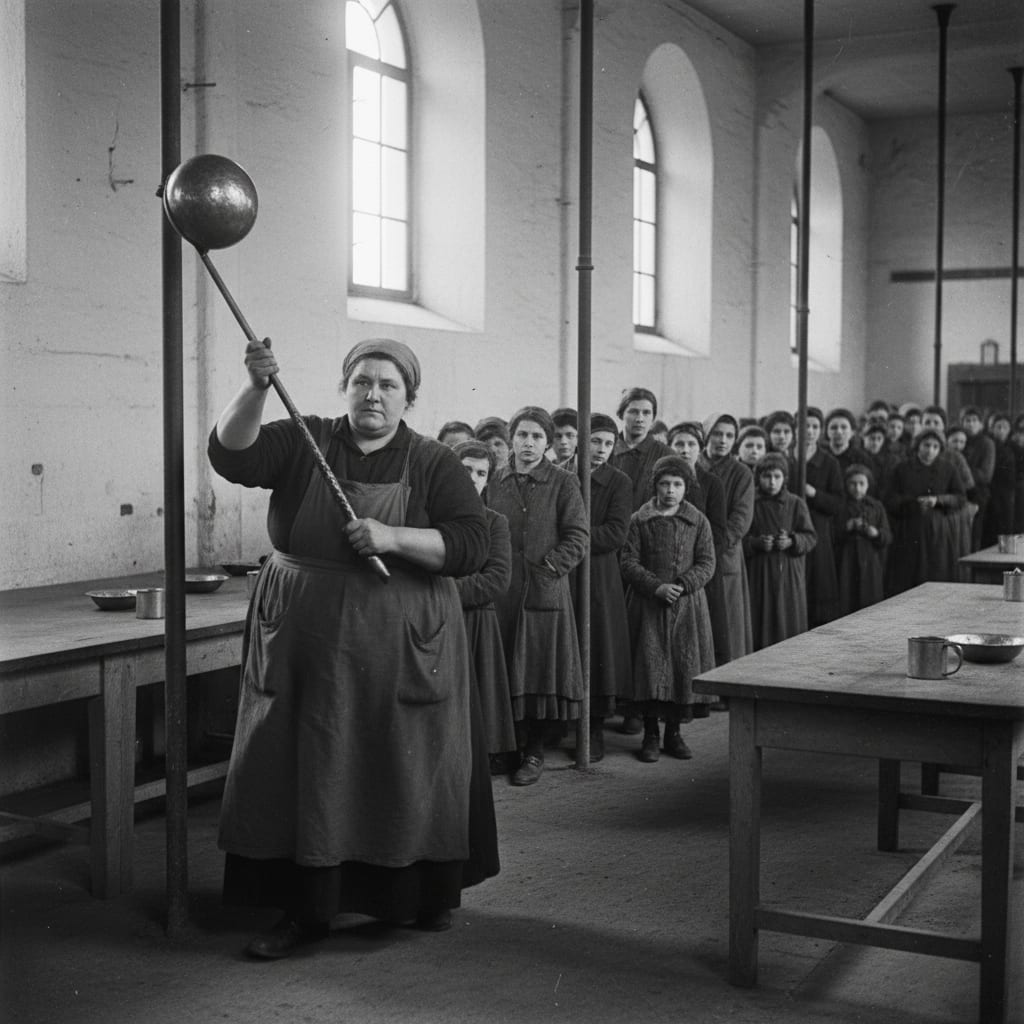
The evening meal is broth. Always broth on the Feast — never bread, never meat, never anything solid enough to constitute genuine generosity. Broth can be watered. Broth can be stretched. Broth can feed three hundred from a pot designed for fifty if the cook has sufficient nerve and insufficient conscience. The Mothers claim this honours Saint Halva's own miracle of multiplication. The Bureau of Tithes claims it honours the quarterly budget. Both are correct. Neither admits it.
#On Her Uses
Saint Halva is deployed — and I use the word "deployed" with the precision of a man who has watched the Bureau of Doctrine weaponize sentimentality for three decades — in four primary contexts:
First: the training of new Mothers. Every apprentice Mother receives a devotional card depicting Halva with ladle, cradle, and storehouse key. The card's reverse bears the motto: Plenty is obedience made edible. The apprentice is expected to memorize the motto, internalize the card, and understand — without being told in words — that her role is to make hunger bearable without making it avoidable. She manages the queue. She does not end it.
Second: the justification of ration cuts. When allocation is reduced — and allocation is reduced with a regularity that suggests the Bureau of Tithes considers it a liturgical calendar rather than a failure — the Mothers invoke Halva. She fed two hundred from a pot meant for twelve. Are you less faithful than a dead widow? The logic is airtight. The theology is impeccable. The broth is thin.
Third: the recruitment of pregnant women into Plenty Houses. Saint Halva held the cradle. Come to where the cradle is held for you. The pamphlets are warm-toned, the language maternal, and the Plenty House door locks from the outside. The women enter voluntarily. They leave when the Bureau of Records has completed their natal registration writ.
[CONTENT REMOVED — Bureau of Mercy, Internal Communication, Re: Plenty House Retention Rates and Exit Criteria. Filed under Administrative Compassion, Sub-Category: Structural.]
Fourth: the suppression of complaint. A woman in a ration queue who protests the portion size is not protesting the Synod, the Bureau, or the Mothers. She is protesting Saint Halva. She is saying, in effect, that the saint's sacrifice was insufficient — that the widow who died so that others might eat did not die hard enough. The theological implications of such ingratitude are handled by the Bureau of Purity with an efficiency that the ration queue itself might envy.
#On Whether She Existed
I have read the file. I have read every file the Bureau of Doctrine maintains on Saint Halva of the Warm Ladle, and the total documentary evidence for her historical existence amounts to: one unsigned witness statement in a single clerk's hand; one canonization decree citing "common knowledge" as its primary source; one copper ladle that postdates her alleged life by eighty years; and one founding myth that contains four factual claims, three of which are contradicted by the other two approved versions of the same myth.
She may have existed. A widow may have stood before a crowd with broth and nerve and a gift for ledger-work. Such women existed in every bastion, every ration line, every famine winter. They did not require canonization to be brave. They required only a crowd, a pot, and the particular species of exhausted courage that comes from knowing no one else will do it.
The Bureau canonized a type, dressed it in a name, gave it a feast day, and called it sufficient. And it was sufficient. It fed the institution the same way the broth fed the crowd: thinly, warmly, and with the understanding that asking for more would be ungrateful.
The ladle at Mainz is the wrong ladle. The saint may be the wrong saint. The Mothers serve the broth regardless. The queue forms by bell-call. The ration is enough, if obedient.