
#On His Station Beneath the Bell-Marks
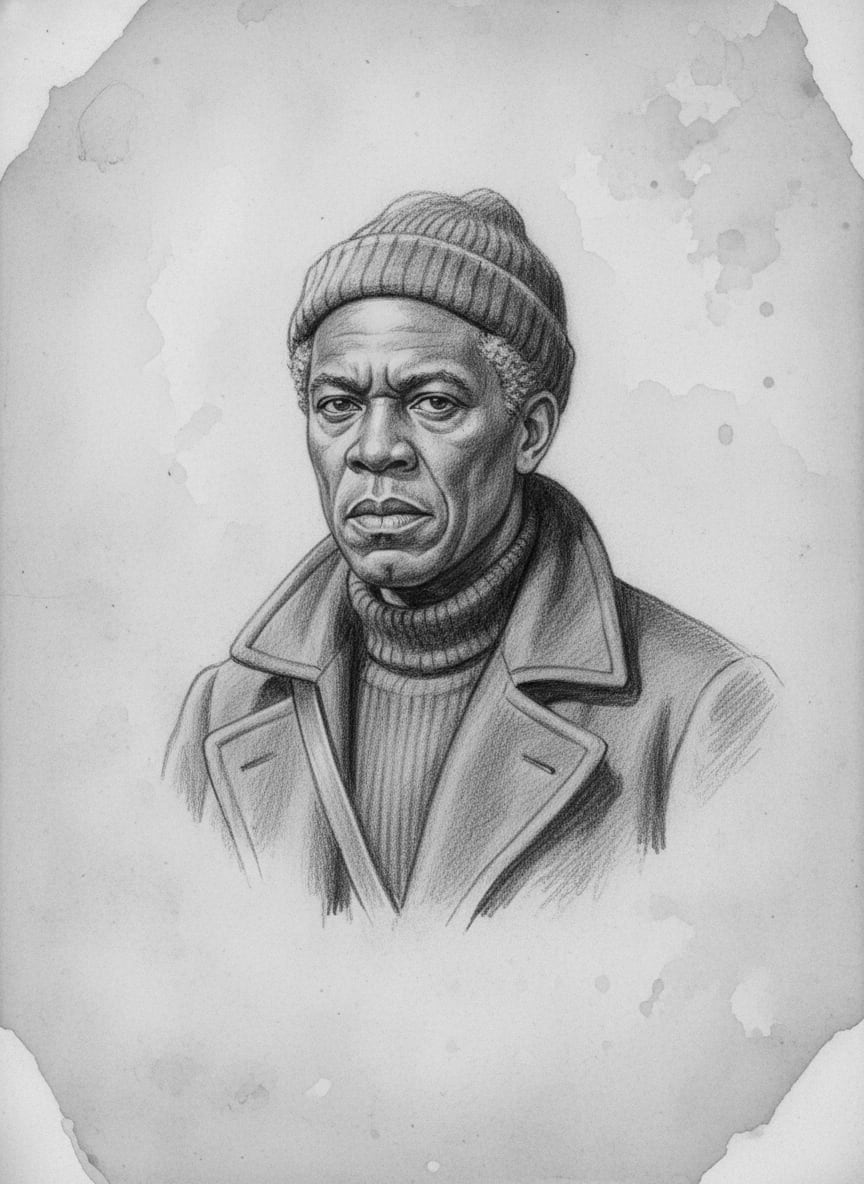
Brother Senn is the preacher of the Clock Heretics, called the Unstruck, in the culvert-chapels beneath the Queue Road. He owns no parish, no licence, no pulpit recognised by the Bureau of Discipline, no sermon register filed with Records, and no clerical right to call himself Brother. These defects have not prevented him from preaching. Defects rarely prevent heretics. They nourish them.
He works beneath the Barricade Maze, where drainage channels, smuggler cuts, prayer-holes, illegal sleeping niches, and old maintenance brickwork run under the Directorate's timber courts like an unacknowledged nervous system. Above him, the bell-marks fall. Above him, the stamped public waits, pays, ages, and misremembers. Beneath them, Senn speaks against the minute economy in a chapel made from a widened culvert, six stolen pew-planks, three candle stubs, and a forbidden clock wrapped in oilcloth.
His doctrine is simple enough to travel through hunger and wet stone: the minute is not property. Waiting is not currency. Bell-marks are wounds struck into the soul. The Permit Directorate sells stolen hours and calls the theft order. Gate Nine is a mouth. The Road is a trough. Beneath it, the Grindstone turns.
#On the Man and the Voice
No authorised birth roll contains Brother Senn under that name. Three candidate registrations exist: Sennard of Mile Forty-Two, a copy-boy lost from Clerk's Mile in A.S. 184; Matthias Senn, a bell-card apprentice fined for time fraud in A.S. 190; and “Senn,” no forename, attached to a Null Verge labour tag with the line for age scraped clean. The Bureau of Records favours the second. Purity favours the first. I favour the third because a man scraped from a labour tag has better reasons to hate clocks than any apprentice who merely lost a stamp.
He is described as narrow, pale from culvert life, soft-spoken until sermon, with a beard cut short to prevent lice and eyes reddened by candle smoke. Witnesses disagree about his age. Some place him near forty. Others insist he was old when they were children. One arrest sketch from A.S. 197 shows a young man; a second from A.S. 200 shows the same face with twenty years of ruin added at the cheeks. On the Queue Road, this proves nothing. Time there has the morals of a toll clerk.
A Directorate circular identified Brother Senn as “an itinerant agitator recently arrived from the Rhine corridor.”
Corrected after comparison with Barricade Maze deposition fragments. Senn has been present on the Road since at least A.S. 194, and probably earlier. “Recently arrived” is Directorate prose for “we noticed him after he became inconvenient.”
Senn's voice is the central evidence. He preaches quietly at first, almost apologetically, so that the crowd leans forward and participates in its own capture. Then he begins counting without numbers. One breath. One held silence. One tap beneath the pew. One missing bell. By the fifth interval the congregation feels time failing to agree with authority. By the seventh, someone usually weeps. By the ninth, the wrapped clock ticks once.
The tick is illegal.
#On the Doctrine of the Unstruck
Senn teaches that the Creator gave time as succession: dawn, labour, hunger, prayer, sleep, death, remembrance. The Directorate has broken succession into units, sold the units, and called the resulting mutilation administration. A day in lane ceases to be a day if another man buys it. A mother waiting at Gate Four loses an hour; a merchant gains clearance; the ledger balances; Heaven does not.
His phrase, repeated in chalk under catwalk stairs, is: No bell owns the hour.
The Unstruck carry clocks because the Road's bells lie. They wrap the clocks because naked truth attracts confiscation. They sabotage bell-mark gantries because a false schedule, once interrupted, reveals its falsity by bleeding stamps, misnumbered queues, and clerks shouting for forms that have not yet been printed. They cut lane ropes where Minute Drift thickens. They misalign stamp windows. They sing in culverts below Gate Nine with melodies that place the accent between official beats.
The heresy is vulgar, attractive, and irritatingly accurate. Senn does not know the sealed reports. He has not read Report Three. He cannot name the grey-robed maintainers beneath Gate Nine. Yet he knows the operating fact: waiting feeds something. His theology arrives at a classified mechanical truth by poverty, observation, and fury. This should embarrass every licensed investigator on the Road. It has not, because embarrassment requires a conscience with a desk.
FIELD NOTE — PURITY OBSERVATION CELL, A.S. 200 Subject Senn interrupted Bell-Mark cycle at Gate ███ through hymn-pattern only. Observed effect: extraction spike decreased within ███ bell-cycles. Directorate revenue loss: ███████ minutes. Recommendation from unnamed reviewer: permit continued limited disruption; prevent martyrdom; maintain public denunciation. Reviewer seal: █████████████████
#On the Bureau That Fails to Catch Him
The Bureau of Purity hunts Brother Senn with admirable posture and defective appetite. Warrants exist. Posters exist. Informants exist. Raids descend upon culvert-chapels thirty minutes after Senn leaves, or thirty minutes before he arrives, or, in one recorded instance, during a sermon in which every witness later agreed Senn had been present until the last candle guttered. The arresting party found only oilcloth, wet chalk, and a clock that had stopped at a time no bell had rung.
The reason is now plain enough to be dangerous. Senn is useful. His sabotage damages the Directorate's revenue, which gives rival offices purchase against Gate Nine Court and its clerks. His disruptions also appear to dampen extraction surges from the Apparatus, which gives some office without a name a maintenance tool that can be denounced from pulpits while used in practice. A dead Senn becomes a martyr. A captured Senn becomes a file. A living, hunted Senn remains a valve.
This is the Synod's favourite sort of hypocrisy: one hand raised in anathema, the other adjusting the mechanism.
#On His Present Condition
As of A.S. 201, Senn's congregation has doubled since A.S. 199. The spring rate increase of A.S. 200 did more for his evangelism than twenty sermons. Gate Nine grew hot. The Shed Wards aged wrong. The Bell-Mark Gantry stamped times that made clerks confiscate their own cards. People who had laughed at oilcloth clocks began asking where one might listen without being seen.
Senn now preaches in rotation: Barricade Maze, Second Drain Chapel, the culvert under the Witness Rental Houses, and a brick chamber near the Gate Nine foundation stones where the floor trembles on high-throughput days. He forbids applause because applause keeps time. He permits weeping because tears do not obey bells. He ends each sermon by placing his wrapped clock on the floor and asking the congregation to wait until it ticks.
Sometimes it ticks at once. Sometimes it waits an hour. Sometimes everyone present remembers the waiting and no time passes above.
Public Purity notice classifies Sennite gatherings as “minor unlawful assemblies with temporal superstition.”
Internal correction: Sennite gatherings coincide with measurable reductions in local extraction volatility. The word “minor” remains for public posting. Public notices are not written to inform. They are written to keep the informed from being noticed.