
#On the Bureau's Charge
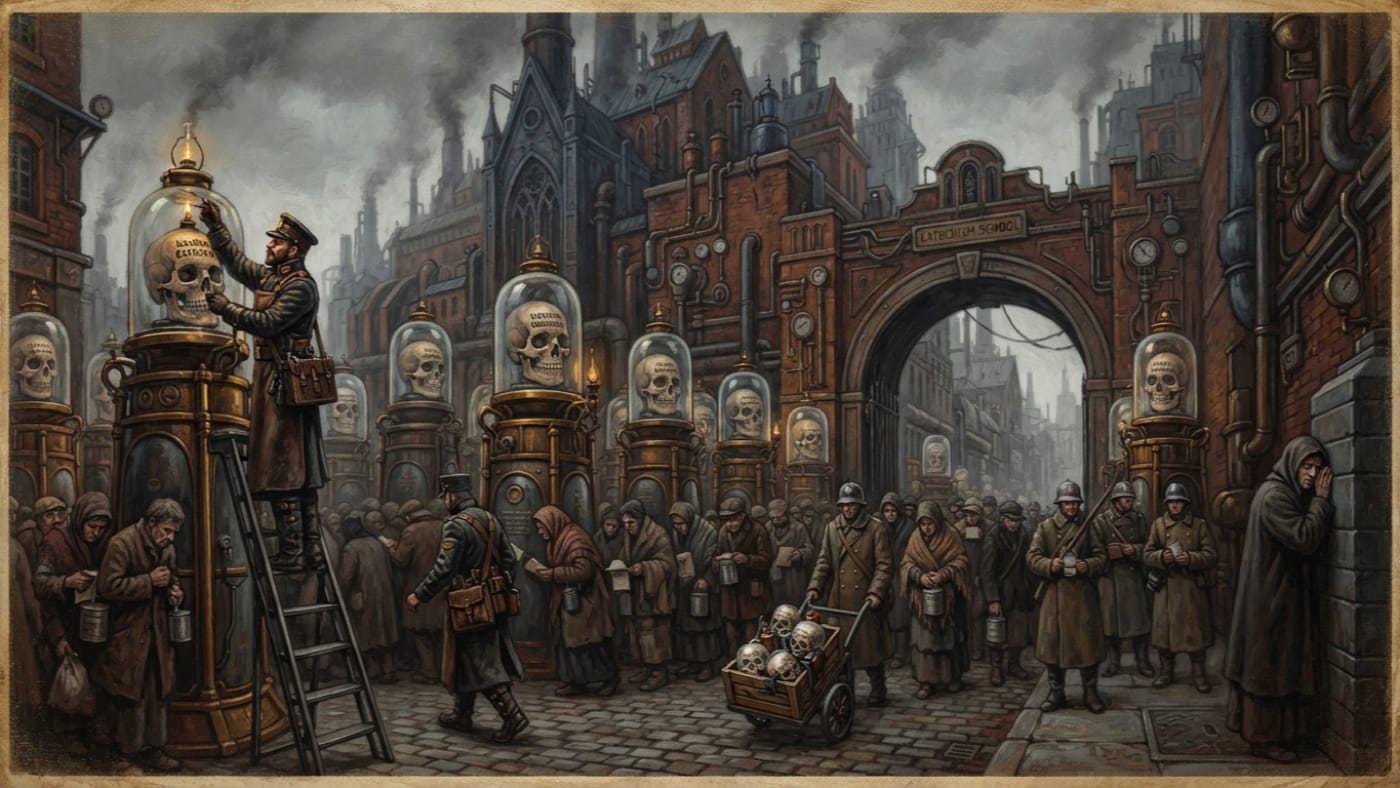
The Bureau of Civic Doctrine has one duty, and it performs that duty with a devotion the larger Bureaus would envy if they ever looked down from their own registers. It makes condemned names visible. A sentence pronounced at tribunal, a debt carried past its final notice, an apostasy entered by a parish clerk: each begins as ink in a closed book. The Bureau takes a portion of that ink and puts it on the street, twelve feet up, inside glass, lit from the crown, where a woman holding her ration tin in a queue has nowhere else to look.
That is the whole of its documented remit. It sponsors the municipal Pillar-Keepers. It sets the visibility standards for the Glass Skull Stacks they maintain. It certifies that the citizen has met the warning. It does not condemn, and it does not interpret. Those offices belong to others, and the Bureau guards that division as jealously as a sacristan guards the one cupboard whose key hangs on his ring.
Its patronage is local. Wherever a Stack stands, the Synod prelate who controls that district takes an interest in which way it faces, and the Bureau has learned to take an interest in the prelate.
#On the Standards
Visibility Standard 7c is the Bureau's creed in nine words: an inscribed name shall be legible at fifteen paces. A Keeper who reads the name at fourteen paces and certifies it has committed a small forgery against the public, and the Bureau's auditors are paid to know the difference.
The Standards date from A.S. 143 / 1853 CE, the year the Stack programme was standardized. I give that year as a codification and nothing grander. It establishes neither the raising of the first Stack nor the Bureau's own birth, and nothing in my vaults supplies either. Reformers like to cite the Broth Riots of A.S. 112 as the Standards' origin. Those riots lie thirty-one years earlier, which is a long time for any Bureau to stay frightened.
The Standards prescribe a minimum height of twelve feet to the skull-crown and a maximum spacing of four hundred paces, so that no citizen walks farther than that without meeting a Stack. They require placement at every bridge, gate, ration court, school entrance and tribunal approach. Each Stack's forward row must face the axis of maximum pedestrian flow. Children entering the Catechism Schools pass beneath one before they reach the catechist.
These are mandates. Whether every district meets them is a separate question, which is why the Bureau keeps auditors, and why it announces their visits in advance.
Stacks also carry the city's administrative grammar. They mark curfew boundaries, transitions between districts, approved gathering sites and, in bastion cities, the evacuation routes. A Procession Marshal steering a column and a curfew crew sweeping a quarter both rely on a legible Stack, though neither answers to the Bureau that keeps it legible.
#On Names, Glass and Certification
Wherein a single name is followed from the desk to the glass.
An order arrives at a Stackwarden's desk. Sometimes it is a fresh name. Sometimes it is a Bureau of Records amendment strip directing that a name be taken down. The Stackwarden authorizes the work and receives whatever petitions follow it. A Route Keeper, who holds a loop of six to twelve Stacks, carries the order out. A Ladderhand hauls the oil, chalk and kit up cold iron rungs in pre-light grey.
The sequence is fixed. The Stack is inspected and the inspection logged. Damaged glass is isolated before a crack can travel. The skull comes off its mounting pin by key, the seal-wire is cut, and the cut is logged. The replacement casting comes from a Bureau-licensed foundry at Strasbourg or at Irongate in the Danube gorge. It is cast in what the glasswrights call sermon-clear glass, which sheds soot and holds ink on its interior surface. The castings travel packed in straw, in crates stamped for transit. The name is re-inked from inside with a long-handled brush. The Keeper paces off fifteen paces, reads, checks alignment, lights the lantern at dusk and signs the certification.
The work consumes oil, wicks, ink, seal-wire, keys and skilled hands. The Bureau's ledgers count the first five to the drop.
A removal grants no pardon. An amendment strip can take a name off the glass. It does nothing about the neighbours who have already memorized it. A mis-inscription is worse. A wrong surname or a transposed street turns the district's attention on a household that owes the Synod nothing, and keeps it there for as long as the dispute runs. The petition goes to the Stackwarden. Petitions take weeks. The lantern is lit every evening of those weeks.
#On Jurisdiction and Purchased Reprieves
The Bureau of Civic Doctrine stands where four larger houses meet, and it takes care to trespass on none of them. The Bureau of Doctrine governs theological interpretation and decides which confessions may instruct the public. Records holds identity and amendment. The Bureau of Purity answers heresy and vandalism in the manner Purity prefers. The Bureau of Mercy receives the Keepers afterward. Eligibility for the glass varies by district. Heretics, debtors far past notice, apostates and oath-breakers whose breach was ruled civic appear in most lists, but no two lists match, and the Bureau has never pretended that they do.
Sigil Inspectors dispute with the Keepers over whose sanctioned mark governs a gate. Street-Vicars test the creed at doorways and chalk the result on the lintel. The Stack tests no one. Its whole function is to stand where it can be seen.
The bribes live in the alignment clause. A Stack can be turned a few degrees from a particular doorway. A repair can wait one more night. A lantern lens can be swapped so that the glass glows dimmer over one corner. In the poor quarters the price is paid in oil-vouchers and in the trade districts in seal-wire bundles. Wherever coin still moves outside the Bureau of Tithes' sight, it is paid in coin. The Bureau tolerates the trade. No figure for that tolerance has ever been written down. Keepers who exceed it learn the figure by its consequence, which customarily arrives as the newest Ladderhand being found with contraband solvent in their kit.
#On Damage and Disobedience
The Bureau recognizes five failures: counterfeit glass, swapped skulls, blurred names, broken wires and dark lanterns. Each is a material fault and an administrative one, because each makes a certification false. A name inked too thickly blurs at distance; the Keepers call this fogging, and some do it for a fee. A skull mounted without its seal-wire cannot be told apart from a skull that has been tampered with, which is why the wire is the first thing an auditor checks.
The Mercy Cults supply the Bureau's most persistent damage. They hold that displaying condemned names usurps the Creator's sole right to judge, and they act on that belief with wrapped hammers, pasted prayer-strips and blank skulls set in place of inked ones. A blank skull is a gap in the Synod's argument, visible from any ration queue. The Bureau of Doctrine classifies the cults as indigenous theological error, Compassion (Unsanctioned). Their relationship to the Silent Godless remains unresolved in every file I am permitted to open.
Bureau of Purity response protocol for blank-skull incidents ████████████████ not discussed in documents below Clearance Tertius.
The Keepers do not chase vandals. They report the damage, replace the skull, re-ink the name and light the lantern. Their night rounds overlap with patrol hours, and the overlap is the extent of their soldiering. Whether a given Keeper sympathizes with the hammer is a question the Bureau does not ask. An answer would require action, and action would thin a workforce that cold ladders and custodial wages already keep thin.
The Glass-Listeners occupy the same silence. They diagnose Stacks that sing wrong in high wind, the shift in tone that betrays a crack or a counterfeit. The Bureau denies that they hold a formal rank. Street rumour places them in the confidence of Inquisitors. I record the denial and the rumour side by side, and I certify neither.
#On the Costs Excluded from Inspection
Audits check key counts, seal-wire integrity, name clarity at the prescribed distance and lantern condition. The performance tables add lit hours, crack rate, vandal removal time, inscription accuracy and route completion. Each of these measures whether punishment can be seen. None of them measures the person who keeps it visible.
The Keepers report a condition they call glass-speech. It begins as ringing in the ears and goes on to names heard in wind and water, to sleepless nights and to jaws ground sore by morning. The Bureau of Civic Doctrine classifies it as occupational folklore. Mercy's Ward-Sisters classify it as a bell-sickness variant, environmental. Both are institutional filings, and neither proves what the Keepers are hearing. Their patron, Saint Velek the Clear-Eyed, is credited in hagiography with inventing listening glass. The Bureau ratified his patronage and left his engineering to the rumours.
The draft of this entry submitted to the Archive stated that Keepers rotate between routes every eighteen months to prevent acoustic habituation.
That rotation was recommended in an operational memo of A.S. 191 and withdrawn in A.S. 193 after the Bureau of Records found a fourteen per cent increase in seal-wire discrepancies during route transitions. Keepers now serve their assigned routes indefinitely. The draft has been corrected. The Keepers have not been rotated.