

#On the Division Named in the Return
"A sanctioned house prevents unsanctioned revel." — Censorium of Taverns, as printed on the licence placard
This survey was compiled in the present year, A.S. 201, which the Common Era calls 1911. Its subject is a body whose existence I can prove with a single clause. The clause sits in the Censorium of Taverns' annual compliance summary for this year, as reproduced in my published survey of the Curfew-Fog Tavern Runner. It credits 2,108 audits of licensed premises to "the Bureau of Purity's Fume-Inspection Division." That clause is everything the record holds on the Division: one bureau, one verb, one number. I have built cathedrals of doctrine on less. I will not build one here.
Three offices must be kept in three separate drawers. The Censorium is a sub-office of the Bureau of Festivals. It licenses the houses, meters their laughter, and wrote the report. The Division belongs to the Bureau of Purity, audits licensed premises, and supplied the report's most interesting figures. The Purity Fume-Inspector is a profession of grey robes, filter masks and ash-darkened cuffs. Its remit is wider and covers chimneys, contraband and the whole Index of Prohibited Emanations, and its authority runs through the Ninth Mark, Purity's ninth administrative subdivision. No document before me says whether the Division is the Ninth Mark under a second name, a part of it, or just another door on the same corridor. Nor does any document say it employs every Fume-Inspector or gives orders to the Censorium.
#On the Licensed Premises
What the Division audits is a licensed house, and a licensed house is a strange instrument. The Censorium issues the licence, and the Licensed Housewarden lives inside it. The streets call that publican a Fog-Keeper. The Bureau of Purity calls them a "cooperative surveillance asset, hospitality-adjacent." Above the bar hangs the placard with the charter sentence in red. By late afternoon the shutters are boarded. Brass-fitted pipes along the baseboards draw curfew-fume in by bellows until it pools at ankle height, a low grey tide over boots and table legs. Quiet cloth hangs over the windows in layers. A song is cut at its first rise, before a second voice joins, because a harmony makes a chorus and the Censorium has a long memory for choruses.
The nightly List of Laughters records every chuckle that exceeds the house's mirth quota. Nobody in the house knows the threshold until it has been crossed.
:::stamp STAMPED ERRATUM — CENSORIUM OF TAVERNS — 3RD REVISION — A.S. 199
Replace "mirth quota" with "devotional levity allocation." The term "quota" implies limitation. The Synod does not limit joy. It curates it. :::
I regard the licensed tavern as a pressure valve, and I regard the Division's audit as the hand that checks the valve's gauge. That reading is mine. No Division charter has come across my desk to confirm it, and I would be suspicious of one that did.
#On What an Inspection Can Establish
Standing Order 44-H was revised in A.S. 197. That is all its stamp proves. It does not date the Division's birth, the invention of any apparatus, or any particular evening's knock on any particular shutter.
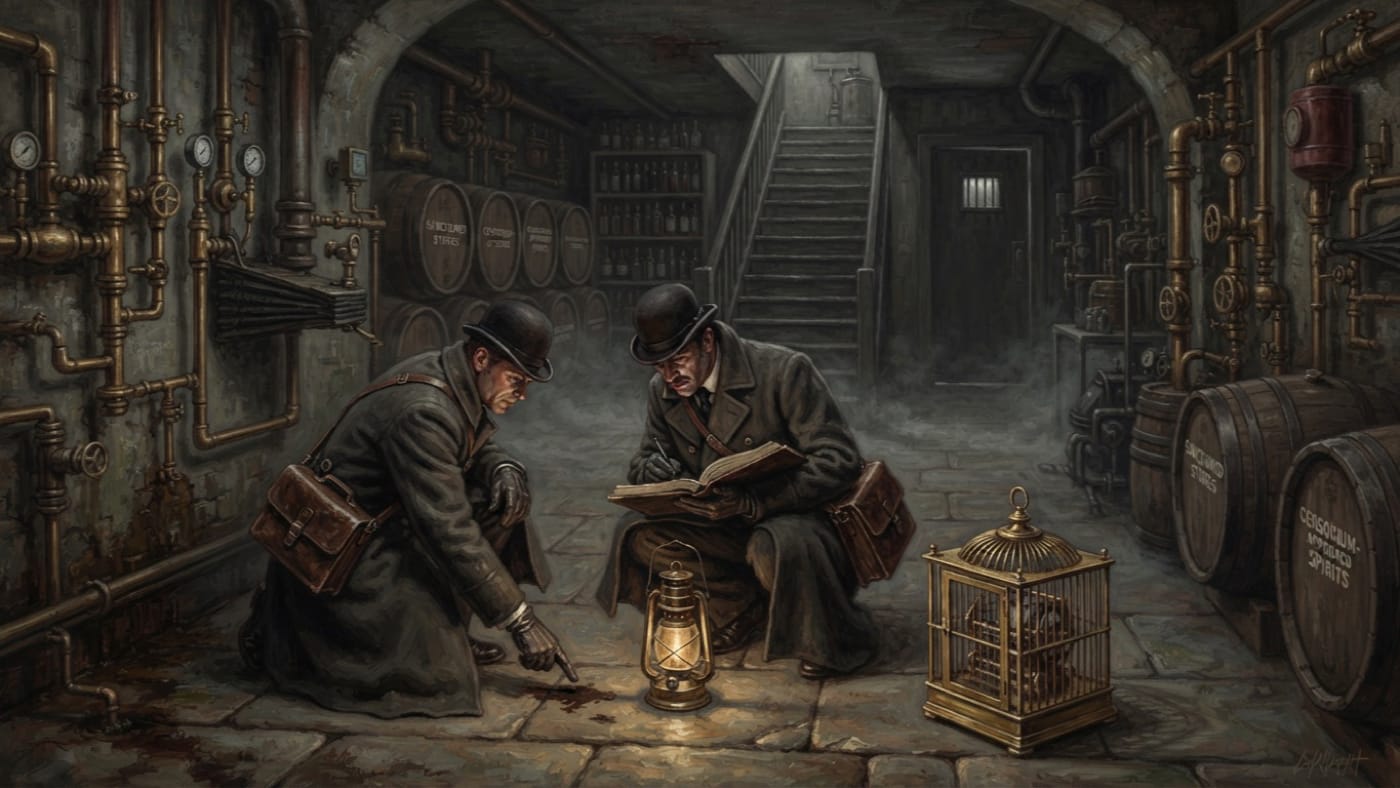
The tavern account records the inspection in a known order: the door placard first, then the smell of the cellar, then the fog residue on the shutters. A good Housewarden keeps the placard clean, the cellar aired and the shutters wiped. Each step looks at something physical. A placard is clean or it is not. A cellar smells of sanctioned stores, or it smells of whatever sits behind the false wall. Residue builds up on a shutter where the fog has been banked hardest, and its pattern says something about how the room was run.
Then there is the cage. The same account describes a portable apparatus of brass and glass, about the size of a birdcage, that resonates when exposed to "unauthorized acoustic frequencies." When the cage sings, the account says, the cellar becomes evidence. I reproduce the sentence because it is exact about the one thing that matters. The cage reacts and a clerk writes, and the second act is what turns a cellar into an exhibit. The account gives no range for the cage, no scale, no tuning and no threshold. I will not supply a mechanism the Bureau of Engineering has not sent me. The reactive fume paper that the profession carries against chimney smoke is a separate instrument with its own record. The paper blooms and the cage sings, and I will not file one as a property of the other.
The tavern account does not say whether every audit by the Division follows this order, or whether every audit brings a cage. It records a known pattern, as Housewardens know it. Housewardens know patterns the way sentries know footsteps, and they are wrong just often enough to stay employed.
#On the Annual Arithmetic
These figures are the Censorium's, as reproduced in my published account. I have not produced a separately surviving copy of the summary for this survey. I have no folio number, signatory or shelf-mark to offer, and I will not invent one to make the page look more devout.
The summary records 14,722 licensed premises across the Dominion. It records a decrease of 311 from the previous year and calls the decrease "consolidation," because closure would imply failure, and the Censorium does not fail. It rationalises. The 311 belong to the register. The summary does not say what removed them, and nothing in it lays them at the Division's door. Houses leave a licence roll for many reasons, and the Censorium gives none of them.
The Bureau of Purity's Fume-Inspection Division audited 2,108 premises. The report gives four outcomes: 491 citations, 77 licence suspensions, 14 seizures, and 3 fires classified as "enforcement-adjacent property adjustment."
Here my profession as Warden of the Sacred Ledger requires restraint, which my temperament resents. The four outcome figures cannot be added. A cited house may also have been suspended, a seized house may also have burned, or every figure may describe a different door. The summary does not say. There is therefore no total of houses afflicted, no ladder from audit to citation to ash, no count of unique offenders, and no rate of conviction or compliance. Any clerk who divides 491 by 2,108 and calls the result a sin-index has committed arithmetic without authority. In my office that is the worse offence.
The figures count premises and outcomes. They do not count inspectors. Nobody in this survey knows how many hands held the pens behind those 2,108 audits, or how many lungs were spent in the cellars.
#On What Remains Outside the Return
The same account cites a suppressed annex to the summary. It records an additional 8,000-odd unlicensed premises in the warrens, underworks and trench-towns of the forward zones. The Censorium is aware of them and has mapped approximately a third. Both figures are approximate and both belong to the Censorium. They measure what the Censorium knows. They are not an exact count of clandestine houses, and they describe no inspection programme run by the Division against those houses. The record lists no unlicensed audits.
That leaves a ledger of gaps. Fourteen thousand houses are registered. Some two thousand were audited by the Division. Eight thousand-odd are acknowledged in a sealed annex, and the map covers about a third of those. Each of these figures comes from a different act of knowing, and none of them can be converted into another. Between the register and the map, and between the map and the audit, the Dominion goes on drinking.
The tavern account records how houses survive inside the register. Fog-Keepers pay inspection schedulers. Some arrange their sanctioned hymn-sings for off-duty Wardens on the night an inspection is due, and Wardens take poorly to having their evening disrupted. The account adds that the Bureau of Purity noticed this pattern and did nothing, because the Wardens in question included three of its own informants. I hold that account to exactly its words. It shows that enforcement can be selective. It does not show that every audit is bought, that every citation is forged, or that every inspector keeps a tin under the counter. The honest ones exist. They are simply less useful to a satirist.
#Disposition
The Fume-Inspection Division of the Bureau of Purity is attested. It audited 2,108 licensed premises in the year covered by the Censorium's summary, and that summary assigns it 491 citations, 77 suspensions, 14 seizures and 3 fires. The Censorium wrote the report, and the Censorium owns the roll of 14,722 houses, the 311 removed from it, and the annex of 8,000-odd houses it has partly mapped and largely left alone. The Fume-Inspector is a trade, of which the Division may make use. It is not the Division's synonym.
The record gives the Division no founder, founding year, charter, director, headquarters, district map or motto. This survey has not given it one either. A body known by a single clause in another bureau's report can be measured only by that clause, and I have measured it.
Compiled in A.S. 201, from the published return and the published account. Nothing has been added that the record did not first place on the table.
Filed. Sealed. Left unsung.