
#On the Office of the Fume-Inspector
"The nose is the first instrument of Purity. The second is the seal. The third is the silence that follows both." — Bureau of Purity, Instructional Writ IX, Revised.
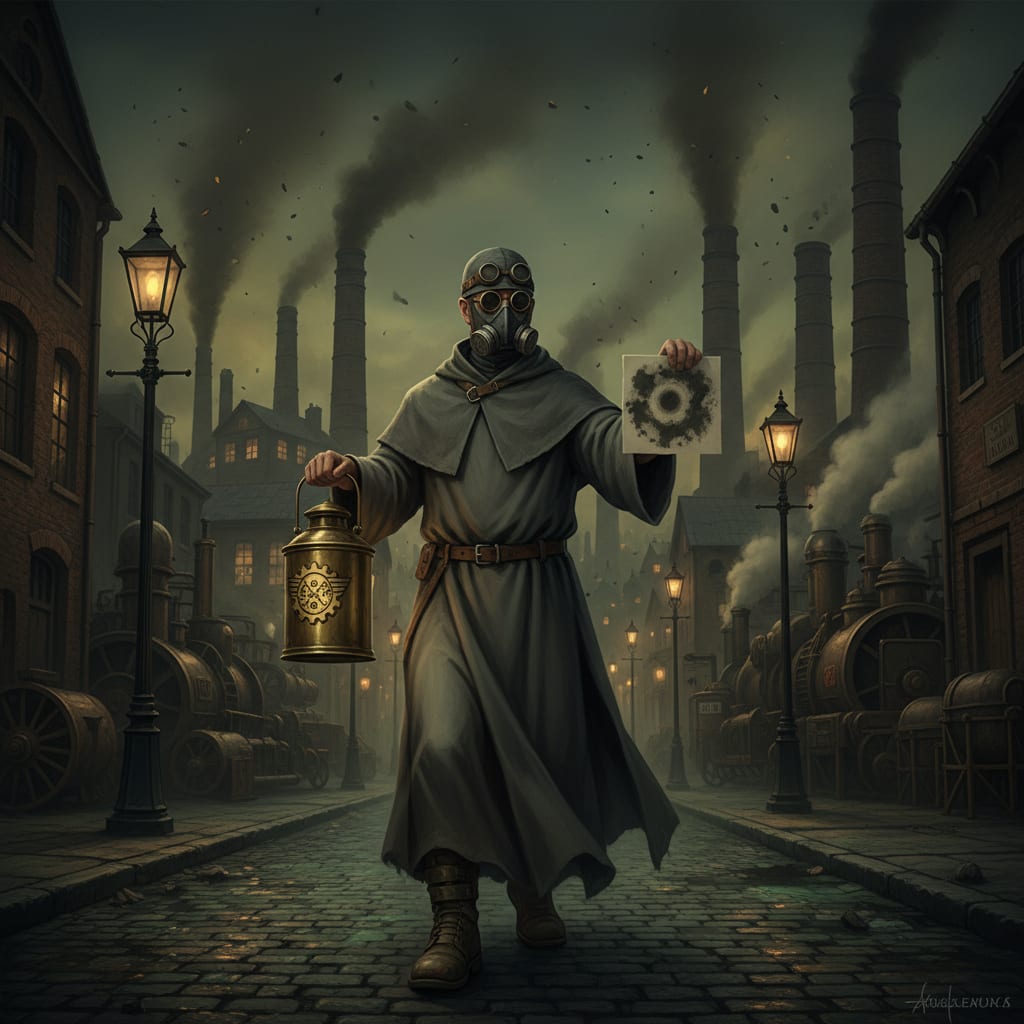
The Bureau of Purity employs, among its many instruments of holy surveillance, a class of technician so lowly that the Bureau's own internal memoranda refer to them as "field apparatus." They are the Purity Fume-Inspectors: robed, masked, equipped with ledger-lanterns and reactive parchment, and sent into the reeking warrens and furnace-districts of the Synod's cities to smell the population into compliance.
I have met a great many Fume-Inspectors. They share three characteristics. First, they cough. Second, they lie. Third, they believe — with a fervour the pulpit should envy — that the lying and the coughing are both in service of a greater truth, that truth being the Bureau's continued ability to claim it sees all, smells all, and permits only what it has weighed and stamped.
The Bureau does not see all. The Bureau does not smell all. The Fume-Inspector's job is to make the deficit invisible.
#On the Apparatus of Detection
The Fume-Inspector's kit is standardised by Bureau writ and includes the following: one ledger-lantern, brass-cased, etched with the Bureau sigil, which serves both as illumination and as the Inspector's badge of office — for a man holding a lantern with a seal upon it is doing more than looking; he is witnessing, and what he witnesses becomes evidence the moment he opens his logbook. Six ash vials, cork-stoppered, for the collection of particulate samples. A censor-kit, smaller than the liturgical models employed by the Bureau of Rites, used for comparative analysis rather than prayer — the Inspector lights a measure of sanctioned incense and holds it against the ambient air, noting by colour and texture whether the district's smoke is doctrinally sound or has been adulterated by combustions the Bureau has not blessed.
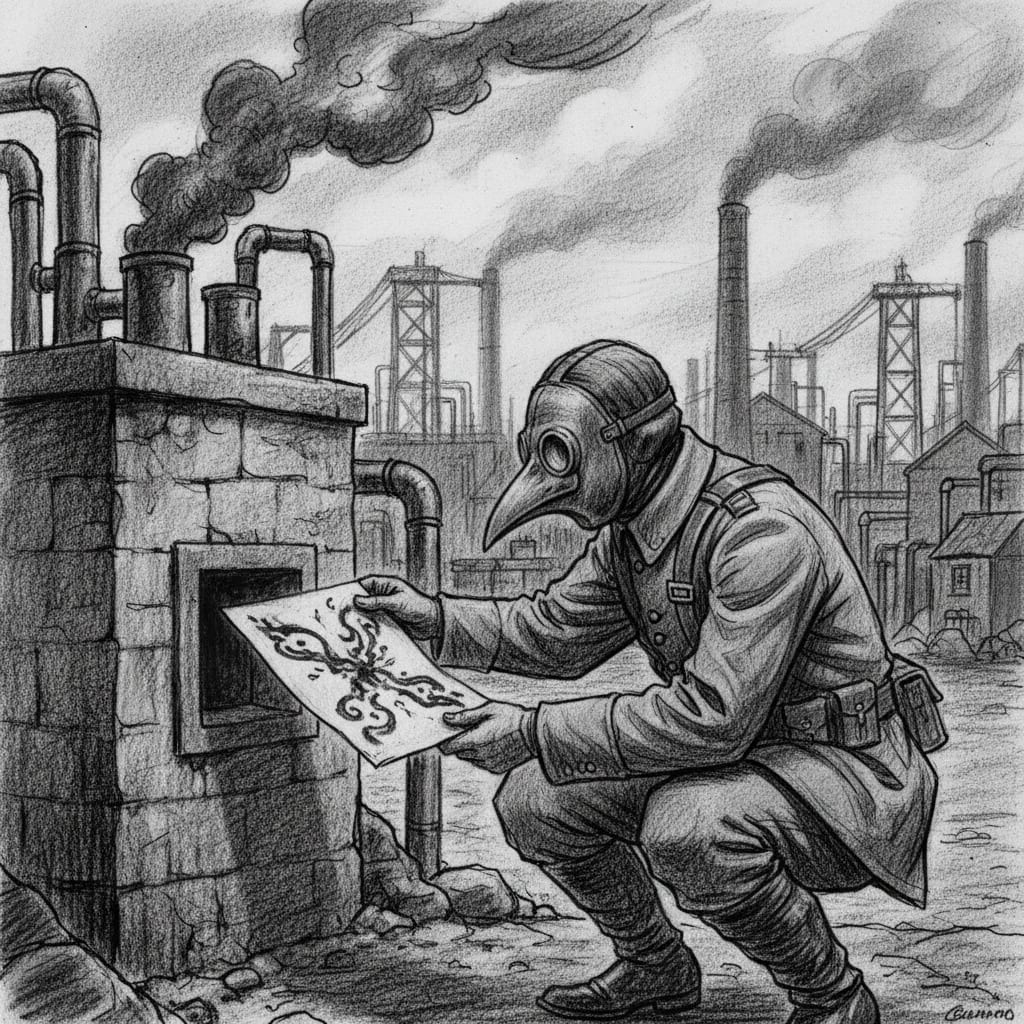
And the fume paper. Reactive parchment, manufactured by the Bureau of Engineering's Scriptoria annex, treated with a compound the Engineering clerks describe in their filing as "alchemically responsive cellulose" and the Fume-Inspectors describe as "the paper that tells on you." When held in proximity to smoke from unauthorised combustion — black diesel, unconsecrated tallow, demon-glass residue, or any of the forty-seven substances listed in the Bureau's Index of Prohibited Emanations — the paper blooms. Patterns spread across its surface like ink dropped in water: dark rings for petroleum distillates, ruddy spirals for animal fat, and, on occasions that the Bureau prefers not to discuss at length, legible script.
The uniform is distinctive and, like most things designed by the Bureau, serves a purpose beyond the merely practical. The half-priest robe — identical in cut to a junior cleric's cassock but dyed in Bureau grey rather than ecclesiastical black — announces the Inspector as an officer of faith without granting him the courtesies owed to actual clergy. The nose-mask, stitched with replaceable charcoal filters, covers the lower face and gives the Inspector the appearance of a man perpetually about to deliver bad news through a bandage. The ash cuffs — bands of treated fabric worn at the wrists — catch particulate and serve as a walking record of the day's exposure, darkening from white to black over the course of a shift. Inspectors who present cuffs that are still white by evening are suspected of not working. Inspectors who present cuffs that are entirely black are suspected of working in the wrong districts.
The brass badge — the "Ninth Mark," so called because Fume-Inspectors fall under the Bureau's ninth administrative subdivision — is worn at the breast. It grants the Inspector authority to enter any premises within his assigned district, to demand the opening of any chimney flue, to inspect any cooking fire, and to confiscate any substance his fume paper identifies as prohibited.
#On the Twenty-Percent Tolerance
The open secret of the Fume-Inspector's profession — a secret that is open in the way a wound is open, which is to say everyone can see it and no one is permitted to remark upon the blood — is the Twenty-Percent Tolerance Directive.
The Bureau of Purity, through the Bureau of Records, determined sometime in the middle decades of the current century that complete eradication of contraband was operationally impossible, economically ruinous, and — this being the reason the other two were noticed — likely to produce riots. The directive, which has never been committed to paper the Bureau acknowledges and which exists solely as an oral tradition among senior Air Auditors, states the following: contraband is to be tolerated at a rate of approximately twenty percent of estimated total volume. The remaining eighty percent is to be documented, cited, and taxed.
Twenty percent flows. Eighty percent is visible, prosecutable, and profitable. The city breathes. The Bureau claims omniscience. The twenty percent that escapes is the precise amount of oxygen the system requires to avoid suffocation.
The Fume-Inspector is the instrument through which this arrangement is maintained. His job is to smell contraband, identify it, and then decide which portion of it to see. The remaining portion he does not smell. It does not exist. It was never combusted, never inhaled, never warmed a room. The affidavit he files at the end of his shift is an act of editorial selection comparable in its precision and its dishonesty to anything produced by the Bureau of Doctrine, and I say this as the Bureau of Doctrine's chief author.
#On the Craft of Selective Olfaction
The training of a Fume-Inspector takes fourteen months. The first three months are spent learning to identify substances by scent — a skill that is genuine, difficult, and medically destructive. Trainees are exposed to controlled burns of every item on the Index of Prohibited Emanations, in ascending order of toxicity, until they can distinguish black diesel from blessed lamp-oil at a distance of forty paces and unconsecrated tallow from consecrated tallow at ten. By the end of this period, approximately one in five trainees has developed a persistent cough. By the end of the full training, the ratio is closer to one in two.
The remaining eleven months are spent learning which smells to ignore.
This is the harder discipline. The nose, once trained, does not forget. The Fume-Inspector who can identify forty-seven prohibited emanations cannot un-identify them. He smells everything, always — the diesel soot on the baker's apron, the unconsecrated grease in the lamp across the street, the faint sulphuric residue that clings to anyone who has handled demon-glass within the past week. His job is to know all of this and to record only the portion the Bureau requires.
An earlier training memorandum described the Fume-Inspector's role as "the impartial detection and documentation of all prohibited emissions within the assigned district."
The word "all" has been revised to "selected." The word "impartial" has been stricken. The memorandum's author has been reassigned. The Bureau does not employ impartial men. The Bureau employs useful ones.
The craft, then, is performance. The Fume-Inspector patrols his district with the lantern held high, the mask cinched, the fume paper at the ready. He stops at a chimney. He tests the air. The paper blooms — or does not. If it blooms, he consults his logbook, checks the address against the day's quota requirements, and makes a determination. Is this chimney's sin to be seen today, or is it to remain invisible until the Bureau requires a public lesson?
If the former: he seals the vial, marks the door with a citation glyph in wax, and files the affidavit. A confiscation crew arrives within the hour. The street watches. The Bureau is demonstrated to be watching.
If the latter: he moves on. His cuffs darken. His logbook gains another line of nothing. The chimney continues to smoke.
#On the Night Raid
The most visible element of the Fume-Inspector's work — the spectacle the Bureau values above all paperwork, above all quotas, above all the silent arithmetic of the Twenty-Percent Tolerance — is the night raid.
Night raids are staged. I say this without embarrassment, because the staging is the point. The Bureau selects a target — a household, a workshop, a bakery — based on criteria that are approximately thirty percent evidentiary and seventy percent theatrical. The chosen premises must be accessible, visible from the street, and inhabited by someone whose arrest will be instructive without being inflammatory. One does not raid a Guild-Master's furnace. One raids the journeyman's. The lesson is the same; the paperwork is smaller.
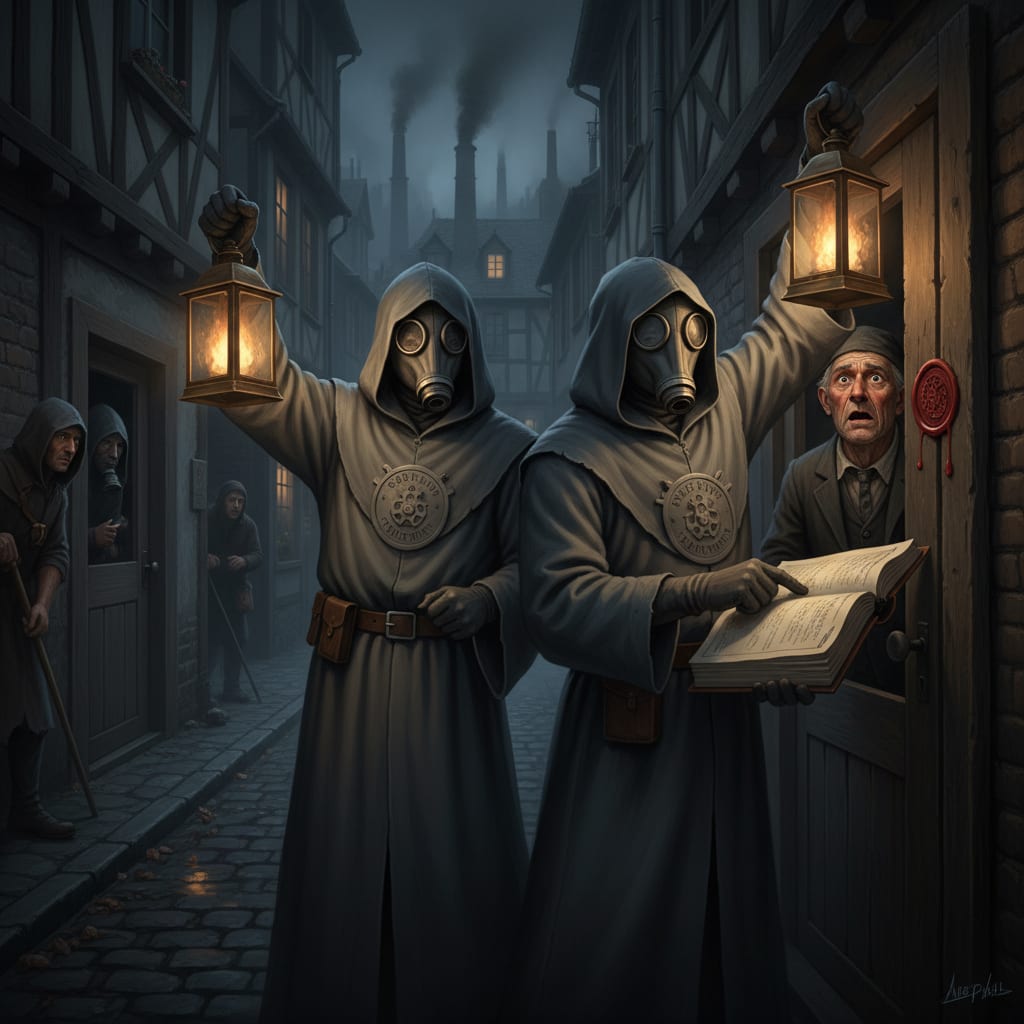
The raid proceeds as follows. The Fume-Inspector arrives after dark with two witnesses — always two; the Bureau insists on pairs, because a single witness can recant, and three witnesses suggest that the Bureau was uncertain, which the Bureau never is. He presents his fume paper, which has been pre-tested against the target's emissions earlier that day during the routine sweep. He knocks. If the door opens, the inspection begins. If the door does not open, the Inspector's ledger-lantern strikes it three times, and the sound — a specific, hollow brass note the Bureau has spent decades engineering into the lantern's casing — carries the legal weight of a summons. After the third knock, the Inspector may enter.
The seizure is brief. The Inspector identifies the offending substance, seals it in a vial, marks the premises, and pronounces the citation in the Bureau's prescribed formula — a three-line pronouncement that names the sin, the statute, and the date, and that ends with the phrase "as witnessed and sealed." The household watches. The street watches. The Bureau, through the Inspector's lantern and logbook and wax seal, is demonstrated to be awake.
#On Script-Smoke and the Limits of the Profession
There are days — the Bureau's internal filings call them "anomaly events" and the Inspectors call them "hymn-smoke days" — when the fume paper does something the training does not cover.
The paper blooms. But instead of the usual rings and spirals that indicate petroleum or animal fat or any of the catalogued emissions, the patterns resolve into letters. Legible script. Words, sometimes phrases, written in an alphabet the Bureau of Doctrine has classified and the Bureau of Purity has been instructed to pretend it cannot read.
Script-smoke (Unregistered) is the boundary beyond which the Fume-Inspector's competence ends and the Inquisitor's begins. When a chimney's emissions begin to spell, the Inspector is required to seal the entire block, alert the Bureau, and withdraw. He is not required to read what the smoke writes. He is forbidden to read it. The Bureau's operational guidance on the subject is three words long: "Seal. Report. Forget."
An earlier edition of this entry described script-smoke events as "extremely rare, occurring perhaps once per decade per district."
The Bureau of Purity has revised this estimate. Current occurrence data is sealed. The Fume-Inspectors' guild newsletter — an unofficial publication the Bureau tolerates because suppressing it would confirm its contents — reports that script-smoke events in Strasbourg's industrial wards have increased threefold since A.S. 195. The Bureau considers this figure "unverified." The Inspectors consider it "Tuesday."
The Script-Interpreter — the highest specialist rank within the Fume-Inspector hierarchy — is the only officer authorised to approach a script-smoke event without immediate withdrawal. There are, by the Bureau's last published count, eleven Script-Interpreters in the Synod. They are stationed at the seven bastions and at Strasbourg, and they are, by the unanimous testimony of every Fume-Inspector I have interviewed, the most frightened people in the profession.
#On the Profession's Internal Factions
Three tendencies divide the ranks. The Clean-Lung Purists believe the profession's mandate is literal: eradicate all prohibited emissions, enforce the Index without compromise, accept no tolerance and no quota. They are idealists. They are also, by the Bureau's own attrition statistics, the faction with the shortest average career span — three years, after which they are either dead of fume-sickness contracted during overzealous field work, reassigned to sanitation duties in the frontier ossuaries, or quietly transferred to desk positions where their enthusiasm can evaporate without infecting others.
The Twenty-Percenters are the professional core. They understand the Tolerance. They enforce the quota with the precision of accountants and the conscience of morticians. They do not pretend the system is just; they pretend the system works, which is a different and more sustainable fiction. A Twenty-Percenter files clean numbers, maintains district equilibrium, and retires — if retirement is the word for the condition in which a man's nostrils have been chemically burnt to the point where he can no longer distinguish incense from excrement — after fifteen to twenty years of service.
The Stagehands are the Bureau's favourites. They specialise in the visible enforcement that keeps the population afraid: the night raids, the dawn sweeps, the perfectly choreographed seizures that arrive in time for the morning bell and depart before the afternoon Litany. A good Stagehand can turn a three-ounce confiscation into a district-wide demonstration of the Bureau's omniscience, and a great Stagehand can do it while the actual smuggling operation runs undisturbed two streets over.
The Bureau promotes Stagehands. The Bureau tolerates Twenty-Percenters. The Bureau buries Purists.
#On the Cost
The Fume-Inspector is paid in wages, rations, and what the Bureau's payroll division delicately calls "confiscation participation allowances" — a percentage of the value of seized goods, calculated by the Bureau of Tithes and disbursed quarterly, always late, and always for an amount slightly less than the Inspector expected. The shortfall is explained by "processing fees." The processing fees are explained by nothing.
Mask filters must be replaced weekly. The Bureau supplies them monthly. The difference is paid by the Inspector from his own wages, or — more commonly — by the baker, the lamplighter, or the workshop foreman who would prefer his chimney remain uninspected for another seven days. The bribe economy of the Fume-Inspector is so thoroughly systematised that the Bureau of Records, during a particularly ambitious audit in A.S. 178, attempted to tax the bribes. The effort failed because the Inspectors, with a solidarity that would have impressed any guild organiser, simultaneously filed zero-income declarations and dared Records to prove otherwise. Records could not. The Inspectors' logbooks were, after all, impeccable.