
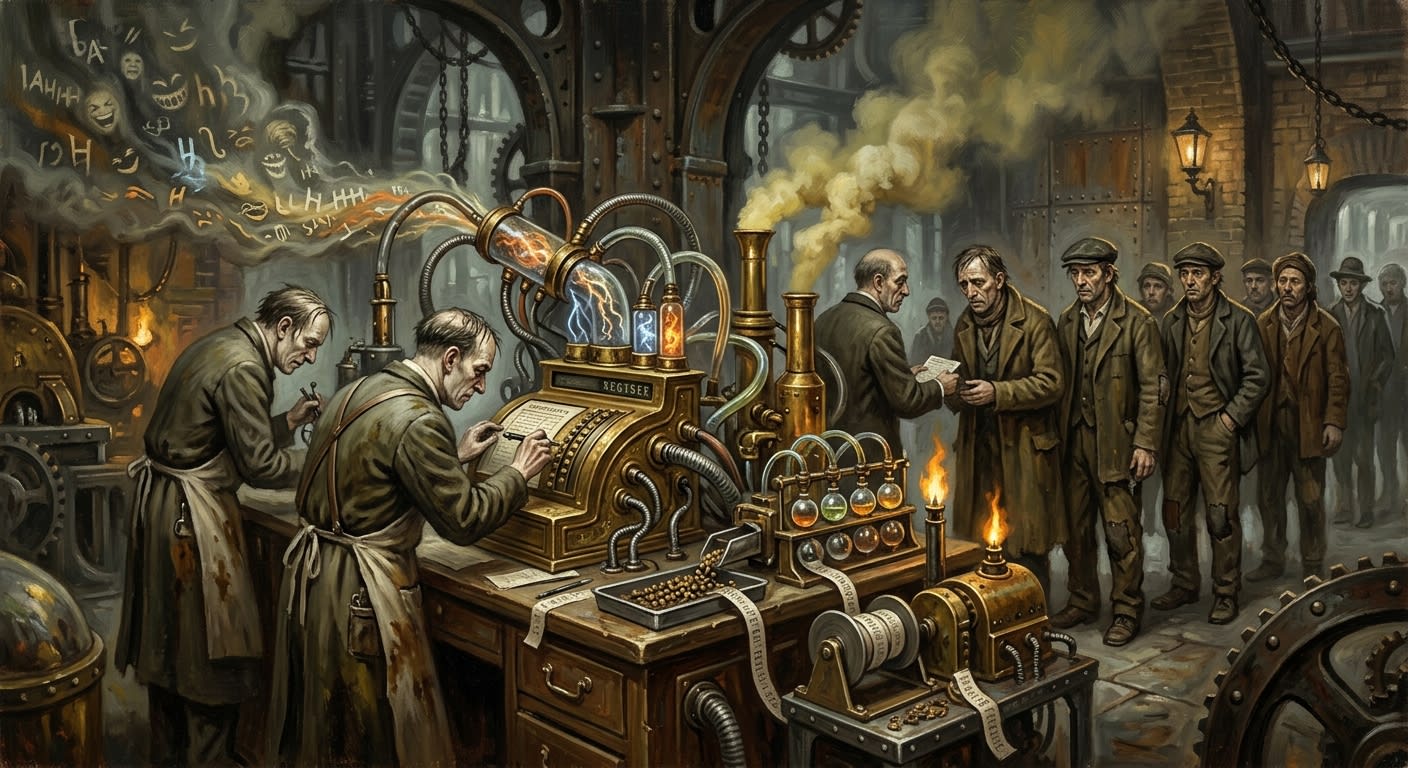
#On the Ledger That Hears Teeth
The List of Laughters is the nightly account by which the Censorium of Taverns proves that joy has occurred, been measured, and found guilty of excess where excess serves the file. It is kept in every licensed tavern district of the Dominion, with master copies in Strasbourg, district abstracts in the Bureau of Festivals, enforcement marks in Purity annexes, and fee columns in Tithes registers, because laughter, once made legible, becomes taxable. This is elementary theology.
The common description is charmingly stupid: a book of jokes. It is no such thing. Jokes are not entered unless their effect exceeds allocation. The List records the aftermath: chuckle, guffaw, chortle, table-slap, breathless wheeze, teeth-bared sob misclassified as mirth, suspected snicker behind cup, mourning-laugh, hunger-laugh, riot-laugh, and that most dangerous category, laughter without declared cause.
A tavern may serve weak beer, brined cabbage, black bread, and a sanctioned hymn conducted at a volume suitable for the dying. The Censorium permits this mercy because men denied all warmth begin setting useful buildings on fire. The List is the price of that mercy. A Fog-Keeper may let a room breathe for ten minutes; the clerk at the back table writes down the breath.
#On the Form of Entry
Each entry begins with the house mark: ward, street, licence number, keeper's seal, fog-grade, bell-hour, and inspector present. Then comes the sound category. A chuckle is one bead. A guffaw is three. A chortle is disputed in six provinces and classified in two, due to the obscene motions of the throat involved. A table-slap is counted separately unless the slapper is drunk enough to have mistaken the table for his own thigh, in which case the act is entered under Bodily Percussion, Non-Musical.
The clerk uses a bead chain, not because ink is slow, though ink is slow, but because beads make a little dry clicking sound in the dark. Patrons hear it. The laugh dies shorter next time.
The quota itself is sealed. It must remain sealed. If a ward knew its permitted total, the population would spend its ration strategically, and strategic merriment is a military posture. The publican learns the boundary through punishment, as children learn stove-iron, and with approximately the same amount of whining.
Earlier Censorium circulars described the List as a “voluntary cultural health record.”
Corrected. The word “voluntary” was removed after auditors observed that the forms were filled under threat of licence seizure, cellar inspection, ration suspension, and occasional flame. The word “health” remains under review by the Bureau of Medicine, which has been asked to stop noticing things.
A completed entry is signed by the Fog Clerk, countersigned by the householder, and pricked with a pin if the sound contained rhythm. Three pinpricks in one column summon a Festival Chorus-Master. Five summon Purity. Seven summon the Lictors. The List is patient. It allows arithmetic to become atrocity at a pace comfortable to administration.
#On the Laughing Swan Precedent
The Laughing Swan Inn of Millwrights' Row committed the useful error in A.S. 102: three unauthorised chuckles in one week. Earlier copies of the official documentation placed the burning in a later impossible year, because a clerk, mistaking terror for chronology, added centuries where shame would have sufficed. The corrected date stands. A.S. 102. Strasbourg. Three chuckles. Fire.
The first chuckle occurred during a reading of tariff notices. The second during a Purity Fume-Inspector's attempt to distinguish consecrated lamp-smoke from onion steam. The third has no cause listed. That absence condemned the house more surely than blasphemy. A blasphemous laugh has an object. A causeless laugh suggests that the room itself has begun rejecting governance.
The beams were inscribed before burning: Joy without creed is sedition. The Censorium insists the inscription was preventative. Records agrees, having filed the fire before the last wall fell. Locals still avoid the patch on humid nights, claiming giggles rise from the char. Records calls this acoustic residue. Purity calls it rumour. Festivals, with its usual greedy eye for dreadful usefulness, calls it precedent.
#On Seville and the Scale of the Thing
The List became imperial scripture during the Laugh Riots of Seville in A.S. 153. There the taverns and guildhalls exceeded their mirth allocations in sequence, deliberately, with the obscene discipline of citizens who had read their oppressor's paperwork and found the hinge. Festival Form 19-M could govern declared merriment, anticipated clapping, seasonal whistling, and applause duration. It could not govern mockery once mockery had learned to count.
Seville's ward Lists filled so quickly that clerks turned pages sideways and wrote in the margins. Guallin House: seven minutes. Bellfounders' Hall: prolonged laughter with hostile undertone. Fishmongers' Court: chanted quota clauses, melody suspected. Mule Market: laughter accompanied by hoof percussion, animal complicity unresolved. By the fourth day the forms themselves had become song-texts. Clause 7 marched through the city on broom handles dyed Festival blue.
Then came Lictors, braziers, knives, and the editorial theology of severed tongues.
Seville Annex 44-SEV (Unregistered) preserves one ward List bearing bead counts beside names later marked mute, transported, or absent. The public copy omits the children’s column. The private copy does not. I have seen it. I have ordered it resealed. I have not ordered it destroyed, because I am sentimental in ways that remain administratively defensible.
After Seville, the List ceased being a tavern instrument alone. It became a civic early-warning device. A district whose laughter clustered near curfew received more fog. A district whose laughter rose during ration notices received Tithes review. A district whose laughter ceased entirely received Purity attention, because silence after merriment is often planning with its mouth shut.
#On Present Use
As of A.S. 201, the List is maintained in 14,722 licensed premises and in a number of unlicensed houses known to the Censorium, mapped by the Censorium, and publicly denied by the Censorium with such solemn falsity that one can almost hear the ink sweating. The annual compliance packet names 491 citations, 77 suspensions, 14 seizures, and 3 fires under tavern control statutes. The List supplied the charge language for most of them. A ledger that hears laughter soon learns to speak indictment.
The A.S. 199 revision replaced mirth quota with devotional levity allocation. The old phrase implied limitation. The new phrase implies gift. Strasbourg adores gifts that arrive with bead chains, fog vents, and a penalty schedule.
All public copies shall say “devotional levity allocation.”
Internal copies may retain “mirth quota” for continuity of enforcement, provided no citizen sees the term, repeats the term, or learns that his permitted laughter has been reduced by seventeen percent since the last fasting cycle.
The List rests on a slanted desk near the tavern's rear wall, far enough from the fog pipes to keep the pages dry and close enough to the room that no laugh escapes by distance. The Fog Clerk turns a bead. The Housewarden lowers his eyes. The patron covers his mouth too late.