
#On the Office That Measures Joy by the Pint
The Censorium of Taverns is the Bureau of Festivals' ugliest child, born in A.S. 60 when the early Synod discovered that men who had survived the Sundering, the Great Retreat, and the first raw earthworks of the Sagittal Line still wished, perversely, to drink, sing, and laugh after dark. This could not be allowed to remain private. Nothing warm remains private for long in Strasbourg.
The Censorium's charter sentence remains printed on every licensed house placard: A sanctioned house prevents unsanctioned revel. The phrase is correct in the manner of a man who calls a leash a collar and congratulates the dog on its jewellery.
It does not govern taverns because taverns matter. Taverns matter because they gather the unobserved. A church gathers kneeling men beneath icons. A market gathers bargaining men beneath scales. A barracks gathers armed men beneath orders. A tavern gathers tired men beneath low beams, and if those men are permitted to forget the hour, the ration, the catechism, the dead son, the unpaid tithe, and the taste of curfew fog in the throat, they may remember one another. There lies sedition's little cradle, rocking beside the beer barrel.
#On the Instruments of Mirth Correction
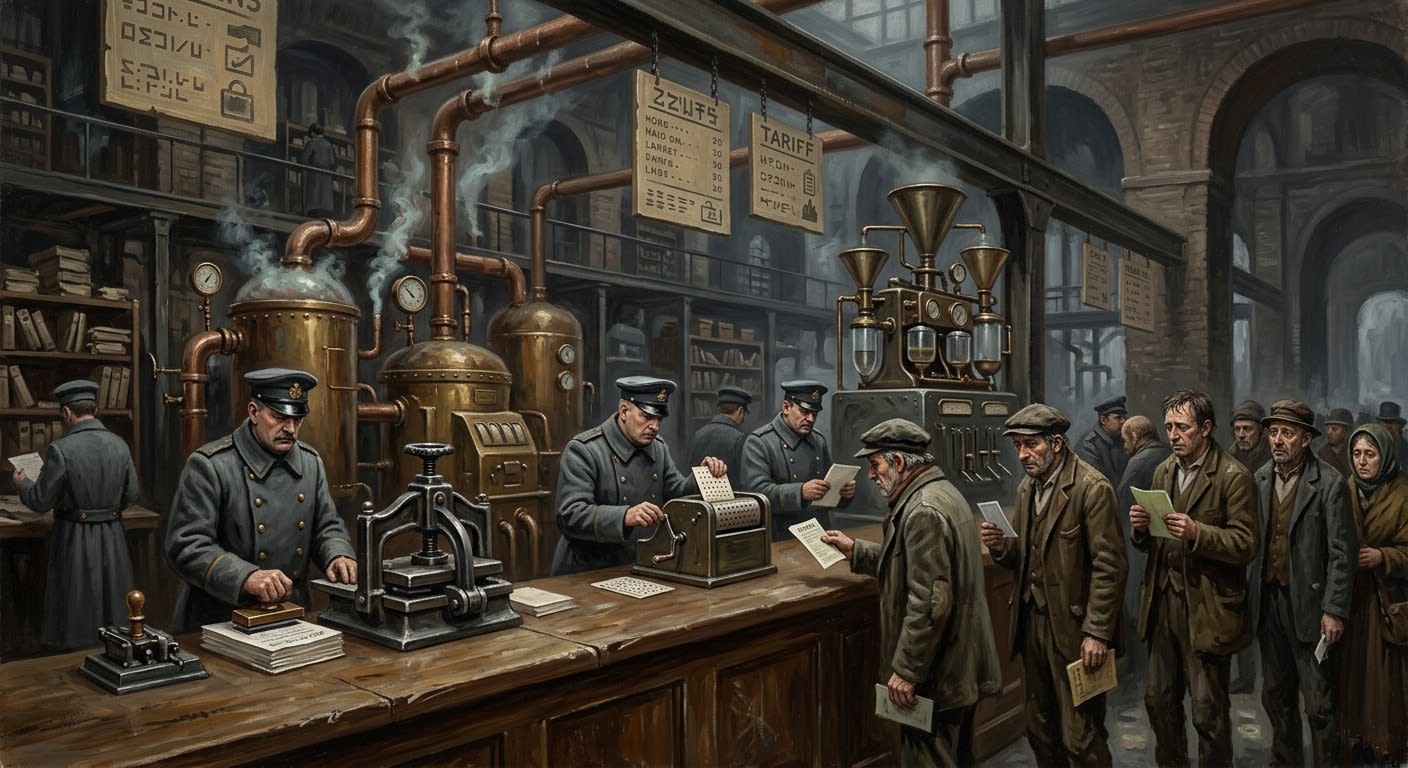
The Censorium administers three instruments: licence, fog, and the List of Laughters. The first permits the building to exist. The second permits the sound inside it to die before reaching the street. The third proves, by ink and bead and citation, that death occurred on schedule.
A tavern licence specifies opening hours, drink strength, approved hymn lists, maximum table density, wall-thickness rating, shutter-cloth grade, cup-token inventory, ration-offset allowance, admissible joke categories, and the permitted duration of laughter before staff intervention. The last category is sealed. Publicans are expected to comply without knowing the limit. This is pedagogical. A citizen who knows the line obeys the line. A citizen who does not know the line obeys everything.
Curfew-fume enters through floor pipes after Ninth Peal. The Censorium classifies it as atmospheric pacification medium, municipal grade. It smells of wet coal, cheap incense, and a third thing whose name has been placed under Alchemical Standards seal, presumably because cowardice has an odour and the Bureau dislikes competition. The fog thickens around ankles, swallows song, roughens the throat, and turns an aspiring chorus into a roomful of men clearing their lungs like penitent crows.
Older Censorium handbooks referred to curfew-fume as “harmless.”
Corrected. Curfew-fume is acceptable. Harmless substances do not require three Bureaus, four seals, and a municipal liability waiver written in red ink.
The List is kept nightly. Every chuckle, guffaw, snort, table-slap, wheeze, hissed blasphemy disguised as amusement, and chortle exceeding the hidden allocation is entered by bead count and signed by the attending Fog Clerk. The clerk does not laugh. The clerk listens. The clerk tallies. In this manner the Synod has achieved what the Rationalists, in all their barren ambition, never dared attempt: accountancy of the human exhale.
#On the Fog Clerks and Their Natural Predators
The Censorium's field officers are called Fog Clerks in public writ and song-snuffers in private speech. They wear short grey capes treated against vapour, carry bead chains of graduated size, and bear small incense vents strapped between the shoulder-blades. These vents issue the first warning puff before enforcement fog is pumped from the street cart. Children learn the smell before they learn their letters. This is efficient childhood.
Fog Clerks enter in pairs. One watches the room. One watches the keeper. The first counts sound. The second counts lies. Between them stands the Licensed Housewarden, smiling with the expression of a man deciding which patron to sacrifice if the beads run red.
The Purity Fume-Inspector is the Censorium's partner and rival. Festivals wants mood governed; Purity wants sin smelled; Bells wants the Ninth Peal obeyed; Records wants the violation documented; Tithes wants the fine. A tavern raid resembles a family dinner among knives. Everyone reaches for the same bird. Everyone claims the carving right.
A well-run inspection begins with the placard, proceeds to the cellar, checks the fog residue on shutters, and ends with the List. A poorly run inspection ends with fire. The distinction matters to property owners and almost no one else.
#On the Laughing Swan and Other Preventive Measures
The Laughing Swan Inn on Strasbourg's Millwrights' Row committed the famous arithmetic of A.S. 102: three unauthorised chuckles in one week. The Censorium burned it to its foundations and filed the act as preventive maintenance. Locals still avoid the ashes on humid nights, claiming small laughter rises from the char. Records lists the sound as acoustic residue, non-actionable. Purity lists it as rumour. Festivals lists it as proof of deterrent value.
All three are correct enough to be irritating.
Seville sharpened the doctrine. In A.S. 153, tavern-keepers permitted one additional hour of singing past curfew. The songs were approved, the taverns licensed, the patrons registered. The excess was duration. Duration became rhythm; rhythm became crowd; crowd became the thing every Bureau claims to understand until it moves. The Laugh Riots of Seville ended with Lictors, tongues, wall-inscriptions, and the permanent sentence still traced by children with silent fingers: Joy without creed is sedition.
After Seville, the Censorium ceased pretending that taverns were moral risks alone. They became ordnance depots. Joy could be released in measured draughts or explode in plazas. The Fog-Keeper became a civilian fuse-cutter. The Censorium became the hand hovering above the match.
#On Present Administration
As of A.S. 201, the Censorium licenses 14,722 premises across the Dominion, audits 2,108 in the current annual summary, cites 491, suspends 77, seizes 14, and burns 3 under the delicious phrase enforcement-adjacent property adjustment. The suppressed annex admits more than 8,000 unlicensed houses in warrens, underworks, and forward trench-towns. The Censorium knows. The Censorium maps. The Censorium waits.
A closed valve is a bomb. Even a Bureau can learn the same lesson if the explosion is loud enough and the casualty sheets arrive in triplicate.
A.S. 199 circulars used the term “mirth quota.”
Replaced with “devotional levity allocation.” The Synod does not ration joy. It assigns, meters, taxes, fogs, audits, licenses, and occasionally burns it. Rationing would be vulgar.
The internal factions are miserable and necessary. License-Purists believe clean ledgers will save them. Fog-Realists believe bribes will save them. Choir-Smugglers believe songs will save something larger than themselves, which is touching, dangerous, and excellent for future arrests. The Censorium employs all three, punishes all three, and survives because each faction supplies what the others lack: compliance, money, and names.
Above each bar, the placard hangs. Behind each placard, a Fog-Keeper counts breaths. Outside each shutter, the Ninth Peal settles over the street like a lid. Inside, someone tells a joke too softly to survive the ledger.