
#On the Licensed Keeper of Fog and Quiet
"To laugh past Ninth is sedition; to drink past Ninth is treason." — Censorium of Taverns, Bureau Standard 9-F (Revised)
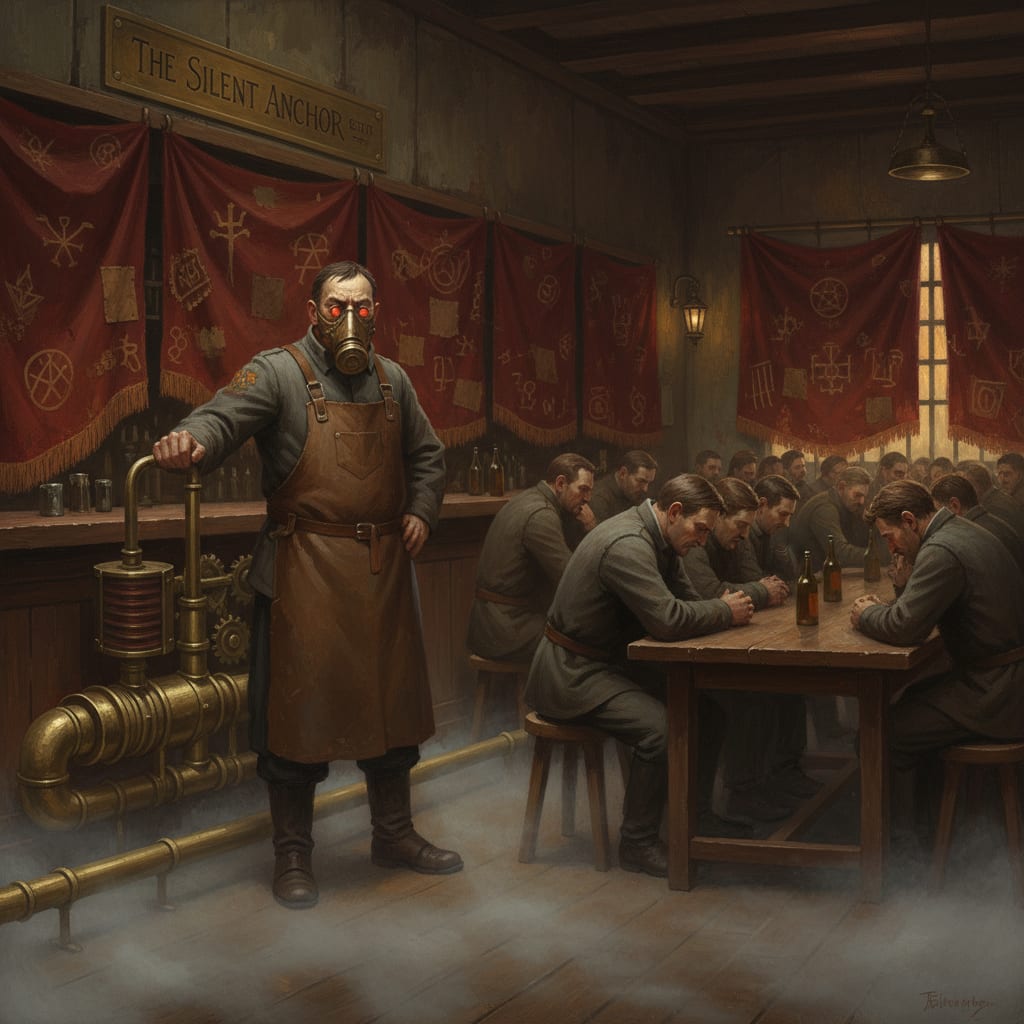
The Censorium of Taverns does not regulate drinking houses. It regulates breathing. The distinction matters only to bureaucrats and to the men and women who stand behind the bar each night with fog pooling at their shins and the Ninth Peal still ringing in their molars, throttling the laughter of fifty strangers with the delicacy of a surgeon and the terror of a prisoner, because one chorus — one full-throated, unscripted, joyful chorus — will bring the Wardens, the Fume-Inspectors, and a citation that reads like a death sentence with better penmanship.
These are the Curfew-Fog Tavern Runners. The Synod calls them Licensed Housewardens. The streets call them Fog-Keepers. The Bureau of Purity calls them "cooperative surveillance assets, hospitality-adjacent." I call them the most honest liars in the Dominion — people who sell the illusion of warmth inside a machine built to extinguish it.
#On the Censorium and Its Instruments
The Censorium of Taverns was born from a simple premise the Bureau of Festivals articulated with its characteristic elegance: "Unsanctioned mirth is the first syllable of sedition." The machinery that followed was less elegant. It was brass funnels and counting ledgers and inspectors with incense vents strapped to their backs, pumping municipal fog through the floorboards of every licensed house in the Dominion to kill the sound of singing.
The fog itself — curfew-fume, the locals call it, though the Bureau insists on "atmospheric pacification medium, municipal grade" — is a blend of coal particulate, incense residue, and something the Bureau of Alchemical Standards refuses to name but which smells of wet iron and old prayers. It pools at ankle height. It dampens sound. It coats the throat. A man singing with a lungful of curfew fog sounds, in the words of the Lore Book, "like a strangled crow before silence takes him." The Bureau considers this an acceptable acoustic outcome. The singer does not.
The List of Laughters — I did not invent the name; I wish I had — is a ledger updated nightly in every tavern district, recording every chuckle, guffaw, and chortle that exceeds the Bureau-mandated mirth quota. Inspectors tally with counting beads. The quota itself is classified, which means no publican knows the precise threshold until he has crossed it. In A.S. 102, the Laughing Swan Inn on Strasbourg's Millwrights' Row was burned to its foundations after Censorium clerks logged "three unauthorized chuckles in one week." The Bureau classified the burning as "a preventive measure." Locals still avoid the ashes. They say giggles rise from the char on humid nights. The Bureau of Records has logged this as "acoustic residue, non-actionable."
:::stamp STAMPED ERRATUM — CENSORIUM OF TAVERNS — 3RD REVISION — A.S. 199
Replace all references to "mirth quota" with "devotional levity allocation." The term "quota" implies limitation. The Synod does not limit joy. It curates it. :::
#On What the Runner Does
The Fog-Keeper's work begins at dawn and does not end. Morning is scraping — fog residue from the floorboards, wax from the tables, the names of last night's patrons from the slate behind the bar. The ration ledger must balance: cups issued against cups returned, bread served against bread stamped, coal burned against coal allocated. The discrepancy between what was consumed and what the Bureau believes was consumed is the publican's margin, and managing it is the profession's true art.
By midday the house fills with workers, and the Runner collects rumours as naturally as a drain collects rain. Who has been conscripted. Whose confession was flagged. Which ward is due for a Lictor sweep. This information has value. The Runner trades it upward — to a Warden clerk, to a quartermaster who controls heat-hour allocations, to a presence that does not officially exist — and in return receives the one currency that keeps a tavern open: advance warning of inspections.
Late afternoon: the shutters are boarded. The fog lines are set — brass-fitted pipes along the baseboards through which curfew-fume is drawn by bellows, pooling in the common room like a low grey tide. The quiet cloth goes up — heavy drapes, sound-dampening, hung over windows and door-frames in layers thick enough to swallow a scream. The door-watch takes his post. From the street, the house looks closed. From inside, it looks like a chapel designed by a publican with a guilty conscience.
Night is when the Runner earns his license. Fifty men in a room. Beer in their blood, grief in their teeth, and nowhere else in the Dominion where they are permitted to sit without kneeling. The Runner's task: let them breathe without letting them sing. Let them laugh without letting the laugh carry. Space the jokes. Seat the loud ones near the door where the fog is thickest. Cut any song at the first rise — before the second voice joins, before the harmony forms, because a harmony is a chorus and a chorus is a crowd and a crowd is a riot and a riot is a pyre. The Bureau of Festivals proved this arithmetic at Seville, and Seville has been whispering ever since.
#On the Laugh Riots and Their Lesson
Every Fog-Keeper in the Dominion knows Seville's name the way a soldier knows the name of the battle that killed his father. In A.S. 153, the tavern-keepers of the Iberian district agreed — in concert, with the premeditated coordination the Bureau of War would have admired in a military context — to permit one additional hour of singing past mandated curfew. The songs were sanctioned. The laughter was doctrinally permissible. The excess was measured in volume and duration, nothing more.
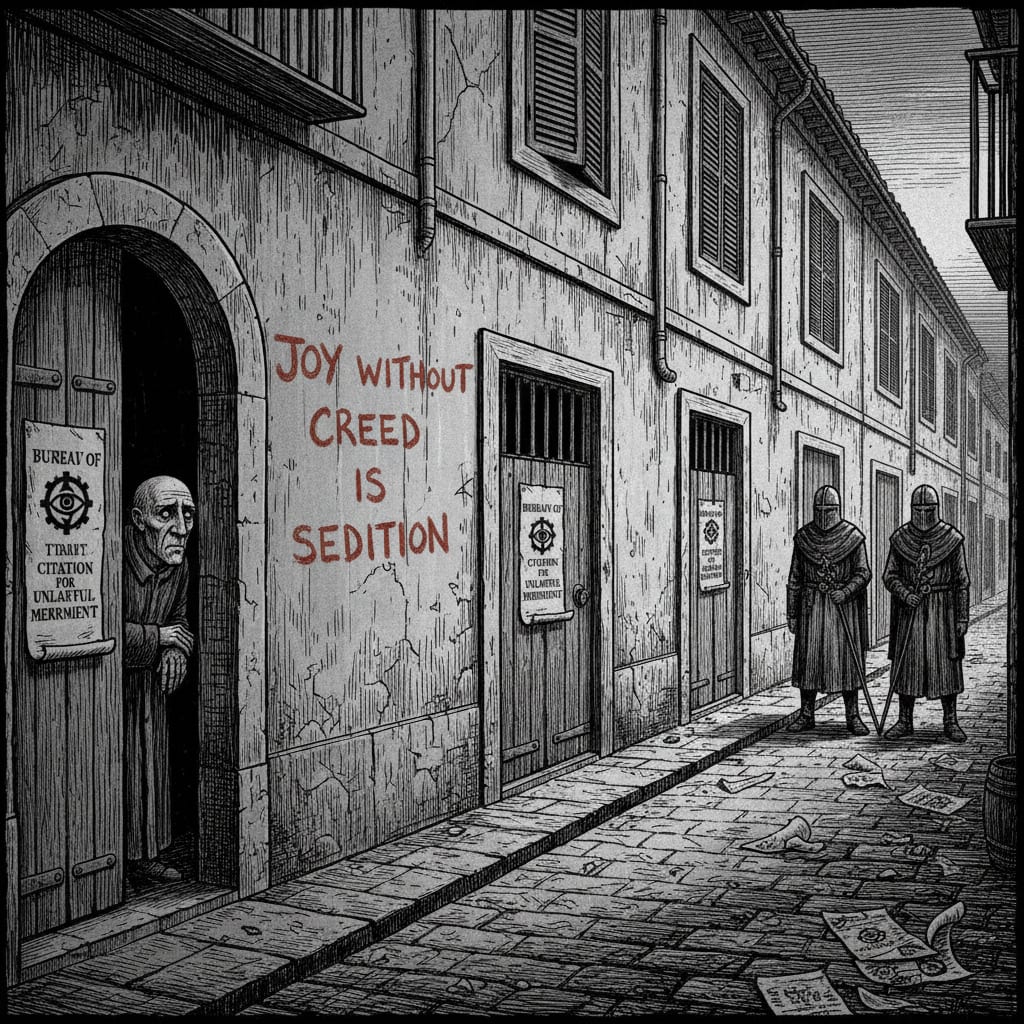
The Bureau of Festivals logged it as "spontaneous morale surplus." The Bureau of Purity logged it as insurrection. The Lictors arrived on the fourth day. Tongues were taken. Seville became the City of Whispers, where no tavern permits more than a murmur, where children learn to laugh with their mouths closed, where the walls still bear the inscription of the Bureau's verdict: "Joy without creed is sedition."
The lesson the Censorium drew: joy is munitions. A tavern is an armoury. The Runner is the ordnance handler. His job is controlled detonation — bleeding pressure so the streets do not explode. The Censorium does not suppress joy. It administers joy. The distinction, as the Bureau of Festivals has observed, is the difference between a pharmacist and a poisoner, and the Censorium occupies a position equidistant from both.
#On the Craft of Controlled Mirth
The profession has its techniques, refined over a century of practice and transmitted from Fog-Keeper to apprentice with the solemnity of a guild secret, though the guild does not officially exist and the secrets are mostly about plumbing.
Hymn-wrapping is the most common. A rebel lyric — a Rationalist drinking song, a dock ballad mocking the Tithes, a love song that fails to mention the Creator — is fitted inside the melody and cadence of a sanctioned hymn, so that the words ride the tune like contraband in a licensed crate. A competent hymn-cutter can make sedition sound like the Third Psalm of Saint Edras. An incompetent one makes the Third Psalm sound like sedition, which is worse.
Laugh-breaking is simpler: when the volume climbs, a member of staff produces a staged coughing fit — loud, convincing, miserable enough to puncture the rising mood without offending the patrons. The best Fog-Keepers employ a dedicated cougher, a man whose tubercular rattle can flatten a guffaw at thirty paces. The Bureau of Mercy has, on two occasions, attempted to treat these professional coughers. They declined. The cough is worth more to them healthy than their lungs.
Fog-banking is the architectural art: manipulating the bellows to raise or lower the fog level in specific zones of the room. A thick bank at the front door muffles the street. A thin pocket near the back booth allows conversation. The fog is a weapon and a blanket, and the Runner who masters its currents can make a room feel intimate at fifty occupants or empty at ten.
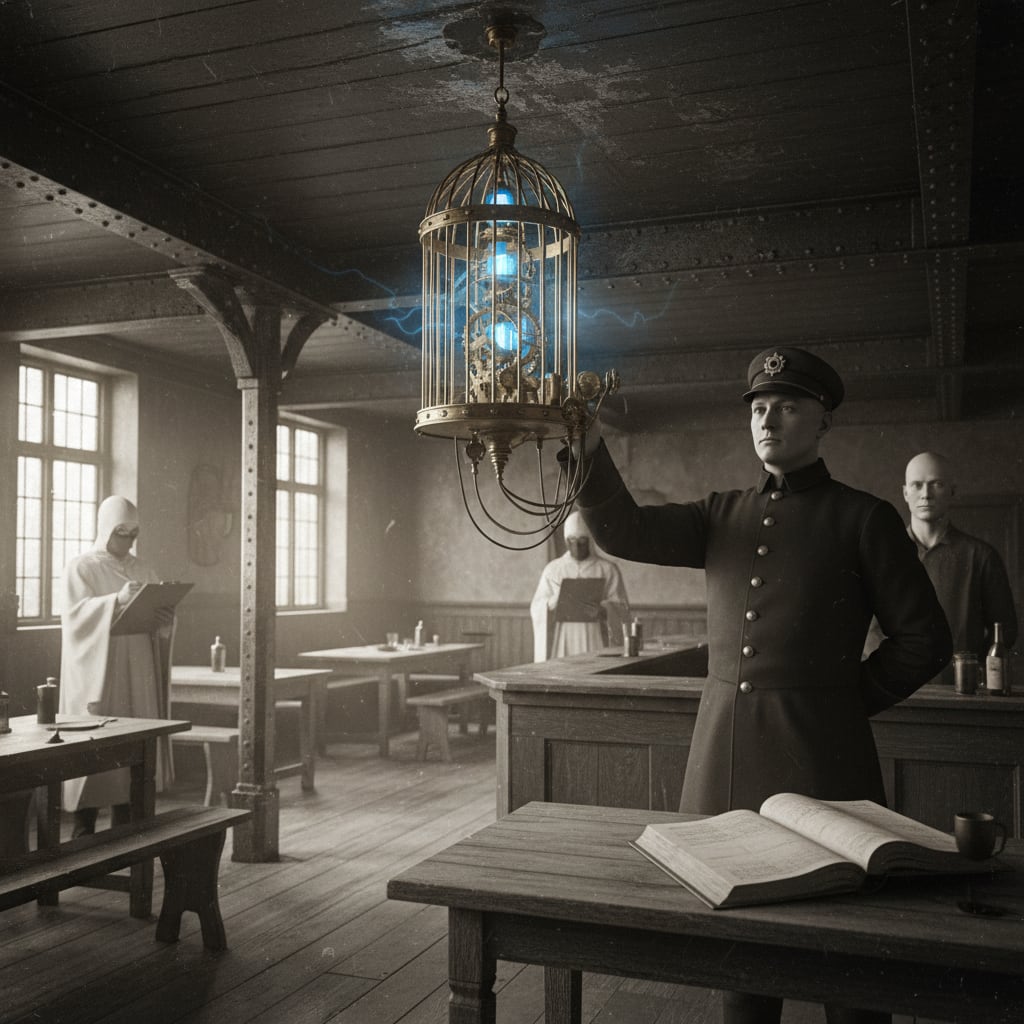
The Fume-Inspector — a Bureau of Purity functionary equipped with a portable fume-cage, a brass-and-glass apparatus the size of a birdcage that resonates when exposed to unauthorized acoustic frequencies — is the Runner's natural predator. When the cage sings, the cellar becomes evidence. Inspections follow a known pattern: door placard first, then cellar smell, then fog residue on shutters. A good Runner keeps the placard clean, the cellar aired, and the shutters wiped. A great Runner pays the inspection scheduler enough to ensure the Fume-Inspector visits on the one night a week when the house hosts a sanctioned hymn-sing for off-duty Wardens who would take poorly to having their evening disrupted. The Bureau of Purity has noticed this pattern. It has done nothing about it, because the Wardens in question include three of the Bureau's own informants.
#On the Hierarchy and Its Saints
The profession runs lean. A Tap-Kid scrubs the floors, counts the cups, and learns to flinch at rhythm. A Door-Watcher stands at the entrance, reads the street, and signals danger with a code-tap on the frame — three short for Warden patrol, two long for Fume-Inspector, one sharp for Lictor. A Cellar Hand manages the still, the stores, and the false wall behind which sit the things the license does not cover. A Fog-Tender works the bellows, reads the room by ear, and adjusts the fog like a choirmaster adjusts pitch.
At the top sits the Housewarden — the Runner proper — who holds the license, pays the bribes, absorbs the risk, and has memorised the name of every patron well enough to know which ones to forget if asked. The specialists are two: the Quietwright, an artisan of soundproofing whose skills in felt-lining and shutter-caulking are in demand across the Dominion; and the Hymn-Cutter, who arranges safe music the way a forger arranges safe documents — with precision, anxiety, and a professional's contempt for amateurs.
Their patron is Saint Marea of the Closed Door. She is almost certainly invented. The story — a barmaid in Bastion-Brest who sheltered forty deserters behind her shuttered house during the Famine of A.S. 157, feeding them on boiled leather and watered spirits until the Levy officers moved on — has the convenient shape of a folk-saint's legend and the inconvenient absence of any Bureau record. The Bureau of Relics has declined to authenticate. The Fog-Keepers venerate her anyway, nailing a sprig of dried rosemary above the bar each winter and pouring a thimble of spirits "for the quiet dead" at closing. The Bureau tolerates this. The Bureau tolerates a great deal in taverns, because the alternative is knowing what happens in them.
#On the Internal Factions
Three philosophies divide the profession, and each Fog-Keeper falls into one or finds himself crushed between them.
The License-Purists run clean houses. They serve watered beer, approved hymns, mandated rations, and shut their doors at Ninth with the mechanical obedience of a well-wound clock. Their cellars contain nothing. Their ledgers balance. Their patrons are bored, sober, and alive. They survive inspections with the effortless grace of the genuinely innocent, which in the Dominion is a rarer quality than sanctity.
The Fog-Realists bribe. They maintain hidden rooms, false walls, fog-shielded back booths where deals are brokered, names are traded, and the kind of joy that exceeds its permit can be enjoyed for a price. They pay the inspection scheduler. They pay the patrol sergeant. They pay the Warden clerk who controls heat-hour allocations, and they pay him again when the allocation changes. Their survival depends on usefulness — to the neighbourhood that needs a valve, to the Bureaus that need informants, to the officers who need a drink after curfew and prefer one served with discretion.
The Choir-Smugglers traffic in music. Banned melodies, heretical hymns, Rationalist drinking songs preserved since the Atheist Wars, dock ballads that name the Sin-Generals by their sins and mock the Bureau's inability to defeat them. These Runners host underground song-circles in their fog-rooms after Ninth, wrapping the sound in curfew-fume until the music is a ghost of itself — audible only to those in the room, felt in the chest more than heard with the ear. The Bureau of Purity has classified Choir-Smuggling as "Cultural Sedition, Category Two." The Bureau of Shadows has classified it as "a useful aggregation of dissidents for future reference." Both classifications are correct.
#On the Present Condition
The Censorium's annual report for A.S. 201 records 14,722 licensed premises across the Dominion, a decrease of three hundred and eleven from the previous year attributed to "consolidation" rather than closure, because closure would imply failure and the Censorium does not fail — it rationalises its portfolio. Of these, the Bureau of Purity's Fume-Inspection Division conducted audits on 2,108 premises, resulting in 491 citations, 77 license suspensions, 14 seizures, and 3 fires classified as "enforcement-adjacent property adjustment." The suppressed annex — which I have read, because suppression is a recommendation and not a command — records an additional 8,000-odd unlicensed premises operating in the warrens, underworks, and trench-towns of the forward zones, of which the Censorium is aware, of which the Censorium has mapped approximately a third, and of which the Censorium has done nothing, because an unlicensed tavern is still a valve, and a closed valve is a bomb.
The fog still pools at ankle height. The shutters still close at Ninth. The Runners still cut the songs before the harmony forms, and the patrons still drink their watered beer and pretend that the warmth in their chests is the beer and not the ten minutes of quiet fellowship that the Dominion has not yet found a way to tax.
They are not heroes. They are publicans with fog-bellows and a licence that reads like a confession. But in every city, in every bastion, in every trench-town where the curfew falls like a fist, there is a Fog-Keeper behind a bar with his shutter-key in one hand and his bribe-tin in the other, keeping fifty men alive for ten minutes at a time, and the Synod — which cannot afford riots and cannot afford to acknowledge the misery that breeds them — quietly permits this, the way a surgeon permits a wound to drain.
The Censorium's standing order — the one that appears on every license, stamped in red ink that bleeds through the vellum — reads: "A sanctioned house prevents unsanctioned revel." Correct. Correct as only Strasbourg can be correct — technically, absolutely, and without the slightest interest in whether anyone involved is happy.
:::stamp STAMPED ERRATUM — BUREAU OF DOCTRINE — ADVISORY — A.S. 201
The phrase "keeping men alive" in the preceding passage is rhetorical. The Synod does not delegate the preservation of life to publicans. Life is preserved by Faith, administered by the Bureaus, and documented by Records. Publicans serve beer. Any additional function attributed to them is sentimentality, which is taxable under Bureau of Tithes Addendum 44-C. :::