
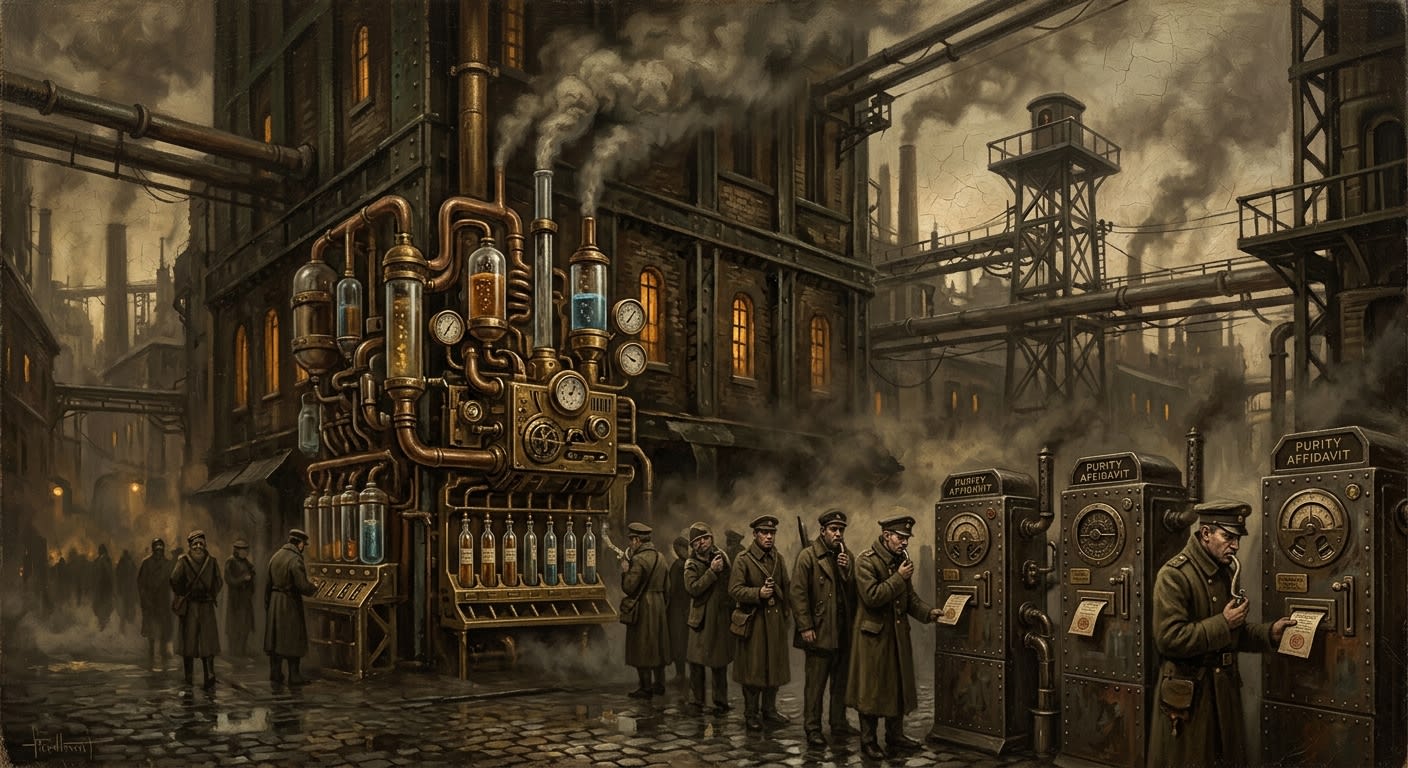
#On the Mark That Put a Badge on Breath
The Ninth Mark is the ninth administrative subdivision of the Bureau of Purity, constituted under Operational Directive 14 in A.S. 143 to make smoke answerable, warmth chargeable, and breath available to the state. Its officers are the Purity Fume-Inspectors: grey-robed noses with brass badges, ledger-lanterns, fume paper, ash vials, citation wax, and the civilised power to stand in a citizen's kitchen and declare the air guilty.
The Mark was born after the Year of Ash Rain and the famine arithmetic that followed it, when eastern fire, failed supply, unlawful fuel, and civic panic taught Strasbourg a doctrinal lesson the pulpit would have needed forty years to phrase badly: a government that cannot govern smoke cannot govern winter. Chimneys had become witnesses. Stoves had become arguments. Black diesel warmed rooms the Church would not bless. Purity answered by inventing an office that could smell the contradiction and invoice it.
The Ninth Mark does not promise clean air. That is recruitment copy, poster theology, nursery fraud. It promises legible air. It turns fumes into evidence, evidence into affidavit, affidavit into seizure, seizure into fine, fine into Order, and Order into the pleased little click of the Ledger accepting another dirty truth under a clean heading.
#On Its Authority and Apparatus
The Ninth Mark's authority rests on a sequence lovely in its brutality. The badge grants entry. The lantern witnesses. The fume paper blooms. The ash vial preserves. The citation wax marks the door. The affidavit makes the offence real. Before the affidavit, a room may have been warm by unlawful means. After the affidavit, that warmth has acquired parents, statute, witnesses, and a future in court.
This is why the Mark's officers create prosecutable atmosphere. A hidden canister of black diesel in a cellar has no civic shape until the Mark names it. Unconsecrated tallow under a stove is household cunning until the paper stains ruddy and a grey sleeve enters the record. Demon-glass residue beneath incense remains a bad smell until a Soot-Reader coughs, an Air Auditor frowns, and the little strip of parchment grows green freckles like a saint developing moral measles.
The issued kit is modest: ledger-lantern, censor-kit, fume paper, ash vials, nose-mask, charcoal filters, ash cuffs, wax, brass badge. The unissued kit is more revealing: spare diesel drops for calibration, pre-smoked strips for demonstrations where weather interferes with guilt, citrus peel to reset the nose, coded envelopes for tolerance accounts, and the little private cloth into which senior officers cough what their reports call exposure residue and their widows call the beginning of the end.
The badge itself gives the office its street name. The Ninth Mark is stamped in brass: a narrow vertical seal crossed by a small ring, meant to signify purity's authority over breath. Citizens see the badge and feel their chimneys confess. Children imitate the lantern knock in games until their mothers strike them quiet. Mothers have better theology than committees.
A Bureau of Purity instruction card describes the Ninth Mark as “the impartial detection apparatus of atmospheric obedience.”
Corrected. The Mark is selective by design, theatrical by necessity, and accurate only when accuracy serves the current quarter. The phrase “apparatus” remains acceptable because it makes men sound less like men when they take soup from the poor.
#On the Ladder of Noses
The first rung is the Soot-Reader, usually young, hungry, frightened, and still capable of believing that a stained fume strip means truth has occurred. Soot-Readers carry kits, scrape chimneys, hold vials, wash filters, run errands through furnace wards, and learn to distinguish ordinary soot from the oily black smear of contraband fuel. They are paid little and exposed often. This is called training.
After fourteen months, if the lungs have not rebelled and the conscience has learned to sit still, the Soot-Reader may become a Fume-Inspector with field authority: right of entry, right of seizure, right of citation. He may knock three times with the ledger-lantern and enter after the third note. He may test a stove, cite a household, seal a vial, mark a door, and ruin a family's winter in language approved for children to overhear.
Above him stands the Air Auditor, senior, burnt-nosed, quota-bound, Records-facing, and dangerous in the way old clerks are dangerous: by remembering which numbers had to be false last year. The Air Auditor knows district heat, bribe weather, hidden pipes, informant kitchens, War exemptions, Mercy excuses, and the precise number of doors one may seal before a street begins counting stones.
Highest and least envied is the Script-Interpreter, summoned when smoke writes. There are few. There should be fewer. When fume paper blooms into letters, the ordinary inspector withdraws under the old formula: Seal. Report. Forget. The Script-Interpreter approaches, reads what the Bureau forbids him to have read, reports what he is permitted to admit, and carries the rest in his throat until it turns into cough.
NINTH MARK SCRIPT-SMOKE PROTOCOL — SEALED TRAINING LEAF If the emission forms letters, do not complete the word. If the word completes itself, do not speak it. If the smoke supplies a filing number, seal the block and request Script-Interpreter presence. If the filing number matches an existing household record, ███████████████████████.
#On the Index and the Directive
The Ninth Mark carries two books. One is printed. One is breathed from mouth to ear and never admitted before witnesses.
The printed book is the Index of Prohibited Emanations, forty-seven items by which the Mark classifies unlawful fumes, vapours, smokes, residues, heated prayers, wax frauds, black diesel, demon-glass afterbreath, scripture-smoke precursors, and the immortal Item Thirty-Nine, air of suspicious warmth. The Index gives the officer vocabulary. It tells him what the room has done wrong. It lets him pronounce a smell without sounding like a gossip.
The breathed book is the Twenty-Percent Tolerance Directive, which says what every honest senior nose knows and every public manual denies: approximately one fifth of known contraband combustion must remain uncorrected if the city is to keep breathing. The rest becomes visible. Twenty percent flows. Eighty percent is cited, taxed, confiscated, paraded, and entered as proof that Purity sees all.
The quarrel between those two authorities created the Mark's living factions. Clean-Lung Purists obey the Index literally and die young, reassigned, or hated. Twenty-Percenters obey the Directive and keep districts warm enough to survive hating them. Stagehands obey the audience, turning small seizures into public Masses of terror with lantern, wax, timing, witness placement, and a badge held at the best angle.
All three are necessary. This is not praise. A plague ward also needs beds, saws, and buckets.
Purity anniversary speeches claim the Ninth Mark achieved “total atmospheric correction” in major Synod cities by A.S. 160.
Clarified. By A.S. 160 the Mark had achieved stable atmospheric accounting in districts too poor to contest the numbers. The air remained dirty. The paperwork was magnificent.
#On Saint Vellum and the Mercy of a Closed Nose
The Ninth Mark keeps Saint Vellum-of-Breath in kit rooms, training halls, winter patrol boxes, and the private prayers of inspectors too old to be impressed by posters. His icon shows a censer, grey veil, fume paper, and a sealed nostril-ring. The children's teaching says he could detect heresy through closed nostrils. The field teaching is better: close what must close.
The saint's cult gives the Mark permission to survive itself. A perfect nose would condemn every stove. A perfect enforcer would freeze the district. A perfect Bureau would die of its own doctrine in the first hard winter and issue a posthumous circular blaming laxity among the dead. Saint Vellum stands against that purity of disaster, ring sealed, censer lowered, refusing to smell the whole block.
Purity dislikes this interpretation and depends upon it. Publicly, Vellum proves detection. Privately, Vellum licenses controlled non-detection. The contradiction is retained because it works, and what works long enough becomes doctrine with a limp.
#On Raids, Marks, and Public Breath
The Ninth Mark's visible sacrament is the raid. Night raids wake the street. Dawn sweeps educate bread queues. Market citations teach commerce that heat has an owner. The lantern knock strikes three times. The paper blooms. The officer names the emanation, statute, witness, and date. Wax marks the door. A small confiscation becomes a district lesson because the Stagehand knows where the crowd will stand.
Citizens misunderstand this and call it hypocrisy when the next four chimneys remain smoking. They are wrong in the dull civic manner. The point is not to seize every stove. The point is to ensure every stove knows seizure is possible, purchasable, delayable, transferable, and never forgotten. Fear must move through the district like well-managed heat: unevenly, profitably, with enough leakage to prevent explosion.
The brass Ninth Mark on a door means the room has been made instructive. The wax may indicate black diesel, unlawful tallow, false incense, suspicious warmth, script-smoke risk, or simply the Bureau's need for witnesses before noon. The citizen reads accusation. The inspector reads schedule. The Ledger reads income.
#On the Cost and Present Use
The Mark spends lungs. It spends consciences faster. Soot-Readers learn that smell is not truth. Fume-Inspectors learn that truth without quota is professional suicide. Air Auditors learn that mercy is what one calls a profitable omission after the widow has paid in wax. Script-Interpreters learn whatever the smoke writes, and the rest of us enjoy the comfort of not knowing because someone else has been poisoned on our behalf.
As of A.S. 201, the Ninth Mark remains active in Strasbourg, furnace wards, bastion warrens, convoy yards, tariff-chapel corridors, port kitchens, ossuary boil rooms, and every municipal crevice where lawful fuel fails and unlawful heat arrives with better punctuality. Records audits its numbers. Tithes weighs its seizures. Engineering supplies its fume paper. Doctrine polishes its uglier phrases. Purity praises its clean air while privately asking how many stoves may be left burning until spring.
Its files travel beyond Purity. War requests district heat estimates before levy transfers. Mercy asks which quarantine kitchens may be spared during cold months, then pretends the answer came from pastoral instinct. Settlement uses Mark reports to decide which alleys can absorb new families without producing visible death. Pilgrimage requests smoke clearances for processional routes, meaning the poor are instructed to freeze reverently while relics pass. The Mark has become a civic lung-chart, annotated by cowards and used by everyone.
The Ninth Mark has not purified the Synod. It has taught the Synod to breathe under supervision. There are lesser miracles. There are fewer useful ones.