

#On the Present Reference
Compiled A.S. 201 / 1911 CE as a documentary survey of present practice. This dateline marks the date of compilation. It is not the date the Standard was issued. No file supplied to this office records that date.
Bureau Standard C is the pitch against which the Iron Choir Brand-Singer is measured, and against which the Brand-Singer measures the room. Current practice attests two uses, and this survey confines itself to them. The first is chamber tuning. The Singer's pitch-fork is calibrated to Standard C before it is struck against the stone of a penitence hall. The second is vocal examination. Under Writ 14-C, a licensed singer holds pitch against Standard C while an examiner marks drift.
That is the whole of the Standard's public employment. It has no office of its own, no roster, no seal and no territory. It is a profession's reference, kept in the fork and in the throat, and it does what references do: it stays put while everything around it is judged.
The documents do not say what the letter C signifies. I will not guess on the Bureau's paper.
#On the Authorized Flatness
"A clean note wards a dirty mouth." — Saint Orla of the Steady Note
The Standard's one celebrated fact reaches me secondhand, and I report it as I received it. The Bureau of Orison and Song assures me that Bureau Standard C sits a half-tone flatter than the pitch civilian choirs consider standard. The reason, Orison says, is that the committee which set it included no musicians. The error was noticed and left uncorrected. It was then classified as "doctrinally correct."
I have not seen the committee's minutes. I do not know where it sat, who sat on it, how it voted, or in what year it made its contribution to sacred acoustics. Orison has not offered these particulars, and Orison is hardly a disinterested witness on the subject of other people's ears. The account is Orison's testimony, and it is entered here under Orison's name.
The doctrine can be admired without minutes. A committee that by Orison's account held not one musician fixed the pitch by which trained voices would afterwards be licensed, examined, suspended and fined. When the discrepancy came to light (the record does not trouble to say who raised it), the Church faced the ordinary choice between amending an instrument and amending reality. It amended reality. By this reckoning every civilian choir in the Synod sings a half-tone sharp of orthodoxy, and has done so in mild presumption for as long as anyone has bothered to compare.
The arrangement has one great merit. Any fool with a good ear can challenge a correct standard. Only a heretic can challenge an erroneous standard that has been declared correct.
#On the Three Taps
The chamber is tuned before the condemned enters. Room tuning is the first stage of the six-stage rite under Writ 14-C, and it is the Standard's first work.
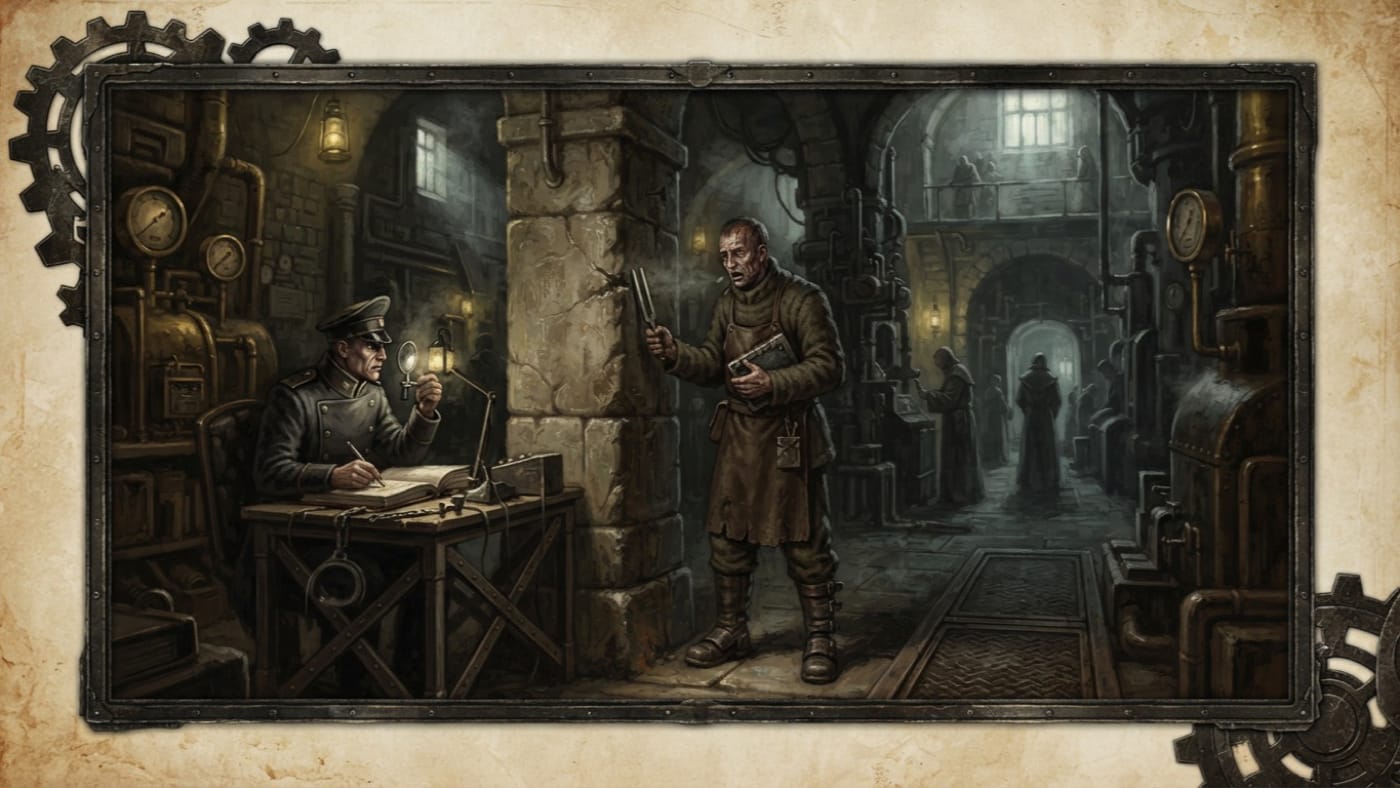
The Singer is issued a pitch-fork tuning rod along with the throat-mask, the bell-hour token and the hymn slate. The rod is calibrated to Bureau Standard C. The sources supplied to this office say nothing of its making, its metal, its dimensions or the hand that calibrates it, and I add nothing. The Singer strikes it against stone three times. It is always three. The stone is chosen for its resonant properties, which means a penitence hall is built in part as an instrument, and each session the Singer's first task is to find out whether the instrument is still in tune.
The Writ's annex gives the order: fork against stone, listening interval, chalk mark, witness note. The Singer strikes, listens, marks, and has the result witnessed. This sets the room's acoustic baseline, the way one particular hall answers a known sound on one particular morning. A hall in good repair sounds clean. A cracked hall does not, because cracks in stone change everything. Every Brand-Singer will tell you so, and every prefect will forget it. A damaged chamber produces harmonics that the Singer must compensate for before the Opening Hymn. Certain of them, the intervals the Bureau classifies as "invitations," must be suppressed entirely.
The damp corner is marked. The loose bracket is either tightened or declared spiritually irrelevant. The crack is logged before the auditor hears it, as the corridor maxim has it, because a logged crack is the room's fault and an unlogged one is the Singer's.
Tidy-minded readers will confuse the three taps with the Closing Tone. They are separate parts of the rite. The taps open it: a fork struck against stone, governed by the Standard. The Closing Tone ends it: three descending notes in the throat and fourteen heartbeats of silence, governed by Standing Order 22-S. Neither document says whether the shared number three means anything. The Church is fond of threes, and fondness proves nothing.
#On the Licensed Throat
Once the room has been tested, the Standard tests the singer.
Writ 14-C mandates an annual throat inspection and a quarterly renewal of the vocal licence, held at Matins on the first day of each quarter. The examination is intimate in the way only government can manage. The examiner inspects the cords by mirror and lamp, measures the scar ridges and times the breath. Then the singer is ordered to hold pitch against Bureau Standard C while an assistant reads aloud false accusations, family names, offers of sugar, insults to the singer's school and fragments of forbidden melody. The singer holds and the examiner listens. Drift is marked.
Tears are permitted if pitch holds. Coughing requires explanation.
I have read the procedure with the professional calm of a man whose own throat is not under seal. It is a model of its form. Every distraction the rite might produce is rehearsed in a cold room by a clerk with a list, and the singer's only defence is the Standard. That is a pitch set flat by a committee that could not have sung it, and the singer must hold it exactly while a stranger reads out a mother's name.
The Writ's grounds for suspension include cord scarring, bell-sickness and "pitch pulled by sobbing." Scarring is universal after enough years of metal-smoke and lye, and veterans develop the scar-voice, which carries well through damaged acoustics. The Bureau of Medicine files bell-sickness as occupational resonance exposure. No document supplied to me says what scarring, fatigue or bell-sickness does to a singer's hold on Standard C, and none states how much drift the examiner will forgive. No tolerance is published. There is a mark on a slate and an examiner's judgement, and in the Church a judgement without a published tolerance is the most durable kind.
#On Drift and the Record
Three things in the Brand-Singer's work are routinely confused, and the confusion has filled more than one audit.
The pitch reference is the note the singer must hold. Cadence decides when things happen. Rising patterns mark the identity clauses, falling patterns mark the enumeration of sins, and a held tone marks the sentence. Each pattern tells the Brand-Smith when the iron descends and when it withdraws. Interval is the distance from one note to the next, and the Bureau's interest in intervals is chiefly in forbidding some of them. The Standard governs only the first of the three. The Approved Hymn Protocols, Revision 14 of A.S. 199, govern the second and police the third. A singer can be flawless on Standard C and still miss every cue.
After the rite, the Singer reports pitch anomalies, cadence deviations and unapproved harmonics. That report is set beside the Brand-Smith's alignment log and the scribe's inscription record before any of it travels downstream to the Bureau of Records. A pitch break where the scribe records a clean application triggers an audit, and so does a clean tone where the Brand-Smith reports misalignment. The Standard is the fixed term in this arithmetic. Everyone else's testimony is measured against it, and it is measured against nothing.
When a room answers, the Standard explains nothing. The Singers call this echo weather, Doctrine calls it residual liturgical resonance, and Orison calls it acoustic reflection. The baseline records that the room departed from it and does not record why. Anyone who claims the flatness invites the answer, or wards it off, is claiming more than any file in my possession supports.
One last distinction, for the clerk who files by consonant. Bureau Standard C and Bureau Standard 7-C share a letter and, on the evidence, nothing else. Standard 7-C appears in Purity's hesitation reporting, in the written format for ritual queries and in gestural review, and no common text for it has been proved. Standard C is a pitch. No source consulted for this survey connects the two. A singer reported under 7-C for hesitating has a separate problem.
#On Present Application
As compiled in A.S. 201 / 1911 CE, Bureau Standard C remains in use for the two purposes surveyed. It calibrates the Brand-Singer's tuning fork before the three taps against stone, and it holds the examined throat to account under Writ 14-C. It operates inside the licensed profession commanded by the Bureau of Purity's Directorate of Acoustic Enforcement. The flatness account remains Orison's. Neither of these facts establishes who keeps the Standard, who may revise it or who first issued it, and this survey does not pretend otherwise.
The first issue is unrecorded and the committee unnamed. The half-tone stands.
Civilian choirs are advised that their pitch has not been condemned. Competent authority has merely found it to be slightly above itself.