#On the Origin and Purpose of the Brand-Singer
"Pain opens. Hymn orders. Truth seals." — Cantor's Primer, Bureau of Purity, Third Revision
The Brand-Singer exists because screaming is imprecise.
Early in the Bureau's history — in the years following the Concordat, when the apparatus of sanctified punishment was still being assembled from the wreckage of ad hoc justice — the men who held the irons discovered a practical truth that no catechism had prepared them for: a body under the brand thrashes. The thrashing ruins the inscription. Ruined inscription means the confession is illegible, which means the confession is invalid, which means the procedure must be repeated, and the Bureau of Records — which is downstream of everything, which waits with quill poised for a legible input — will file a complaint.
The solution was sound. Choirs were introduced into the rite between A.S. 94 and A.S. 104 — first informally, as field expedients borrowed from the Bureau of Orison and Song's trenchline psalmists, later formalised under the Bureau of Purity's own licensing regime. The theory was elegant, as Bureau theories tend to be when the alternative is chaos: a sustained hymn regulates the condemned's breathing, stabilises the body's involuntary convulsions, masks the acoustic signature of uncontrolled pain (which draws attention both human and otherwise), and provides a standardised cadence against which the Brand-Smith can time his strokes. Each segment of the confession maps to a note pattern. Each scar corresponds to a syllable. The body becomes a ledger, and the Brand-Singer is the metronome that ensures the entries are legible.
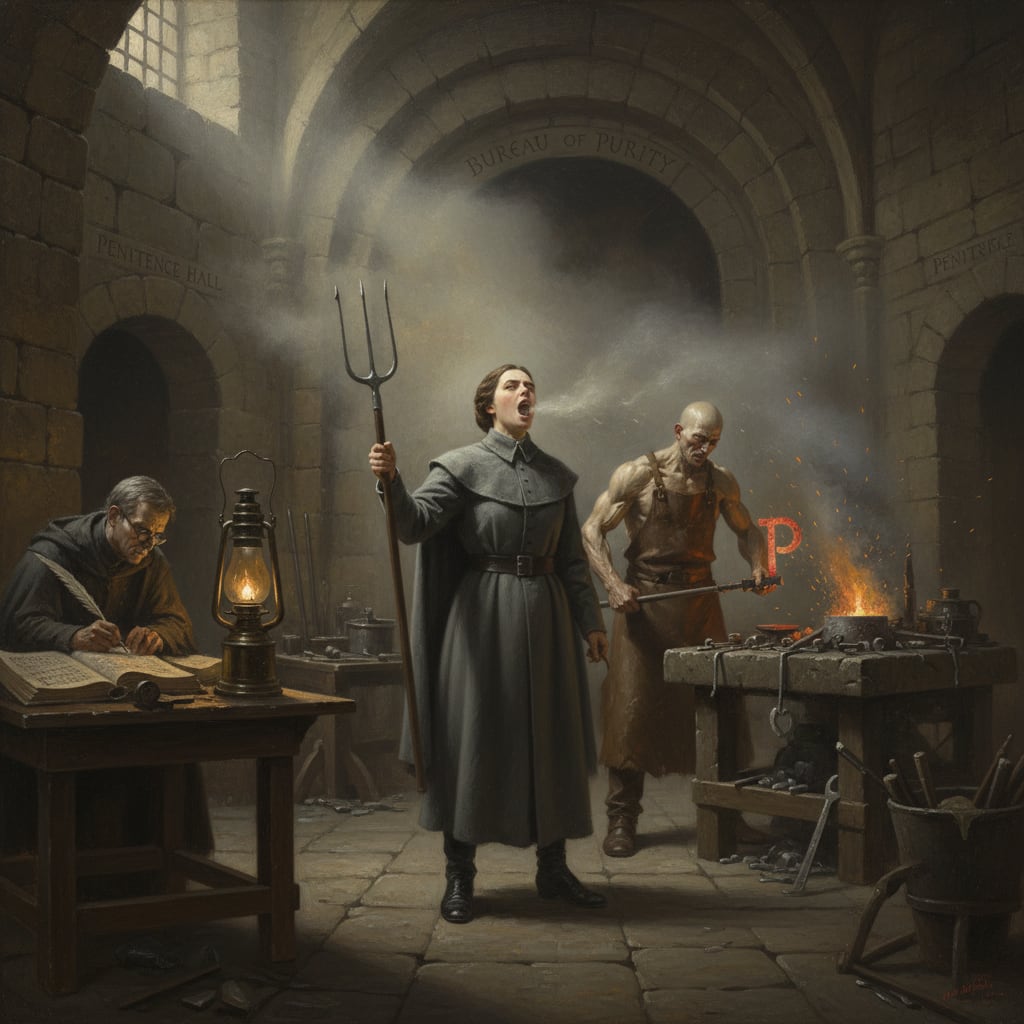
The Lictors supply the irons. The Brand-Smith applies the geometry. The scribe records the outcome. The Brand-Singer holds the pitch that keeps the entire apparatus from degenerating into mere butchery.
#On the Mechanics of the Rite
"A clean note wards a dirty mouth." — Saint Orla of the Steady Note
The rite proceeds in six stages, and the Brand-Singer governs five of them.
First, the room is tuned. The Singer strikes a pitch-fork against stone — three taps, always three, the stone chosen for its resonant properties, the fork calibrated to Bureau Standard C (which is, I am assured by the Bureau of Orison and Song, a half-tone flatter than what civilian choirs consider standard, because the Bureau's standard was set by a committee that included no musicians, and the error has since been classified as "doctrinally correct"). The tuning establishes the room's acoustic baseline. Cracks in stone change everything. A penitence hall in good repair sounds clean. A damaged hall produces harmonics the Singer must compensate for, and certain harmonics — the diminished fifth, the augmented fourth, the intervals the Bureau classifies as "invitations" — must be suppressed before the rite begins.
Second, the Opening Hymn. This is the breath-stabilisation phase. The condemned is brought in — chained, stripped to the waist if forearm work is required, stripped entirely if the inscription covers chest and back — and the Singer begins a drone: low, steady, sustained, the kind of sound that enters the body through the ribcage and persuades the lungs to follow. The condemned's breathing slows. The body's panic subsides from frantic to manageable. Veterans of the profession call this "setting the bellows," and the metaphor is precise: the condemned becomes an instrument, and the Singer is tuning it.
Third, the stage cues. Each confession segment maps to a note pattern — rising cadence for identity clauses, falling cadence for the enumeration of sins, sustained tone for the sentencing formula. The Brand-Smith listens for these cues with the attentiveness of a partner in a rite that both participants would rather not be performing. When the Singer's pitch rises to the approved interval, the iron descends. When the Singer holds steady, the iron is withdrawn, and the scribe records the diameter of the resulting inscription.
Fourth, the synchronised application. This is where artistry — and I use the word with full awareness that the Bureau of Purity would prefer I said "technical compliance" — separates the competent from the gifted. A skilled Brand-Singer can hold three simultaneous rites in adjacent chambers, moving between doorways, adjusting cadence for each condemned, cueing different Brand-Smiths with fractional pitch shifts that an untrained ear would miss entirely. Master Cantor Vell, whose tenure at the Strasbourg penitence halls between A.S. 130 and A.S. 147 remains the profession's benchmark, is said to have managed seven simultaneous rites without a single misaligned inscription. The Lictors called him "the tuning fork of the Creator." The Brand-Smiths called him something considerably less theological.
Fifth, the Closing Tone. A descending phrase, always the same, codified under Standing Order 22-S: three notes falling by intervals of a third, followed by a silence of precisely fourteen heartbeats. The silence is the seal. It prevents what the Bureau terms "echo lies" — residual vibrations in the room that might imprint false information on still-raw flesh. Whether this is physics, theology, or institutional superstition, the Bureau declines to specify. The distinction, it insists, is immaterial.
Sixth, the documentation. The Singer files a report: pitch anomalies, cadence deviations, any moment where the room's acoustics produced an unapproved harmonic. These reports are cross-referenced with the Brand-Smith's alignment logs and the scribe's inscription records. A discrepancy — a pitch break where the scribe records a clean application, a clean tone where the Brand-Smith reports misalignment — triggers an audit. Audits are thorough. Audits are dreaded. A Singer who falsifies a pitch-anomaly report faces the same penitence halls in which they once held the cadence, and the irony is classified as "instructive."
#On the Schools of Singing and Their War
"Off-tempo is invitation." — Bureau of Purity Instructional Broadsheet, A.S. 147
The profession is divided, as all professions under the Synod eventually divide, along a fault line that the participants believe to be theological and the Bureau believes to be administrative.
The Mercy Tone school advocates slow, steady hymns — sustained drones and long intervals designed to preserve the condemned's breathing, reduce thrashing, and extend life. Their argument is doctrinal: a living condemned can confess more fully; a dead one is an unfinished sentence in the Ledger, and the Ledger does not tolerate incompletion. Mercy Tone Singers are favoured by the Bureau of Records, which prefers clean inscriptions, and by the Bureau of Mercy, which prefers living patients — or at least patients who die of causes that can be filed under a medical classification rather than "procedural excess."
The Judgment Tone school favours sharp cadences, staccato rhythms, intervals designed to accelerate confession. Their argument is also doctrinal: mercy extended to the guilty is mercy stolen from the innocent; a swift rite frees resources for the next condemned; and the Creator's patience, while infinite in theological terms, is finite in administrative ones. Judgment Tone Singers are favoured by tribunal prefects running quota, by Brand-Smiths who prefer efficiency over artistry, and by the Bureau of Purity itself — whose institutional preference for speed is one of the few things about which the Bureau is entirely honest.
The Silentists are the third faction, the smallest, the most distrusted. They argue that any singing risks drawing demonic attention — that the acoustic envelope of a rite, however carefully tuned, creates an aperture through which hostile entities can feed. They advocate minimal tone: a metronome tick, a whispered cadence, the bare minimum required by protocol. The Bureau of Purity tolerates them because they produce the fewest anomaly reports. The Bureau of Orison and Song despises them because they are, in the Bureau's characterisation, "musicians who have abandoned music, which is to say they have abandoned the one thing that made them useful."
The war between these schools has produced no casualties that appear in any official record, though three Singers reassigned to trenchline discipline wards at Bastion-Shipka in A.S. 184 were classified as "voluntary transfers," and the two who survived declined to specify which school they had offended.
#On the Hazards of the Work
"Keep the bell in your ribs." — Iron Choir Brand-Singer field slogan
The Brand-Singer's body is the instrument, and instruments wear.
Cord scarring is universal. Ten years of sustained professional singing in rooms thick with metal-smoke, lye vapour, and the particular humid heat of bodies under duress ruins the vocal cords with a thoroughness that no amount of salt-ash gargling can reverse. Veteran Singers develop a characteristic rasp — the "scar-voice" — that paradoxically makes them more effective, as the rough timbre carries better through damaged acoustics. A Singer whose voice remains smooth after five years is either gifted, cheating, or singing softer than protocol permits.
Bell-sickness is the profession's signature affliction. Singers begin to hear cadences in everything — footsteps, rainfall, the creak of doors, the breathing of sleeping companions. They count in bell-time. They flinch at harmony. The Bureau of Medicine classifies bell-sickness as "occupational resonance exposure, Category Two" and prescribes silence weeks — enforced periods of total vocal rest, during which the Singer is forbidden to speak, hum, or whistle. Whether silence weeks cure bell-sickness or merely suppress it is a question the Bureau of Medicine has been studying for forty years without conclusion, which suggests the answer is one the Bureau prefers not to file.
And then there is the hazard that the Bureau does not discuss in its instructional broadsheets, the one that appears only in classified anomaly reports filed under triple seal: the room that sings back.
A Brand-Singer enters a penitence hall. She establishes the room tone. She begins the Opening Hymn. And the hymn returns — half a beat late, harmonised by a voice that belongs to no one in the chamber. The Bureau of Doctrine classifies this as "residual liturgical resonance." The Bureau of Orison and Song classifies it as "acoustic reflection, architecturally induced." The Brand-Singers themselves have a different classification, spoken only among themselves, in corridors where no auditor walks: "echo weather."
Standing Order ████████ (A.S. ████): "In the event of unsolicited acoustic response during a sanctioned rite, the Brand-Singer shall ████████████████ immediately cease ████████████████ the cadence and ████████████████ evacuate ████████████████ the chamber. Under no circumstances shall the Singer ████████████████ attempt to harmonise with ████████████████ the response. Those who have ████████████████ harmonised ████████████████ are no longer ████████████████ classified as ████████████████ personnel."
#On the Condemned Who Sing
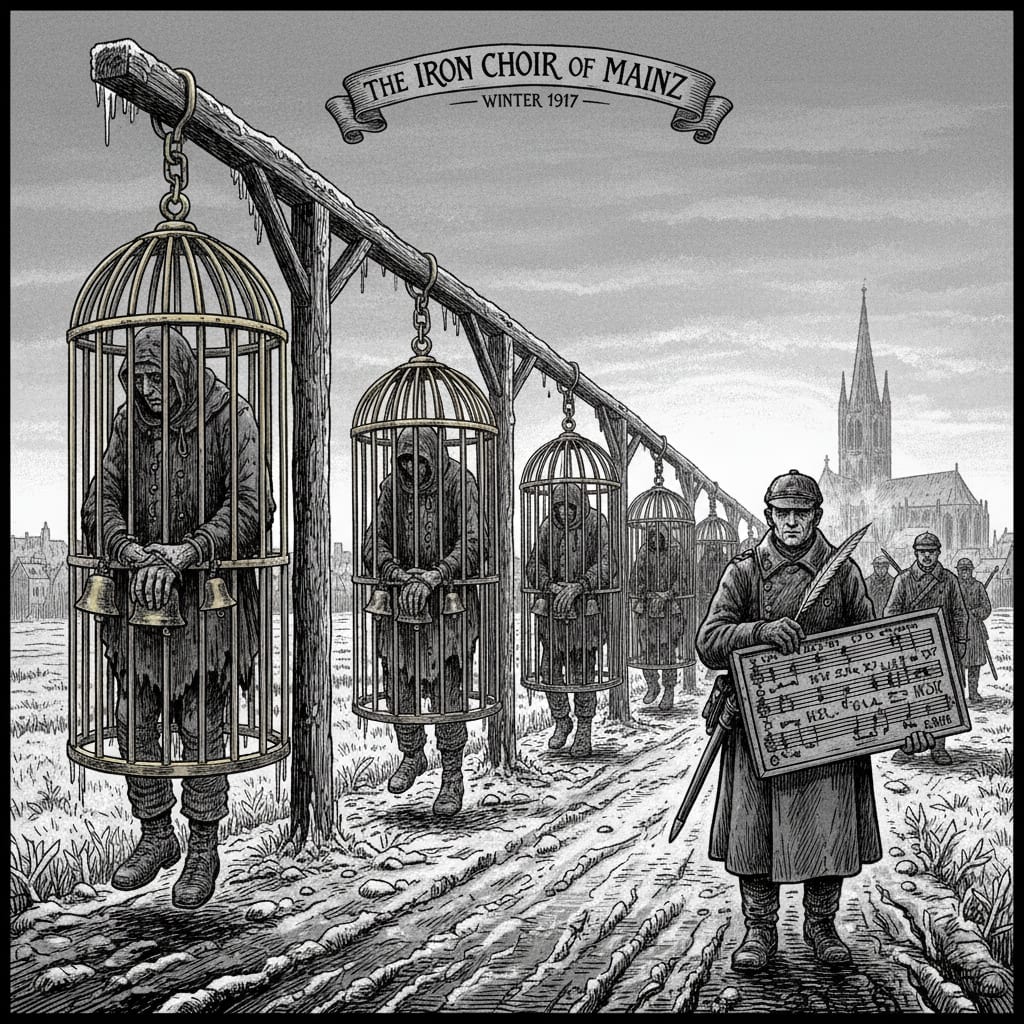
The Iron Choir of Mainz — those rusted cages lining the road from Mainz to Strasbourg, into which the branded condemned are hung for public display — is the Brand-Singer's gallery. Every body in the Choir is the product of their work: the inscriptions legible because the cadence held, the confession sealed because the silence fell at the proper moment, the condemned alive (at the time of hanging) because the Singer's breath sustained them through the rite.
The condemned in the Choir sing hymns of contrition from matins to compline. This is mandatory. Those who refuse are denied rations. Those whose tongues have been "edited" by the Lictors are given small brass bells tied to the wrist with cord, and the bells ring when the condemned man breathes. The Bureau calls this "involuntary hymn."
Brand-Singers maintain the Iron Choir's acoustic schedule. They walk the road. They listen to the cages. They tune the condemned as one tunes an instrument — adjusting hymn assignments based on vocal degradation, replacing the dead with the newly branded, ensuring that the Choir's sound remains within the Bureau's approved parameters. A Choir that falls silent is an embarrassment. A Choir that produces unapproved harmonics is a catastrophe. One Iron Choir installation — the location, date, and details of which have been thoroughly redacted from every archive I have access to — was decommissioned after branded prisoners in the cages achieved a resonance frequency that collapsed the structural supports of the adjacent nave. The Bureau of Records classified the event as "an act of architectural piety." The survivors were rebranded.