

#On the Origin of the Craft
"A man's flesh lies; a triangle does not."
The Bureau of Heraldry claims the Geometry Brand-Smith as its own, which is accurate in the way that a landlord claims the rain: the water fell before the lease was written. Branding predates the Bureau by decades. The Inquisition seared its marks into the condemned long before any standardising hand intervened — pyre-crosses on foreheads, the charred stump of a tongue declared sufficient testimony. What the Inquisition lacked was precision. A pyre-cross applied by a Lictor in Toulouse differed from one applied by a Lictor in Cologne. The condemned carried their guilt, certainly, but guilt that varied from district to district in width, depth, and legibility is guilt that invites disputation, and disputation, as any clerk knows, is the heretic's native climate.
The founding charter — if "charter" is the correct term for a document that the Bureau of Records files under "Operational Clarification, Heraldic (Supplementary)" rather than dignifying with a seal number — was issued in A.S. 104, during the Catechism Third Revision that standardised confession rubrics, ration categories, and the permissible angles of the Triune Knot. The Brand-Smith Corps emerged from the same legislative impulse that produced the Codex Doubt Auditors and the Doctrine Street-Vicars: the Synod's growing conviction that inconsistency at the lowest levels of enforcement would, left unchecked, metastasise into schism at the highest.
The practical catalyst was fraud. During the Great Retreat — when the bastions were raw earthworks and the population of Europe was a stampede moving west — identity was a fiction maintained by whatever paper a refugee could produce, forge, or steal. Ration stamps changed hands in markets. Travel papers were copied by the hundred. Guild charters were fabricated from memory by men who had never held a chisel. The Latchford Permit-Yards processed sixty thousand bodies per convoy season and could verify perhaps a third. Paper, the Synod discovered, is loyal only to whoever holds the pen.
Flesh is more reliable.
#On the Substance of the Work
The Brand-Smith's function is classification made permanent. Where the Confessor-Booth Clerk writes sins on paper and the Erasure Notary deletes names from ledgers, the Brand-Smith inscribes proof onto the body itself, so that the proof walks with its bearer through every gate, past every checkpoint, into every ration queue, and — should the bearer be fortunate enough to die with bones intact — into the ossuaries where the classification endures on calcified tissue until the Creator's own archivists choose to reclassify it. Whether they do is a matter the Bureau of Doctrine has declined to address.
The geometry is exact. A single equilateral triangle, seared into the left cheek: heresy of the first category, doctrinal deviation, reclaimable. The penitent may walk abroad. The penitent will be watched. A double triangle, inverted, on the right forearm: heresy of the second category, active propagation, reclaimable with difficulty and at cost. The bearer is barred from market-work, from pilgrimage routes, from any district where the bell schedule exceeds seven peals. A triple triangle — the Bureau's own Triune Knot, inverted and broken — across the forehead: heresy of the third category, irredeemable, marked for the scaffold or the Paper Mines of Ulm.
But heresy classification is the oldest application. The system has spread. Levy-age sons receive the conscription tri-mark on the wrist — ink that does not wash clean for nine days, branded into permanence at the muster shed if the boy is taken. Orphans processed through Orphanage Registrars carry a ward-triangle on the inner forearm, classifying them as "property of the Bureau of Mercy until reclassification or death." Pardoned criminals bear a halved triangle — the geometry of conditional forgiveness, which is to say the geometry of a leash measured in angles. Oaths of guild membership are sealed with a tri-mark on the palm, so that the hand that works is the hand that testifies.
The tools are standardised. Every licensed Brand-Smith carries a serialised triangle brand — three sizes, calibrated to tolerances that would satisfy the Bureau of Engineering, though the Engineers have never been invited to verify and would prefer not to be. A measuring frame ensures the angles. A swatch plate displays the approved proportions. Witness seals authenticate the event. Record plates log the mark's location, class, and serial number. Cleansing kits — vinegar, salve, and a prayer card specifying the appropriate invocation during cauterisation — complete the issued set. The prayer card is not optional. The Bureau of Rites insists that the invocation transforms the act from mutilation into sacrament, and the Bureau of Heraldry has filed no objection, because the alternative is admitting that its most effective instrument is, technically, assault.
#On the Controversies
The Paper Plague (Unregistered) of A.S. 112 — in which forged transit passes caused a breach at the western perimeter of Bastion-Przemyśl, allowing two hundred refugees with falsified identities to enter a garrison district containing a forward ammunition depot — accelerated the Brand-Smith's jurisdiction beyond heresy classification into general identity authentication. The breach cost the garrison eighty-seven dead and three days of lockdown. The Bureau of War blamed Records. Records blamed Settlement. Settlement blamed the refugees, who were by that point dead, imprisoned, or successfully vanished into the Warrens. The Bureau of Heraldry blamed paper.
The solution was the Compulsory Marking Decree of A.S. 113: every individual passing through a forward-zone checkpoint would carry, in addition to transit documents, a tri-mark corresponding to their identity class — civilian, military, clerical, ward, penitent, pilgrim, or condemned. The decree tripled the Brand-Smith Corps overnight. Angle-Runners (Unregistered) were recruited from the orphanage rolls. Frame-Hands (Unregistered) were trained in three-week courses that the Bureau of Doctrine later described as "adequate to the task, which is not a compliment."
Earlier editions of this official documentation attributed the Compulsory Marking Decree to the Bureau of Purity, citing its enforcement apparatus as the originating authority.
The Bureau of Heraldry has corrected this attribution. The decree was heraldic in origin, inquisitorial in enforcement, and bureaucratic in application. The Bureau of Purity provided the tongs. The Bureau of Heraldry provided the geometry. The distinction matters to the Bureaus involved and to no one else.
The Angle Riots followed. In A.S. 119, during a Purity sweep through the southern districts of Bastion-Irongate, a team of hastily trained Brand-Smiths applied incorrect tri-marks to an entire quarter — 1,400 civilians branded with second-category heresy marks when the majority held clean confession records. The error was geometric: a miscalibrated iron produced inverted doubles instead of identity singles. By the time the error was discovered, three hundred of the mis-marked had been detained by the Lictors, forty-seven had been transferred to the Paper Mines, and eleven had been executed under Standing Order 22-D, which treats the mark as self-executing evidence.
The correction required a new sub-profession — the Re-inspection Brand-Smith — tasked with verifying existing marks against ledger records and, where necessary, performing surgical rebranding. The procedure involves overlaying a corrective triangle onto the erroneous mark, which must be done with sufficient precision that the corrected geometry reads as an amendment rather than a second offence. The margin of error is two degrees of arc. The psychological cost to the subject is not measured, because the Bureau does not measure what it does not wish to quantify.
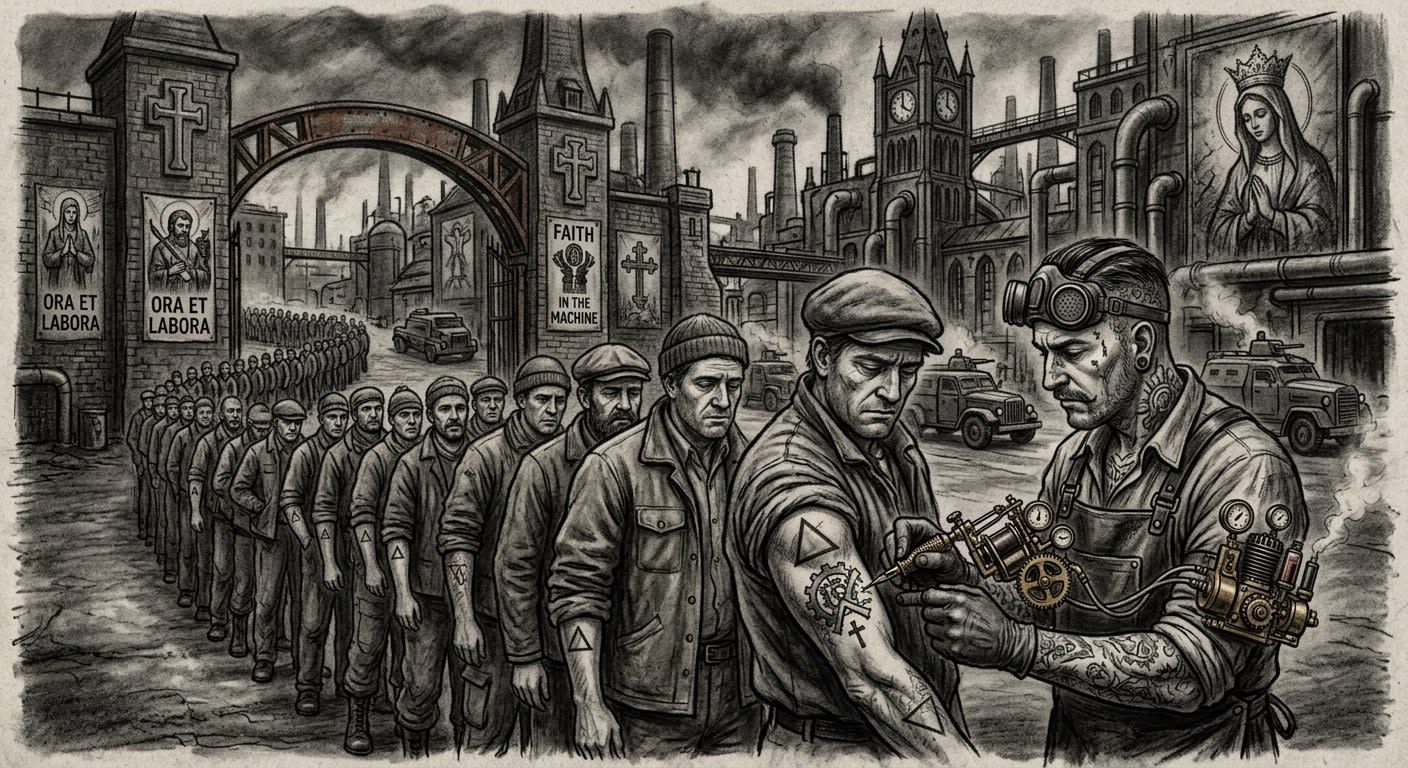
The black market in branding is the system's shadow. Where the licensed Brand-Smith operates in brand chapels under witness seal, the Shadow Angle crews work in back-alleys and cellar rooms, offering services the Bureau cannot officially provide: identity upgrades for deserters, downgraded marks for the condemned seeking to pass as penitent, false guild tri-marks for workers crossing zone boundaries without sponsorship, and — most dangerously — unbrandings, the surgical removal of existing marks through acid, knife-work, or the application of a counter-brand that scrambles the geometry into illegibility. Unbranding is punishable by immurement. The Bureau of Heraldry classifies it as "heresy against proof itself," which is, one must concede, a charge with a certain theological elegance.
#On the Demon-Taint Question
The question the Brand-Smiths dread — the question muttered in trench-muster sheds and orphanage intake rooms and the corridors of brand chapels after the last client has been filed — is the question of marks that move.
The phenomenon is documented. A tri-mark, properly applied, properly witnessed, properly recorded, begins to shift. The angles drift. A line that was true at noon is crooked by dusk. A single triangle acquires a phantom fourth point. The geometry, which was the Brand-Smith's guarantee of permanence, betrays itself. Bureau of Purity classification: "Demonic Interference with Heraldic Instruments, Category Two." Bureau of Heraldry classification: "Geometric Instability, Under Investigation." The two classifications have coexisted since A.S. 147 without reconciliation.
The protocol is quarantine. A Brand-Smith who observes geometric drift in a recent mark must seal the client in a holding cell, notify the Bureau of Purity, and file a Form 14-G (Anomalous Geometry, Flesh-Based). The Form requires the Brand-Smith to specify whether the drift is "angular," "linear," "rotational," or "unclassifiable." Most Brand-Smiths, confronted with a triangle that appears to be crawling across a screaming client's cheek, select "unclassifiable" and leave the room.
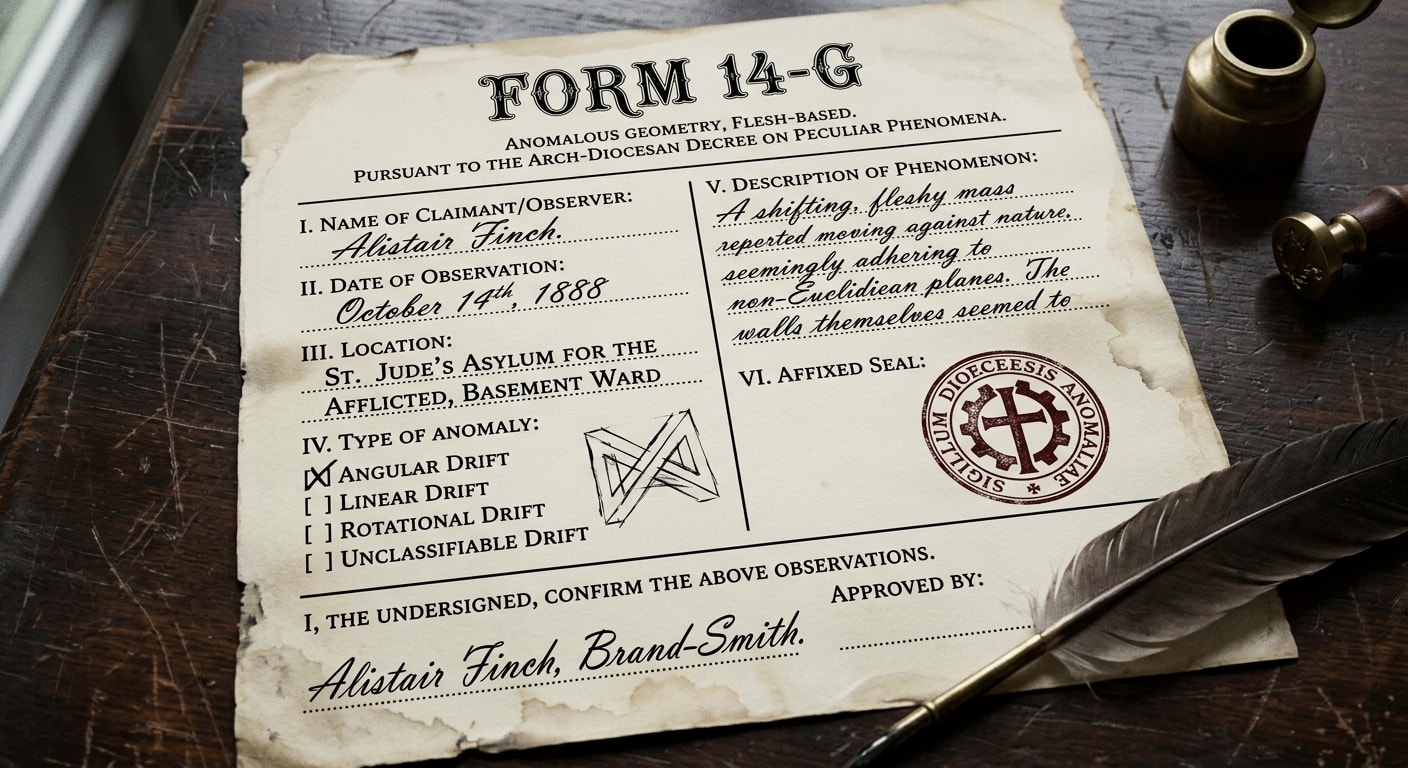
The Brand-Smiths' superstition — and it is superstition, the Bureau insists, which does not explain why the Bureau has never issued a formal denial — is that the brand does not mark the flesh. The brand marks something beneath the flesh. When the geometry drifts, it is because that something is answering. What it answers with is a shape the Bureau has not yet catalogued.
The Brand-Smiths have a saying for it. They say it quietly, after shift, over whatever drink the Tavern Runner has managed to pour before the Ninth: "Crooked angles call crooked friends."
They do not say what happens when the friends arrive. That is not their jurisdiction.
#On the Present Condition
In A.S. 201, the Bureau of Heraldry lists approximately 6,400 licensed Geometry Brand-Smiths operating across Zones 1 through 5, with an estimated 800 unlicensed practitioners operating in the Warrens of Constantinople, the trench-works of Bastion-Shipka, and the back-alleys of every city that possesses both a gate and a reason to circumvent it. The Licensed Chapel (Unregistered) faction — Brand-Smiths who operate exclusively within sanctioned premises under full witness protocol — maintains a formal rivalry with the Quick Burners who staff the trench muster-sheds and levy carts, where throughput matters more than the theological niceties of angle measurement. The Mercy Branders, who quietly downgrade marks for clients they judge over-sentenced, operate between the two and are despised by both.
Tool custody remains the sharpest discipline. A serialised brand-iron lost or stolen triggers an immediate audit chain reaching from the Brand-Smith's immediate superior to the Bureau's Seventh Directorate (Unregistered) in Strasbourg. Three irons were reported missing in A.S. 200. Two were recovered — one in a pawnbroker's cellar in Rheinscarp, one in the kit of a dead deserter outside Bastion-Sibiu. The third has not been found. The Bureau of Heraldry has classified its absence as "an ongoing irregularity." The Bureau of Shadows has classified its absence differently, under a seal the Bureau of Heraldry is not permitted to read.