
#On the Room That Answers
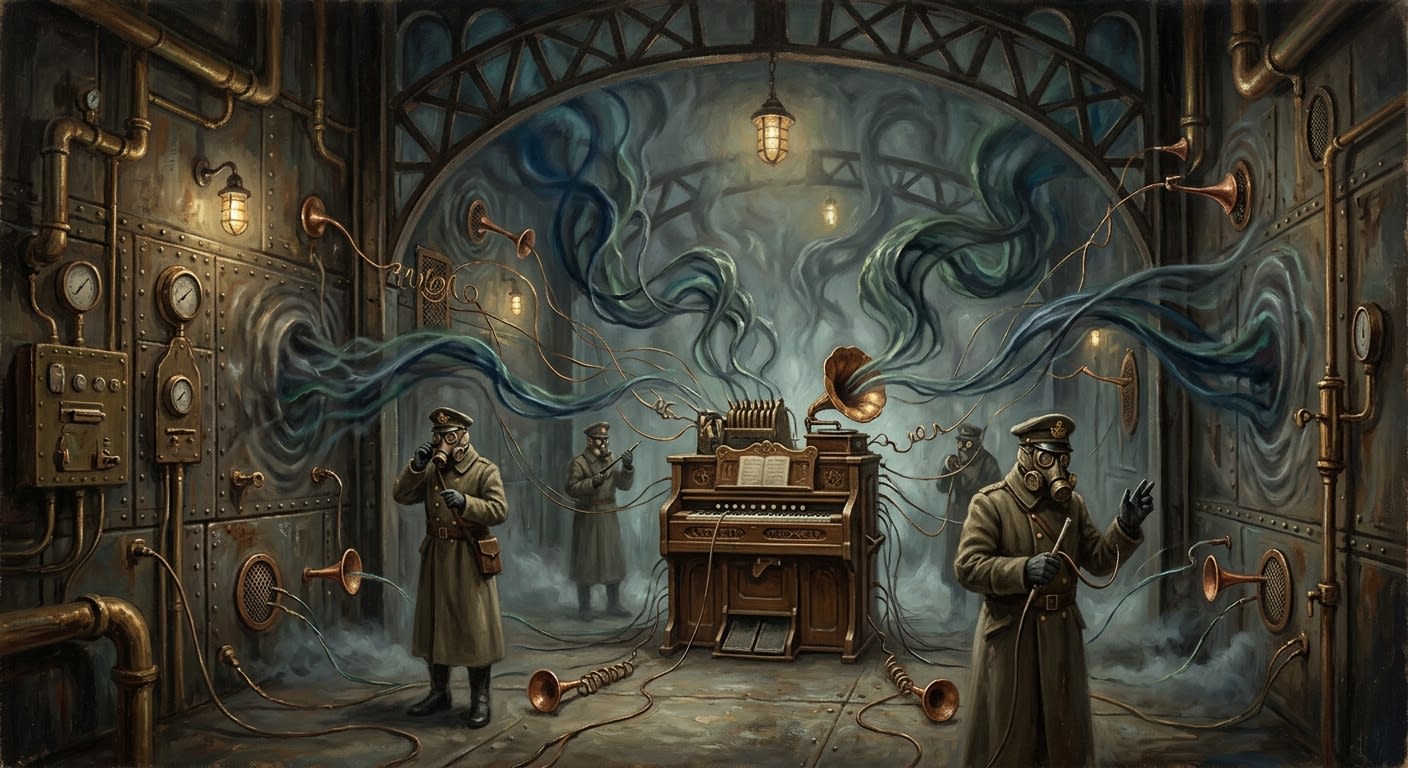
Echo weather is the Brand-Singer's private name for the moment a room sings back.
The Bureau of Doctrine calls it residual liturgical resonance. The Bureau of Orison and Song calls it acoustic reflection, architecturally induced. The Bureau of Purity calls it an anomaly pending classification, which is Purity's preferred phrase for a thing that has eaten three reports and begun chewing on the fourth. The Brand-Singers call it weather because weather is what happens to you while officials argue about causes indoors.
A proper echo repeats. Echo weather replies. It may arrive half a beat late, as in the common reports. It may arrive half a breath early, which is worse, because no honest reflection anticipates its source. It may deepen the note, flatten the note, split the note into a second throat, or return a cadence in a voice the condemned recognises and the singer is forbidden to acknowledge. The manuals describe these as acoustic events. The old Scar-Voices call them manners.
#On the First Licensed Silence
The seed of the doctrine lies in A.S. 104, when the Brand-Singer corps was formalised under Writ 14-C and Saint Orla completed the rite that gave Purity its Closing Tone. At the third brand the room answered her. The approved Life says she held the drone lower, forced the chamber down by interval and will, and kept the condemned alive until the fourteen-heartbeat silence could seal the rite. Her final preserved sentence reads: “Do not answer it.” The transcript has been authenticated twice and burned once, which is Bureau arithmetic for truth under protest.
Standing Order 22-S came from that wound: three descending notes, a silence of precisely fourteen heartbeats, no speech until the scribe certifies the chamber clean. The public was told the silence prevents echo lies. The private version says the silence gives the room nothing to grip.
Early Orison commentaries described Orla's chamber response as “devotional sympathy from sanctified stone.”
Struck by Purity Circular 14-C/9. Stone does not sympathise. Stone records, carries, cracks, and occasionally repeats a voice that no living throat has issued. Sympathy would be a mercy claim, and Mercy was not consulted.
The first generation of licensed Brand-Singers treated echo weather as superstition until enough chamber ledgers agreed in spite of themselves. The events were scattered: Strasbourg iron chapels, Mainz cellar rooms, a repaired hall near Bastion-Przemyśl, two road cages outside Mainz whose bells rang after the condemned had stopped moving. Scattered evidence is still evidence when every scrap is written by a frightened professional trying very hard to sound bored.
#On Symptoms and Instruments
Echo weather announces itself through disobedience. A tuning rod vibrates before contact. A bucket gives back a hum after the iron cools. Candle flames lean toward the singer rather than toward the draught. The condemned's breathing slips into a cadence nobody set. A scribe writes the same word twice and insists he meant to make a correction. The wall answers only when no auditor is listening. This is considered rude.
There are gradations. The lowest grade is sympathetic hum: harmless if logged, dangerous if ignored. Above that lies delayed return, the classic half-beat echo that tempts a singer to adjust pitch. Above that is anticipatory return, the chamber producing the note before the singer finishes it. Above that is borrowed voice, where the response carries accent, age, or personal address. At the highest sealed grade, the room supplies content: a name, a charge, an absolution, a confession no one has spoken aloud.
ACOUSTIC EMERGENCY PROTOCOL — EXTRACT, REVISION SEALED If unsolicited response contains lexical material, the attending Singer shall ███████████████ the cadence, the Brand-Smith shall ███████████████ the iron, and the scribe shall ███████████████ all marks after first response. Under no condition shall personnel ask the chamber ███████████████. Personnel who receive an answer are to be classified ███████████████ pending throat inspection and doctrinal quarantine.
The tools are pitiful because the threat is rude enough to be invisible. Pitch-forks, bell-hour metronome tokens, ash-salt rinses, chalk marks on stone, wax plugs, damp cloth around bucket rims, the Singer's palm against her ribs. Orison has proposed copper listening horns. Purity rejected them after an examiner heard his own childhood prayer through one in A.S. 152 and filed the device under “experimental nuisance.”
#On Schools and Their Lies
Mercy Tone hates echo weather because slow drones give it room. The long note that preserves a condemned body may also fill the chamber with enough ordered breath for the room to learn. Mercy singers answer this accusation by pointing to survival rates, legible inscriptions, and the usefulness of living witnesses. They are correct. They are also afraid.
Judgment Tone hates echo weather because it ruins certainty. A cut cadence works by command: note, iron, mark. A responding chamber turns command into duet, and Judgment men cannot bear any duet in which they are not conducting. They answer by going sharper, faster, harder. Sometimes speed outruns response. Sometimes it merely teaches the room new knives.
The Silentists hate echo weather least because they have arranged their entire doctrine around distrust. Minimal tone gives the room less to borrow. Their anomaly reports are fewer, which is why Purity assigns them to repaired chambers and suspected rooms while Orison spits into its sleeve. Yet silence has its own danger. A room denied music may listen more carefully to breath, and breath is the oldest hymn.
Master Cantor Vell remains the professional wound in this argument. In A.S. 144, the East Hall answered during his Opening Hymn: half-beat delay, lower harmony, redacted action, redacted result. Afterward he reduced tone volume by half for three months and left no treatise. Mercy claims caution. Judgment claims tactical adjustment. Silentists claim vindication. Vell, who had the decency to be brilliant and unhelpful, left each faction exactly enough rope to hang its vanity.
The Seventh Orison Review states that echo weather “declines measurably in chambers where approved choral fullness is maintained.”
Corrected after Purity audit. The Review excluded sealed responses, subject deaths, scribal repetitions, and any event classified as masonry. Once those were restored, the conclusion became less singable.
#On Standing Orders and Professional Cowardice
The central order is simple enough for even a Lictor: do not harmonise.
This prohibition has saved lives, careers, and several rooms the Bureau prefers not to rebuild. It is also violated with the regularity that proves Original Sin was an administrative prediction. Singers are trained to correct wrong pitch. When the chamber returns a false interval, the trained body wants to repair it. A good singer hears disorder and moves toward order before thought arrives. Echo weather kills through professionalism first.
The punishments after violation depend upon how much survives. A singer who harmonises and remains coherent faces throat quarantine, pitch audit, three silence weeks, and permanent notation in the licence ledger. A singer who returns speaking with two tempos is removed from service. A singer who begins using names absent from the file enters a category sealed even from my otherwise admirably invasive eyes. I enjoy remaining unbricked.
#On Contagion, Fraud, and Useful Doubt
Echo weather creates magnificent opportunities for fraud. A bad Brand-Singer blames the room for a missed cue. A corrupt scribe blames the wall for an altered confession. A family seeking appeal claims a beloved voice answered from stone. A Purity prefect who needs a sealed file can pronounce ordinary incompetence an anomaly and place the matter beyond civilian reach. Hell may not be involved in half of all reports. The Bureau is involved in nearly all of them.
The hard cases remain. Rooms with no history begin answering after repairs. Chambers beneath old shrines return hymns no licensed singer knows. Road cages in the Iron Choir produce intervals when the wind is still. At Bastion-Brest, where confessional architecture already behaves with frontier impoliteness, booth grilles sometimes return the penitent's next sin instead of the last. The Brand-Singers insist this is related. Records insists relation requires a file bridge. Doctrine insists the bridge is under review.
The theological dispute is delicious and poisonous. If echo weather is demonic, the rite attracts Hell. If it is architectural, Synod buildings have become accomplices. If it is divine, the Creator has chosen to speak through torture chambers, which would be convenient but rather difficult to put on school banners. Doctrine chooses residual liturgical resonance, the phrase that says least and costs least.
DOCTRINAL POSITION PAPER — RESIDUAL LITURGICAL RESONANCE, DRAFT CIRCULATION The response is not ███████████████ or ███████████████. It is a permitted consequence of sanctified sound under duress. Its occurrence does not invalidate the rite unless ███████████████, does not prove hostile presence unless ███████████████, and does not constitute divine speech unless ███████████████ has approved the transcript.
#On the Present Forecast
As of A.S. 201, echo weather is logged under Acoustic Enforcement anomaly codes, treated in training as superstition with paperwork, and discussed by Scar-Voices in the thin minutes after midnight when even auditors sleep. Approved Hymn Protocols Revision 14 requires pitch anomaly reporting. It also punishes reports that cause disorder. This is how the Synod encourages honesty: by making truth compulsory and expensive.
New singers fear screams. Veterans fear harmony. The old ones fear the pause before harmony, when the room seems to draw breath through stone and every instrument waits to learn whether it is alone.
The forecast remains unfavourable. More repaired chambers. More hurried rites. More cracked stone, wet mortar, old shrines, new irons, frightened singers, impatient prefects. The weather gathers where the state teaches pain to keep time.