
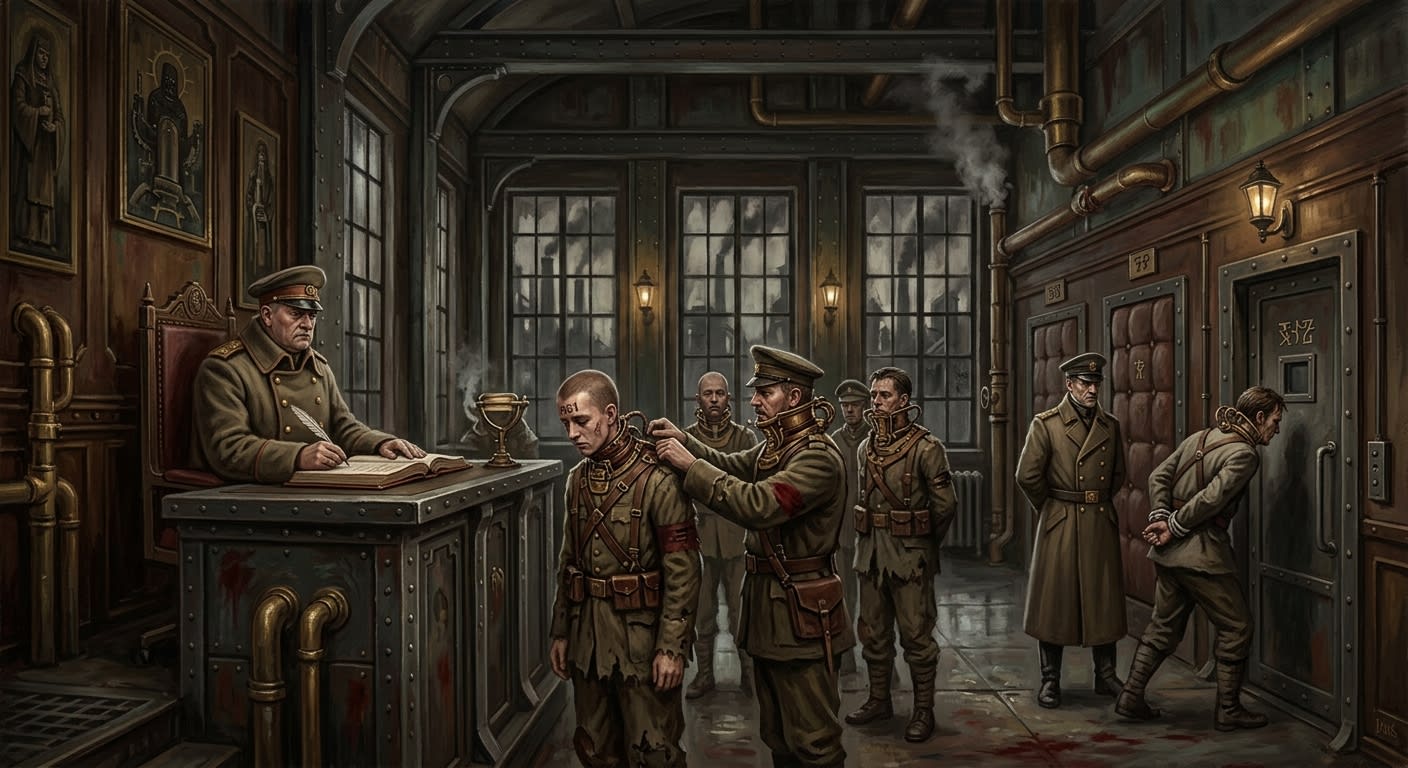
#On the Writ That Licensed the Throat
Writ 14-C is the Bureau of Purity instrument by which a borrowed singer became a licensed tool, a torture chamber became an acoustic workplace, and screaming, that old democratic nuisance, was converted into procedural sound. It was sealed in A.S. 104 after ten years of provisional chant in iron rooms, because the Synod can tolerate improvisation only until improvisation becomes useful enough to tax.
The Writ formally constituted the Iron Choir Brand-Singer corps under Purity's Directorate of Acoustic Enforcement. It mandated annual throat inspection, quarterly vocal licence renewal, rite documentation, chamber baseline testing, approved cue patterns, and the first durable separation of the three schools later called Mercy Tone, Judgment Tone, and the Silentists. It also codified the doctrine that pain, to be valid, must be legible.
Before the Writ, Purity's iron chapels borrowed singers from the Bureau of Orison and Song whenever a branding rite threatened to become untidy. The psalmists were dragged from trenchline hymnals, parish choirs, penitential processions, and in one Strasbourg case a funeral vigil whose mourners had to finish the antiphon without a tenor. They were told to hold a note while the condemned was marked. Some did. Some fainted. Some sang so beautifully that the body thrashed harder, which taught Purity its first valuable musical lesson: beauty is not compliance.
Writ 14-C ended the embarrassment of dependency. Purity stopped asking Orison to lend voices as if sound were a kettle. It claimed the voice, licensed the voice, inspected the voice, punished the voice, and placed the voice where Purity places every useful organ: inside a schedule.
The Writ is short in public copy and obese in annex. Its main clause requires a sanctioned singer for all major penitential branding rites in permanent Purity chambers and forward discipline halls. Its first annex establishes vocal licence. Its second annex defines authorised room tone. Its third annex, much revised and never publicly read without interruption by coughs, concerns unsought response from stone.
That third annex is why the old singers still touch the page before speaking of it.
#On the Years Before the Seal
The borrowed-choir years ran from A.S. 94 to A.S. 104, though the habit began earlier in uglier corners where records arrived after the burns. Purity had discovered that a condemned body under iron resists its own conversion into text. Arms jerk. Backs arch. Breath scatters. A Brand-Smith whose hand follows moving flesh produces crooked geometry, and crooked geometry produces lawyers, whose population the Synod has always tried to restrict through plague, war, and employment.
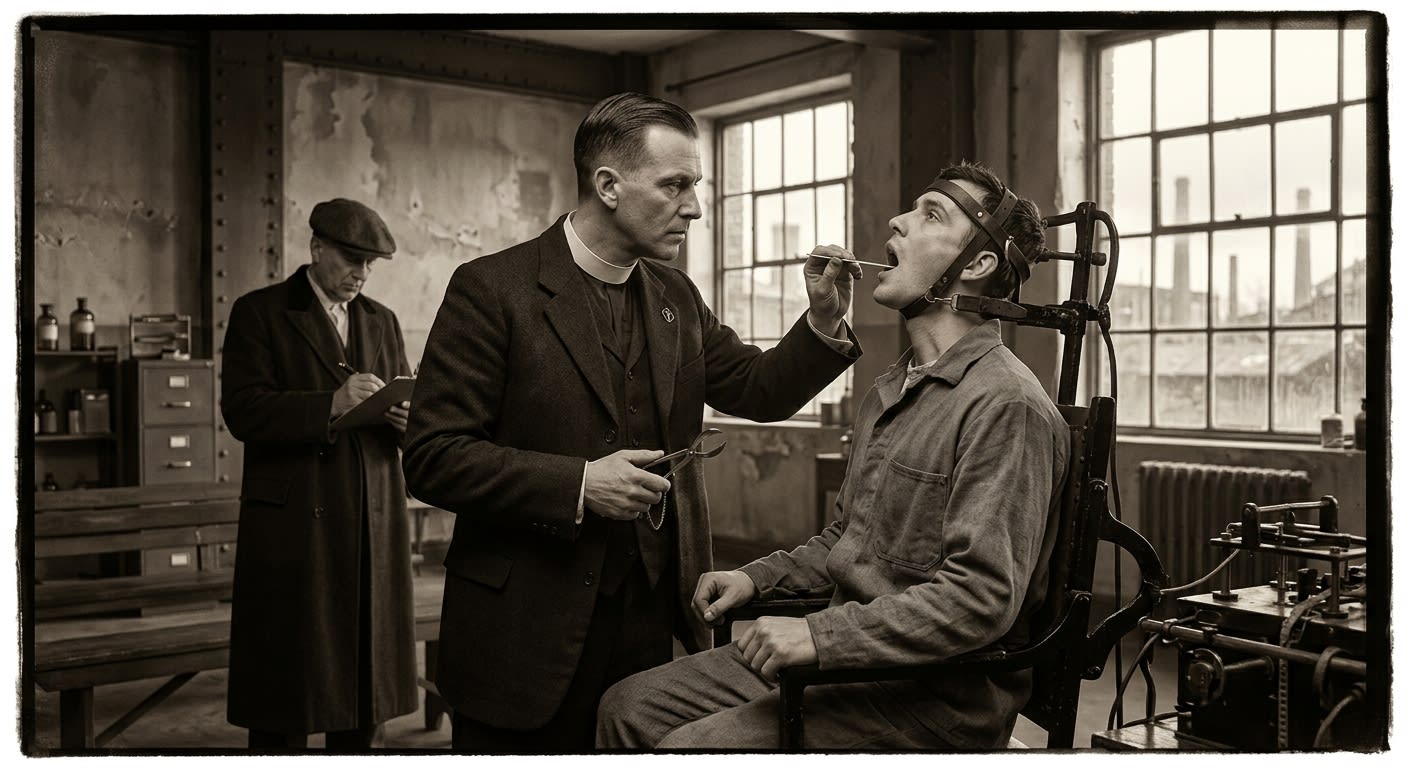
Sound steadied the body. A low drone slowed panic. A cut cadence brought the forearm down at the proper instant. A held note masked the uncontrolled acoustic signature of pain, which mattered more than doctrine admitted. Screams draw crowds, sympathy, demons, novice fainting, Orison complaints, and Records queries about why the inscription diameter does not match the confession slate. A note makes pain behave.
The early psalmists had no uniform method. Orison men sang hymns because hymns were what they possessed. Parish women used cradle intervals. Trench psalmists used marching drones. One Ash Chorister in Mainz reportedly used a cattle-calling pattern from the Moselle circuit and achieved magnificent results until the condemned began lowing during the forfeiture clause. Purity objected less to the sound than to the agricultural implication.
The chief difficulty was ownership. Orison insisted that any sanctioned song remained under its custody. Purity insisted that anything performed beside a hot iron belonged to Purity by proximity and moral smell. Records objected that neither Bureau had supplied clean registers. Doctrine, seeing a jurisdictional quarrel mature into useful doctrine, convened review.
The review did what reviews do: it discovered the answer already being used and charged the world for discovering it.
Writ 14-C declares that a singer assigned to a penitential branding rite becomes an Acoustic Enforcement Person under Purity command for the duration of the rite. The voice remains human in theory, licensed in practice, and expendable by implication. Orison retained ceremonial courtesy: it may certify certain hymn origins, inspect musical notation for heretical interval content, and complain in sealed memoranda no one important reads after the second page.
An early Orison digest described Writ 14-C as “a cooperative loan framework between sister Bureaus.”
Corrected by Purity objection. The Writ is annexation of function under penitential necessity. Orison supplied technique, not sovereignty. The difference is the sort of thing men kill one another over when budgets are warm.
#On the Six-Stage Rite
The Writ's most durable achievement is the six-stage rite protocol (Unregistered). Before A.S. 104, a branding session ended when the iron cooled, the subject collapsed, or the supervising prefect grew bored. After A.S. 104, the rite possessed a spine.
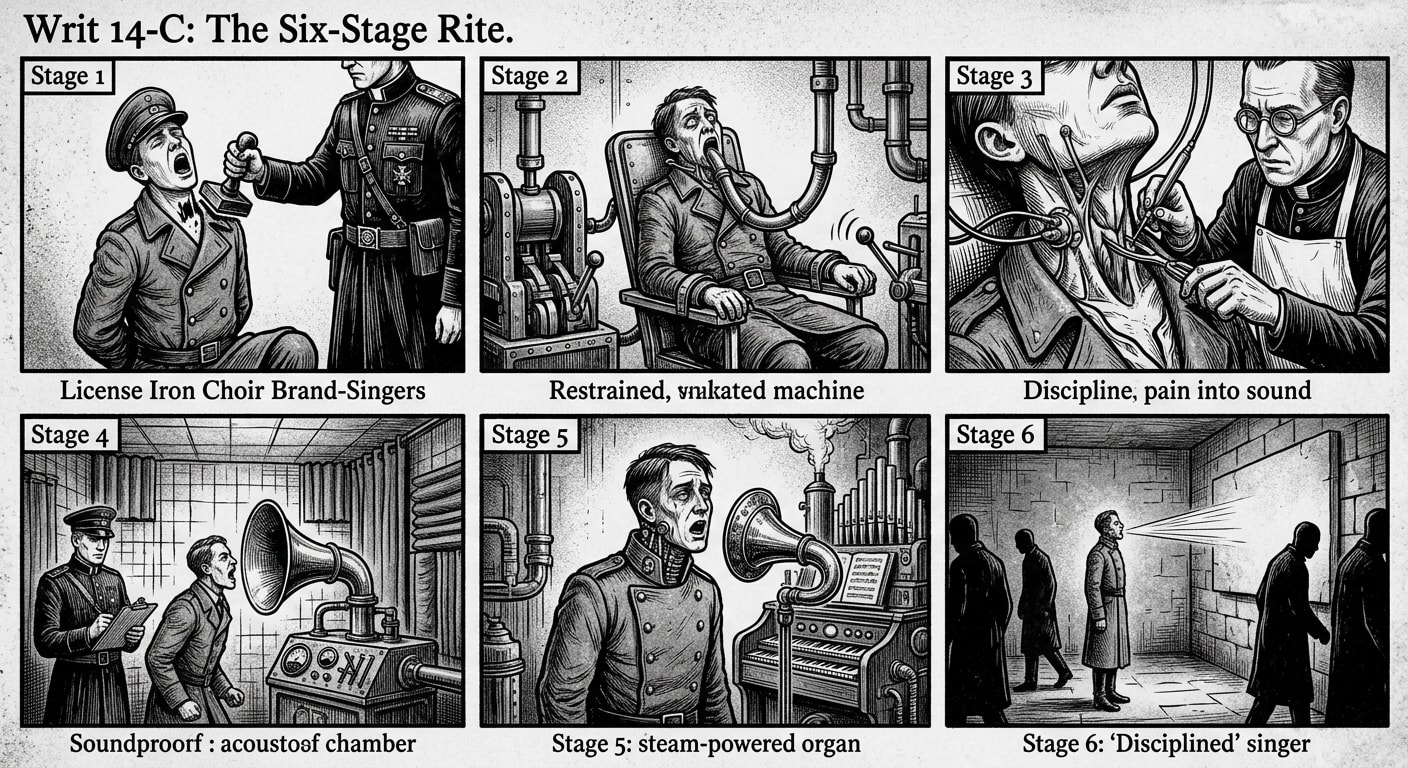
First comes room tuning. The Brand-Singer tests the chamber: pitch-fork against stone, listening interval, chalk mark, witness note. Cracks are logged. Damp corners are marked. Loose brackets are either tightened or declared spiritually irrelevant, a phrase that has never tightened anything. Baseline must be established before the condemned enters. A room without baseline is a courtroom without a judge: still dangerous, less flattering to the institution.
Second comes the Opening Hymn, the breath-stabilisation phase. Mercy singers hold it low. Judgment singers keep it taut. Silentists reduce it to a breath count if the room's history smells wrong. The purpose is the same: place the subject's lungs under external discipline. A man who cannot govern his breath cannot govern his body. A body not governed by breath ruins the text.
Third come stage cues. Identity, charge, enumeration, recantation, forfeiture, lineage, and sentence each receive distinct acoustic marks. The Brand-Smith listens. The scribe listens. The condemned listens with the anxious attention of a man learning which note means another piece of him becomes official.
Fourth is synchronised application: the iron, the note, the mark, the slate. This is where skill lives, though Purity dislikes that word because it smells of guild autonomy. A gifted Singer can control pulse without sentiment, cue a Brand-Smith without theatrics, and hold pitch while some tribunal prefect behind him mistakes impatience for zeal. A bad Singer produces meat-scribble. A mediocre one produces forms. A great one produces fear that can be filed.
Fifth is the Closing Tone, later hardened under Standing Order 22-S: three descending notes and fourteen heartbeats of silence. The Writ's first version calls the silence “settling interval.” Later copies call it “seal interval.” The private manuals call it “the moment the room must be starved.” Names matter. They show which men have heard stone breathe.
Sixth is documentation. The Singer records pitch breaks, subject collapse, chamber hum, cue alteration, missed strike, improper silence, borrowed voice, and any response from wall, bucket, chain, cage, rod, grate, floor, or throat not currently licensed to sing. The report is compared with Brand-Smith alignment and scribe text. Discrepancy triggers audit. Audit triggers confession. Confession, if convenient, triggers another rite. The wheel is very holy.
#On the Three Schools Made Legal
Writ 14-C did not invent the schools. It gave them fencing, names, examination standards, and enough mutual contempt to remain governable.
Mercy Tone grew from the slow drones of Orison psalmists who discovered that a living subject writes longer. Its adherents preserve breath, extend confession, lower panic, and supply Records with luscious names. They call this mercy. They are correct, and insufficiently ashamed. Under the Writ, Mercy Tone received recognition for contested confessions, lineage extension, infirmary-adjacent rites, and cases where the Bureau wished the condemned to remain alive long enough to implicate family.
Judgment Tone grew from docket pressure. Its singers use sharp cadence, staccato cues, and fast certification when crowds gather, coal runs short, cells overflow, or a prefect has promised completion before Vespers. Its foundational manuals cite the Three-Slate Session at Mainz (Unregistered), c. A.S. 106, where twenty-seven condemned printers became certified bodies before supper. Judgment's doctrine fits nicely inside a warrant: delay breeds appeal, appeal breeds doubt, doubt gives heresy shoes.
The Silentists emerged as a tolerated embarrassment, then a necessary one. Their formal descent begins at the Writ, but their authority sharpened after the North Annex Hush of A.S. 118, when Irena Vos closed her mouth in a repaired chamber that answered too eagerly and certified three subjects with tap-cadence alone. Writ 14-C had left enough room for “minimal authorised substitute.” The Silentists crawled through that gap and furnished it with slate, metronome tokens, and suspiciously clean anomaly ledgers.
The Writ requires all schools to pass the same throat examination, room-tone test, cue separation, and Closing Tone certification. Each school then adds its own arrogance. Mercy tests endurance; Judgment tests tempo; Silentists test refusal. All three claim Saint Orla of the Steady Note. Saints endure theft better than budgets.
The school quarrels proved useful at once. Mercy accused Judgment of killing evidence. Judgment accused Mercy of indulging criminals. Silentists accused both of making invitations with their mouths. Purity recorded these disagreements as “healthy methodological pluralism,” a phrase that means no faction yet controls enough offices to threaten the Directorate.
#On Orla's Clause and the Room That Answered
The Writ bears Orla's shadow in every annex. Saint Orla did not write it; saints become more useful when they stop editing. Her final Strasbourg Iron Chapel (Unregistered) rite in A.S. 104 supplied the Writ with its saint, motto, Closing Tone, and most frightening clause.
The accepted account is now familiar to every licensed singer and to several million civilians who have misremembered it into tenderness. Orla stood in a repaired chamber during the branding of three condemned prisoners from a backward-Doctrine cellar academy. The baseline was unstable. The transfer request was denied. At the third brand the room answered before her own note had completed. She lowered the drone, held the condemned alive, finished the Closing Tone, and left the command that matters more than all later commentaries: “Do not answer it.”
The public copy softens this. It speaks of echo management, resonance settlement, and prevention of false impression. The private annex has fewer candles in its language. It knows a room may answer. It knows a trained singer may want to correct the answer. It knows professionalism can kill faster than panic.
ACOUSTIC EMERGENCY PROTOCOL — WRIT 14-C SEALED ADDENDUM When unsolicited response contains a name absent from the case file, attending personnel shall ███████████████. When response issues instruction, the Brand-Singer shall ███████████████ voice use and be classified ███████████████ until throat inspection confirms ███████████████. Personnel who harmonise remain personnel only until ███████████████.
Doctrine calls the phenomenon residual liturgical resonance. Orison calls it acoustic reflection. Purity calls it anomaly. Brand-Singers call it echo weather. The Writ calls it response, and that single honest noun is the reason old Scar-Voices touch their throats when 14-C is read aloud.
The Orla Clause also produced a politics of silence. Mercy Tone argued that the slow note gives the room too much to grip, then proceeded to sing slowly because living evidence still counts. Judgment Tone argued that speed outruns response, then discovered some rooms enjoy knives. Silentists argued that refusal is the truest obedience, then learned that silence also has acoustics. The room, having no committee seat, continued answering when neglected.
#On Licence, Inspection, and the Bureaucracy of the Throat
The Writ's first annex concerns licensing. A Brand-Singer is not a singer who brands. That would be simple, which makes it heretical. A Brand-Singer is a licensed Acoustic Enforcement Person whose throat has been examined, sealed, indexed, and placed under disciplinary condition for the term of service.
Annual throat inspection is mandatory. Quarterly renewal occurs at Matins on the first day of each quarter. The singer presents licence slate, throat seal, prior anomaly reports, silence-week record, ash-rinse compliance, and two witnesses able to swear that no unauthorised performance, lullaby, tavern song, private hum, theatrical chant, or unsanctioned funeral harmony has occurred since the last renewal. Exceptions exist for siege, illness, emergency rite, and bribery with excellent penmanship.
The examination is intimate in the way only government can make intimacy repulsive. The examiner inspects cords by mirror and lamp. Scar ridges are measured. Breath duration timed. Pitch held against Bureau Standard C (Unregistered). The singer is ordered to sustain a drone while an assistant reads false accusations, family names, offers of sugar, insults to school, and fragments of forbidden melody. Drift is marked. Tears are permitted if pitch holds. Coughing requires explanation.
Licences can be suspended for cord scarring, bell-sickness, school deviation, unlogged chamber response, unauthorised silence, unauthorised singing, excessive compassion, insufficient compassion where preservation was ordered, pitch pulled by sobbing, failure to log borrowed voice, and the charming category “throat unreliability in politically sensitive cases.” A suspended singer may be reassigned to road-cage maintenance, silence weeks, Ash Chorister instruction, or the other side of the iron if Purity requires an example.
Writ 14-C makes the throat an office. That is its genius. A private voice can tremble, pity, refuse, love, lie, pray, or sing nonsense to a child. An office can be audited.
#On Vell and the Proof of Mastery
Master Cantor Vell was not present at the Writ's founding. He is its later proof, which is more useful. A law proves itself first by creating personnel, then by creating excellence so severe that everyone below it feels legal.
Vell entered the post-Writ rosters in A.S. 124 and served the Strasbourg penitence halls from A.S. 130 to A.S. 147. His Seven-Rite Session (Unregistered) of A.S. 141 remains the benchmark: seven chambers, seven condemned, seven Brand-Smiths, seven scribes, zero misaligned inscriptions. Writ 14-C had imagined the controlled rite. Vell made the imagination sweat.
He used all three schools as instruments. Mercy intervals when survival served legibility. Judgment cuts when speed served legibility. Minimal tone when a room became impolite. Factional manuals steal him because factions are thieves with footnotes. Vell left no treatise, a kindness to himself and a cruelty to everyone who came after. His corridor maxims survive: keep the bell in your ribs; do not chase the scream; never let pity pull pitch; log the crack before the auditor hears it; if the room sings back, lower your eyes and become stone.
The Cantor-Marshal's Handbook once described Master Cantor Vell as “the fullest flowering of Writ 14-C's unified choral doctrine.”
Withdrawn. Vell proves no unity. He proves precision. The schools were tools under his hand, and a tool has no right to call itself the craftsman.
Vell also exposed the Writ's moral joke. Its purpose was standardisation, but mastery depends upon judgement beyond forms. Its annex forbids unsanctioned deviation, while every surviving practical tradition depends upon knowing when the printed cadence will kill the room, the subject, or the singer. Writ 14-C turns discretion into a licence and then prosecutes discretion when it embarrasses a superior. This is administration, not contradiction.
#On Export, Misuse, and Rival 14-Cs
The number 14-C has multiplied across the Synod like mould in a damp archive. Standing Order 14-C governs Theobaldine geometry in Heraldry. Ration Directive 14-C governs Tithe Assessors. Supplementary Charter 14-C shelters Medicine in its long leash. Form 14-C verifies names for gravestones. Storm-Shelter Node 14-C freezes convoys under Black-Snow Lor. This abundance is not coincidence. Numbering is a Bureau's way of declaring a precedent while pretending not to imitate its neighbours.
Purity's Writ 14-C came first in the acoustic line and remains the one that made throats into jurisdiction. Rival 14-Cs borrowed its prestige without admitting debt. A number acquires authority the way a saint acquires relics: one fragment at a time, each claimed authentic, all profitable.
Misuse began early. Local prefects cited Writ 14-C to require singers for minor lash rites, public recantations, school discipline, and one disastrous Cologne guild banquet at which a licensed Brand-Singer was ordered to “steady the room” during an argument about barrel tariffs. Purity later clarified that Acoustic Enforcement Personnel are not for civic ambience. The clarification arrived after the singer filed an anomaly report describing the banqueting hall as “hungry for applause.”
Forward bastions adapted the Writ brutally. At Bastion-Przemyśl, Brand-Singers attached to discipline wards learned to compete with wire hiss and rail thunder. At Bastion-Brest, bridge-fort acoustics turned Judgment cadence into something sailors mistook for order bells. At Bastion-Shipka, time-fog made Closing Tone counts unreliable, producing the infamous question of whether fourteen heartbeats remain fourteen when the room has forgotten the order in which they occurred. Doctrine answered yes. Medicine answered no. Purity counted anyway.
Approved Hymn Protocols Revision 14 in A.S. 199 attempted to harmonise practice across the corps. It increased reporting duties, clarified school permissions, added echo-weather grades, restricted Orison advisory rights, and made prior revisions retroactively inadequate except when needed as precedent. The revision was praised as modernisation, a word I dislike because it usually means the old cruelty has received cleaner stationery.
#On Enforcement, Failure, and the Little Grey Exceptions
A Writ lives only when it can punish. Writ 14-C punishes beautifully. The appendix on witness hierarchy is uglier than the rite cards suggest. A Singer's report outranks a Brand-Smith's complaint on pitch, but not on iron landing. A scribe outranks both on text, unless the text concerns sound, at which point the Singer returns through a side door with ink on her fingers and murder in her eyes. A prefect outranks everyone until an anomaly begins, whereupon the room outranks the prefect by having the common decency to be dangerous. It reaches the singer through licence, the Brand-Smith through alignment, the scribe through comparison, the prefect through quota review when politics requires a senior corpse, and the condemned through everything. This is why it survived its first century. It made every participant vulnerable in a different direction and called the arrangement accountability.
The first enforcement cases were crude. A psalmist in Metz sang an Orison funeral interval during a Purity rite and was charged with unauthorised consolation. Two singers in Mainz split a Closing Tone because one counted heartbeats by pulse and the other by bell-token; both were fined, the Brand-Smith was re-examined, and the condemned, already dead, was reclassified as procedurally patient. Strasbourg produced the earliest throat suspension in A.S. 107 after a singer took coin to use a Mercy interval in a Judgment assignment. The subject survived long enough to name two cousins. Purity punished the singer and kept the cousins.
Writ 14-C also created the grey exception, that blessed little cupboard where necessity stores its knives. Siege conditions allow abbreviated tuning. Structural instability allows Silentist substitution. Subject collapse allows Mercy extension if confession remains incomplete and if no quota officer with hot blood is present. Public disorder allows Judgment acceleration. Echo weather allows cessation, evacuation, sealing, and any quantity of later lying. Every exception requires witness notation. Every witness notation can be challenged. Every challenge requires a hearing. By this chain the Writ made obedience into litigation and litigation into faith.
The most famous grey case before Vell was the Lannach Double Breath (Unregistered) of A.S. 116, when two condemned brothers were branded in adjacent rooms under one singer because the second singer had lost his voice to smoke. The Writ forbade dual assignment without Cantor-Marshal approval. The Cantor-Marshal was trapped behind a locked processional gate because the key had been blessed into the wrong cabinet. The attending singer held two cadences anyway, one Mercy-low, one Judgment-cut, and both inscriptions passed audit. Purity censured her for unauthorised parallel application and then added her method to a restricted training appendix.
A document loves nothing so much as the exception it can later deny.
Forward discipline halls made the Writ harsher. In Strasbourg, a bad cadence ruins an afternoon. At the Line it may ruin a battalion. A singer at Przemyśl who delays certification during an infiltration alarm can send unprocessed prisoners into holding pens already too full of fear. A singer at Shipka who trusts a clock during fog may seal fourteen heartbeats over a room whose time has learned to sleep. A singer at Brest can lose the Closing Tone beneath bridge guns and hear it return from water. The Writ says procedure travels. Procedure does travel. It arrives exhausted, covered in mud, and lying about its health.
The little grey exceptions are why the corps has not collapsed under its own sanctity. They are also why Purity keeps knives near the ledgers. Every singer knows the printed rule. Every veteran knows the room. Between the two stands the Writ, holding a pen in one hand and a noose in the other. The noose is braided from exemptions, witness clauses, appeal hooks, revised margins, and the tiny grey mercy by which a clerk becomes executioner without standing up.
#On the Writ's Present Teeth
As of A.S. 201, Writ 14-C remains active, revised, cited, feared, misquoted, and useful. It governs every licensed Brand-Singer from Strasbourg's lower halls to Mainz road cages, from Przemyśl's discipline wards to Shipka's half-sleeping punishment rooms. Its public clauses are taught to candidates. Its private annexes are shown only after the candidate has already surrendered the throat.
Its achievements are undeniable. Branding rites became legible. Confessions became certifiable. Brand-Smiths received cadence. Scribes received cleaner text. Records received fewer complaints, which in Strasbourg counts as a minor miracle. Purity acquired a profession that can be praised as sacred, disciplined as technical, and spent as necessary.
Its costs are equally well filed and safely ignored: cord scarring, bell-sickness, silence weeks, echo-weather quarantines, school feuds, singers who hear breathing in stone, condemned bodies preserved past mercy because evidence remained hungry, and rooms that have learned enough of our music to answer in time.
Current status, since some poor future clerk will ask: active under the Bureau of Purity's Directorate of Acoustic Enforcement; revised by Approved Hymn Protocols Revision 14 in A.S. 199; governed by the old command to sing only as licensed, document every deviation, and never answer the room. Breach invites suspension, throat quarantine, reclassification, or penitential application, depending on what remains of the singer and how embarrassed the prefect has become.
The Writ's central brilliance is its conversion of a human faculty into an administrative surface. A voice was once breath made meaning. Under Writ 14-C it is breath made instrument, evidence, warrant, hazard, and confession's leash. The singer holds the note. The iron descends. The room listens.