
#On the Saints and Their Country
"Do not say their names at the shrines. Do not say their names anywhere." Street counsel at Peregrine Row, given away free, which is how one knows it is worth something.
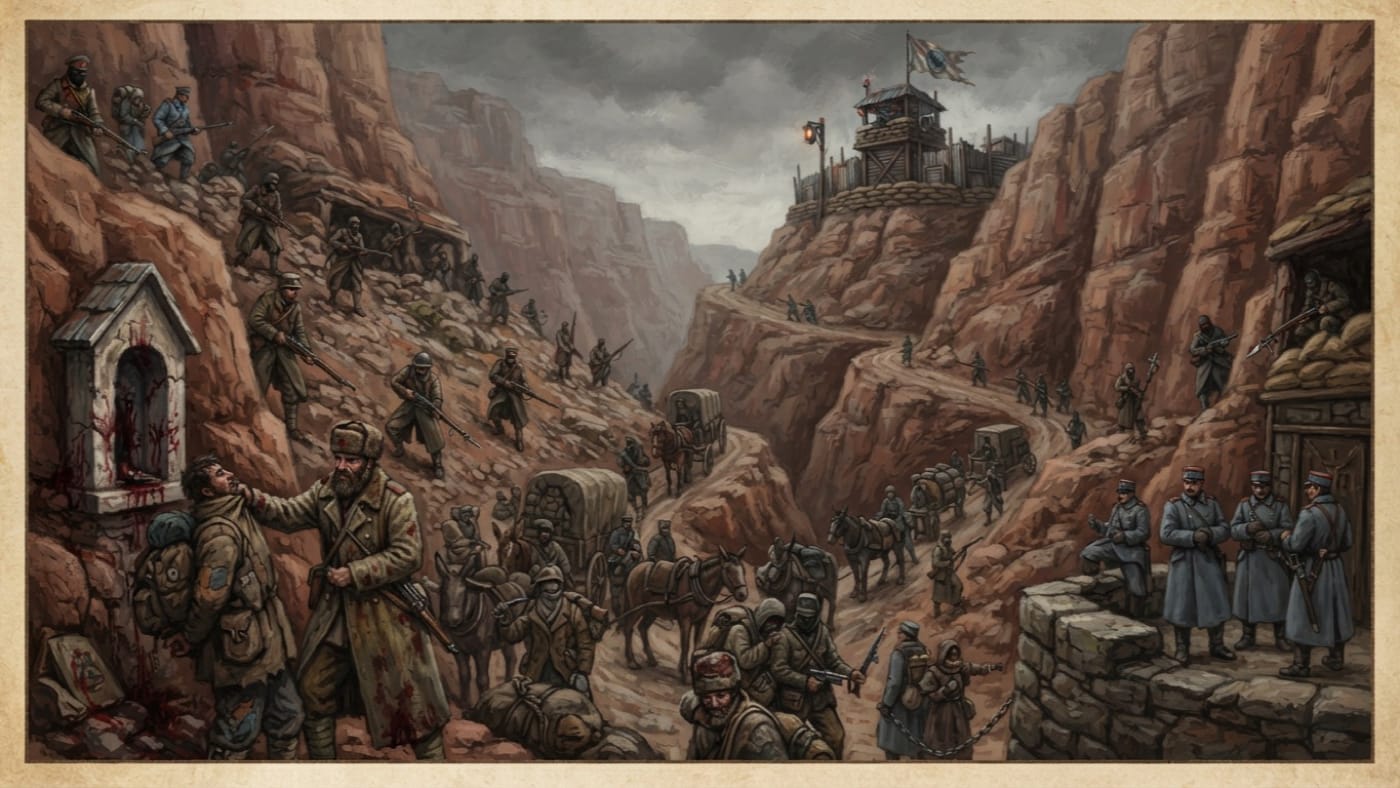
The Canyon Saints are an outlaw coalition of ambush bands. They work the canyon mouths around Peregrine Row, the waystation-market in a limestone throat of the Pilgrim Roads that charges for every syllable passing through it. The Saints hold no charter and publish no programme. The Row's survey records that their whole public presence is myth and terror, two commodities the Synod has never managed to license.
Their country is the eastern approach: red dust, pale cliffs, dry scrub along the ridges, and road cuts squared off by engineers who wanted the switchbacks wide enough for a mule and too narrow for a column. Beyond the eastern gate-arch the road runs toward the forks for the sanctuary cities and the trench-supply spurs. There the walls pinch together and the scrub climbs above them. A convoy loaded with offerings moves slowly in that stretch, and the Saints prefer slow.
Shrines stand at the canyon mouths. Pilgrims press a bead, a crust or a coin into their cracks, and the dust at their bases is dark with old blood. The Row's own record says what the pilgrims would rather leave unsaid: the saints remembered at these shrines are bandits. Their names appear on the local list of forbidden speech, between the mispronounced Creed and questions about where detention fees go.
The Bureau holds no record of any canonization, miracle, founder or rite attached to these memorials, and I will not invent one for the reader's comfort. Nor does the record say who first called ambushers saints, or whether it was done in mockery, devotion or fear. The pilgrims' word for an ambush route is saint-lane. They say it quietly at the eastern gate, while the chaplain is listening for something else.
#On the Road's Revenues
The Saints tax the road with blood. The phrase is the survey's, and I keep it because the Bureau has nothing more exact. No tariff schedule has been recovered, no ransom table, no collector's tally. Whatever accounts the coalition keeps, it keeps in the canyon, and the canyon misquotes.
They are not the only ones taxing the road. Before a pilgrim reaches the eastern approach he has paid at the Gate of Clean Tongues for his creed-test, at the Bead Courts for reconciliation, and at the Compact's dais for an escort voucher whose grief clause was priced before he set out.
The Synod Road Chapter of Peregrine, chartered in A.S. 94, four years after the Concordat of Strasbourg, controls creed-testing, permits and detention. The licensed Broker Compact sells the insurance and bonds the escort companies. Under the general oversight of the Bureau of Pilgrimage, the two offices sell safety and process sin. The Saints supply the reason anyone buys either.
Protection is bought against a danger, and the danger must stay close enough to keep the purchase sensible. A pilgrim who has never heard of the canyon-mouth shrines buys the basic voucher. One who has heard of them buys the premium. The Saints collect at the far end of the road, in hostages, blood and offering-carts. The brokers collect at the near end, in ink.
#On the Hostage Creed
The survey names the coalition's characteristic method as the hostage creed-game. The Bureau has no rulebook for it, and I distrust the tavern versions, which grow more elaborate the farther the teller lives from the canyon. Only the general form is attested: captives are made to recite, and what they recite bears on what happens to them.
The insolence deserves full appreciation. On the western side of the Row, a gate proctor hears a pilgrim recite the Seventh Catechism, hears the Echo Creed return it with one vowel wrong, and assigns the fault to whichever party the quarterly detention schedule requires. On the eastern side, a man with a blade hears the same pilgrim recite the same words against the same pale stone. The Road Chapter calls its procedure discernment. The Saints do not bother to name theirs.
The doctrinal offence is plain enough that the Bureau of Doctrine has noticed it. Creed-testing at Peregrine Row is sacred procedure, and sacred procedure is not to be imitated by unlicensed persons, still less at knife-point in a ravine without a scribe. The commercial offence is subtler. A pilgrim who survives a creed-game has learned that recitation is a negotiation with an armed man. On his next pilgrimage he brings that lesson back to the Gate of Clean Tongues, and the proctors can read it in his face.
#On Lanterns and Safe Windows
Every movement in the canyon is watched from the ridge. By its own public statement, the Ridge Lantern Watch exists to spot ambushes. The survey adds that the Watch sells intelligence to the highest bidder, trades in misinformation and practises selective blindness. It also records one lookout paid by ambush bands. It does not say which bands, and it does not say that every lamp on the ridge burns for the Saints. One bought lookout is a matter of record. A bought ridge is a rumour, and rumours belong to the Bureau of Purity whenever it has men to spare, which is seldom.
Captain Odrik, called Ridge-Hook, commands the largest escort company in the Yards and knows the canyon routes and their echoes better than any man willing to admit it. He has survived two formal investigations into his relationship with the Canyon Saints. Both times his defence was the same: he cannot answer for what happens outside his contracted safe-window. The Hall's file notes that his safe-windows never overlap the Saints' operating hours. I record the coincidence without ruling on it. Two investigations have already tried, and both left the captain in possession of his company, his contracts and his nickname.
The Echo Creed file reports a further pattern. Escort captains open safe-windows when the echo is low and close them when it is high, and ridge lantern codes are adjusted around echo forecasts. According to that file, the Canyon Saints receive those forecasts with suspicious regularity and strike on days of heavy vowel drift, when gate detentions have already filled the Quiet Pens. The brokers deny any coordination. The file names no courier.
Nor does it claim that the Saints understand the disturbance, command it, or foresee it by any gift of their own. The Bureau of Alchemical Standards classified the Echo Creed as Category Two and has kept it under review since the Year of Ash Rain in A.S. 143, without explaining it either. The Saints need only read a forecast. The more alarming finding is that bandits can read.
#On Demonstrated Risk
The first great slaughter on the eastern approach came in A.S. 101. Six hundred pilgrims were ambushed from the ridge caves, and two hundred and fourteen died. The Bureau of Doctrine blamed impure recitation and fined the survivors. The attackers were never identified. Some tavern historians credit the massacre to the Saints, because the Saints are the bandits they know by reputation. The Bureau does not. A band left unidentified in A.S. 101 stays unidentified, however convenient a name would be a century later.
In A.S. 199 a ledger leaked from the Broker Compact's internal audit. It recorded "demonstration ambushes" in the eastern canyons, contracted and paid for by brokers, since a well-timed attack proves the insurance model. The Road Chapter investigated, found "no evidence of systematic coordination between licensed brokers and unlicensed hostile elements," and sent the leaking clerk to the Quiet Pens, where his status is still filed as "processing." The Row has stood at Amber since that year.
Earlier reports from this office described the Choir-Broker Compact as "a model of Synod-private cooperation."
REVISED following review of the A.S. 199 audit documents: "A model of Synod-private cooperation, operating within parameters that are currently under review." Filed.
Both documents sit in the archive, and they disagree. The ledger records payments for staged attacks; the finding denies that any system existed. Neither says which Saints, if any, signed contracts or took payment, or which attacks were staged. The street keeps no ledger, but it says the brokers tip off the ambush bands to keep premiums believable and then pay the escorts to "save" the survivors. The street is no court of record, only the place where the survivors live.
The consequences are already priced in. Broker-Matron Lysa Vane keeps a ledger of bodies lost on contracted escorts, grief clauses paid and refunds refused. Escort premiums have doubled during Cantor-Auditor Selm Peregrin's eleven years in office. Pilgrim numbers have fallen by nine per cent, which the Road Chapter puts down to seasonal variation and the merchants of the Queue Road put down to pilgrims choosing longer roads that frighten them less.
#On the Present Danger
As of A.S. 201, the Saints still work the canyon mouths, and a convoy rich in offerings still draws them. Hostages and stolen contracts move through the Ash-Run Canyons, a predator corridor three to six hours from the Row, which also keeps the memory of the Night of Wrong Syllables. The record leaves that massacre undated and unattributed. So do I.
No shrine has yet been pulled down. The escort yards are still hiring, and Desk Three still sells clarification vouchers against the echo. Pilgrims bound for the sanctuary cities and the Line depots still buy the premium package after hearing about the shrines from someone who heard it from someone else. It is the only advertisement the Compact has never had to pay for.
At the eastern gate, a military chaplain listens to one more prayer. A broker countersigns one more voucher. On the ridge, a lamp is lit, or it is not.