
#On the Licensed Face
"Three loops, one law." — saying of the Knotwrights
The face is a confession. It is the first document a citizen presents and the only one they cannot leave at home. In Article Fourteen of its Standing Catechism, the Bureau of Doctrine holds that to cover the face is to cover the self, that to cover the self is to cover the soul, and that this last is spiritual fraud. Masks are therefore forbidden throughout the territories of the Synod.
On the Carnival of the Triune Knot, the Bureau of Festivals requires them, and the whole city goes under the mask by statute.
I set those sentences side by side because the Bureau of Festivals sets them side by side. The Bureau of Masks and Seals reconciles them the only way the Synod reconciles anything: with paper, with wax and with a number. The Carnival is one of three observances on which Festivals mandates a masked procession. The other two are the Feast of the Departed Flames and the Night of Penitents, and each has its own entry, its own masks and its own sorrows. What follows concerns the Knot alone.
Some readers will expect a history of the Carnival: a founding saint, an inaugural route, a year in which some bishop first tied a ribbon round his face and called it piety. They will be disappointed, and their disappointment has not been licensed. The Carnival is an established observance. It exists the way a gatehouse exists. I describe its administration because its administration is what there is to describe.
#On the Knot
The Triune Knot is the Synod's sanctioned mark of three loops. The Bureau of Heraldry designed it for official documents, and the Gate-Carvers cut it into lintels, shutters and grave-slabs from one end of the territories to the other. Synod sermons call it the threefold clasp of Mercy, Order and Sacrifice. Official doctrine teaches that the First Bell-Speaker gave it to bind the world's doors against the Outside. I report the doctrine as doctrine. The Bureau of Doctrine asks me to spell its mechanism correctly. It has never asked me to vouch for it.
Its civic office is plainer. A door bearing a registered Knot is a door the Synod can read. Behind it is a household that may claim rations, or a grave whose occupant is formally dead, or a warehouse that has passed inspection. The carvers have a word for a door without one. They call it a mouth.
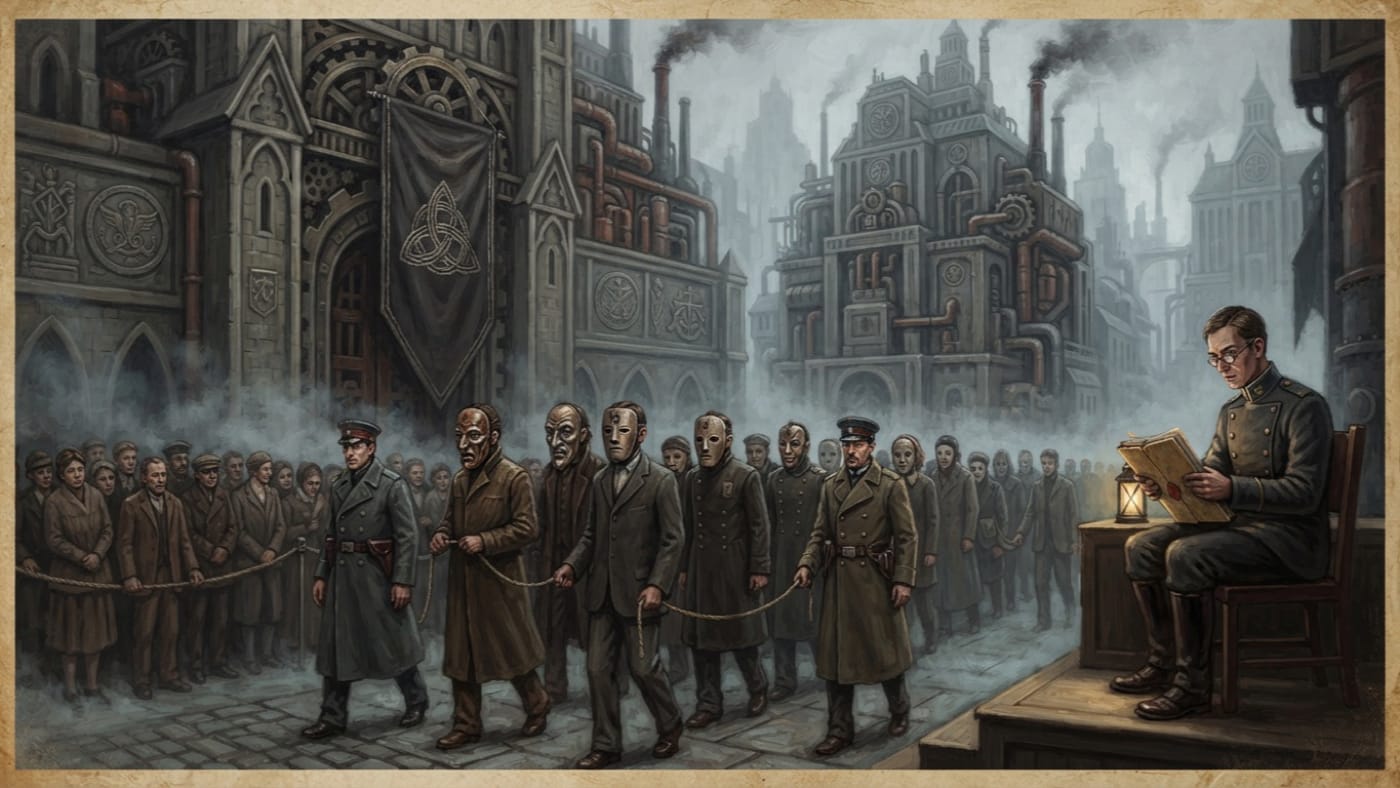
My reading of the Carnival's name follows, offered under my own seal and no one else's. On the day the faces go under cloth and lacquer and pasteboard, the Knot stays where it was: on the banner, on the threshold, on the licence folded into the wearer's sleeve. The citizen may withdraw a countenance for the afternoon. The Synod keeps its mark in full view. The procession may become unreadable only because everything around it stays legible. Every door is counted, every emblem registered, every mask numbered against a ledger. The faces are covered, and authority has left its own face bare.
#On the Licence
The Bureau of Masks and Seals registers and stamps every mask worn within Synodal jurisdiction and gives each a licence number. This covers the gilded visor and the sackcloth hood alike. It covers the Carnival's procession as it covers every other licensed occasion. The licence specifies four things.
The occasion. A mask licensed for the Night of Penitents is not licensed for the Carnival of the Triune Knot, however penitent its wearer may feel. The clerk reads that line first.
The duration. A licence opens and it lapses. A face still covered after the lapse has returned to what it is on every other day of the year, which is forbidden.
The permitted design. Heraldry decides which visages may lawfully mean anything. Masks and Seals records which visage this particular wearer has been granted. There is no single Carnival mask. There are as many as there are approved filings, and each is described on paper so precisely that a portraitist would be ashamed.
The eye-holes. Archon Casselius of Mainz personally insisted that every licence state their exact dimensions. An opening wider than the licence allows makes the mask, in the Bureau's words, "an instrument of surveillance rather than devotion." The wearer loses the mask and pays a fine. The logic is beyond reproach. The wearer may look at the Creator. The wearer may look at the road. The wearer may not look about.
When the face is gone, the clerk still knows a great deal. The clerk knows the licence number, the occasion and the hours. The clerk knows the design and can hold the object up against its description. The clerk knows the width of the holes through which the wearer is looking back. The wearer knows all of this too. The result is the most thoroughly identified crowd in the Church: a column of strangers, every one of them on file.
#On the Procession
Of the Carnival's programme I will say only what the Synod's general practice allows. I will not pass general practice off as the Carnival's own custom. No route has been certified to this article, and no anthem, step count or hour of assembly either. Those belong to whatever authorities stage each procession, and they may keep them.
What any Synodal procession requires is known. The Synod moves crowds in step because it has learned what crowds do out of step. Procession marshals mark lanes with rope and chalk, hold the beat with drum, clapper or heel, and cite anyone who drifts. Festival Chorus-Masters vet every refrain and schedule every response. They tally attendance in ledgers that the Bureau of Festivals reads more closely than it reads scripture. Sigil Inspectors, those tireless enemies of ornament, walk festival routes looking for unregistered emblems and confiscate what offends.
No one has shown me whether each of these officers attends the Carnival of the Triune Knot in any given town. What I describe is the machinery the Synod keeps for any licensed procession. Picture it at work. There is damp wool under lacquer and breath fogging behind the cheek-plate. Footsteps are corrected into unison. At every crossing a clerk with a lantern compares an object to its paper. The column advances at the speed of verification. The spectators stand bare-faced and watch the masked file past, and the masked watch them back through eye-holes of licensed width.
ERRATUM — On the Licensed Face
The Warden wrote above that "the whole city goes under the mask by statute." The sentence is withdrawn. The instrument says that the Bureau of Festivals mandates masked processions on this occasion. It says procession, and the Warden had no warrant to read it as city. Each mask in the procession carries its own licence for occasion, duration, design and eye-holes. Universal masking belongs to the Feast of Buried Names, which is another day, another cloth and another entry. The Warden regrets the enthusiasm.
#On the Several Authorities
Three Bureaus have a hand in the Carnival, and a reader who confuses them will be corrected by all three.
The Bureau of Festivals governs the occasion: which days may be kept, which entertainments performed, which processions masked. Festivals mandates the masks. Where Festivals has withdrawn masks from particular provinces, as it did after the Tumults of Lyon, that withdrawal is a separate instrument. I do not presume to read the Carnival into it or out of it.
The Bureau of Heraldry governs meaning. It keeps the Armorial of the Faithful and decides which symbols may appear and what they may signify. The Knot is its own design.
The Bureau of Masks and Seals governs material: the stamp, the licence, the number, the registry, the measurement. Its question is never what a mask means. Its question is whether this mask is the one that was permitted.
At present both Heraldry and Masks and Seals answer to one Archon, Casselius of Mainz, who holds the two offices in personal union. The union does not merge them. Their charters list them separately, and the Bureau of Records keeps their filing numbers apart. If the Bureau of Records maintains a separation, the separation exists. One pair of ink-stained hands decides what the procession may display and also makes the proof that it displayed it lawfully. The offices remain two.
Behind all three stand Doctrine and the Bureau of Purity. Doctrine supplies the theology that makes a covered face a fraud. Purity enforces against that fraud on every day the licence does not cover.
#On the Present Observance
As of A.S. 201, the Carnival of the Triune Knot is one of the three observances on which the Bureau of Festivals requires a masked procession. Every mask carried in it is licensed by the Bureau of Masks and Seals. Those licences come from the Sigillary, beneath the eastern cloister of Strasbourg Cathedral. The licences are numbered, the eye-holes measured and the occasion and hours written down, and the Registry holds every one.
For one procession the wearers may hide their faces. The Knot on the banner stays in plain view, and so does the clerk at the crossing.
Petitions to widen the eye-holes should go to the Mask Registry, where they will be measured.