
#On the Origin of the Knot and Those Who Cut It
"Three loops, one law." — Inscription above the Knotwright Registry, Strasbourg
The Triune Knot existed before Theobald of Worms fixed its geometry, and the men who carved it existed before the Bureau of Heraldry gave them a title. In the first decades after the Sundering, when the retreating columns were still hauling their dead westward and the parish rolls were ash, someone — no one knows who, and the Bureau has filed seven contradictory claims of authorship — began scratching three-looped binding marks into the lintels of occupied houses and the slabs of fresh graves. The marks were crude. The theology was cruder. Three loops for the Trinity, or three loops for the three things a man needed to survive — a roof, a ration, and a record that he was alive — depending on which drunk you asked in which ditch. The Bureau of Doctrine would later claim these marks had always been doctrinal. The Bureau of Doctrine would later claim many things.
What mattered was that the marks worked — worked in the only sense that counts in the Age of Heresy, which is to say that people believed they worked, and belief is policy. A house with a three-loop scratch on its lintel was a house that had been claimed. A grave with a binding mark was a grave that had been sealed. In the chaos of the Great Retreat, when a hundred thousand refugees poured through the Rhine corridor and every granary became a courthouse and every courthouse a morgue, the question of who owned what and who was dead and who was merely missing required answers faster than any clerk could write them. The three-loop mark answered. It said: someone is here, someone has filed, this threshold belongs to the Synod's order. It was folk bureaucracy scratched in lime and desperation, and it saved more lives than any prayer.
Theobald standardised it in A.S. 90 — the year of the Concordat, the year everything received a charter and a seal and a standing order. He fixed the geometry: three interlocking loops, angle-true, each representing one pillar of the Concordat — Mercy, Order, and Sacrifice. He decreed the Knot be carved into every gate, stamped into every document, pressed into the wax of every absolution token, seared into the crown of every ration loaf, and inlaid above every doorway operating under the Synod's licence. A house without a Knot was "unmoored." It could not claim rations. It could not call for the Wardens. It could not prove that the dead within it had been properly filed.
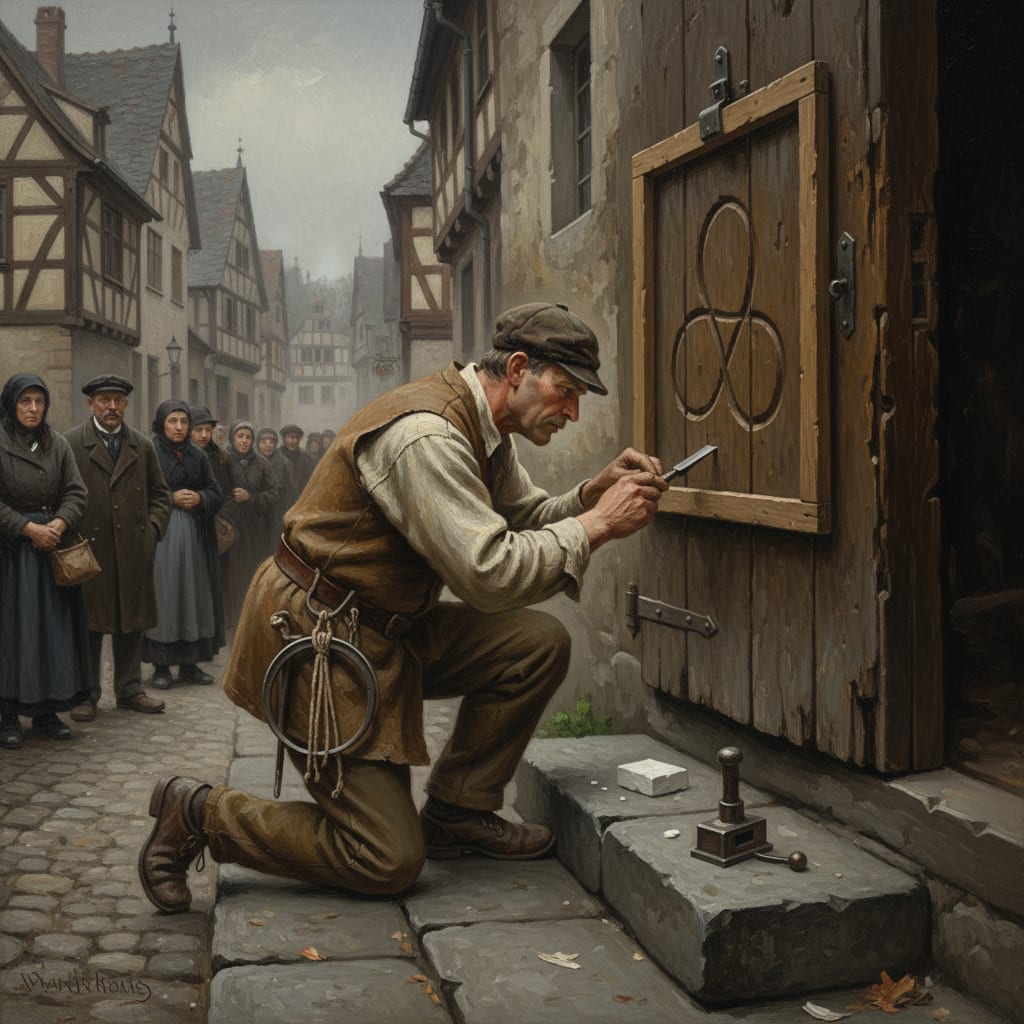
The Gate-Carvers who execute this decree are tradesmen with chisels and registry punches who smell of wood dust and consecration chalk, whose callused palms carry the small cut-maps of a lifetime spent making stone and timber legible to authority — the Synod's quiet wardens of thresholds. The Bureau of Heraldry calls them Threshold Artificers. The street calls them Door-Knotters, Seal-Cutters, Splinter Priests. The Bureau does not care what the street calls them. The Bureau cares that every door in every parish in every zone from Brest to the Bosphorus bears the Knot in the correct geometry, at the correct depth, registered in the correct ledger, and punched with the correct serial.
#On What the Gate-Carver Does and Why It Matters
The work is carpentry performed under prayer. A Gate-Carver arrives at dawn with his stencil case, his tri-cord measure — three knotted lengths for spacing and proportion — his registry punches, and his consecration chalk. He verifies the claim: paper, sponsor, local ledger entry. He selects the knot class — household, ward, warehouse, grave, ossuary niche. He measures the threshold geometry with the tri-cord and frame. He carves. He chalks the consecration line, counts three breaths over the cut, applies the wax tag. He registers: punch, location, knot class, date. The door is now real. The Synod can read it. The Wardens can defend it. The Bureau of Records can file it. The dead behind it, if any, are sealed.
If the Gate-Carver stops working, the system does not merely slow. It disintegrates. Property claims unravel into violence — because a claim without a Knot is a claim without proof, and proof without a Knot is paper, and paper without a Knot is the property of the Bureau of Records and should be returned to them. Grave-fields become rumour farms. Unsealed niches breed panic. Demons, the Bureau insists, find weak thresholds; an unmarked door becomes blamed for every horror that creeps through a district after Ninth Peal. Inspectors purge whole blocks for "heraldic heresy" or "unsealed dead." The Gate-Carver is the man who prevents this by the slow, unglamorous act of cutting three loops into wood and stone, registering the cut, and moving to the next door.
There are, at last census, approximately 6,400 licensed Gate-Carvers operating across Zones 1 through 5. The number is imprecise because the Bureau of Heraldry counts licences, the Bureau of Settlement counts housing registrations, and the Bureau of Tithes counts taxable tradesmen, and the three figures have never once agreed. An additional population of unlicensed carvers — "shadow knotters" in the trade's own parlance — operates in the back-alleys and trench-lines where the Bureau's inspectors are unwelcome or simply absent. These shadow knotters carve "protective knots" for refugees, "silenced doors" for gangs, and emergency grave seals after suspicious deaths. The Bureau is aware of them. The Bureau has always been aware of them. The Bureau's awareness is its own form of licence.
#On the Lintel Pogroms, the Ossuary Breach, and the Reform
"A door without a Knot is a mouth." — Gate-Carver proverb
The profession's three great crises are taught in every Knotwright shop, rehearsed the way soldiers rehearse defeats they survived.
The Lintel Pogroms of A.S. 112 — the same year as the Quiet Purges — began when Bureau of Purity operatives discovered that false knots were being carved onto the doors of houses sheltering unregistered persons. The knots were geometrically correct. The registry punches were counterfeit. Fourteen houses in the Cologne river quarter bore marks that, upon inspection, had been cut by unlicensed hands using stolen stencils. The Bureau of Purity's response was comprehensive and, in the estimation of the Bureau of Purity, proportionate: every door on the affected streets was stripped to bare wood, every resident re-documented, every Knotwright in the district hauled before a Sigil Inspector and made to reproduce his assigned geometry freehand while the Inspector compared the cut to the registry. Three carvers failed the test. Two had been selling stencil access to a Black Ledger cell. One had simply trembled. The Bureau did not distinguish between treason and nerves. All three were immured.
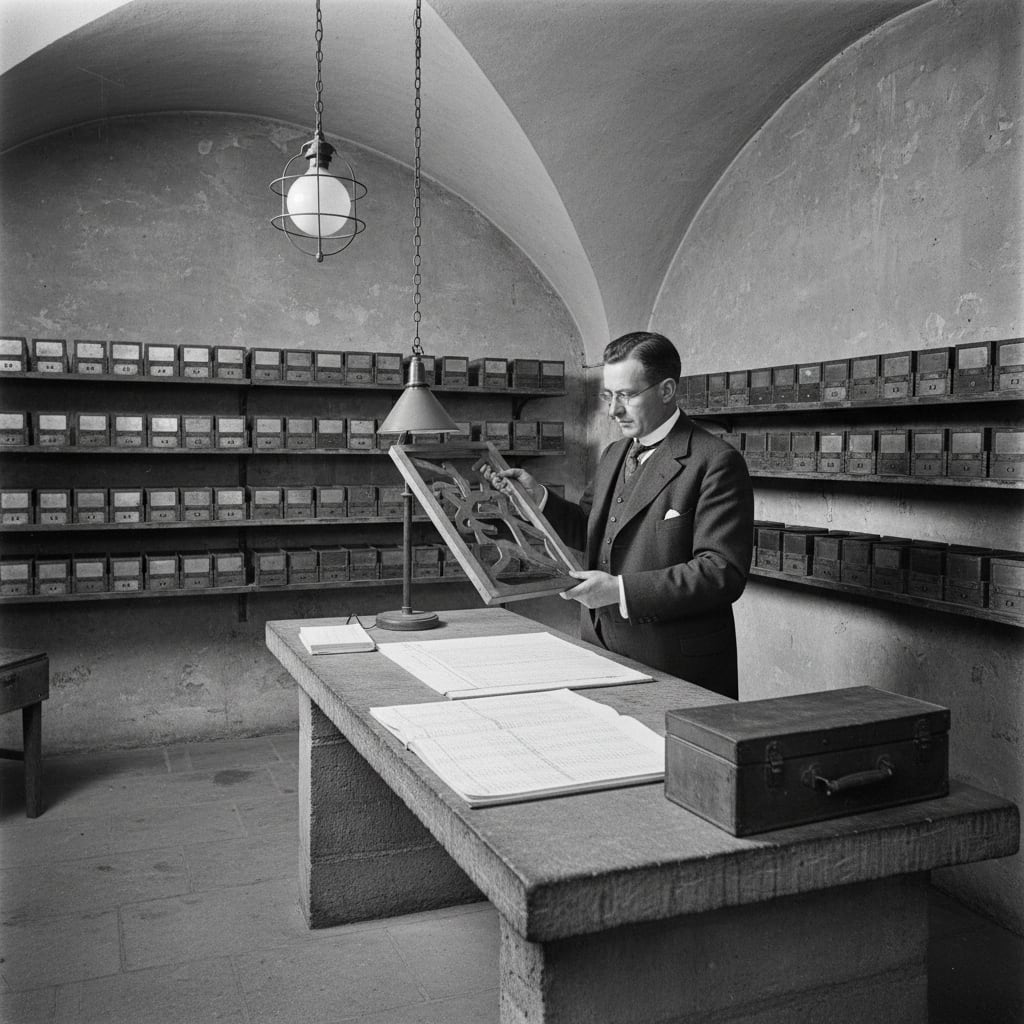
The Knotwright Registry was established in the Pogroms' aftermath — a centralised roll of every licensed carver, every issued stencil, every serial punch, maintained by the Bureau of Heraldry and audited quarterly by the Bureau of Masks and Seals. A stencil found unregistered was treated as a weapon. A carver found without his serial punch was treated as a deserter.
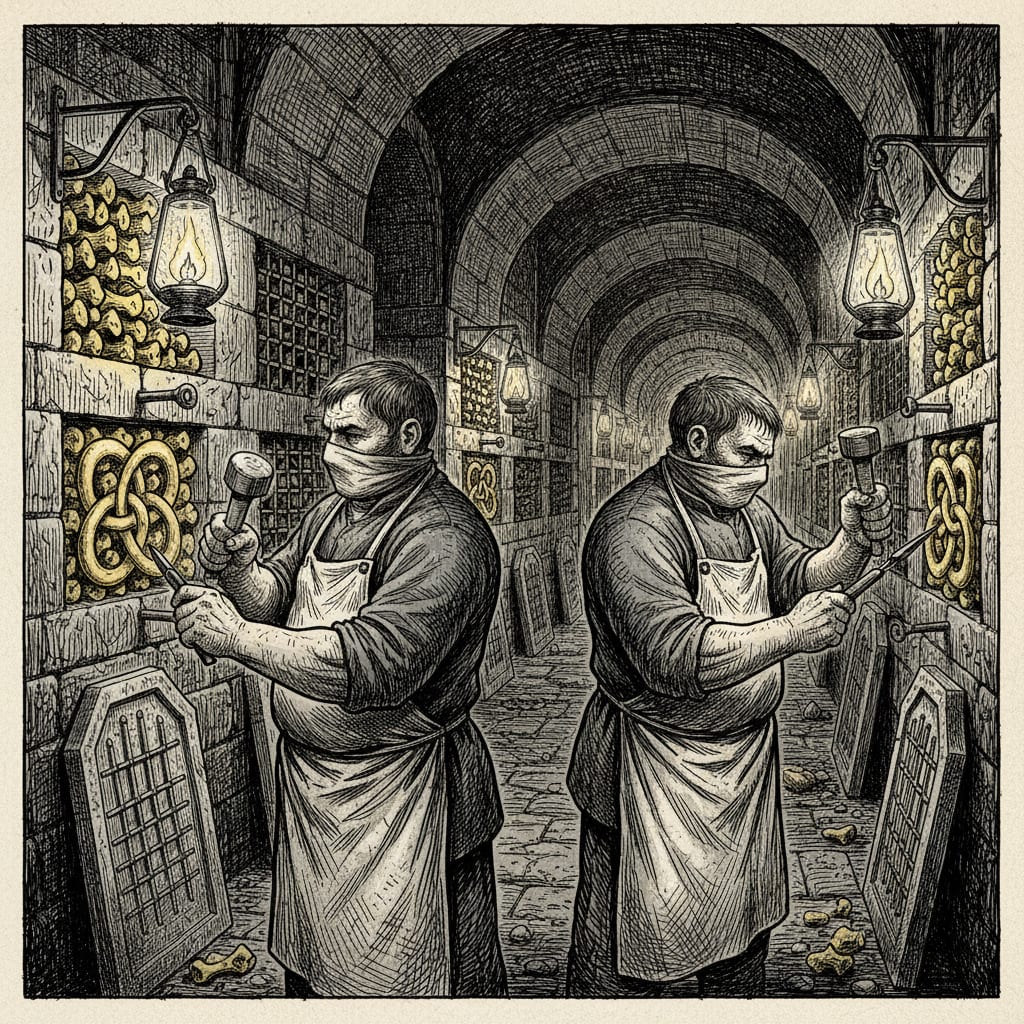
The Ossuary Breach Winter of A.S. 134 was worse, because it involved the dead. Unsealed niches in the eastern catacombs of Bastion-Irongate were blamed for a "rising scare" — reports of movement in the bone-walls, of scratching from sealed chambers, of a corpse found standing upright in a corridor it should not have been able to reach. The Bureau of Engineering declared the disturbances structural. The Bureau of Doctrine declared them spiritual. The Bureau of Heraldry, responsible for the grave-seal system, declared nothing and tripled the Knot quota for every Gate-Carver in Zones 3 and 4. For nine months, carvers worked double shifts — dawn to Ninth in the living quarters, Ninth to Third in the ossuaries — sealing every niche, every slab, every bone-alcove with the authorised geometry. The stone dust cough that year killed more Gate-Carvers than the demons did. The Bureau of Heraldry recorded these deaths under "occupational attrition" and increased the stencil stipend by a quarter-Crown per annum.
ERRATUM — A.S. 199 — Standing Order 14-C (Revised)
The entry for "Triune Knot, Authorised Variants" previously listed forty-seven permitted geometries. This has been revised to forty-three. Four variants have been retroactively reclassified as "insufficiently angular" by the Chancellery of Colors. Craftsmen who have already carved the withdrawn variants into gates and lintels should note that the Bureau considers this an administrative inconvenience. Reclassification to heresy is pending.
The Sigil Reform of A.S. 158 was the Bureau of Heraldry's extension of the Beast Proscription into the Gate-Carver's domain. Animal crests — the old boars, wolves, serpents, and eagles that families had carried since before the Sundering — were banned from all threshold decoration. The Gate-Carvers were ordered to chisel them off every door, every lintel, every family crest-stone in their assigned blocks. They were given six months. In Cologne, a man attacked a Knotwright with a hammer for removing the stag from his grandfather's door. In Metz, a widow set fire to her own lintel rather than watch the serpent gouged out. The Bureau classified these incidents as "resistance to administrative improvement" and did not increase the deadline.
The Gate-Carvers who survived these reforms carry the memory in their practice. Every stencil is counted twice. Every registry punch is sealed in a locked case at shift's end. Every cut is witnessed — or, when witnesses are unavailable, logged in a personal ledger that serves as both defence and confession. The profession runs on paranoia refined into procedure.
#On the Daily Work and the Culture of the Knot
The rhythm is predictable. Dawn: queue at the shop — landlords, widows, ward-siblings, warehouse bosses, cemetery clerks. Registry book opened, stencils counted, first house-call run. Midday: peak pressure — inspectors roaming, new housing blocks demanding knots, grave-field requests stacking after a battle report arrives from the Line. Late day: repairs, re-consecrations, the tedious diplomacy of placement — "The mark goes above the door, Frau Keller, and if your mother objects she may take the matter up with the Chancellery of Colors." Night: the shadow work, if the carver does shadow work. Outlaw knots for refugees. Emergency grave seals. Doors that need to be quiet in ways the Bureau's geometry does not officially accommodate.
The internal factions are ancient and immovable. The True Knot purists insist on full ceremonial for every cut — tri-cord measure, breath-count, wax-tag, registry entry, no deviation, no shortcuts. The Fast Hands chase quotas and call the purists "Grave-Whittlers" — men who treat a door like a coffin-lid and take twice the time the living can spare. The Grave-Sealers and the House-Knotters hold each other in mutual contempt that borders on professional theology: the Grave-Sealers insist their work is sacred (they bind the dead), while the House-Knotters insist their work is real (they feed the living). Both are correct. Both are insufferable about it.
The patron is Saint Edrin of the Three Nails, who is said to have sealed a plague-house with a single knot and a doorbar during the Lull of Names in A.S. 78. The Bureau of Doctrine endorses this account. The Bureau of Medicine has noted that doorbars do not typically arrest plague. The Bureau of Doctrine has noted that the Bureau of Medicine's opinion on matters of sanctified carpentry is "unsolicited."
The tools are simple. The stencil frame — serialised, registered, inspected, the carver's protection and his leash. The tri-cord measure — three knotted lengths, wet-proof (or meant to be; wet cord lies, and a lying cord produces a lying knot). The consecration chalk and wax-tag set. The registry punches, kept in a locked case that the Bureau of Heraldry has specified must weigh no less than four pounds, because a case too light might be carried casually, and casual custody of instruments of authentication is the first syllable of fraud.
Every carver carries a bell sliver in his apron seam. The superstition is that the bell warns when a threshold goes wrong — when something on the other side pushes back. The Bureau does not endorse this belief. The Bureau has not forbidden it.
#On the Knot That Fails
One matter remains — the matter every Gate-Carver carries in his chest like a splinter too deep to tweeze.
The Knot fails.
It fails rarely. It fails in ways the Bureau prefers to classify as "installation error" or "material degradation" or, in the most creative filing I have encountered, "retroactive geometric insufficiency." But it fails. A door sealed with a perfect Knot — inspected, registered, punched, consecrated — opens to something that should not have been able to enter. A grave sealed to the authorised depth, with the authorised geometry, in the authorised stone, yields a body that is no longer where it was placed. The Ossuary Breach Winter was the largest of these failures, but it was not the first, and it has not been the last.
The Gate-Carvers know this. They know it the way soldiers know that armour does not stop every round. They carve the Knot because the Knot is the best tool they have, because without it the door is a mouth and the grave is a suggestion, because the alternative to imperfect geometry is no geometry at all — and a world without geometry is a world the Bureau cannot read, and a world the Bureau cannot read is a world the Bureau cannot defend.
They carve. They register. They count three breaths over the cut and move to the next threshold.
The bell sliver in the apron seam hums, sometimes, on nights when it shouldn't. They do not report this. The Bureau would want paperwork. And the paperwork would require a stencil, and the stencil would require a serial, and the serial would require an inspection, and by the time the inspection was complete the humming would have stopped and the Gate-Carver would be standing in an empty room wondering whether the door he sealed was really sealed, or whether the seal was merely the Synod's way of telling itself that the dark has edges.
It has edges. The Gate-Carver's chisel finds them, every morning, in wood and stone and bone.
Three loops. One law. And the prayer — unspoken, unregistered, carved into the silence between the breath-count and the wax — that this time, this threshold, this door, will hold.