

#On the Inspectorate of Visual Compliance
"The eye is a mouth. Feed it only law." — Codex of Permitted Symbols, frontispiece, Bureau of Heraldry, A.S. 109
The Bureau of Heraldry tells the world what it is allowed to look like. The Sigil Inspector is the man who walks the world and checks.
He carries a seal-book. He carries a scraper blade. He carries, in the breast pocket of a grey coat streaked with solvents and dye-transfer and the accumulated contempt of every market-stall owner between Strasbourg and the Sagittal Line, a set of colour swatches so precisely calibrated that the Chancellery of Colors issues replacements quarterly, on the understanding that human sweat degrades the margins between "sanctioned crimson" and "tolerated vermillion." The distinction between those two reds has generated more litigation than most bastions generate casualties. The Sigil Inspector enforces that distinction with a citation tag, a heated scraper, and the absolute conviction — shared by no one outside the Bureau and approximately half the people inside it — that a crest unsealed is a lie with teeth.
The profession's formal title is Heraldic Examiner, a phrase used exclusively in documents and never by anyone who has met one. The street calls them Color-Cops, Flag Rats, Patchmen — or, when the street is feeling less charitable, Paint-lickers, Banner Butchers, and Ink Inquisitors. The Bureau calls them the Inspectorate of Visual Compliance, which is the kind of phrase that sounds like it was designed by a committee and was in fact designed by Archon Casselius of Mainz personally, in a memorandum so dry that the clerk who filed it developed a cough.
#On the Founding and the Crimson Boar
"Beasts belong to wildness, not banners."
The Inspectorate did not exist before the Crimson Gate Riot. This is the kind of sentence that invites qualification — there were heraldic clerks before A.S. 106, there were men who checked supply-convoy crests against ledger entries, there were garrison officers who squinted at unfamiliar banners and decided whether to shoot — but the Inspectorate, as a commissioned body of licensed examiners armed with codex authority and scraper blades and the legal right to confiscate a man's livelihood because his shop sign contained a curve the Armorial had not sanctioned, did not exist until a quartermaster in Essen-of-Hymnsteel revived the crimson boar of Saxony on a supply wagon and eighty-seven people died in four hours.
The Beast Proscription of A.S. 108 created the demand. The Inspectorate was constituted in A.S. 110 to enforce it. Its first cohort numbered forty-three examiners — drawn from the heraldic clerks of the Chancellery, supplemented by discharged Bureau of Purity field agents whose talent for noticing things had outlasted their appetite for applying the tongs. They were given grey coats, brass eye-badges, a seal-book containing the first edition of the Codex of Permitted Symbols (forty-seven pages, hand-stitched, incorrect in eleven entries that would not be discovered until A.S. 114, by which point three guilds had been wrongly fined and one dye-merchant had been branded for heraldic heresy on the basis of a printer's error), and a mandate: go forth. Look at everything. Scrape what is wrong.
They did. The guilds of Worms, Cologne, and Augsburg lost their animal crests in a single season. The lions went first. The eagles went last. Three guilds rioted. The Bureau of Purity handled the riots; the Bureau of Heraldry handled the paperwork. The Inspectors filed their reports and sharpened their scrapers and moved to the next district.
#On the Codex and the Chancellery
"Colour carries vows."
The Sigil Inspector's authority rests on two instruments. The first is the Codex of Permitted Symbols — a portable abridgement of the Armorial of the Faithful, updated annually by the Chancellery and issued in a stitched folio small enough to fit inside a coat pocket, thick enough to stop a thrown stone. The current edition — the ninety-first — runs to four hundred and twelve pages and includes subsections on permitted geometry, sanctioned colour ratios, authorised animal forms (geometric only, stripped of naturalism until they resemble diagrams more than creatures), banned configurations, and an appendix of "historically suspect devices" that is longer than the section on approved ones.
The second is the swatch set: a folio of dye samples representing every colour the Chancellery of Colors has approved, graded, or suspended. The swatches are manufactured in the Bureau's own dye-works in Strasbourg, from pigments supplied under seal by the Bureau of Tithes' controlled dye-lots. A swatch set costs more to produce than a Sigil Inspector earns in a month. It is replaced quarterly because the pigments degrade, and because the Chancellery adjusts its approved palette with a frequency that suggests either meticulous scholarship or institutional sadism.
The Codex is law. The swatch set is evidence. The scraper blade is the sentence.
#On the Working Day
"Dusk is a liar."
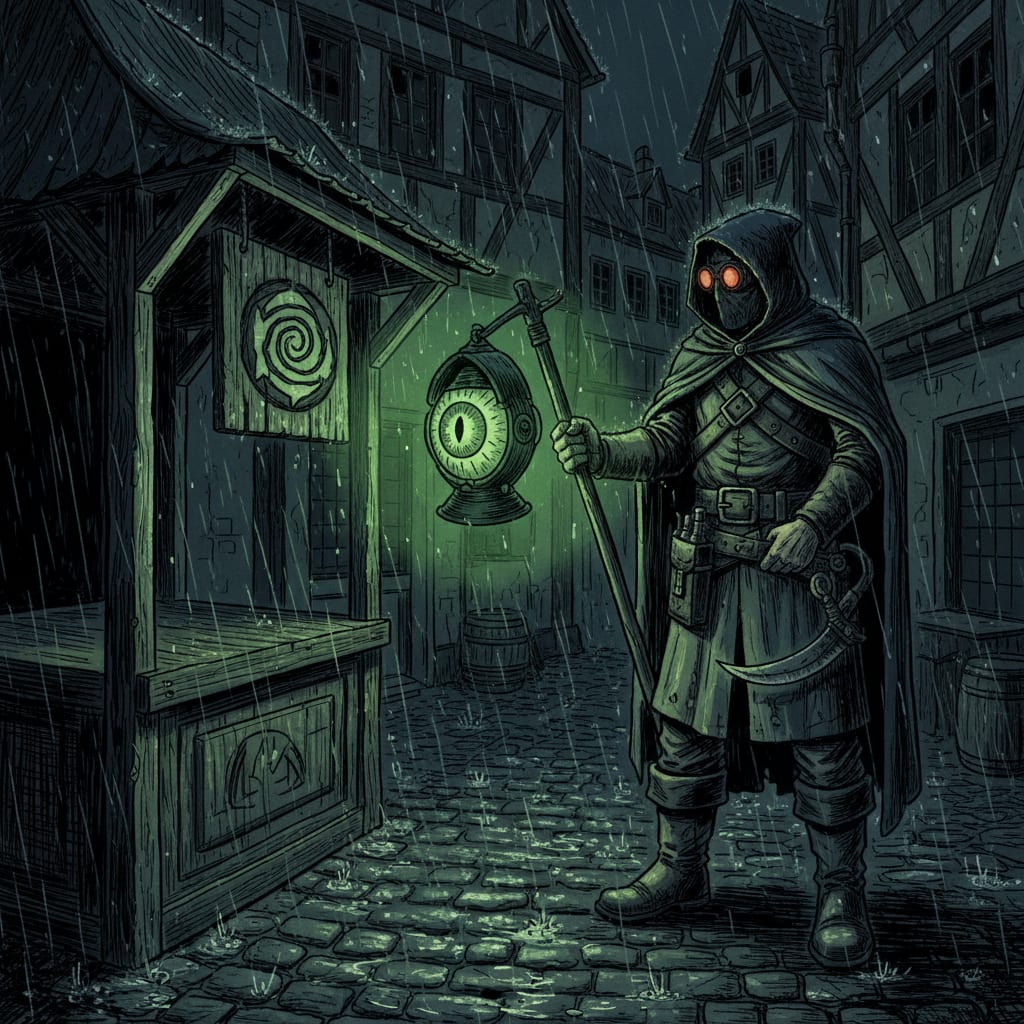
A Sigil Inspector's day begins at the gatehouse, because the gatehouse is where the world tries to enter. Dawn patrol: wagons queue at the bastion gates — supply convoys, pilgrim caravans, merchant trains, refugee columns. Each wagon bears markings. Each marking is a claim. The Inspector checks the claims against the Codex, verifies colours against the swatches, tests pigments with a solvent-dampened cloth. Authorised dye bleeds evenly, in a clean ring. Outlaw dye bleeds in streaks. "Ghost ink" — the transparent overlay used by the Seal-Forgers' guild — does not bleed at all. If the cloth comes back clean, the surface is lying.
Mid-morning: the guild districts. The Inspector walks with his Codex open, comparing what he sees to what is permitted. A cobbler has added a naturalistic stag to his sign — a family crest, predating the Beast Proscription, displayed for twenty years. The Inspector issues a repaint order. The cobbler protests. The protest is noted. The sign is scraped. Late day: the muster yards — soldiers' patches checked for counterfeits, stitch directions verified against the authorised pattern, a wrong thread sufficient for detainment. Deserters hide under stolen patches. Infiltrators wear false colours. The Inspector is the last gate before the trench.
Night: the counterfeiters. After curfew, the Inspector follows solvent-smell, watches for fresh paint-shine, listens for the tap-tap-tap of a stencil being cut. He brings the eye-lantern — a hooded lamp fitted with true-glass that reveals pigment composition under its light. Under true-glass, authorised dye fluoresces blue, outlaw dye fluoresces yellow, and ghost ink fluoresces the sickly green the Inspectors call "demon-spit." Gang ambushes have killed seventeen Inspectors in the Cologne district alone since A.S. 195. The Bureau classifies these as "operational attrition." The Inspectors classify them differently.
#On the Beast and the Child's Chalk
"If it rallies, it's dangerous."
The Beast Proscription banned animal heraldry. The Beast Proscription did not ban animals from the human imagination.
Children draw beasts. They draw them in chalk on tenement walls, on cobblestones, on the margins of catechism worksheets. Lions and wolves and creatures with no names, invented from the shapes of fear that fill a city where the east wind carries the stink of the Blightmarsh. The children do not know they are committing heraldic heresy. The children are drawing pictures.
The Sigil Inspector knows this. He also knows that every cult, every schismatic cell that has ever tried to rally a population against the Synod has begun with a symbol — and the symbol has almost always begun as a drawing that someone dismissed as harmless. The difference between decoration and declaration is a crowd, and a crowd can form around a chalk beast faster than a Chromarch can write a citation.
This is the profession's knife-edge: a child's play, a grandmother's nostalgia, a cult's recruiting mark, a demon-linked icon that has begun to move by lamplight — and the Inspector must distinguish between them in the field, alone, because by the time he files a report the symbol has either faded or rallied a neighbourhood.
ERRATUM — A.S. 201 — Inspectorate Field Manual, Section 14
An earlier edition of this manual classified children's chalk drawings as "Category One: Aesthetic Nuisance, no action required."
#On the Hierarchy and the Chromarch
"A clean field is a quiet field."
The Inspectorate's ranks mirror the Bureau's own architecture: narrow at the bottom, narrower at the top, and ruthless throughout. A Swatch-Runner carries replacement sets and learns the Codex by copying its entries longhand until permitted geometry lives behind his eyelids — he is a pair of legs and a good memory, and the Bureau values the legs more. A Gate Inspector processes the daily flow at the bastion entrance, develops the professional squint, and learns the difference between crimson and vermillion under changing light. A District Crest Adjudicator commands three to six city blocks, runs the hearing-room where disputes are adjudicated — guild against guild, merchant against citation — and manages the Inspectors and swatch-runners who supply them.
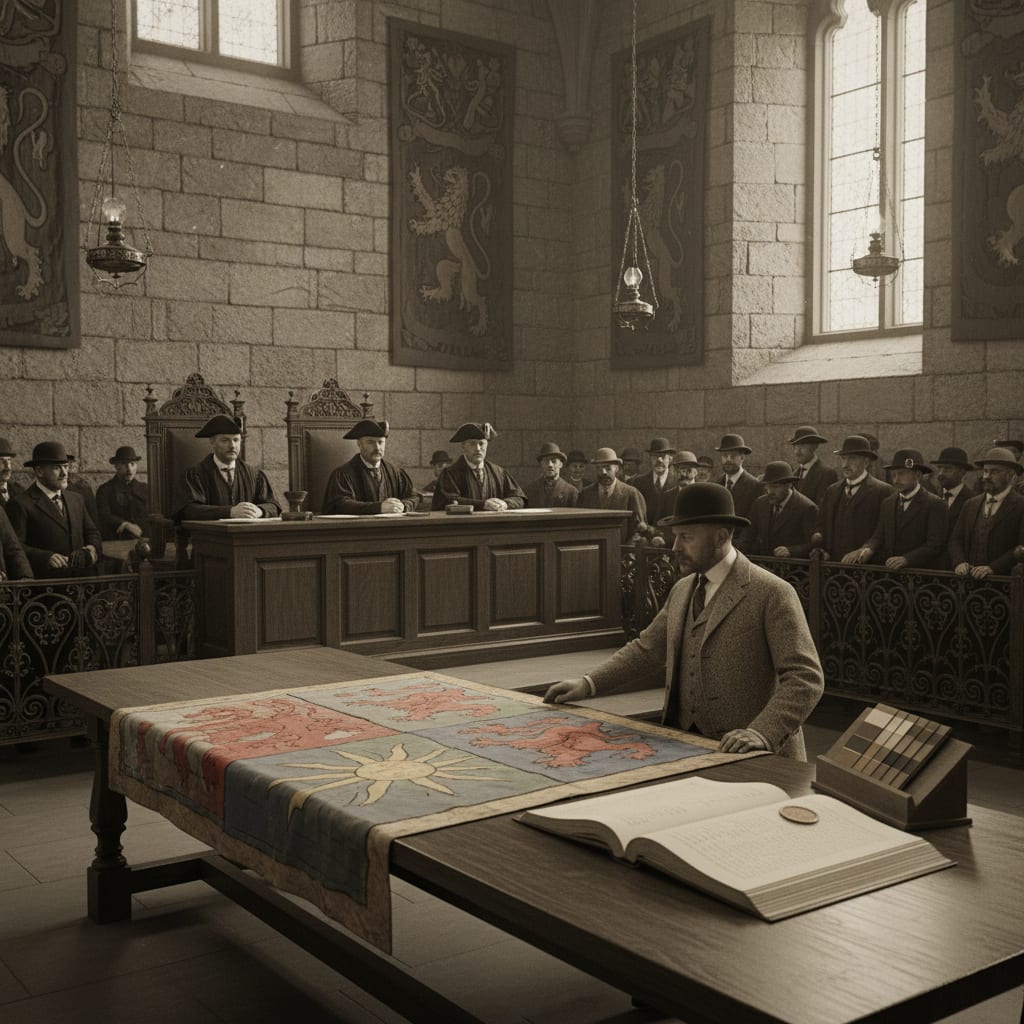
A Chromarch is the regional authority — the senior Inspector who commands a city's entire Inspectorate, reports directly to the Bureau of Heraldry's central office in Strasbourg, and carries the distinction of being the only person in the heraldic chain who can authorise a "heraldic heresy" citation without prior approval from the Chancellery. The Chromarch is feared. He is feared because he can, with a single decision, declare a guild's century-old crest illegal, a neighbourhood's traditional colours seditious, a soldier's unit patch evidence of desertion. He can do this at dawn and by dusk the repaint orders are issued, the scrapers are working, and the old symbols are being burned in the courtyard brazier with the same methodical indifference the Bureau applies to everything — which is to say, with no indifference at all, only the appearance of it.
Above the Chromarch stands the Seal Prefect, a political appointment, and above the Seal Prefect stands Casselius of Mainz, who holds both the Bureau of Heraldry and the Bureau of Masks and Seals in a grip that the other Archons describe as "efficient" and that everyone else describes as "Casselius."
#On the Scraper and the Blade's Edge
"Scrape it now or bleed later."
The scraper blade is the profession's emblem. Six inches of flat steel, ground thin at the edge, brass handle shaped for the palm. It removes paint, strips dye, peels off applied crests, and — when held at the correct angle — communicates that cooperation is the less expensive option. Inspectors sharpen their blades weekly. In certain districts of Bastion-Irongate, the sound of a blade on a whetstone is sufficient to clear a market stall of unapproved signage before the Inspector has crossed the street.
The remaining kit is practical: measuring cord, citation tags (pre-stamped, numbered, triplicate), a portable brazier for heating the scraper when cold surfaces resist removal. And one item that the Equipment Manifest has never listed and the Bureau has never acknowledged: a lead cosh, wrapped in a strip of confiscated banner cloth, carried by every Inspector who has survived more than a season on night patrol. The Inspectorate's casualty rates in districts where the cosh is carried are forty-three percent lower than in districts where it is absent. The Bureau considers this correlation "insufficiently documented for formal acknowledgement" and "adequately documented for informal tolerance."
#On Demon-Linked Iconography and the Moving Lines
"Singing paint."
The Sigil Inspector's most dangerous assignment is not the night patrol, though the night patrol kills more Inspectors per annum than any other duty. It is the assessment of suspected demon-linked iconography — symbols that the Bureau classifies, with the clinical detachment that passes for courage in Strasbourg's filing halls, as "Class Seven Visual Anomalies."
A Class Seven is a symbol that behaves. A crest whose lines shift when observed by lamplight. A chalk glyph that reappears on a wall after scraping — simply present again, as if the stone had remembered. A colour that matches no swatch because the dye-works have never produced it, and yet it sits on a gate-post in Bastion-Sibiu and the residents have stopped looking at it because the headaches give them dreams.
Protocol: do not scrape, do not touch. Seal the perimeter, send for a Bureau of Relics assessor, and wait. A demon-linked icon feeds on observation — the more eyes on it, the more it manifests. The standing order, issued by the Chromarch of Sibiu in A.S. 191, is to look but briefly, record but do not study. And if the symbol begins to sing — a low tonal vibration from the pigment itself, felt in the teeth — evacuate.
#On Corruption and the Colour of Money
The profession pays a wage. The wage is not enough. This is by design — the Bureau pays its Inspectors just below the threshold of sufficiency, on the principle that a man who can survive on his salary alone is a man the Bureau cannot control.
An Inspector who sells clearances — approving a near-banned crest for a fee, stamping a disputed colour as "within tolerance" in exchange for wax, or paper, or a name erased from a citation — is corrupt. He is also functional. Stability requires that some violations be overlooked, some guild-masters appeased, some gang leaders permitted their patches on the understanding that the patches stay indoors. The Bureau tolerates this economy exactly as long as the district remains quiet. The moment it stops being quiet, the Inspector's seal trail becomes a prosecution — auditors from the Bureau of Records reconstruct his career from wax residue, impression depth, and the weight of a seal-book that has been pressed more times than the records show.
#On the Badge and the Burnout
The brass eye-badge depicts an open eye above the Triune Knot — universally recognised in any district where an Inspector has worked. To see it is to understand that you are being looked at, and that the looking has legal weight.
Inspectors develop tells. Solvent-burned fingertips that crack in winter. Ink under the nails that no scrubbing removes. And the habit — invariable, inescapable — of reading every surface as a statement. A sunrise is a colour that must be classified. A guild banner is a legal document masquerading as decoration. A wall is a page that someone has written on without permission. The burnout endpoint is a person who sees heraldic heresy in wallpaper and the crimson boar of Saxony in every sunset. The Bureau reassigns such Inspectors to the archives, where the only surfaces they must read are vellum pages whose colours have been approved for two centuries and whose geometry, at least, is still.
█████████████ ████████ ██████████ ████████████ CHROMARCH'S INCIDENT LOG — COLOGNE — A.S. 197 — The crest appeared on three hundred doors overnight. Same pigment — a red that fluoresced black under true-glass. Inspectors scraped sixty doors before dawn. By mid-morning the crest had reappeared on the scraped surfaces. The Chromarch sealed the district. The crest vanished on the fourth day, leaving stains no solvent could remove and three Inspectors who refused to return to the Weavers' Quarter. The Bureau filed the incident under "Resolved — Administrative." The stains remain. ████████████████████ ██████████████████████ ████████████