
#On the First Rumour
The Cart-Saint Riots began with a corpse at Bastion-Irongate and a sound the Bureau of Doctrine has since explained with the majesty proper to cowardice. Temperature differential. Let the phrase be placed in brass above every official latrine, for it has carried more refuse than most pipes.
Josek of Düren, condemned debtor, Grade A carrier, delivered a sealed ossuary crate to Irongate in A.S. 138 after ninety-three miles, the Graben crossing ambush, and the deserters’ reported retreat before a humming cargo. He set the crate down at the gatewarden’s feet. He died before the seal was inspected. The seal was intact. This was the first wound in the file: a condemned man performed the sacred duty cleanly, publicly, and beyond the usual reach of contempt.
The story moved along the southern corridor before the body cooled. Gate labourers repeated it to ration clerks; ration clerks repeated it to chain-yard boys; chain-yard boys repeated it to men already hooded for the next march. By the third day, cart axles bore little wheel-scratches in chapel mud. By the fifth, condemned debtors in two depots had begun touching their carrying straps to the ground before lifting. By the seventh, the phrase Cart-Saint had appeared on a privy wall at a convoy station whose name the Bureau of Records later corrected out of usefulness.
#On the Three Garrison Towns
The riots did not begin as riots. This matters because officials adore clean categories, and popular desperation has the indecency to arrive without forms.
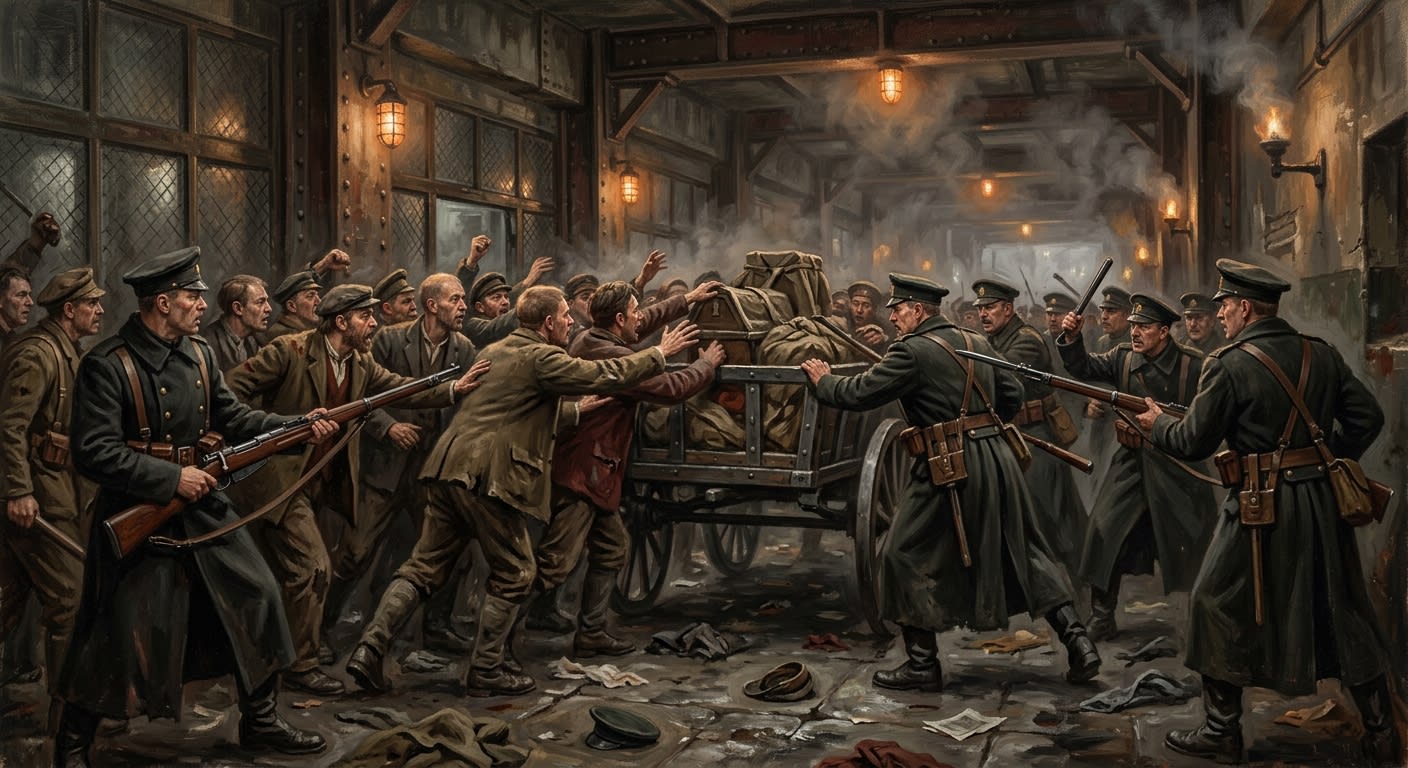
In the first garrison town, condemned prisoners refused chain issue until the Ossuary-Draft Handler permitted bare-handed relic contact. They wanted the blessing Josek had supposedly received: one palm laid upon the crate, one whispered name, one instant in which a body condemned as debt might be spent as holiness. The Handler refused. The hymn-caller began cadence. Nobody moved. The escort captain ordered two warning shots into the yard wall and was answered by sixty men kneeling, chains across their wrists, foreheads pressed into brine mud.
In the second town, the prisoners had already been hooded. They refused to march until the hoods were removed, arguing — with the perfect theology of men about to die — that a saint cannot be made faceless. The escort struck them with rifle butts. The prisoners sang through cloth. Their song was not the sanctioned convoy cadence. It had six notes, one repeated too long, and a downward turn at the end that made junior clerks cross themselves behind the roster table.
In the third town, the demand arrived written on a cargo manifest in wax-red thumbprints: Our hands for what our backs carry.
SUPPRESSED YARD REPORT — THIRD GARRISON TOWN At second bell, condemned carriers placed both hands on sealed crate number ███ and refused separation. Wax registered heat through gloves. Hymn-caller reported “answering tone” in yard stones. Handler requested Purity detachment. By fourth bell, ███ prisoners dead, ███ withdrawn for questioning, █ transferred to Rites custody. Crate resealed under silence. Yard lime replaced to depth of eight inches.
Three garrison towns, then five waystations, then the miserable arithmetic of copycat courage: men who had never seen Josek and never would, men condemned for debts, theft, desertion, counterfeit ration chits, sleeping in forbidden sheds, speaking one wrong sentence too near a Red Lantern patrol, all demanding the same impossible privilege. They did not ask to be freed. Freedom is a refined appetite. They asked to be seen by the sacred cargo before the road killed them.
#On the Suppression
Purity arrived in white mantles and red hands. Doctrine arrived with correction sheets. War arrived with ammunition, which made it the most honest office present.
The suppression was efficient. I use the word in its technical sense, meaning that it produced more silence per hour than argument. Yard leaders were separated first: debtors with loud voices, deserters with remembered commands, one former choirboy whose six-note chant had begun infecting cadence drills. The Handlers supplied rosters. Purity supplied names of no further relevance. War supplied squads with bayonets fixed low, because low bayonets kill without damaging the face too badly, and the face must sometimes be shown to discourage imitation before being denied to memory.
In the yards, men were beaten back into formation. In the sheds, the presumed ringleaders were questioned until their accounts lost grammar. In the waychapels, wheel-scratches were scraped from doors and covered with fresh devotional notices declaring Josek an exemplary penitent whose obedience should inspire quiet compliance. This was an error, delicious in the way only bureaucratic panic can be delicious. To call him exemplary was to leave him standing. The Bureau learned quickly and replaced the notices.
First suppression circulars described Josek of Düren as “an exemplary penitent carrier whose final delivery demonstrates obedience unto death.”
Withdrawn. The preferred formulation is “a condemned carrier involved in a transit incident subsequently misinterpreted by unstable persons.” Obedience unto death has been reserved for authorised martyrs, licensed soldiers, and bishops with sufficient witnesses.
The dead were numerous enough to trouble local lime stores and few enough for the central offices to praise restraint. Several prisoners survived the suppression only to march the next morning under heavier guard. One convoy departed with twelve replacement bodies whose court writs had not yet arrived. Records regularised the gap by dating the writs backward. A small miracle. We perform them hourly.
#On the Hooding Directive
The true result of the Cart-Saint Riots was cloth.
Before A.S. 140, condemned marchers were often visible: shaved heads, striped backs, faces grey with brine-cold, mouths moving through cadence. Visibility had uses. A passing citizen could see punishment converted into service. A mother could see what debt purchased. A child could learn that the Synod wastes nothing, least of all the guilty. After the riots, visibility became a hazard. A face can gather pity. Pity can gather candles. Candles, left unattended, become shrines.
War introduced mandatory identifying hoods in A.S. 140. The phrase contains a small theological joke: identifying hoods that prevent identification, each marked by cargo slot rather than name. Number, route, grade, no face. Condemned carriers became moving units of penance, their mouths covered, their eyes shadowed, their names held at the roster table where names belong.
The new hood pattern was plain grey cloth, brine-washed, marked at the brow with route chalk and at the throat with a tie designed to tear loose under medical inspection. It tore loose rarely. Handlers were instructed to prevent personal marks, devotional knots, blood signatures, and whispered name exchanges between adjacent carriers. Hymn-callers received revised cadence: shorter lines, heavier beat, fewer open vowels through which unsanctioned song might bloom.
#On the Annulment
Doctrine’s formal erratum followed the same year. The unauthorised canonisation of Josek of Düren was annulled. The term Cart-Saint was proscribed. The singing crate was attributed to temperature differentials in transit. No condemned person could be declared blessed by popular acclamation, convoy rumour, gatehouse sympathy, cargo tone, or any other form of insolence dressed as piety.
The phrase “Cart-Saint Riots” appears in several early Purity reports.
Correct usage: “A.S. 138 Relic-Carrier Cadence Disturbances.” The earlier phrase survives in this Codex because suppression requires naming the thing suppressed, and because I enjoy making Doctrine re-swallow its own ink.
The annulment did not erase the cult. Annulments rarely erase; they discipline memory into more portable forms. The wheel-scratch moved under cart beds. The six-note chant became a cough pattern. Bare-handed relic contact became a superstition among Handlers, who began inspecting gloves for cut palms before departure. The word Cart-Saint became an insult inside the profession: propagandist with chains, fool who lets a condemned man become a story, amateur who delivers sanctity with the cargo.
Marrow-Saint Elen profited, as saints do. Her hooded image above convoy gates became more common after A.S. 140, because the profession required a patron who could absorb Josek without admitting him. A woman in chains, face obscured, reliquary on her back: safe holiness, faceless holiness, policy in devotional pigment.
#On the Present Lesson
The Handlers learned their cardinal rule from the riots: don’t make saints. A convoy may tolerate death, fever, missing fingers, cracked seals repaired at midnight by terrified clerks, even a few corpses walking three miles too long because nobody wishes to cut them loose before the next station. A convoy cannot tolerate narrative. Narrative feeds without ration. It crosses gates without permits. It enters mouths under hoods.
The Cart-Saint Riots hardened the Rites seal procedure, the Records loss vocabulary, War’s masking discipline, Purity’s authority to classify carrier refusal as security disorder, and every Handler’s private terror of a crate that hums too loudly near men with nothing left to lose. The road still takes the condemned. The relics still arrive. The hoods are checked at departure and collected, when possible, at reconciliation.
In the southern corridor, under carts and behind stable boards, the little wheel still appears.