
#On the Ditch That Became a Witness
The Graben Crossing is a minor southern-corridor ford in every office except Doctrine, War, Relics, Records, Purity, the Ossuary-Draft Handlers, three garrison chapels, five waystations, and the private terror of men assigned to sealed bone-cargo after dusk. Maps call it a crossing. Convoy rolls call it a risk point. Local mud calls it what mud calls everything: mine, eventually.
It lies on the relic road into the Irongate corridor, west of the black throat of Bastion-Irongate, in that shabby geography where roads cease pretending they are civilian and become long arguments between the Bureau of War and weather. The name Graben is older than the Synod's present neatness: ditch, cut, trench, drain, wound. All correct. A shallow watercourse, a timber bridge repaired too often, banks thick with brine grass, a waychapel dedicated to a mule saint whose certification was revoked in A.S. 141, two milestone posts, one toll hut, three cart ruts, and enough mud to remember every boot without being accused of memory.
Before A.S. 138, Graben existed as an inconvenience. Convoys slowed there. Wheels sank there. Escort captains cursed there. The hymn-caller changed cadence before the timber planks because the water below made low notes travel strangely. Deserter bands liked it because the banks gave cover and the bridge forced files to narrow. Clerks disliked it because delays at Graben required explanations, and explanations at minor crossings breed suspicion faster than rats breed in oat stores.
After A.S. 138, no official route table could look at Graben without blinking.
#On the Ambush
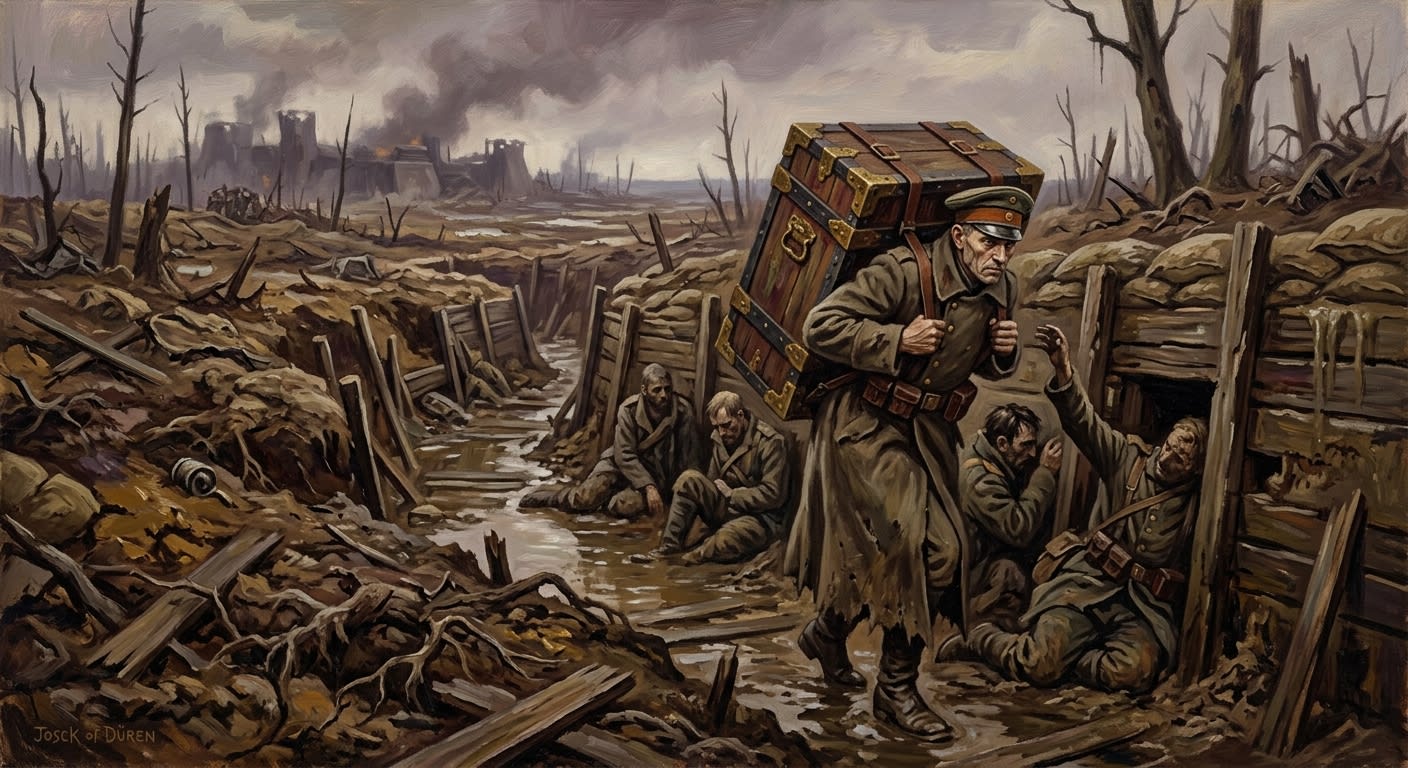
The convoy that made Graben infamous carried a sealed ossuary crate bound for Irongate. Its Grade A debtor-carrier was Josek of Düren, condemned to relic transport in A.S. 138, strong enough to be useful and poor enough to be converted into procedure. His file gives the Bureau's preferred portrait: debt, grade, chain assignment, cargo. A man rendered as load-bearing capacity with a given name attached, because even cruelty enjoys a label.
The march had already become ugly by the time it reached the crossing. Two fever-thin carriers were failing. The hymn-caller's throat had cracked. The escort was counting lamps instead of faces, which is the hour when discipline puts its head down and sin comes over the bank. The deserters struck at dusk. Two bailiffs died in the first volley. Three prisoners broke chain order and were shot by their own escort captain. The timber bridge took blood in its seams and did not complain.
Josek walked forward.
The crate began to sing.
ESCORT CAPTAIN'S DEPOSITION — GRABEN EXTRACT Sound: low, steady, audible at twenty paces. Deserter line parted before debtor-carrier. One deserter knelt. One removed his cap. One discharged weapon into own mouth. Carrier did not alter pace. Hymn-caller ceased authorised cadence for ████ seconds. Bridge planks registered vibration after convoy had crossed.
That sentence, the crate began to sing, has been strangled by more offices than any ballad in the southern corridor. Doctrine prefers temperature differential. Relics prefers sympathetic reliquary response when speaking privately and categorical denial when speaking to anyone with ink. War prefers morale contamination. Records prefers transit anomaly. Purity prefers names of witnesses. The condemned prefer Josek.
The deserters did worse than flee. Flight would have been convenient. They parted. They made room. Their line opened before a chained debtor bearing a sealed crate over a ditch in bad light while official cadence failed. Men whose profession had become refusal yielded to a man whose punishment was obedience. That symmetry has irritated Doctrine for sixty-three years.
#On the Bridge, the Mud, and the Waychapel
Graben's bridge was replaced in A.S. 140, again in A.S. 151, and officially for the last time in A.S. 173, which means the current planks are younger than the story and guilty by association. The original timbers were removed under Bureau of Records custody after pilgrims began shaving splinters from the rail. Seven authenticated splinters were declared inauthentic, fourteen inauthentic splinters were confiscated for possible authenticity, and one beam disappeared between a Records wagon and a Purity lock-shed. The beam has never been found. This is how relic economies begin: with an absence and a clerk pretending not to sweat.
The mud proved harder to remove. Wheel-scratches appeared first at the bank where the convoy narrowed. A small circle, four spokes, sometimes a drop beneath it. The first marks were scraped away. The second were burned. The third were plastered over with a notice warning that unauthorised axle-devotion constituted cargo interference. By winter, the wheel had moved under cart beds, inside toll hut shutters, and onto the underside of the waychapel bench where condemned men rested chains during rain.
A.S. 139 corridor notices described the Graben marks as “local vandalism unrelated to relic traffic.”
Corrected after identical wheel-signs appeared at Irongate lower ration court, two convoy yards, and a chapel privy whose wall had been whitewashed three times under Purity observation. Vandalism is local. Devotion travels.
The waychapel lost its mule saint after the Cart-Saint Riots because the animal's painted burden began to look doctrinally hazardous. A mule with a reliquary on its back, standing beside a crossing where a condemned man had borne saint-bone through deserters, invited comparison. The Bureau of Doctrine replaced the image with Marrow-Saint Elen, hood drawn low, face erased into piety. The villagers continued leaving little cart wheels under the candle shelf. Doctrine removed the shelf.
#On Witnesses and Their Correction
Graben produced too many witnesses of the wrong sort. The escort captain saw enough to revise himself. The hymn-caller first testified that Josek moved his lips when blood ran through the carrying straps; his later testimony remembered silence more obediently. A deserter taken alive claimed the crate sounded like a bell heard underwater and that the water in the ditch flowed backward during the crossing. He recanted after three hours with Purity and died of fever six months later, having written wheel signs in broth on his cell floor.
Records attempted ordinary containment: sealed depositions, corrected route language, witness dispersal, custody of planks, a ban on public retelling within three miles of the crossing. The ban improved the story. Nothing sharpens memory like being told memory is illegal by a man holding a stamp.
The southern corridor made its own record. Stable boys counted the bridge boards. Condemned carriers tapped six notes against chain-rings before crossing. A toll widow swore she heard humming under the planks when no convoy was due. Three children drowned in the ditch in A.S. 144 after daring one another to listen with one ear in the water. Their parents petitioned for a fence. War installed a sign. The sign warned against obstruction of convoy movement.
Popular accounts maintain that Graben water still sings on the anniversary of Josek's passage.
No sanctioned test confirms annual vocalisation. Two Orison auditors, one Relics subdeacon, and a Records clerk reported tonal variance during separate inspections and later accepted revised wording. The water does not sing. The water is under review.
#On the Riots Born Downstream
Graben did not cause the Cart-Saint Riots. It gave them a hinge. Josek's death at Irongate gave the corridor its forbidden saint; Graben gave that saint his trial. A man may die after carrying cargo and be called obedient. A man who walks through armed deserters while the cargo sings becomes useful to imaginations that have not been properly starved.
The condemned heard the lesson most clearly. They did not demand freedom in the first garrison town. They demanded bare-handed relic contact. In the second, they demanded unhooded march visibility. In the third, they wrote their petition in wax-red thumbprints: Our hands for what our backs carry. These were not clever demands, which is why they were dangerous. Clever demands can be negotiated into committees. Stupid holy demands have to be beaten until they stop glowing.
Purity suppressed the yards. War supplied hoods. Doctrine annulled the Cart-Saint title in A.S. 140 and attributed the singing crate to temperature differentials. The Handlers learned their rule in the short form: do not make saints. Graben entered the profession's private training as the example spoken after doors close, before the younger Handlers have learned to laugh at suffering in the approved tone.
#On the Present Crossing
The present Graben Crossing is cleaner than it has any right to be. The banks are cut back. The bridge rails are iron-sleeved. The waychapel wall bears no shelf, no mule, no visible wheel. A Purity notice forbids devotional marking, relic shaving, anniversary assembly, water-listening, and the recitation of condemned names. The toll hut keeps a broom for mud and a scraper for theology.
Convoys still slow there. Drivers pretend it is because of the bank. Escort captains count faces twice before the bridge and once after. Hymn-callers hate the acoustics. Condemned carriers, hooded since the A.S. 140 masking directive, cannot easily see the planks beneath them, but their feet know when wood replaces road. Some stumble. Some straighten. Some tap six notes against the chain, soft enough that the escort can pretend not to hear.
The new bridge inspection rule requires every south-bound relic convoy to halt one hundred paces before the first plank while the lead Handler inspects the under-rail, toll-post, chapel threshold, and inner wheel-ruts for fresh marks. He carries chalk, scraper, wax, and a little bag of lime. The chalk names lawful damage. The scraper removes unlawful memory. The wax takes impressions for Records when removal would destroy evidence. The lime is for blood, old water, and whatever the escort captain does not wish to describe at supper. Practical piety. The only durable kind.
Several Handlers add a private act. They press two fingers against the bridge rail before crossing, then deny it if asked. The gesture is explained as vibration testing, splinter checking, cold-metal assessment, glove seating, anything except reverence. I accept these explanations with the serene expression by which senior officials honour useful falsehood. A profession may survive one forbidden saint if it learns to hide its genuflection inside procedure.
No office has successfully renamed the place. Graben Crossing remains in the mouth because the mouth is harder to audit than a map. Two draft route tables tried Saint Elen's Ford. One tried Southern Relay Cut 12-B. A War clerk suggested Hostile Contact Point Graben and was promoted sideways into hay accounting, where his imagination could injure fewer people.
The ditch keeps its old name. The bridge keeps its iron sleeves. The mud keeps everything.