
#On the Profession of Turning Men into Freight
"Count the living. Count the dead. Deliver the relic." — Standard dispatch catechism, Ossuary Convoy Office, all bastions
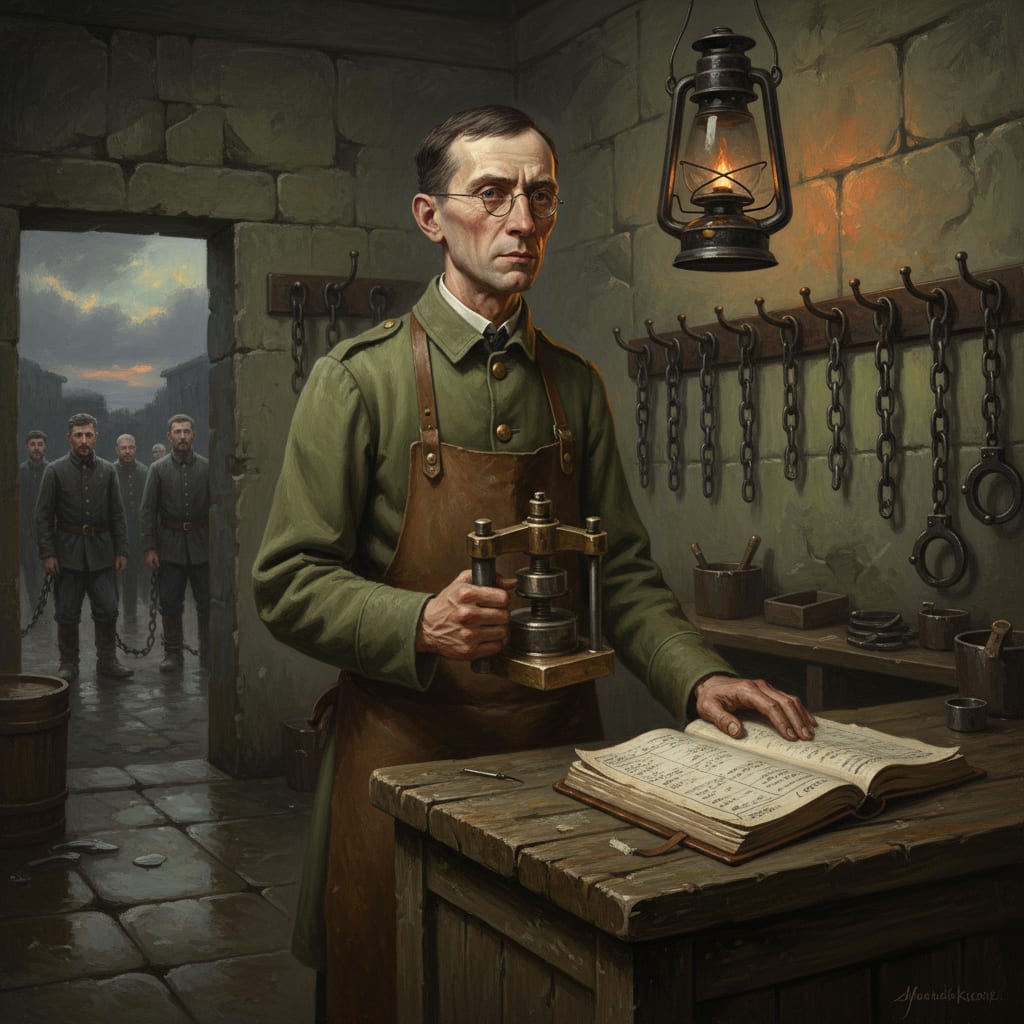
The Ossuary-Draft Handler converts the condemned into transport capacity. This is his function, his daily bread, and his particular damnation. The Synod requires relics at the front. Relics are heavy — ossuary crates packed with sanctified bone, sealed bell-caskets trailing ward-chains, reliquary chests whose wax seals must arrive unbroken or the entire shipment is doctrinally void. Trained soldiers cannot be spared to haul them. Mules die. Carts break axles on roads the Bureau of Engineering has not resurfaced since A.S. 160. And the condemned — the heretics, the debtors, the deserters, the petty apostates whose crimes were too small for immurement and too large for pardon — the condemned are abundant, disposable, and already in chains.
The Handler takes the body the courts have finished with and puts it to work one final time.
The profession is licensed under joint writ of the Bureau of Rites and the Bureau of War, which means that two bureaucracies share jurisdiction and neither accepts blame. The Handler operates at their intersection — a clerk of bodies and bones, a quartermaster of penance, a man who has learned to weigh a human being by cargo capacity and classify the result as doctrine.
#On the Chain March
The condemned do not simply walk. They march in formation — a chained column, each prisoner bearing a share of the relic cargo, spaced at intervals determined by the Handler's manifest. The order matters. Certain relics cannot be carried behind certain crimes; a blasphemer may not bear a saint's femur, a debtor may not walk ahead of a sealed bell-casket, and a deserter — having already turned his back on the Synod once — is placed at the rear, where his back faces the direction the column has already passed and therefore faces nothing of consequence.
The column moves under hymn cadence. A licensed hymn-caller sets the rhythm, and the prisoners walk to it because the alternative is the whip, and because — and this the Handlers know better than any theologian — rhythm is control. A column walking in cadence does not riot. A column walking in cadence does not think. The feet move, the chains clink on the beat, the hymn fills the space where desperation would otherwise bloom, and the miles pass in a stupor that the Bureau of Doctrine is pleased to call penitential meditation.
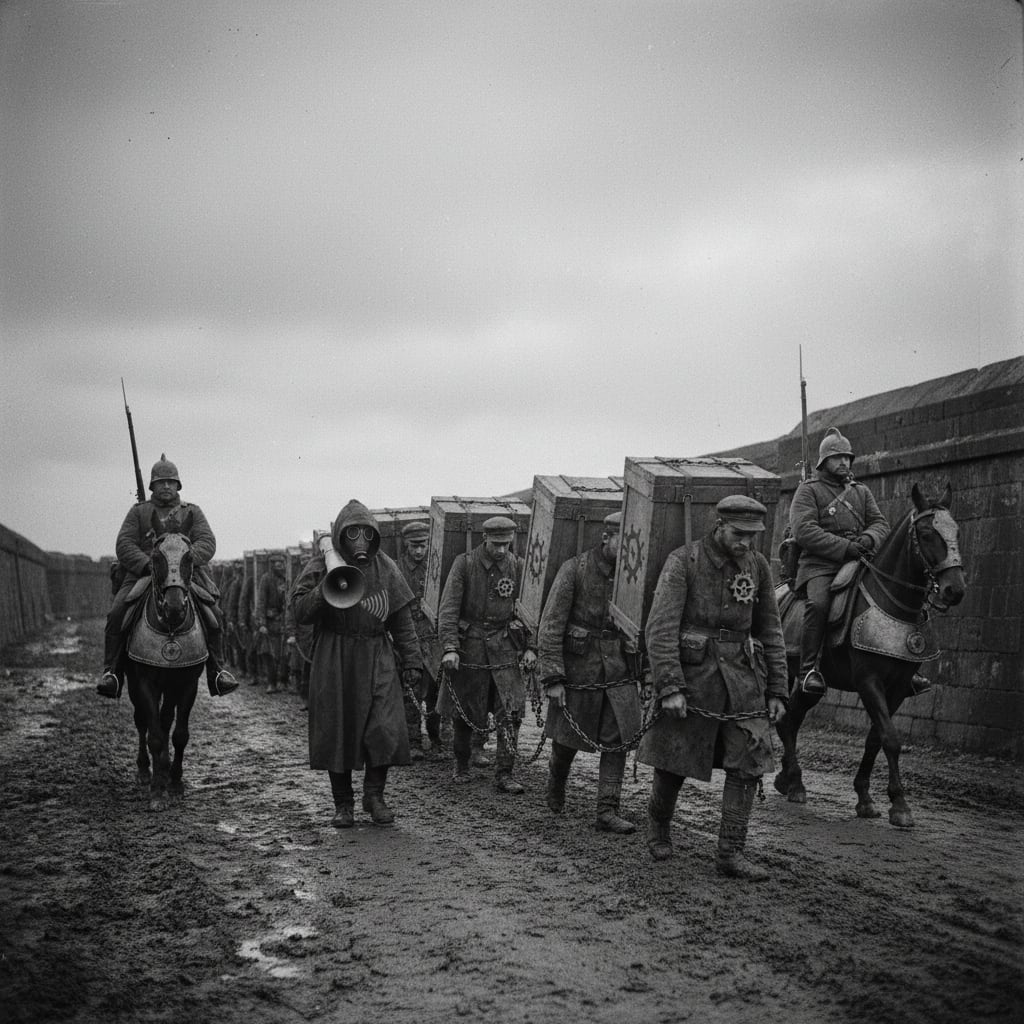
The cargo itself is sealed before departure. Each ossuary crate receives a wax stamp from the seal room — a ceremony performed under incense, with a brief prayer whose text the Bureau of Rites updates quarterly and the Handlers have memorised in seven obsolete versions because no one told them to forget the old ones. The seal is the Handler's bond. A broken seal upon arrival means the cargo is void, the Handler is suspect, and the convoy's entire loss report becomes a tribunal matter. Handlers guard seals the way priests guard relics: with obsessive attention and a terror that borders on the devotional.
#On Quarantine and Classification
Before the march begins, the Handler performs triage. The condemned arrive from courts, from prison hulks, from the Bureau of Purity's holding cells — each bearing a writ that describes the crime but not the body. The body is the Handler's problem.
He classifies. Grade A: strong-backed, disease-free, capable of carrying forty pounds for twenty miles. Grade B: functional, suitable for lighter cargo or shorter routes, expected to survive the march with adequate feeding. Grade C: unfit for march — assigned to depot labour, ossuary feedstock, or "delayed" — a classification that in theory means deferred and in practice means sold to whoever needs a body for work the Synod prefers not to stamp.
The quarantine sheds smell of brine and resignation. Lice checks are performed with combs, lanterns, and the cold efficiency of men who have learned that vermin carry disease and disease kills convoys and dead convoys produce tribunals. The Handler walks the line. He examines hands, teeth, feet, the hollow behind the collarbone where fever hides. He makes marks in a ledger. The condemned stand naked under lamplight while a clerk decides their remaining utility, and the clerk is thinking about departure windows and seal inventory and whether the escort captain will accept a convoy with more than six per cent Grade C, and the naked men before him are column entries, cargo variables, logistical denominators in an equation that ends at the front.
#On the Cart-Saint Riots
The profession acquired its folklore in A.S. 138, when a condemned man named Josek of Düren (Unregistered) — a debtor, Grade A, assigned to a relic convoy bound for Bastion-Irongate — carried a sealed ossuary crate for ninety-three miles without rest, without complaint, and without dying. The convoy was ambushed by deserters at the Graben crossing. Josek, still chained, still bearing the crate, walked through the ambush. The deserters parted. The escort captain later testified that the crate was "singing" — a low hum, audible at twenty paces — and that the deserters fled from the sound. Josek delivered the crate to the Irongate gatewarden, set it down, and collapsed. He was dead before the seal was inspected.
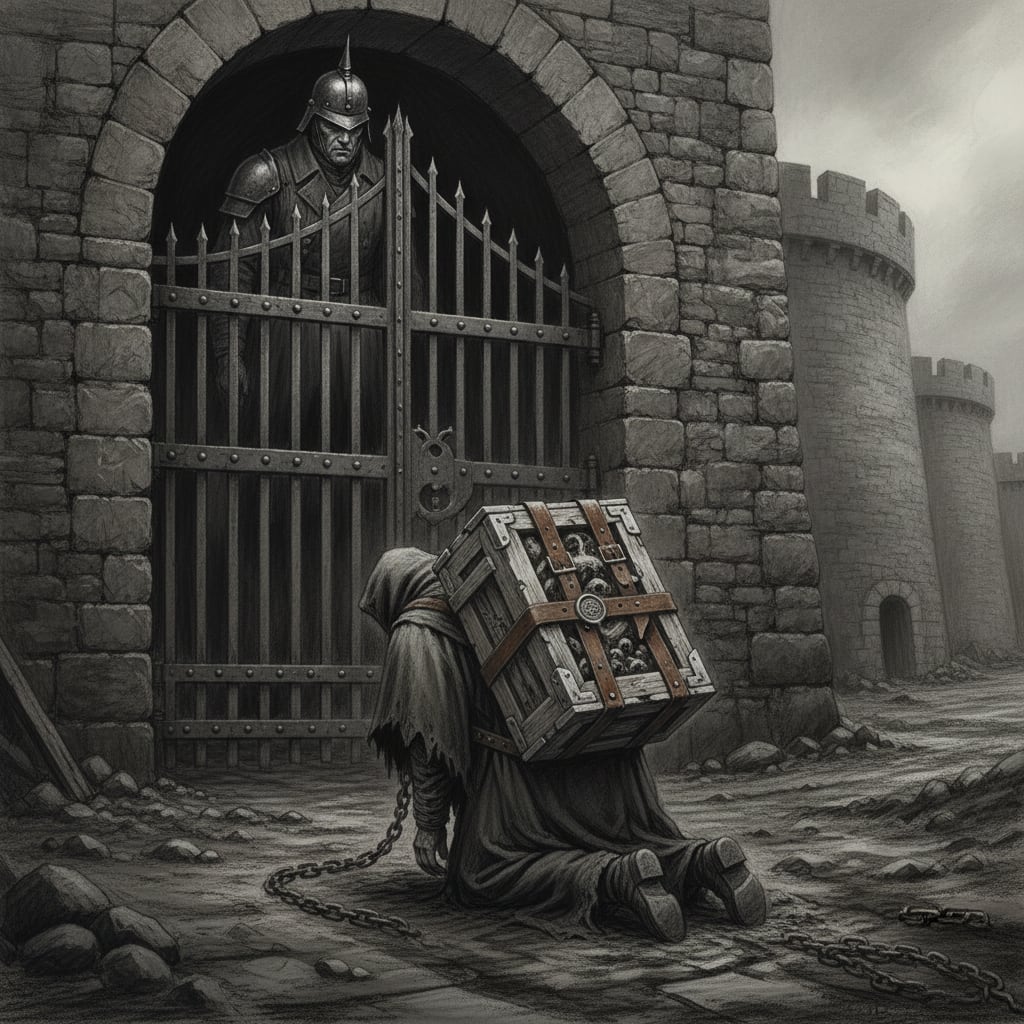
The people of the southern corridor made him a saint within the week. They called him the Cart-Saint — the man who carried holiness on a criminal's back and was redeemed by the weight.
STAMPED ERRATUM — Bureau of Doctrine, A.S. 140. The unauthorised canonisation of "Josek of Düren" is hereby annulled. No condemned person may be declared blessed by popular acclamation. The "singing crate" has been attributed to resonance effects caused by temperature differentials in transit. The term "Cart-Saint" is proscribed. — Sealed, A.S. 140.
The Cart-Saint Riots followed. In three garrison towns, condemned prisoners refused to march unless granted the same "blessing" Josek had received — the right to carry relics bare-handed, to touch the sacred cargo, to be sanctified by proximity. The Bureau of Purity suppressed the riots with characteristic efficiency. The Bureau of Doctrine suppressed the name. The Bureau of War, characteristically practical, introduced stricter masking — condemned marchers would henceforth wear cloth hoods bearing no identifying marks, to prevent the inconvenience of the public remembering their faces.
The Handlers adapted. They always adapt. They sealed the folklore behind operational language: "Don't make saints" became the profession's cardinal rule. A convoy that produces a martyr has failed more catastrophically than a convoy that produces a plague.
#On the Shadow Draft and the Ghost Slot
The system, being human, leaks. Handlers control bodies, routes, and classifications. These three levers, pulled correctly, can make a person disappear.
The "ghost slot" is the profession's open secret. A Handler adds a blank entry to the roster — no name, no crime, no classification. The slot exists on paper. Later, when a name needs moving — a debtor whose family has paid, a political prisoner whose patron has intervened, an innocent caught in a Purity sweep whose release would embarrass the wrong bureau — the ghost slot receives a name, a classification of C, a note reading "expired in transit," and the person walks free at a waystation where the escort has been instructed not to count heads too carefully.
████████████████████████████████████████████████████████████████████████ ██████████ of the Ossuary Convoy Office estimates that between three and seven per cent of all recorded "transit losses" across the bastion network represent ghost-slot operations. ████████ considers this figure acceptable. ████████████████ does not.
The "mercy downgrade" works the opposite direction. A Grade A prisoner — strong, healthy, march-fit — is reclassified as C on the strength of a fabricated medical note. He stays in the depot. He is sold to labour gangs, or assigned to permanent quarantine, or simply left in a holding cell until the next convoy cycle, by which time his family has paid the Handler's price and the man walks out through a door that was never officially opened.
The bribes flow in salt, fuel chits, morphine drops, counterfeit passage tokens, and wax — always wax, because wax is the Handler's currency, the seal press his sceptre, and a man who controls wax controls the difference between a valid convoy and a doctrinal violation.
#On What the Work Costs
The Ossuary-Draft Handler sleeps in quarters that smell of lime and brine because the disinfectants never fully wash out. His hands are cracked from wax and cold. His throat is permanently hoarse — either from cadence-calling in the quarantine sheds or from the bitter tea the old hands brew to "kill crate hum in the throat," a folk remedy for a spiritual complaint no physician will acknowledge and no Handler will deny.
He counts keys obsessively. Every shackle key is numbered, stamped, and blessed; every key accounted for at shift's end. A missing key is a missing prisoner, and a missing prisoner is a tribunal, and a tribunal is the end of a career that was already an inch from the wall. The Handlers tap their key rings the way soldiers check ammunition — compulsively, unconsciously, a tic that marks the profession as surely as wax burns on the palms.
The profession's burnout is specific and diagnostic. A man who has spent years classifying the condemned by cargo capacity will, eventually, stop distinguishing between classification and identity. The Grade A back becomes the person. The Grade C loss becomes the death. The numbers replace the names, and the names — the names are things the Synod giveth and the Synod taketh away, and the Handler, having processed enough of both, forgets that names were ever anything other than column entries in a ledger that someone else will audit when the convoy is finished and the relic is at the front and the bodies that carried it are counted, reconciled, and filed.
STAMPED ERRATUM — Bureau of Mercy, A.S. 199. An internal review of Convoy Office personnel found that sixty-three per cent of senior Handlers (fifteen years or more in service) exhibited "occupational detachment consistent with prolonged exposure to custodial logistics environments." The review recommended counselling. The recommendation was filed. The filing was lost. The loss was categorised as "administrative correction."
The condemned march. The relics arrive. The seals hold or they do not. The Handler stands at the intake counter in the cold lamplight, wax press in one hand, roster in the other, and the next column is already assembling in the chain yard, and the hymn-caller is warming his voice, and the escort captain is checking his ammunition, and somewhere in the quarantine shed a man is standing naked under a lantern while a clerk decides whether he is worth forty pounds over twenty miles.
The Synod calls this penance logistics. The Handler calls it Tuesday.