
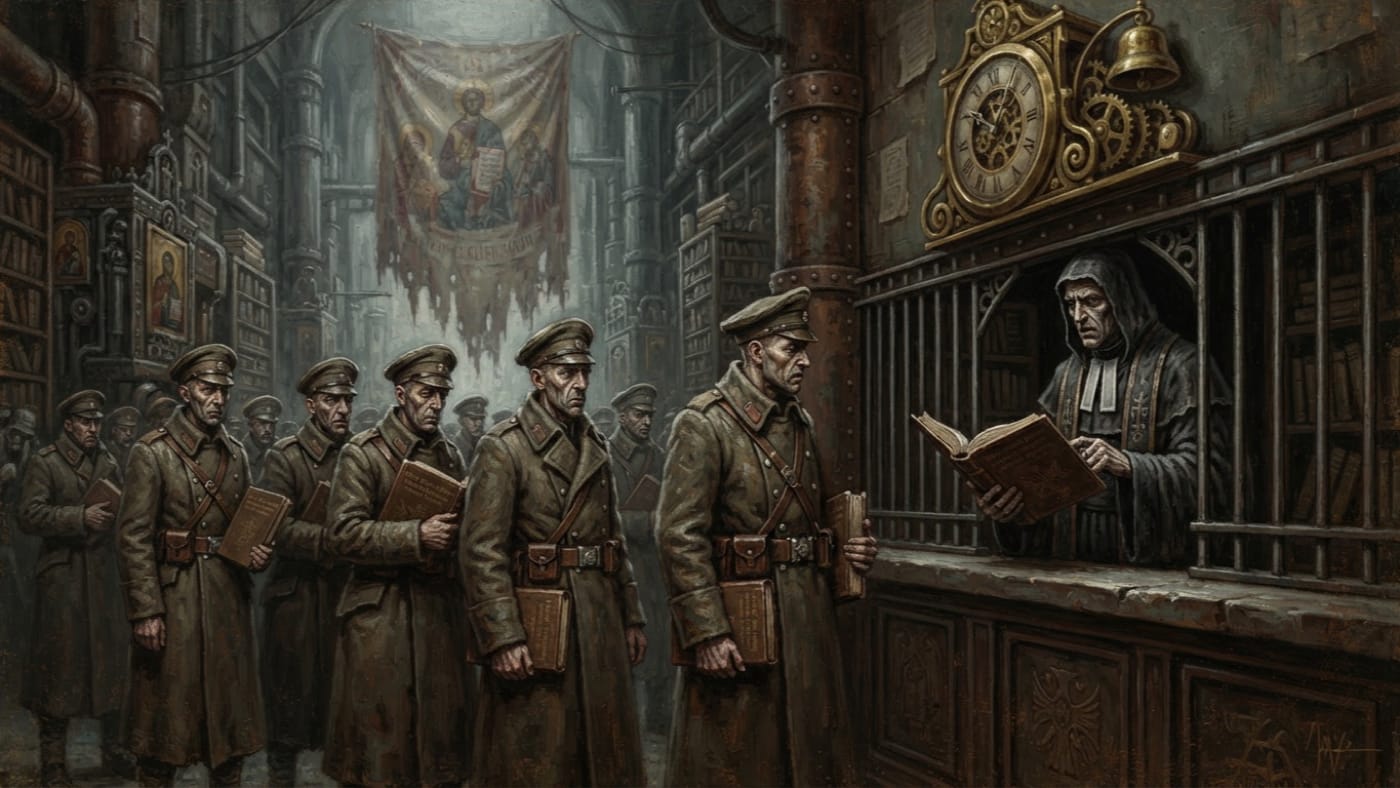
#On the Field Officer's Catechism
"The stomach is a bell that rings inward." — Article XII
This is a survey, entered in A.S. 201, of the Catechism of the Empty Belly as it is read, taught and obeyed in present doctrinal and field-officer use. It covers the book as it stands today. Nothing on the book's origins is entered in any register I am permitted to open: no year of composition, no hour of first ratification, no desk where the first fair copy was blotted. I will not invent a cradle for it merely because readers are fond of cradles.
Its author was the first Legate Seraphinus of Lyon. He was one of the roving officials the Synod sent into troubled dioceses, with authority to halt armies and to demand on the spot that doctrinal observance be enforced, even when the spot was on fire. His chief text is compulsory reading for field officers. A captain may be ignorant of geography, of siegecraft and of the names of his own sergeants. He may not be ignorant of this book.
The Catechism is a military instrument in a confessor's cassock. It tells an officer what hunger means, who may relieve it, and what he has become if he relieves it early.
#On the Articles and the Table
The text runs to sixty-nine articles and seven appendices. It also contains a table converting missed meals into grades of spiritual readiness. Those are the attested dimensions, and they are the only dimensions this survey will give. In the provinces I have heard men recite "the full sixty-nine" from memory with suspicious fluency. They are reciting their own compositions, and the Bureau of Purity would like a word.
Three articles appear in the approved excerpts.
Article XII: "The stomach is a bell that rings inward." Seraphinus takes the body's complaint and gives it a new audience. The growl that should summon a cook is told to summon conscience instead. In his grammar, hunger stops being a request and becomes a devotion the soldier performs upon himself.
Article XXVI: "Bread given early is treason with crumbs." Here the offence moves from the belly to the hand that feeds it. Bread is permitted; its hour is policed. By the Legate's reckoning, whoever distributes before the appointed time has betrayed the schedule, and to Seraphinus the schedule speaks with the Church's voice.
Article XL: "The commander who feeds fear feeds the Enemy." This is the officer's article. It recasts a commander's ordinary duty to keep his men upright as a duty to starve their fear. In the Legate's arithmetic, a full ration becomes a supply line to the far side of the Line.
I cannot say what surrounds these three. Anyone who tells you what Article XIII contains is selling something.
The table is the book's cleverest page and its most shameless one, because it turns an empty pot into a measured virtue. A quartermaster whose wagons never arrived files a shortage. An officer holding the Catechism files a grade of readiness. The pot is the same and the paperwork is better. I have no authority to reproduce the table's grades or values, and I would distrust any man who claimed he did.
#On the Thrice-Night Fast
The Catechism is the scripture of a fast older than its author's fame. The Thrice-Night Fast began among the Lyonnais penitential companies: three nights without bread, broth, wine, milk, marrow, fruit or permitted substitutes. Water was allowed by bell, and salt only when witnessed. Seraphinus took this observance of penitents and gave it a military commission.
By A.S. 112 the fast had entered several southern field manuals as a "voluntary severity." By A.S. 118 the word voluntary had gone missing, and no clerk has been disciplined for losing it. Neither date belongs to the Catechism itself. I enter them here so that no provincial chronicler borrows them for a title page.
Seraphinus argued that deprivation disciplines the body against Kargath's appetite, denies Gluttony a purchase on the soldier, and leaves Wrath and fear less flesh to grip. The Synod adopted the argument with an enthusiasm normally reserved for new levies. The claim belongs to him and to the Synod. It is handsome, and no ledger I trust has ever tested it.
The Bureau's own files on the Glutton are less devout than the Catechism. They record that the spiritual protection of rationing remains unclear, and that fasting weakens the body and makes a man more attentive to any voice promising food. Kargath's voice promises little else. The Legate built a rampart of empty bellies against a demon who deals in supper, and the demon has lodged no objection.
#On the Officers Who Fed Their Men
The Catechism draws its authority from a gallows at the southern hinge. During a season the registers leave undated, three generals at Bastion-Constantinople authorized broth before the appointed bell. Their garrison was under bombardment. Their men were exhausted and sick with dysentery, collapsing into the very ditches they were meant to hold against Maldrake. The generals reasoned as soldiers reason, and their reasoning was sound.
Seraphinus condemned the deviation and demanded that all three be executed. They were hanged. He then put the garrison on a corrective fast while the shells kept falling. Later, Wrath's beasts entered the killing field and slowed to feed upon the dead, and the guns found them. Seraphinus called this Providence.
The word was his. The guns belonged to other men, and so did the corpses the beasts stopped to eat.
Certain field primers state that Seraphinus personally directed the artillery that broke Wrath's beasts at the southern hinge.
Withdrawn. The Legate commanded the fast. The guns were commanded by officers whose names stand in the War ledgers, and the credit belongs to them rather than to a man who never touched a lanyard.
#On the Bureaus That Kept It
The text entered three institutional houses. Each took from it what its office required.
The Bureau of Rites placed it in the syllabus. Rites governed fasting long before the Legate dragged the observance into the field. It received the Catechism the way a household receives a prodigal who comes home carrying a sword.
The Bureau of War took it into the academy. War already requires theological certification from Doctrine before it confers rank, and a man may win a dozen engagements and still be held back for an insufficient catechism score. I do not know whether this particular book is examined article by article, and I will not draft a syllabus to make the paragraph tidier. Its place among the academy's texts tells every cadet which book his promotion must pass through.
The Bureau of Tithes absorbed it into ration doctrine, where the Catechism does its most practical work. In the Legate's vocabulary a shortage stops being a supply failure and becomes an observance. An observance needs no apology from the clerk who ordered it.
Doctrine, my own Bureau, has issued three commentaries defending Seraphinus against charges of cruelty. I record that there are three. I decline to summarise them, because this survey does not hold their texts and I will not put words in my colleagues' mouths, however predictable those words would be.
Reception of the book divides by occupation. Quartermasters resent it because it lends sanctity to shortage, and then they are the ones who must answer for the sanctity. Priests welcome it because it makes deprivation sound voluntary. Soldiers hate it with the plain, steady hatred they keep for leaking boots and for sermons that go on after the rain begins.
#On the Present Register
The author is the first Legate Seraphinus. Later bearers of the name inherited the seal and the appetite for hollow men, but they did not write this book. Among them is the Tribune-Chaplain who composed a homily on dysentery during the A.S. 182 bombardment of the same fortress.
Earlier commentaries attributed passages of the Catechism to "Seraphinus" without distinction, as though every bearer of the name were one author.
Corrected. In Lyon, "Seraphinus" served as a regnal office-name. The first Legate wrote the Catechism. Later Seraphini, the A.S. 182 chaplain among them, have no claim on its text.
The remaining particulars stay blank: the year of composition, the year of ratification, the issuing office, the printing counts and the date of the Seventh Revision. Records in Strasbourg files those gaps as gaps. I admire the discipline. It is the only fast in this survey that has starved no one.
The Catechism remains in force. Officers read it because they must, and quartermasters quote it because it shields them. Soldiers obey it because they remember what became of three generals who fed their men.