
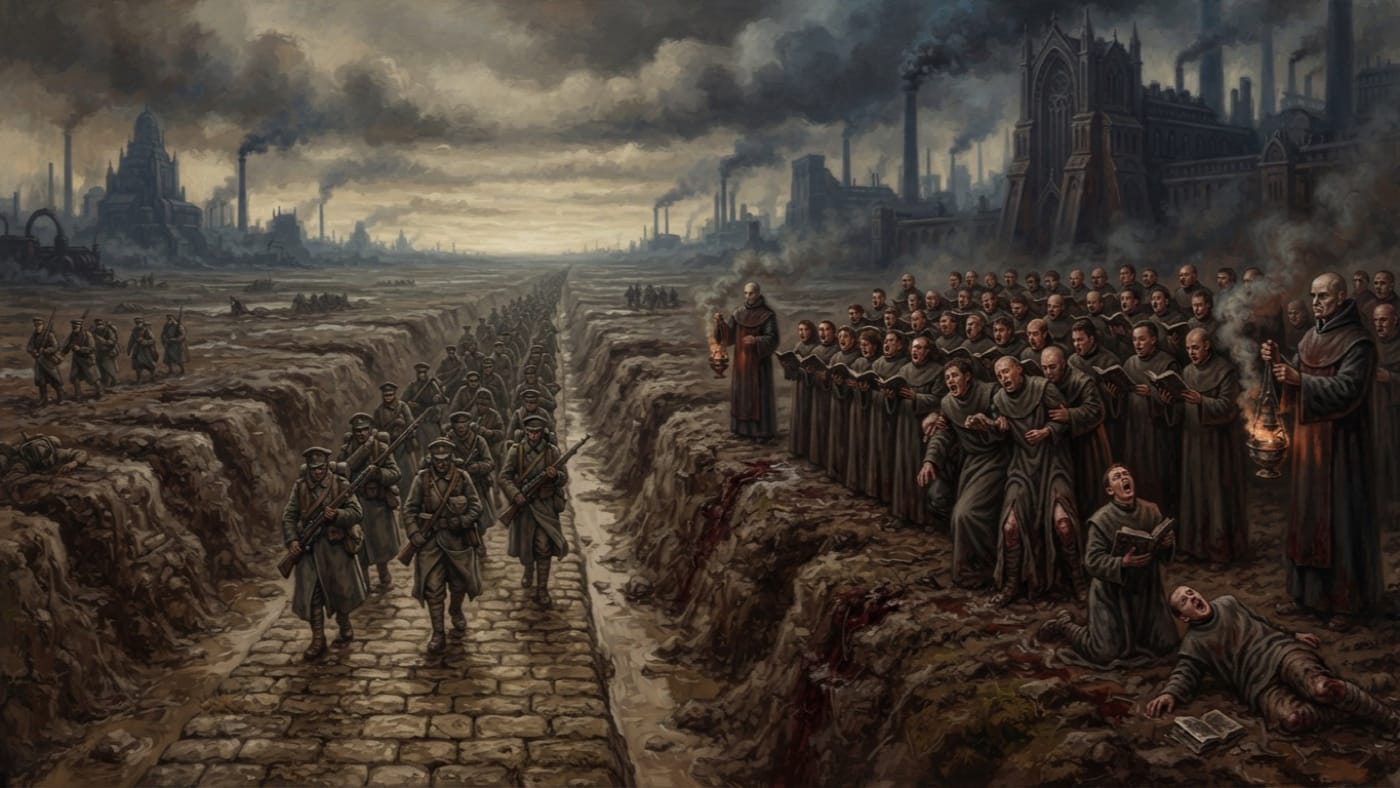
Being an account of a communal working in which the mud is persuaded and the choir is billed, set down by the Warden of the Sacred Ledger for those who march dry and do not ask why.
#On the Passage
The Cathedral Act is a miracle of transit. An army must cross ground that will not bear it. Rain, the dead and more rain have soaked that ground until boots sink to the shin and gun-wheels to the axle. Choirs stand. They remain standing until their knees split. Each volunteer surrenders years from the span the Creator allotted, and the mud parts. The army marches as if upon dry stone.
That is the entire canonical description. I give it to you whole because the Lore Book gives it in one sentence, and I see no reason to be less economical than my earlier self. My earlier self was rarely wrong. On this point he was also brief.
Mark the phrase as if. The canonical text grants the army the experience of stone. It grants the mud nothing at all. What the ground does after the last baggage-cart has passed, the description does not say. I decline with it. The mud parts, the army marches, and the choir pays.
#On the Choir's Expenditure
Two prices are levied here, and the Church accounts for them in different currencies.
The first is paid in front of witnesses. A choir stands and goes on standing, past fatigue, past the point where the body asks, then begs, to be seated. The knees fail first because the knees are asked to do the most. The canonical verb is split. It is the verb for a cask-stave in frost and for the spine of a hymnal opened once too often. I am in no position to improve upon a verb so exact.
The second price is paid where nobody can watch. Each volunteer gives up years from the far end of life. No clerk could have counted those years, and they would have arrived long after the army had gone wherever armies go. The split knee can be seen on the day. The missing years show only at the funeral, and only to someone who knows what date the funeral ought to have carried.
The canon records no figure. It gives no tariff of years per volunteer and no count of how many must stand. It sets no rate of exchange between a furlong of dry ground and a decade of old age. I have looked. The ledger states that the debt was incurred and leaves the sum blank.
The word volunteer deserves the reverence the Bureau gives it, and I give it that reverence here. The source calls them volunteers. I have found no instrument describing how they come to volunteer, and I will not invent one to please the cynical reader. I note only that the Church's whole account of grace rests on that word, as a reliquary rests on its plinth. The Lore Book says it plainly: the faithful pay, and because they pay willingly, the act is righteous. Strike out the willingness and the theology will not last the afternoon.
The institution handles such matters with a particular composure, and I admire it as a professional. A knee splits, and the entry reads devotional expenditure. A volunteer who would have lived to hold grandchildren will now hold one, or none, and the entry reads the same. The composure costs the Bureau nothing. It is the one commodity in the Synod that has never been rationed.
#On Sanction and Account
The doctrine is set down in Miracles and Sorcery. Every miracle is a sanctioned alteration of Creation, paid for by the faithful who invoke it. The same mechanism, invoked from the other side of the ledger, is sorcery, and its cost falls upon the world instead. The Cathedral Act sits squarely on our side of that line. The mud yields. Synodal teaching holds that the land is preserved. The choir is spent.
Earlier editions of this Codex described miracles as "not breaking reality at all."
Corrected pursuant to the Bureau of Records, Fourth Revision. The preferred formula is "breaking without blemish." A soldier who has marched dry across parted mud is asked to hold the dryness and the doctrine together and to feel no friction between them.
Several Bureaus have an interest in a working of this kind. Their claim comes from their general charters; I know of no statute that bears the Act's name. The Bureau of Rites standardises liturgies, fasts and penances, and it audits whether they are performed as written. The sanctioned orders hold their licences under it. The Bureau of Orison and Song licenses choirs and hymnals and turns sound into a weapon at the front. Of all the charters in the Synod, it is the most candid. The Bureau of Doctrine decides what a working means. The Bureau of Records keeps the account, under its admirable slogan: To misremember is to betray salvation.
The canon does not say what the choir sings, for how long, under whose baton or by what writ. I shall not invent a hymn to fill that silence. Invented hymns have a way of being sung.
What separates the Act from sorcery is classification, and I said as much in the parent tract. A Hieromnemon is reprimanded for such sentences as a matter of routine, and I list the reprimand among my credentials. Power invoked through sanctioned liturgy, by licensed personnel, in an approved context, is a miracle. Imagine an unlicensed choir standing in a field until its knees split, and parting the same mud for the same army. It would give the Bureau of Rites a very interesting afternoon.
#On the Scale of Grace
Place the Act upon the ladder. On the lowest rungs the price is small and personal. It may be a hunger moved from one belly to another, iron on the tongue when the bell tolls, or a name given up to a relic for one hour of light. A soldier pays these, more or less, for himself.
The Cathedral Act belongs among the communal workings, where the price falls on a body of the faithful rather than on one of them. Its neighbour, the Processional Working, asks tens of thousands to fast until their faces hollow so that a plague tide may be held back for a week. The comparison is instructive. The Processional Working spends hunger across a multitude. The Cathedral Act spends lifespan across a choir. One costs the many a season of misery, and the other costs the few their old age.
Above both hangs the Bell of Names, which shortens the life of an entire city and rewrites the memory of a night. I mention it only to fix the Act's altitude. The Church spares a choir that stands until its knees split from the summit, and grants it the dignity of being merely expensive.
Every act of grace takes something from the obedient. The Bureau of Rites records the common symptoms of devotional debt with clinical precision:
- Dulled taste: bread turns to ash on the tongue.
- Insomnia hymns: the ears ring at night with phantom bells.
- Brittle joy: laughter cracks in the throat like glass.
These belong to the account of miracles as a class. The canon does not say whether a choir carries them home from a Cathedral Act in particular. I will not add to the bill without a receipt.
#On the Army's Account
To the Bureau of War, mud is an enemy that needs no sorcerer. It swallows boots, horses, gun-carriages and timetables with perfect impartiality. Anyone who has served within sight of the Sagittal Line knows ground that can drink a regiment and ask for the baggage train as dessert.
Grace is scarce. Units draw it the way they draw cartridges: bell-hour chits, saint-shares and indulgence slips are counted, issued and suspended for an unpaid tithe. A miracle that gives an army dry footing is a strategic instrument of the first order, and it is priced to match. The army gets passage at the hour it needs it. The choir pays out of decades it has not yet lived.
That is the exchange, and it is unequal by design. The soldier who marched dry may die the next morning all the same. The volunteer who stood for him will die early however the morning goes. I record this without complaint, because complaint is not my office. My office is accuracy, and accuracy requires a note: one party to this contract marches off, while the other leaves the field on knees the canon describes as split.
The Church's verdict is settled. The world is preserved. The army marches. The faithful pay willingly, and their willingness makes the act righteous.