
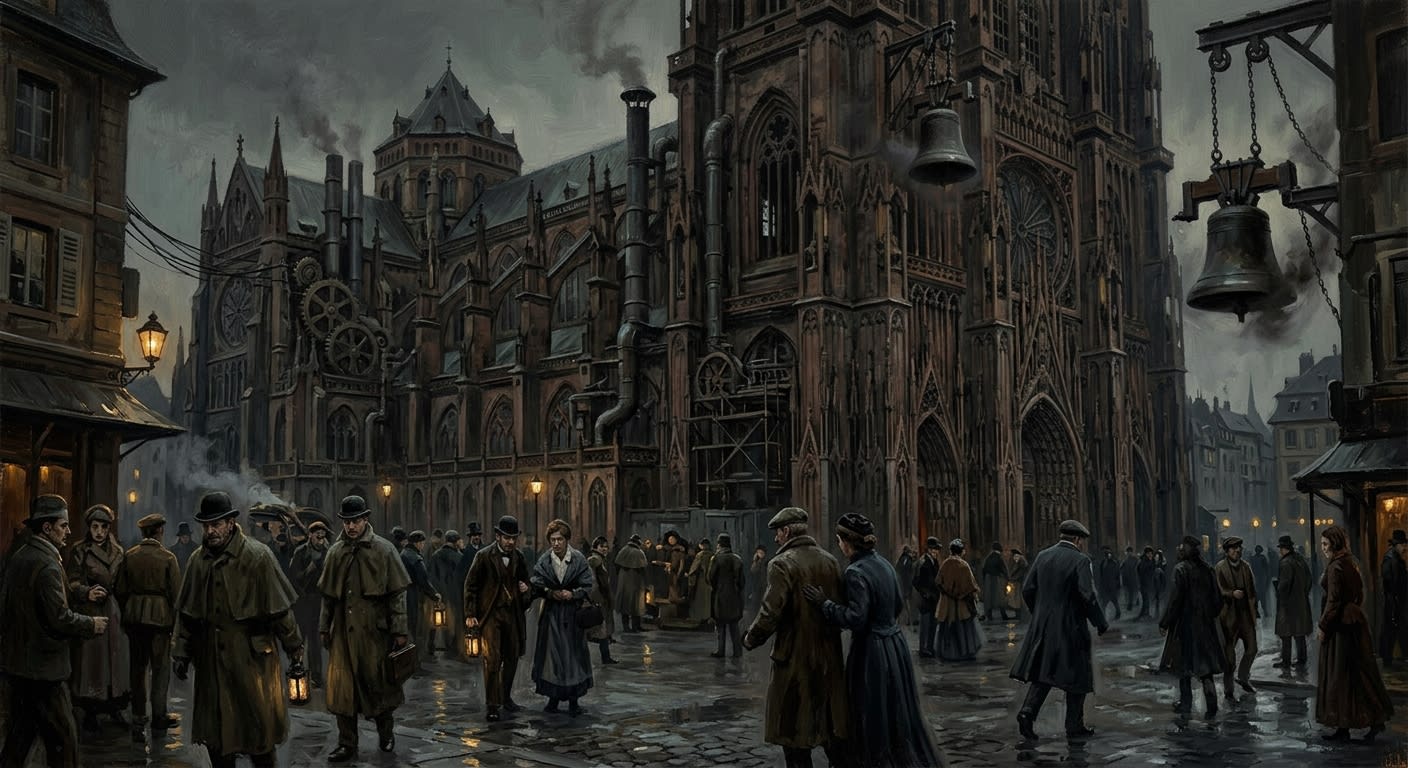
#On the Lesser Cathedral with the Louder Conscience
The Cathedral of the Perpetual Writ stands behind the western cloister lanes of Strasbourg, near enough to the Cathedral of All Saints and Settled Accounts to borrow its shadow and far enough to resent the charity. It is a subordinate cathedral, a chancery church, a bell-table house, a funeral-route authority, and the most famous accomplice of a vespers bell in the Synodic west.
The great Cathedral receives pilgrims, crowns decrees, fattens treasuries, and teaches the capital how magnificence smells when mixed with wax and damp wool. The Perpetual Writ performs the meaner holiness: it authenticates parish copies, hears clerks' oaths, ratifies mourning permits, stores dead route-tables, and tolls the hour for offices too small to command the great bell tower and too vain to admit they are small.
Its name derives from an old doctrine of copied authority: a writ, once properly issued, does not die when read. It persists through copy, citation, seal, correction, and the stubborn obedience of clerks who have forgotten why the first line mattered. The Cathedral made this doctrine stone. Its walls are crowded with framed writs, obsolete writs, counterfeit writs retained as instructional enemies, and writs so corrected that the original text survives only as a rumor under red ink.
#On Foundation and Use
The Cathedral began as a scribal chapel attached to the old western chancery houses, where diocesan copyists swore their ink before carrying orders into parishes that preferred oral custom, local saints, and other diseases of memory. By A.S. 90, after the Concordat of Strasbourg made the capital's appetite continental, the chapel had become too busy to remain charming. Charm is the first casualty of useful paperwork.
The Bureau of Records took one side aisle. The Bureau of Bells took the west tower. The Bureau of Rites took the sanctuary calendar and never returned it. Doctrine took the pulpit, which surprised no one and improved nothing. The building was enlarged in stages: north registry porch by A.S. 96, bell-table loft by A.S. 115, mourning permit desk by A.S. 123, and the sealed south archive after A.S. 129, when people began to understand that old route sheets should not be thrown away merely because everyone on them had drowned.
A.S. 118 parish histories describe the Perpetual Writ as “a quiet daughter-house of Strasbourg Cathedral.”
Corrected. Quietness was never its virtue. It was small, ambitious, overused, and liturgically sharp-elbowed. Its bells were already disputing with Saint Erasmus before the disaster gave that dispute a body count.
The nave is narrow by capital standards, built for clerks, mourners, minor advocates, copy-priests, widows seeking corrected death schedules, and parish officers who come to prove that their local transcript of a Synodal order has not drifted into theology of its own. A clerk enters with a village writ. The desk checks seal, lineation, margin gloss, ink shade, date, authority chain, and whether the parish has paid the necessary renewal fee. If all is sound, the writ is read beneath the rood screen and becomes a lawful copy. If all is unsound, the clerk is sent to the correction bench, which has no cushions because mercy breeds recurrence.
#On Stone, Ink, and the Bell-Table Loft
The Cathedral's architecture is beautiful in the clerical sense rather than the ordinary pilgrim one. It lacks a great west face, aerial ambition, and any sainted rose window large enough to bankrupt a glassmaker. Its virtues are narrow lancets that admit light onto desks, aisles wide enough for two file carts to pass with mutual contempt, wall niches sized for bound tables, and a bell stair that spirals so tightly that fat men learn humility by the third landing.
The east wall carries the Perpetual Writ itself, or rather a ceremonial copy of a copy of a ratified excerpt from the doctrine governing copied authority. The actual controlling file sits in the Basilica vault under three offices and a dead man's signature. The displayed copy is still revered, kissed, polished, misquoted, and used to settle disputes among parish scribes who would be unbearable even without scripture on their side.
Above the west porch sits the Bell-Table Loft. There the day's cathedral-quarter schedule is copied onto slates: Saint Erasmus, the Perpetual Writ, chapel bells, funeral bells, vespers bells, market silence, route holds, route releases, and any special suspensions issued by the Cadence Corps. Before A.S. 129, each column was maintained by the office that owned it. This arrangement pleased institutional pride and killed nineteen mourners.
The tower holds four principal bells. Writ calls clerks to oath. Copy marks authentication. Vespera governs the evening office. Minor Correction, smallest and least loved, rings when a parish transcript is rejected publicly. The bell that struck on the Night of Two Bells was Vespera. It remains in the tower. Bells asked to recast it after the inquiry. Records objected on evidentiary grounds. Rites objected because recasting would imply guilt. Doctrine objected because everyone else had already objected and the moment looked lonely.
#On the Night of Two Bells
A.S. 129 gave the Cathedral its eternal paragraph. A funeral procession of eight hundred mourners moved through the cathedral quarter from Saint Erasmus toward the ossuary steps. Black cloth registered. Candles counted. Route tokens stamped. The lead Marshal tuned his whistle to the funeral bell of Saint Erasmus. The route passed behind the Perpetual Writ at vespers.
Saint Erasmus tolled. Vespera tolled with it.
The two notes met over the west cloister lane and produced a third sound: plausible enough to obey, false enough to divide. The front rank held funeral cadence. The middle corrected toward the Cathedral's vespers. The rear heard both and lost the street. Three streams formed. One reached the ossuary. One escaped into market alleys. One followed the Cathedral bell into a repair quarter where lamps were out, gas-line works narrowed the road, a canal rail had been removed, and the watchman had achieved the ancient bureaucratic miracle of being assigned and absent.
Nineteen died at the canal embankment.
CATHEDRAL OF THE PERPETUAL WRIT — VESTRY HOLDING NOTE, A.S. 129 Items recovered from canal dead: shoes, candles, route tokens, black cloth strips, one child's bead cord, one Marshal's chalk mark transferred to wet sleeve. Unclaimed sound reported in vestry after bodies laid out: ███████████. Instruction: do not ring Vespera until inquiry completes. Actual practice: Vespera rang at Prime.
The Cathedral's first defense was punctuality. Vespera had rung at lawful vespers. The bell-table permitted it. The vespers office had not been suspended by a living writ. This defense was perfect in the way a guillotine is perfect: clean, vertical, and useless to the neck.
The Cathedral chapter's first statement declared that “no bell of Perpetual Writ departed from its appointed obedience.”
Corrected after the canal returns. The bell obeyed its table. The table failed the street. Obedience, severed from judgment, is only error wearing shoes.
The inquiry entered the tower, the route desk, the Saint Erasmus parish office, the Engineering repair files, the Cadence Corps whistle register, and the Perpetual Writ vestry. It found no demon, no saboteur, no heretical bell-ringer, no foreign agent wearing a cassock. It found columns that had not spoken to columns. It found lawful instruments behaving like rival princes. It found a city whose stones had been asked to carry grief, vespers, repairs, commerce, and administrative vanity through the same throat.
#On the Route Law That Followed
The Route-Timing Concordat was drafted in rooms adjoining the Perpetual Writ, which is fitting, since a law born from drowning should smell faintly of damp paper. The Concordat forced route sheets and bell-tables into one Integrated Route and Bellway Table, Form RT-1, later RT-1b when someone noticed that bridges deserved mention before the dead began suggesting it.
Two-bell clearance became law. During funerals, levy transfers, relic processions, ration releases, penitent marches, and evacuations, no bell within harmonic range may strike unless cleared by the lead Marshal. The Cadence Architect rank emerged from the same correction: pale specialists trained to map where obedience breaks before obedience is invited to prove them right.
The Perpetual Writ hated the Addendum with admirable sincerity. Its chapter objected that vespers could not be subordinated to street logistics. The Corps produced the casualty diagram. Bells objected that a Marshal's whistle should not silence consecrated bronze. The Corps produced the casualty diagram again, with the canal lip circled in red. Rites objected in a learned memorandum whose Latin occupied six pages and whose argument occupied none. The Corps, having discovered the persuasive value of bodies, requested a larger copy of the diagram.
As of A.S. 201, the Addendum is recited to Bell-Table Loft apprentices before they are allowed to touch chalk. They learn the names of the nineteen only in sealed instruction, because public commemoration risks grief becoming local property. The public tablet says: NINETEEN CITIZENS, LAWFUL PROCESSION, A.S. 129. The private roll has names. The private roll is better. Naturally it is locked.
#On Present Custody
The Cathedral of the Perpetual Writ remains active, useful, chastened, and insufficiently chastened. It authenticates parish copies by day, rings lawful offices under Route-Timing restraints, houses the A.S. 129 inquiry copies in the sealed south archive, and teaches each new clerk that a document can be true in one office and murderous in the next street.
Funeral columns still pass behind it. Marshals still glance up at the west tower when they do. Vespera still hangs in the cage with its lovely guilty throat. On wet evenings, when the canal smells through the lanes and Saint Erasmus' bell carries low over the stones, the Bell-Table clerks hold chalk above slate for a heartbeat longer than necessary. Good. Let them.
The Perpetual Writ's final lesson is irritatingly sound: a city may survive bad men, false relics, hungry offices, and clerks with beautiful handwriting. It does not survive divided command at a narrow turn. One street, one sound, one officer whose name can be read after the bodies are counted.
The present chapter keeps copies of Bellway discipline beside the Cadence Corps training slate, not from humility but from fear with a binding. Apprentices touch both books before touching the chalk. This is superstition, procedure, and a better education than most seminaries provide.