
#On the Slope
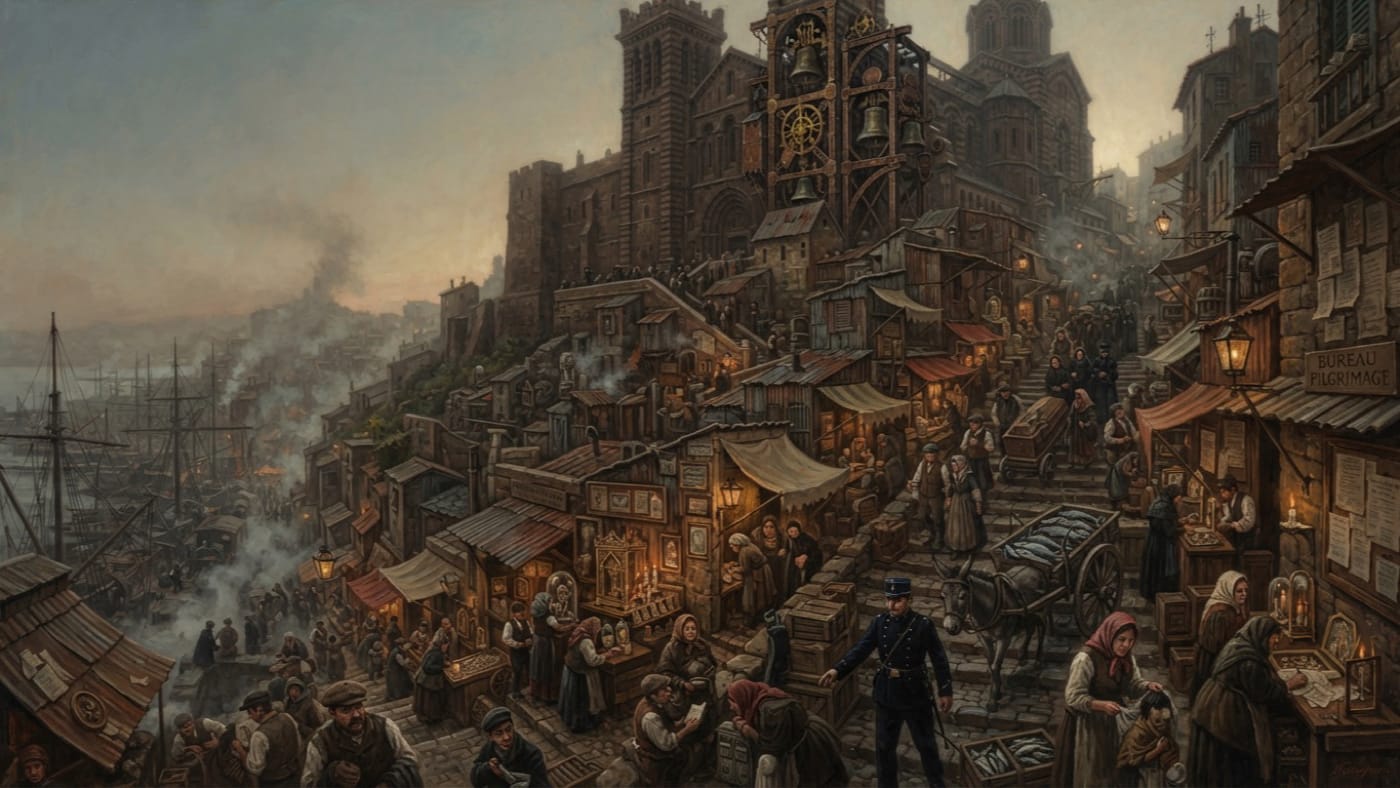
The Cathedral Quarter of Marseille is the ground Saint-Victor could not consecrate fast enough. It starts where the cathedral's lower steps turn into shopfronts. By common consent it ends somewhere near the old harbour, where the lanes stop being pious and start being fish. No Synodal surveyor has fixed its edges. Several have tried to walk it with a chain and come back with a rosary, a fried sardine and a guide they never asked for.
The lanes fall in cramped descents of salt-worn stone between cathedral and water. The relic dealer district presses against the lower steps. Pilgrim hostels, scribal booths and wax shops crowd the rest. Above it all stands the cathedral's western mass, with the reinforced bell cage of the Bureau of Bells driven through it like an awl through a ledger spine. One climbs toward sanctity and descends toward supper. The gradient is the same both ways. Only the prices change.
The air carries wax, salt, frying oil, wet rope from the ropewalks, incense from the porches and the cold breath of very old stone. A pilgrim fresh off the Rhône road smells holiness. A resident smells Tuesday.
#On the Stalls and Their Licences
The wax sellers trade at the top, nearest the porches, because candles sell best within sight of the thing they are lit for. Below them work the rosary-cutters and the reliquary polishers, bent over benches of brass and glass. They buff the little windows through which the faithful may inspect a knuckle, a tooth or a sliver of something brown. Fried-oil stalls hold the corners. Scribal booths go wherever a clerk can wedge a stool, and there the clerks write petitions, letters home, vows, complaints, and now and then a confession for a pilgrim whose hand shakes.
Then come the dealers. Licensed relic dealers frame their certificates under glass, often in gilt, sometimes with a candle burning beneath, as though the seal of the Bureau of Relics were a minor saint. Authenticated fragments share the counters with fragments still awaiting authentication. Uncertified objects travel under counters and inside sleeves. They are offered in a low voice to anyone whose accent suggests a long sea voyage and little acquaintance with the Bureau. The every-second-shop arithmetic in my cathedral article was satire. Nobody has measured the real proportion, and I decline to measure it. If I did, the Bureau would be obliged to act on the figure.
The canons have made a sacrament of frontage. Stalls on ground beside the cathedral are leased under parish licence. Guides pay for the right to start their tours in the shade of the west door, which is the coolest shade in the Quarter and so the dearest. When a buyer complains too loudly, a dealer may purchase a Mass of Remedial Doubt, and the complaint is offered up with the rest of the morning's intentions.
Near the southern porch hangs the noticeboard of the Bureau of Pilgrimage. It carries departures for Thessaloniki, penance schedules, berth changes and lost children, all pinned at the same height. Mothers read it before they read the sailings.
#On the Hours and the Crossings
The Marseille Watch owns no bell, yet it has learned to tell the time by obstruction. Its note of A.S. 200 is the nearest thing the Quarter has to a constitution.
Prime is the pilgrims' hour. The hostels empty uphill toward Mass and the guides gather their flocks at the west door. The Watch calls the crush manageable, which in Watch language means nobody fell down the steps who could not get up again. By terce the market is awake. Little Beryn sounds its cracked complaint over the roofs. It cracked in A.S. 167, was never properly mended, and every child in the lanes can imitate it. Then the relic trade spills out of its doorways into the street. The Watch's word is severe. Visitors assume Beryn opens the market. It does not, and no statute ties the trade to terce. The trade arrives when the pilgrims have finished being blessed and started having money.
Between sext and none the Quarter performs its daily miracle of traffic that cannot fit. Fish carts climb up from the harbour while funerals cross the slope, and both cargoes are perishable. The Watch calls this interval intolerable. The mourners and the fishmongers have their own words for it. I have heard them. They are not in the Bell Codex.
Above the lanes, the relay orders the harbour, and the harbour answers in the lanes. When Marthe calls pilgrim muster, hostel doors bang and guides lose half their parties to the quay. When the relay holds ship traffic for a relic transfer from Quai Saint-Lazare, the stallholders know a fresh certification will soon come up the slope, and they adjust their prices. Salt-John's harbour alarm stops bargaining mid-coin. The descending five-peal for fire in the dock quarter sends half the street downhill to help and the other half uphill to watch. At vespers the bells simply drown the haggling. The Watch records the complaints as routine, which they are.
#On the Claims upon the Quarter
Nobody rules the Cathedral Quarter. Everybody collects from it.
The Diocese and the cathedral chapter hold the church's interest and the property, which is to say the frontage. The city of Marseille claims its streets. It exercises that claim through the Watch, mostly by writing down how impassable the streets are. Bells owns the sound and every movement the sound commands. Pilgrimage steps in when ships are boarding, and Relics whenever anything certified moves. Tithes comes for its assessments. War arrives when a harbour alarm reaches the garrison. The Bureau of Purity comes when its broken triplet sounds, and residents mistake that triplet for a fishmonger's handbell more often than Purity would like recorded. That makes eight claimants on one slope. In no archive of the Synod have I found any settlement among them.
The chapter is the most practised claimant. In A.S. 174 Tithes sought a levy on bell-tour admissions, and the canons reclassified the tower stairs as a penitential ascent. The guides at the west door went on paying the chapter. In A.S. 186 the Thessaloniki surge brought Pilgrimage demanding the nave. Bells answered with a maintenance peal that ran for six hours, and the departing faithful poured down through the Quarter to the quay, buying candles on the way.
Relics circulate through the same lanes. Objects refused at Saint-Lazare are carried uphill for comfort. The canons store them for a time in the Victor Crypt, and in due course a Relics clerk carries them back down. Every leg of that circuit passes a dealer. Demand, of course, is fed by the cathedral's own treasures: the Arm of Victor, the Rib, and the Vessel of Harbour Rats. The canons tell of a plague procession whose passing drowned the harbour rats, and the faithful repeat it at every stall. Relics has authenticated some of the bones. It has declined to authenticate the rats' motive.
Earlier parish pamphlets claimed that "no false relic has ever rested beneath Saint-Victor."
Corrected by the Bureau of Doctrine. Rejected offerings rest in the crypt as a matter of routine while they await return to Quai Saint-Lazare. The lanes below the steps contribute their share of them.
#On the Lower Lanes after Compline
After compline the Quarter does not empty. It shrinks. Awnings stay lashed out over the lanes, crates stay stacked against the walls, and people stay wherever they last sat down. The Watch reports that its enforcement wagons cannot pass lower Saint-Victor Lane until awnings, crates or people are moved. The wagons wait. The Quarter sleeps on.
The cathedral above keeps its own night file.
BUREAU OF BELLS INTERNAL NOTE — SAINT-VICTOR RELAY, A.S. 191 The midnight return-peal of Victor during calm weather has no authorised ringer. Rope inspection: dry. Bell motion: confirmed. Sound direction: inward. Witnesses: ███████████████████
Bells denies any anomaly. The canons deny hearing anything after midnight. Neither denial accounts for a dry rope on a moving bell. And the lack of an authorised ringer proves only that nobody with permission was holding the rope. The file stays open in every sense a file can be.
The fishwives of the lower Quarter keep a separate custom for a separate sound. When Victor groans in fog, they cross themselves and refuse to sell eels before dawn. The custom concerns fog. The file concerns calm weather. Visitors confuse the two. Residents never do, and on every foggy morning the eel trade loses its first hours to the difference.
As of A.S. 201 the Quarter is open, crowded and paying rent. The wax is lit, the certificates are framed and the noticeboard is full. Lower Saint-Victor Lane is blocked, as it was last year and as the Watch expects it to be next year. Over Marseille the bells keep the hours, and below them the slope keeps its accounts.