
#On the Present Review
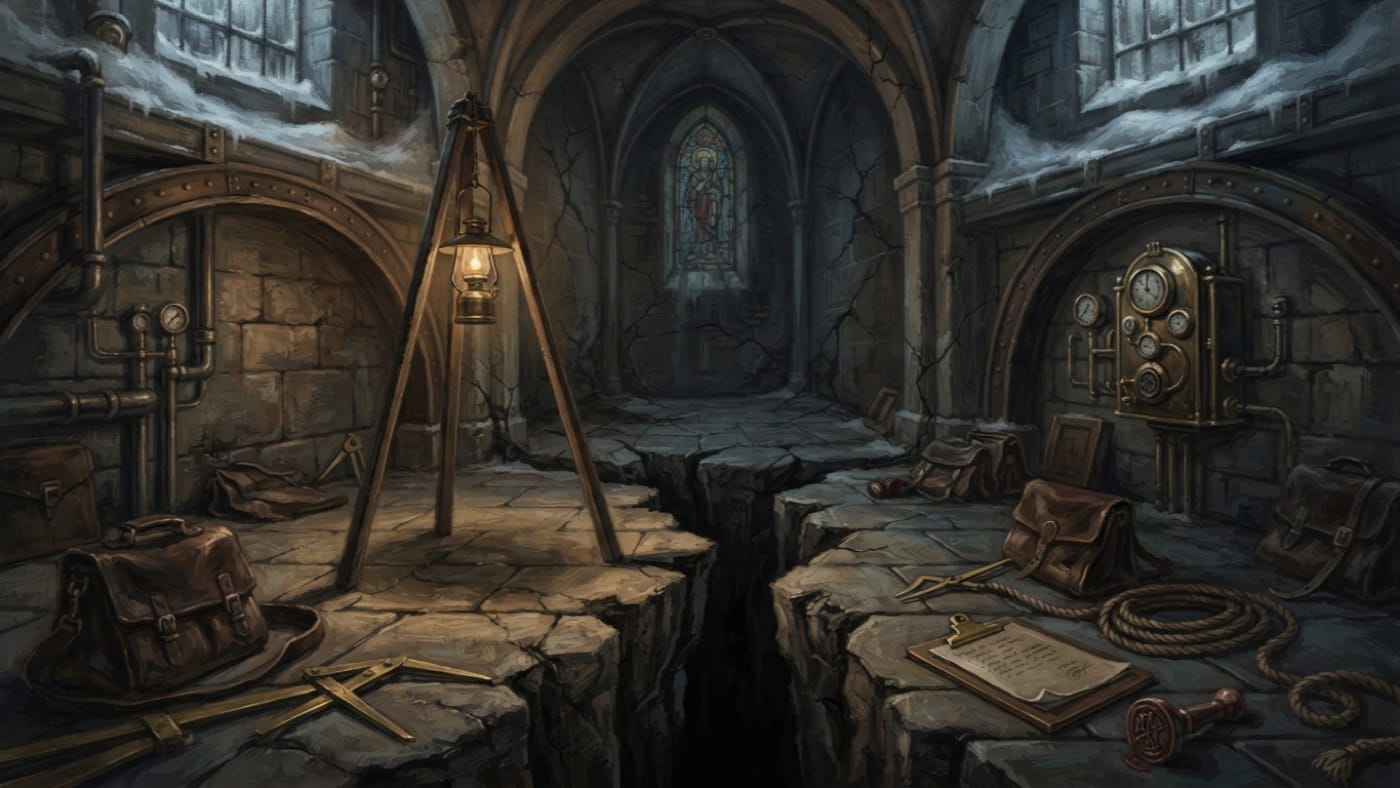
This survey was conducted in A.S. 201 under my seal, at my considerable inconvenience, and it concerns a crack. More exactly, it concerns what the archive still says about a crack. That is less than the crack deserves and more than most chapels ever receive. The Chain-Vault Crack opened beneath a chapel in Przemyśl, in late winter. The year is unrecorded. So is the chapel's dedication, and so is whatever waited at the bottom. I will thank the reader to stop leaning forward.
The evidence under review is one sentence in the First Quake-Ledger, in its passage on the date. It says that the earliest regional returns were gathered after the Chain-Vault Crack beneath a Przemyśl chapel in late winter. That sentence is the whole surviving incident. I have reviewed it. Reviewing an incident is a different act from dating it. A reviewer may sit in A.S. 201 and examine an old wound without moving the wound into A.S. 201, much as a coroner signing in the afternoon does not become the hour of death.
No field inspection was made for this file. I did not go down. The present condition of the fissure is a matter for whoever now answers for the floor.
#On the Recorded Crack
Four things survive: a name, a place under a building, a season and a sequence. A meaner archivist would call that poverty. I call it a perfectly good inventory with an unfortunate number of shelves.
The name comes first, and it is the most dangerous of the four, because readers treat names as testimony. "Chain-Vault" invites the imagination to forge links, hang relics on them and dig a vault of sensible masonry underneath. The imagination should be fined. Records names holes the way a tax office names dogs: to tell one from the next, sometimes to flatter, now and then as a joke nobody else is meant to get. Two nouns and a hyphen prove neither a chain nor a known vault design. The archive gives no reason for the name, and this survey supplies none.
The place is beneath a chapel in Przemyśl, which today means the country of Bastion-Przemyśl on the western Carpathian arc, where the ground under the passes is crossed by tunnels and loose stone keeps its own counsel. The chapel's name is not recorded. It is not to be confused with any better-known chapel in the town, however convenient that would be for the index.
The season is late winter. It stays a season. I will not turn it into a Church month or a weather report.
The sequence is the only thing in the record that does any work. The earliest regional returns came after the crack. That fixes the crack's place in a series of documents, not on the calendar. A detailed incident report would carry a deponent, a clerk's hand and a measure of the opening. What survives is a reference inside someone else's report, which is how most of the dead are remembered.
#On the Three Ledger Dates
The Bureau of Records has dated the Ledger three times, and none of those dates belongs to the crack.
The first circulation bore A.S. 104 (1814 CE), and the Ledger's own account says the clerks chose it because the earliest returns followed the crack. That choice anchored a document to an incident. Run the reasoning backwards and you get nonsense: the Ledger never says the crack happened in 104, only that the returns came after it, and "after" is a word with a long stride. Records later withdrew 104 as the accepted date. It survives as the label of a stage, the moment the compilation first went out.
A second register moved the Ledger to A.S. 106 (1816 CE), because the licensing circular did not leave Strasbourg until that year. That was a date for a consequence. It too was corrected.
The accepted index is A.S. 105 (1815 CE), settled after internal quarrels whose stationery would furnish a modest chapel. It dates the Ledger and nothing else.
Some summaries cite the First Quake-Ledger as a document of A.S. 104, others as A.S. 106.
The accepted index is A.S. 105. A.S. 104 marks the Ledger's first circulation, since withdrawn as its accepted date. A.S. 106 marks the departure of the licensing circular from Strasbourg. None of the three is the year of the Chain-Vault Crack, which remains late winter, year unrecorded.
The Creator knows the year. Records does not. Of the two, only Records issues receipts.
#On the Regional Compilation
The Ledger did not grow out of one hole. It grew out of many, and the crack's only distinction is that it comes earliest in the order the record gives.
Records gathered returns from the underworks of Przemyśl, from Brest, from the Danube batteries and from lesser chapels that had never earned a place on a map until something valuable came up out of their floors. The clerks wrote no theology. They counted. When the whole compilation was added up, it held thirty-seven collapse sites, nine suspected vault mouths, eleven missing custody packets and four seizures in shrine markets. Those are totals for the entire Ledger, across its whole region. None of them was found under this chapel. The record I consulted does not say which of the thirty-seven sites, if any, was the Chain-Vault Crack, and it does not put the crack among the nine vault mouths or leave it out of them. The same applies to the Ledger's lists of hinges, beads and bell slivers. Those are examples from the region. They are not what came out of this crack.
What the clerks proved, taken together, was what the third folio calls a "secondary economy arising from collapse exposure." That phrase belongs to the whole Ledger. No share of revenue is assigned to the crack, and I decline to estimate one, because an estimate in an archive becomes a fact the moment somebody else copies it.
The title deserves a word too. "Quake-Ledger" is what the clerks called a compilation. It does not prove an earthquake under this chapel, any more than a book of hours proves the hours were well kept. What split the floor is not recorded. Doctrine is welcome to name the Great Deceiver in any sermon it likes. This file names no cause.
#On Custody and Licensing
When the Ledger went out, four offices read the same columns and each found its own grievance in them.
Records found leakage: sacred recoveries that had happened without ever being reported. The Bureau of Relics found a breach of custody, holy matter passing through hands that held no title to it. The Bureau of Tithes found untaxed value, which it regards as the gravest sin because it is the easiest to price. The Bureau of Purity found unlicensed hands touching consecrated things in holes, and read the finding with the intimate pleasure it brings to all such reading.
Records proposed registration. Relics proposed seizure. Purity proposed fire, because Purity proposes fire the way other offices propose lunch. The Synod settled on licensing, the first arrangement that looked like employment.
So the framework for the Reliquary Salvager came out of the Ledger as a whole. The Ledger did not invent the trade. Miners, corpse-haulers, dismissed masons and relic-runners were already going down into ruins and coming back with sacred matter in their pockets. The Ledger identified them, and in Synodal practice identification comes before a collar, a fee and an audit. Licensing tied recovery to contract instead of rumour. It kept the principle that holy matter exposed by a collapse remains the Synod's property, whoever's rope reached it first.
None of this happened at the crack in any way the record can show. The surviving reference names no crew, no contract, no seizure, no tax assessment and no visit from any of the four offices. Later rules belong to later years. Relics put its language of ownership into contract preambles by A.S. 112. The stricter reforms on quieting and triage came after the Singing Plate Disaster of A.S. 131. Nobody applied those rules beneath a Przemyśl chapel in an unrecorded winter, and to say otherwise would be forging the past with the present's seal.
#On the Limits of the Record
The survey keeps what the record supports: the name Chain-Vault Crack, a place beneath an unnamed chapel in Przemyśl, a late-winter setting, and a place in the order of documents ahead of the earliest regional returns that became the First Quake-Ledger. Those four entries stand, and I sign under them.
Everything beyond them stays open. That does not make the rest a zero, a classified finding or proof that some office hid it. An empty column in an archive is just an empty column until a competent hand fills it from evidence. Readers who want a more dramatic crack may commission one from a novelist. Records will fine the novelist.
The file is closed for the present review. If a fuller deposition turns up, it will be read in the order it arrives, and nobody will be allowed to backdate it into this file.