
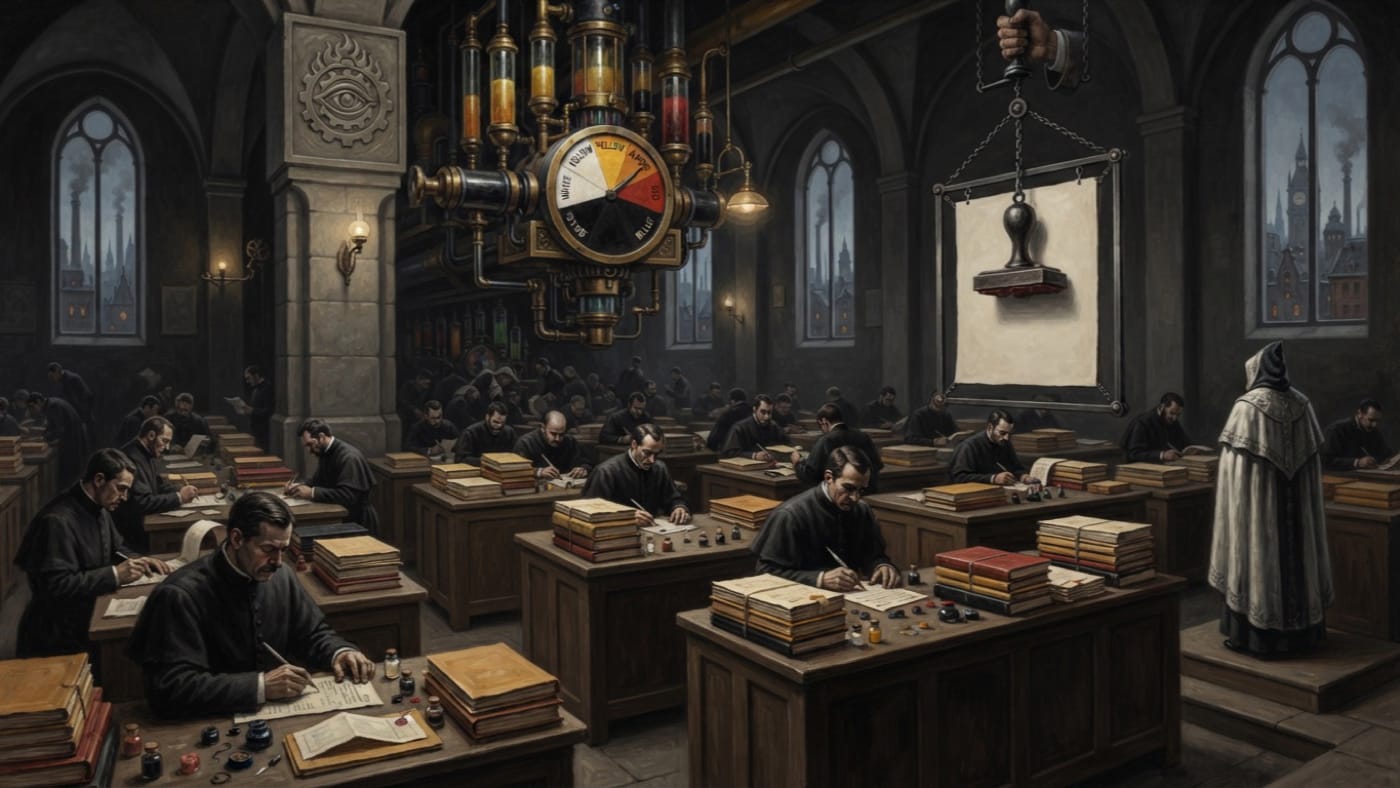
#On the Office and Its Table
The Chromatic Office sits inside the Ashen Cloister, seat of the Bureau of Purity in Strasbourg, three streets east of the Basilica of the Ledgered Saints. Its clerks handle colour the way a sacristan handles chrism: sparingly, by rubric, and in the belief that one drop in the wrong place is sacrilege. The rest of the Cloister holds the Lictor precincts, the dormitories of the White-Mantled, custody of the Index, the Amber watch registry and the ovens that fire tongue-impressions. The Office holds paper.
Two pieces of that paper are documented beyond dispute. The first is the Standing Colour Table, the five-step scale on which Purity grades a soul's distance from the pyre. The second is a small pamphlet bound in bone-white card, which tells a magistrate when a name has earned the third colour. Everything else said of the Office in taverns is rumour or confession, and I file neither under its heading.
Its charter has not crossed my desk. Neither has the name of its first master or the year its door acquired a lock. The Hieromnemon of Doctrine does not invent such particulars. Purity employs its own clerks for that.
What the Office supplies is a word to stand where a verdict would otherwise be required. A baker classified Yellow keeps his oven and loses his Sunday afternoons to correction. A baker classified Amber keeps his oven too. He also acquires a Shadow among his apprentices, wax across his bookshelf and an entry in a book that does not close.
#On the Five Classifications
White is the colour the layman covets, and he should read its line to the end. Compliant, under routine observation. The operative word is routine. The White citizen is watched the way a granary is watched, on the expectation that nothing is wrong and the certainty that someone ought to check. He has been graded, and that is the whole of his innocence.
Yellow is error: a creed mispronounced, a hymn sung with indulgence, a sermon remembered out of order. The Church corrects such men through repetition and expense, and most of them return to White poorer and quieter. The Table calls this mercy, and for once the Table is right.
Red is active heresy and carries a cleansing warrant. Black is contagion, and the Table authorizes the severing of the name. Mark the verb. A name classified Black may stay on a register for a season while the Lictors attend to busier names. The authorization waits for it as patiently as a sexton waits for a widower.
Amber stands in the middle and belongs to neither neighbour. Residual threat, punitive watch. It neither acquits nor convicts. It suspends a warrant over a head and leaves it hanging there. This is the Office's finest invention, and the reason Classification Amber has its own entry in this Codex.
#On the Amber Revision
Amber received its present meaning in A.S. 187 (1897 CE), the year a complete copy of De Vera Luce was found among the officer cadets at Bastion-Przemyśl. Three of them had the Preface by heart. Their instructors said the boys were studying the enemy, and Purity rejected the defence. The cadets were reassigned to instructional terrain, struck from the academy rolls and retained in the Amber Book. I have already praised that retention elsewhere. A Hieromnemon who repeats himself turns into a catechism.
Before Przemyśl, Rationalist sympathy commonly sat in Yellow, beside the mispronounced creed. Purity's Standing Order 14-V moved Rationalist residue into Amber, and the logic of the order is the logic of the Office. Amber does not require proof that heresy has been completed. It requires a trajectory: the direction a man is walking, inferred from repetition, association, tone or absence. One copied fragment is an error. The same fragment copied again after correction becomes a heading.
The bone-white pamphlet turns trajectory into lines a magistrate can read between courses. It covers repeated use of phrases associated with Rationalist apology, contact with three or more Yellow persons within a single bell-cycle quarter, and study of pre-Sundering philosophical instruments without Purity licence. It covers silence during required denunciations, laughter during correction rites and the possession of proscribed fragments short of the Red threshold. The pamphlet does not publish that threshold, and I shall not publish it either. It also lists excessive curiosity about contradictions between the Bureaus. I find this trigger personally flattering, since it assumes the contradictions are worth noticing.
In my entry on Classification Amber, I wrote that every magistrate owns the Chromatic Office's pamphlet.
Corrected. Purity publishes no count of the copies it issues or of the men who receive them. I wrote "every magistrate" because I have never met one without it, and a Hieromnemon's dinner acquaintance does not amount to a census. Records will write to tell me so, at a length I already consider vindictive.
#On the Hands That Enforce the Colour
The Office classifies, and others carry out. Purity guards that division the way a notary guards the line between the witness and the hand that signs. The Bureau's own order is well established. The White-Mantled Inquisitor pronounces guilt, the Penitential Shadows discover it, and the Lictors of Purity make it visible. I cannot tell you where the Chromatic Office ranks among these three, and Purity has not offered to show me. Its guidance lies on all their desks. For a clerk, that is rank enough.
Under Amber, the Lictors must escalate before they cleanse. Short of cleansing, Purity's Amber regime allows them a great deal. They may conduct an interview at dawn and seal a bookshelf in wax. They may take a tongue-impression in a wet ash tablet and brand a temporary glyph on the inner wrist. They may place a Penitential Shadow in the household under the fiction of domestic service and order the subject to the front row of the Procession of Tongues. They may also present an anticipatory confession for signature. It is signed blank, and the text follows when it is needed.
No Office clerk does any of this. The clerk's hand never touches the wrist. It touches the register, which is worse, because a wrist heals.
The Amber Book keeps the name. The Index Damnatus keeps the forbidden texts, names and words the name was caught standing near. One is a roll of persons and the other a roll of poisons. The Office's colours let a magistrate pass from one roll to the other without first consulting a theologian. Doctrine finds this convenience offensive. Purity finds it fast.
#On Corrections That Do Not Close the File
Every neighbouring Bureau has a complaint against the Office's colours, and the best of them is filed with me. Doctrine objects that Purity proceeds on suspicion before heresy has been defined. Doctrine defines heresy, and I keep Doctrine's ledgers, so the objection is mine in every sense that matters. Purity received it with the courtesy a furnace shows a letter. Records objects that the colours outrun its bindings, and that a name struck from one roll while kept on another is a clerical contradiction. War objects to losing cadets it has already fed for three years. Purity counts all three complaints as evidence of its own diligence.
The colour also spreads by proximity. Purity marks the spouse of an Amber subject Amber-Adjacent, and the apprentice too, and by report the tavern table where they drank. I have seen no statute that fixes the radius, and the pamphlet has never needed one. A magistrate who hesitates over an adjacency soon finds himself counted among somebody's Yellow contacts. Contact with three or more of those in a bell-cycle quarter is itself a trigger, so hesitation is self-correcting.
Correction lifts Yellow. I have found no line in the Office's guidance that lifts Amber. A subject may recant, attend every Procession and keep his wrist pale for ten years. All of it will be entered as compliance, beneath his name, in the book that keeps that name. The families of the Przemyśl cadets remain under watch. Their file is still open, and Purity has never asked it to be anything else.