
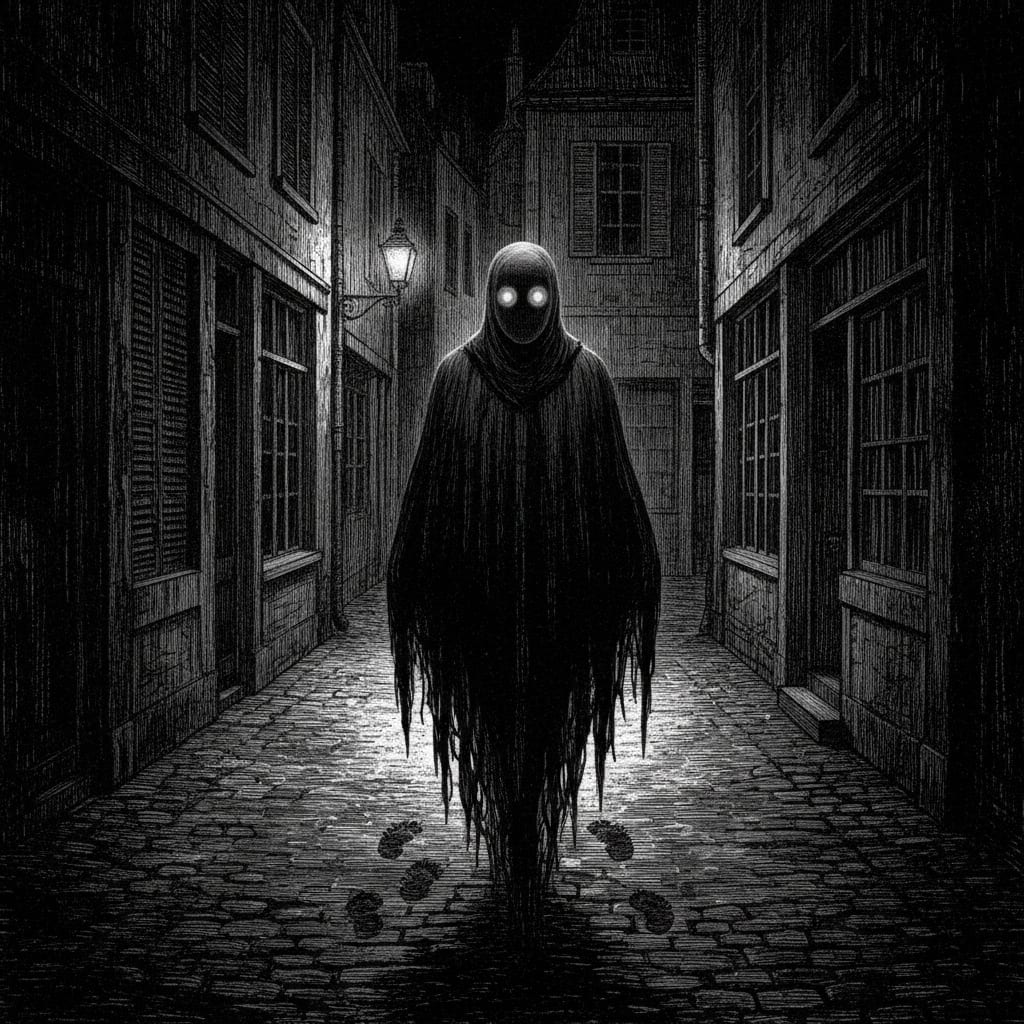
#On the Matter of What Cannot Be Seen
"The Shadow has no name. The Shadow had a name, once, and it was taken." — Found scratched into a cell wall beneath the Tribunal of Ghent (Unregistered), authorship unattributed
I am Valerius Drax, and I confess — not lightly, not without the proper forms filed in triplicate with the Bureau of Orison — that this entry discomfits me. I have written of the Bureau of Purity with the confidence of a man who understands its machinery. I have inscribed the Lictors with the detachment of a cataloguer who has seen their work and kept his supper. The Penitential Shadows are a different matter. One does not catalogue a Shadow. One discovers, upon reflection, that the Shadow has already catalogued you.
The Shadows are the Inquisition's final argument: quieter than blood, quieter than proclamation, and the one that leaves no argument standing. Where the Lictors carve guilt into flesh for all to witness, the Shadows carve guilt out of the world altogether. Persons vanish. Records follow. The neighbours remember nothing, or remember something different, or remember the vanished as someone who never existed at all. The Bureau of Purity does not advertise this capability. The Bureau of Purity does not need to.
#On Their Making
The Shadows are not recruited. They are manufactured.
Prior editions of this Codex described the Shadows as "volunteers drawn from the penitent faithful."
This is a fabrication so threadbare it embarrasses the press that printed it. The Shadows are culled from the broken masses — prisoners, heretics granted conditional mercy, wretches pulled half-dead from the Pillars of Glass or the drainage channels of the Tribunal cellars. They are selected not for zeal but for absence: the absence of ties, of name, of anyone who would miss them.
The process of conversion — the Bureau styles it paenitentia integra, "complete penance" — has never been formally described in any document I have been permitted to read. What is known, from the testimony of Lictors who oversee the early stages, amounts to three facts:
First, the recruit's identity is erased. Not metaphorically. The Bureau of Records receives a sealed writ; the name is struck from the Ledger of Souls. The person ceases, in the Theocracy's canonical reckoning, to exist. They are dead. The fact that they continue to breathe is an administrative courtesy.
Second, the eyes are taken.
Third, the empty sockets receive glass orbs — pale, faintly luminous spheres said to contain the ashes of martyrs ground to a powder finer than flour. The Bureau of Relics provides the ash under sealed requisition. Whether the orbs grant sight in any mortal sense is debated; what the Shadows perceive through them is not sight as the faithful understand it. It is something colder. Several Ordinaries of Severity have described it, in their private correspondence, as a kind of attention that does not blink.
#On Their Methods
A Shadow does not arrest. A Shadow does not interrogate. A Shadow does not, in the conventional sense, act at all. A Shadow watches, and the watching is the sentence.
They dissolve into the architecture of cities. They stand in doorways that were empty a moment ago. They sit in the pews of parish churches where no one remembers seeing them enter. They follow, and the followed do not notice until it is too late — and sometimes not even then, because by the time the followed should have noticed, the followed is already gone. Removed, not from the street, but from the record of ever having walked it.
The hierarchy is precise in its silences. The Inquisitor pronounces guilt. The Shadow discovers it — or, more accurately, the Shadow has already discovered it long before the Inquisitor opens his mouth. The Lictor makes that guilt visible, carved in flesh and displayed in the plaza. The Shadow makes the guilty invisible. Three offices, three functions, one result: the heresy ceases to exist, and the heretic follows the heresy into the dark.
#On What the People Know
The common folk of the Theocracy fear the Shadows more than they fear demons.
This is not hyperbole. This is survey data, collected by the Bureau of Orison's Committee on Public Serenity in A.S. 194, subsequently classified, subsequently leaked, subsequently denied. The numbers were plain enough to make even a committee sweat: in the western provinces, seventy-three per cent of respondents named the Penitential Shadows as the entity they feared most. The Great Deceiver placed second. Famine placed third. The Inquisitors themselves — the White-Mantled terrors who drag men screaming from their beds — placed a distant fourth.
The fear is earned. Demons tear bodies; the Shadows erase existence. A demon's victim is mourned, buried, commemorated in the parish rolls. A Shadow's quarry is not mourned because there is nothing to mourn. The name is gone. The house stands empty and the neighbours say it was always empty. The market stall has a new owner who has always been the owner. The children have a different father and do not remember the first.
The village of ████████ in the Palatinate, A.S. ███, was subject to a Shadow operation following the discovery of unlicensed philosophical texts in its schoolhouse. Within three weeks, the village's population had decreased by ██ persons. The surviving residents reported no unusual activity. The Bureau of Records confirmed no deaths had occurred. The schoolhouse was found empty, its shelves holding only approved catechisms. The philosophical texts were never recovered because, per the final report, they had never existed.
#On Their Place in the Order
The Shadows occupy a curious position in the Bureau of Purity's internal architecture. They stand below the Lictors in formal rank — assuming rank applies to persons who, canonically, do not exist — and above the condemned, who at least retain their names until sentencing. The White-Mantled Inquisitors pronounce. The Lictors enforce. The Shadows are what remains when pronouncement and enforcement have both been deemed insufficient: the quiet third option, the one that leaves no paperwork because it leaves no event to record.
They answer, in theory, to the High Censor of Strasbourg. In practice, even the High Censor trembles before their silent emissaries — or so reports the Bureau of Hearsay, which maintains a shelf of accounts on the Shadows that no one has checked out in living memory. The shelf is never dusty. Someone reads it. Someone always reads it.
The Bureau of Doctrine previously categorized the Penitential Shadows as a "supplementary enforcement cadre" under Inquisitorial jurisdiction.
The Bureau of Purity has requested — with a courtesy that felt like a blade wrapped in velvet — that the categorization be amended to "autonomous penitential instrumentality." The Bureau of Doctrine has complied. The Bureau of Doctrine always complies when the request arrives in that particular shade of silence.
#Closing
I have written what I am permitted to write, and less than I know, and far less than I suspect. The Shadows are not a subject one exhausts. They are a subject one is permitted to approach, briefly, before being reminded — by the quality of the silence in the corridor outside one's study, by the faint scent of cold ash where no fire has been — that the approach has been noted.