
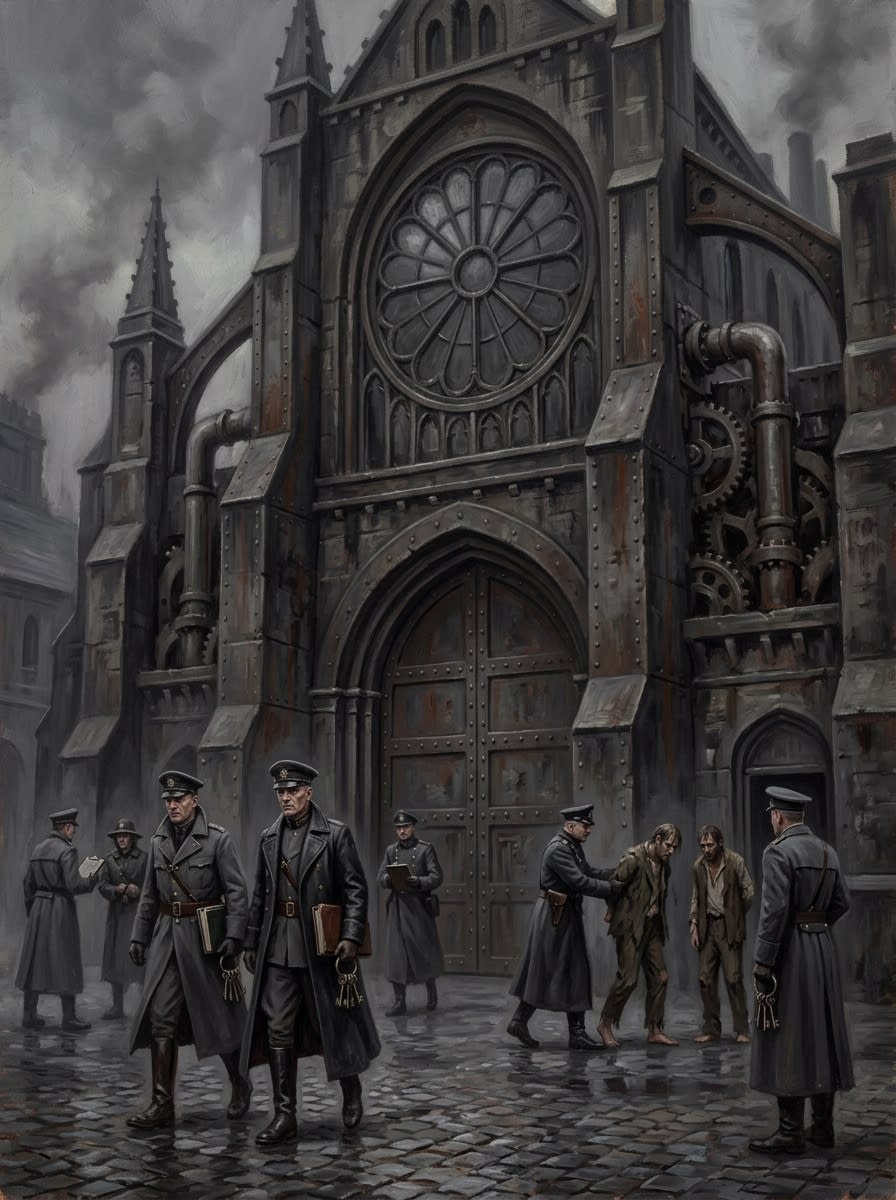
#On the House That Pretends to Be a Cloister
The Ashen Cloister is the seat of the Bureau of Purity in Strasbourg, though the word cloister should be treated with the same suspicion one extends to a smiling confessor, a locked nursery, or a tax remission offered before witnesses arrive. Monks retire from the world. Purity retires the world from itself, one word, one habit, one family recipe, one wrist-glyph at a time.
It stands three streets east of the Basilica of the Ledgered Saints and two streets beyond the public map, in a quarter whose signs grow less informative as one approaches. The paving stones pale. The gutters run clean even after rain. The windows narrow until they resemble slits cut by a cautious surgeon. At the final turn, the visitor sees a low outer wall of grey-white stone dusted with sacramental ash and a gate without heraldry. Heraldry implies invitation. The Ashen Cloister does not invite. It receives.
Officially the Cloister houses administrative offices, sealed chambers, interview rooms, archives, dormitories for senior Inquisitorial staff, calibration chapels, and the Chromatic Office that maintains the Standing Colour Table. Officially. The word has the moral breadth of a rat hole. Beneath those offices run the Vault of Silences, the chained master Index Damnatus, the Amber Book, the tongue-impression ovens, the fifth sub-cellar where glass-chain ranks are inspected, and rooms whose doors have handles only on the outside because theology, if properly administered, need not be comfortable.
#On Foundation and Ash
The Cloister’s public foundation is tied to the Concordat settlement, when the Synod learned that government requires law and correction with teeth. The first Purity offices in Strasbourg occupied borrowed chapter rooms after the A.S. 80 Index courier reforms gave condemned names legs and after the Witch-Hunts of Toulouse had proved that temporary cleansing teams wished to become permanent institutions, as all useful horrors eventually do. By A.S. 90, Purity required a seat. By A.S. 93, after the Council of Mainz hardened the Seven Seals and made dread respectable in committee, it had acquired one.
The site had belonged to an old penitential house whose brothers kept a furnace for burning plague linens and spoiled altar cloths. This was a mercy. Purity improved it. The furnace was enlarged, blessed, renamed the First Corrective Kiln (Unregistered), and given a ledger. The brothers were retained as ash-handlers until their vows were reviewed and found insufficiently exact. Eleven entered Purity service. Three entered the furnace. Records list all fourteen as transferred.
Older municipal guides describe the Ashen Cloister as “formerly a charitable penitential house incorporated by peaceful donation.”
Corrected. The donation was peaceful after the donor had been removed, questioned, reclassified, and rendered incapable of later disputation. Peace is often easier to obtain from an empty chair.
The ash in the mortar is not decorative. Every outer wall contains powdered residue from burned contraband: fragments of Rationalist paper, illicit hymnals, proscribed incense recipes, charms taken from midwives, pages cut from private diaries, three barrels of cerulean dye from Bruges, and at least one confiscated theatre script whose jokes were judged numerically excessive. The stone was mixed to hold memory without preserving content. Purity likes symbols that have eaten their originals.
#On the Courts, Cells, and Offices
The outer Cloister is clean enough to frighten a hospital. Visitors enter the White Court (Unregistered), a roofless quadrangle swept hourly by novices who wear wool over their shoes to avoid leaving prints. Around the court stand four public doors: Petitions, Errata, Interviews, and Returns. Petitions rarely open. Errata opens before dawn. Interviews opens whenever a bell rings from inside the wall, though no exterior bell is visible. Returns is painted shut each winter and opened each spring. No one has explained the rhythm. Explanations would cheapen it.
The Chromatic Office occupies the northern range. Here clerks sort suspicion by colour under high windows glazed in pale amber, yellow, red, black, and white. The Amber desks are the busiest. Amber is the Cloister’s favourite shade because it preserves dread without spending the body too soon. A Red case burns. A Black case vanishes. An Amber case pays rent in fear for years.
Below the south range lie the Lictor precincts. There are six in Strasbourg, each with its own brazier room, glyph cabinet, cooling bench, ash sink, and record table. The Second Precinct is famous for freehand work. The Fourth favours glyph-press speed and is despised by its rivals as industrial, which is to say effective and vulgar. The Sixth handles Errata in Flesh (Unregistered), when a citizen once branded under an old wording must be amended to fit the new wording. It is the Bureau’s most honest office. It admits the body may require revision when policy changes.
The White-Mantled dormitories occupy the eastern walk, if dormitory may name a row of narrow cells where Inquisitors sleep under hooks, glass chains, and shelves of daily Errata strips. Each cell contains one bed, one kneeler, one mirror covered in white cloth, and one aperture through which the morning correction arrives. The mirror is uncovered only during Mantle Examination (Unregistered). Too much self-regard leads to doctrinal softness. I disagree professionally, but Purity has never sought my advice on vanity.
#On the Vault of Silences
The Cloister’s true architecture runs downward. Strasbourg builds upward when it wishes to impress and downward when it wishes to survive scrutiny. The Vault of Silences lies beneath three sealed floors, past the Index stair, past the tongue ovens, past the cold room where confiscated bells are hung without clappers. No guide admits the route. Every guide knows it.
In the Vault are kept silences too dangerous for ordinary absence: sealed testimonies removed from public trial, names struck from proceedings but retained for use, words heard once and forbidden before a second mouth could improve them, breath intervals from Amber interviews, failed confessions, successful denials, the soundless portion of condemned hymns, and the question I submitted to the Hierarch of Purity eight years ago. Yes. Mine has a shelf. I have seen the receipt.
VAULT OF SILENCES — ACCESS NOTE Entry authorised under Fifth Seal, date █████████. Object requested: Register of ███████. Attending Inquisitors: three. Observed irregularity: no page-turn recorded; chain tightened by █████ links. After exit, clerk assigned to stair duty ceased using the word █████████ in all contexts, including prayer.
The chained master Index occupies a chamber adjacent to the Vault, though adjacent is a bureaucratic word where geometry becomes shy. The Index is no single book. It is a legal weather system with hinges: forbidden names, forbidden texts, forbidden tones, forbidden substances, forbidden recipes, forbidden colours, forbidden gestures, forbidden questions, and those future prohibitions awaiting only the courtesy of being noticed. Index Scribes (Unregistered) turn pages with gloves dusted in ash. They are ordered to guard what they may not read and read what they may not remember. Many develop the calm of saints or furniture.
A touring delegation from Cologne once reported that the master Index was “securely stored in the Ashen Cloister archive.”
Clarified. Archive implies storage. The Index is custody with appetite. It grows, answers, tightens chains, and occasionally causes clerks to forget their mothers’ nicknames. Cologne has been advised to improve its nouns.
#On Those Who Enter
There are four ways into the Ashen Cloister. One may serve there, which is ambition with a white hood. One may petition there, which is optimism in its terminal stage. One may be summoned there, which is already a verdict learning to stand. One may be carried there, which simplifies the forms.
Service begins at the small gate on Ash Cart Lane (Unregistered). Novices, fume-paper grinders, errata runners, ash sweepers, tongue-oven stokers, wax clerks, mantle washers, glass-chain polishers, and low Index copyists enter before dawn and leave by different doors according to rank. The lowest are searched on arrival for contraband. The higher are searched on departure for sympathy. Purity knows hierarchy. It also knows leakage.
Petitioners wait in the White Court beneath a frieze of blank tablets. The tablets commemorate corrected errors whose text has been removed for civic safety, leaving the shape of memorial without the hazard of memory. A petitioner may request removal from Yellow, clarification of Amber adjacency, return of seized books, correction of a misapplied wrist glyph, restoration of a child’s name, or confirmation that a spouse entered the Cloister alive. The petitioner receives a number. The number receives a file. The file receives attention if attention serves Purity.
The summoned enter through Interviews, where a clerk asks whether the subject arrived voluntarily. The answer is recorded before the question is understood. Dawn interviews under Amber are conducted in rooms painted the colour of old resin. The chair is bolted down. The table is plain. The wet ash tablet for tongue-impressions sits to the right. The Lictor waits behind a screen, because the possibility of pain is more economical than pain itself and leaves fewer cleaning expenses.
The carried enter through Returns. No one watches Returns if he can help it. Bodies, evidence, corrected persons, failed corrections, confiscated instruments, and those who must be returned to public circulation with improved posture pass through that door. In winter it is painted shut. In spring the paint cracks from within.
#On the Cloister’s Present Hunger
As of A.S. 201, the Ashen Cloister is full. Here, full names appetite meeting abundance rather than strain. Rationalist residue under Standing Order 14-V (Unregistered) continues to feed the Amber desks after the A.S. 187 Przemyśl academy discovery (Unregistered). The Index Runners bring fresh names from gates and ferry houses. The White-Mantled Inquisitors return from cities with boxes of paper, teeth, and explanations. The Penitential Shadows send reports without signatures. The Lictors request more ash sinks.
The Hierarch of Purity rarely appears in the public courts. Her chair is nevertheless felt in every corridor. A door closes more softly when her seal is near. Pens hesitate. Clerks use shorter sentences. Even the braziers seem to burn with improved obedience. I have waited in the White Court twice, once by invitation and once by mistake; both occasions proved spiritually clarifying in the manner of cold knives.
Purity has recently added a seventh lower stair, according to contractors who deny adding it and invoices that deny contractors exist. The stair descends beneath the Vault of Silences toward a room filed as Ventilation Revision 201-C. No air emerges. Ash goes down in sealed pails. The pails return empty, clean, and warm.
The Ashen Cloister does not loom. Looming is theatrical and belongs to fortresses, bad bishops, and men compensating for poor doctrine. The Cloister waits at street level, low and pale, close enough to the market that citizens can smell bread while signing confessions. That is its genius. Hell is beyond the Line. Purity is three streets over.