
#On Remains Without Records
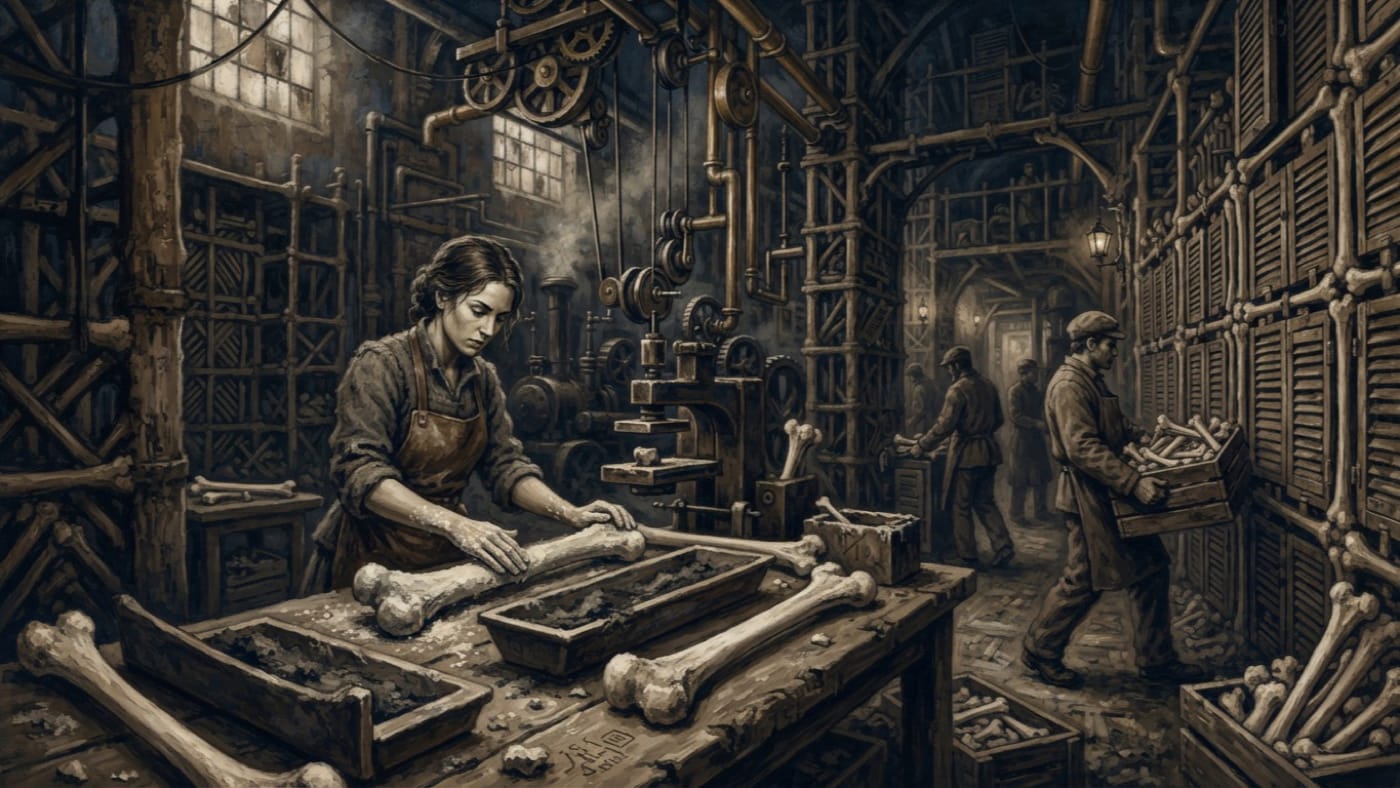
Every rib in a Lor shutter belonged to somebody before it belonged to the shutter. The Bone-Guild of Rib and Reed would prefer to know whom. Where the Bureau of Records has kept faith with its ledgers, the Guild does know: structural bone in Black-Snow Lor carries an origin mark, and the mark answers to a register. But registers fail. They burn in convoy wagons, swell in flooded cellars and go for lamp-paper in a hard winter. Some were never written at all, because the pits beneath the ash flats filled faster than any clerk could wet a nib. For bone in that condition the Guild performs the Common Use Litany: ash wash, salt-lime seal, three knocks, one breath held, function declared.
Then the bone goes to work.
The stakes are plain to anyone who has stood in the Storm Pits after heavy drift and watched the ground hand back what it was given. Lor is built on the dead and kept alive by them. Masks split, shutters warp and braces crack under ash load. The replacement material lies under every street in quantities no Bureau has counted. A town that waited for perfect provenance before fitting a shutter would be the best-documented cemetery on the Carpathian edge.
What follows surveys the practice as it stands in A.S. 201 / 1911 CE. The Litany is performed this week, in Maskers' Row and the Latticeworks, by people with lime under their fingernails. It is no antiquity.
#On the Rule of Measured Remains
The earliest name in the Guild's charter is Mother Pellis of the Split Rib. The charter was recognised after the Second Concordat of Münster bound the craft guilds into Synodal tithe. Pellis standardised the half-face convoy respirator and layered the reed-rib vent screen. She also wrote the first Rule of Measured Remains, which admits no exceptions in its own wording: no bone may be used without origin mark, ash washing, salt-lime sealing and a prayer for function.
Inherited instructional chronologies place the Second Concordat of Münster in A.S. 231.
Corrected to A.S. 105 / 1815 CE. A guild cannot petition for recognition under a settlement a hundred and twenty-six years in its future, however eager its clerks. The correction dates the charter. It dates nothing about the Litany.
Set the Rule beside the Litany and the family likeness is obvious. The washing survives, and so does the sealing. The prayer for function survives as the declaration. Only the origin mark is missing. It is the one thing no workshop can make without committing forgery, and the Guild, whatever its other sins, likes its forgeries to be profitable. The three knocks and the held breath stand where the mark would be.
No document submitted to me records who first set the fallback beside the Rule, or in what year. I decline to supply a founding mother for the reader's comfort. Pellis wrote a Rule that demanded a name for every bone. Somebody in Lor later settled what to do when there was none.
The Litany restores no identity. A bone that has passed through it is exactly as nameless as before. Now it is nameless and employed.
#On the Five Acts
The sequence is short because Lor is short of breath. I give it in its attested order and at its attested depth. Readers who want recipes may apply to the Glue-House and pay like everyone else.
Ash wash. The bone is washed in ash. The town's one inexhaustible commodity, the stuff that kills its citizens through every unsealed seam, is set to scouring the dead. Grave-soil comes away, along with grease and whatever else the pit left behind. Lor takes a grim satisfaction in making its enemy do the scrubbing.
Salt-lime seal. The washed bone is sealed in salt-lime until it takes on the pale, chalky finish visitors mistake for age. The seal closes it against damp, rot and the fine drift that works into anything porous left in Lor long enough. The Rule asks the same of marked bone. In this the named and the nameless are treated alike, which is more than can be said for their surviving relatives.
Three knocks. Three of them, struck before the bone enters service. The sources fix the number and leave the rest to the hand doing the knocking. I have no authority to standardise knuckles and will not pretend to it.
One breath held. In a town where breath is rationed, stamped and sold by the minute, a held breath is a deliberate expense. The Litany as reported does not say whose breath, or for how long. I suspect that omission is its most intelligent clause. Give a rite a stated duration and within a season it will have a timekeeper. Within a year the timekeeper will have a fee.
Function declared. The bone is declared to its use. The surviving description fixes the destinations as shutter, mask, screen and brace. No document I have examined records the words of the declaration. What matters at the bench is the change of address: a fragment that arrived as nobody's leaves as somebody's shutter.
Doctrine's term for the result is consecrated utility. The workshop's term is shorter. The piece is finished.
#On Permitted Service
There are four destinations, each with its own tolerance.
The mask is the closest service the dead can give: a plate of salt-limed bone a finger's width from a living mouth. It is carved in the Mask-House, fitted with reed filters and stamped at the hinge. The shutter is Lattice-House work, a rib-and-reed frame that slams at the third bell and keeps the street's weather outside. The screen belongs to the Vent-House and strains ash from air within its stated tolerances. It clogs in heavy drift and fails at a bad seam, and it promises nothing against an off-cycle storm. The brace carries load in frames and lintels and asks nobody's opinion.
The limits stand, and the Litany moves none of them.
Demonic bone is forbidden without Purity clearance. Unidentified large remains need Engineering review before they bear weight. Children's bones may be used only in mask components for kin households. A failure of Records proves one thing only: that the record failed. It clears nothing for Purity and certifies no load for Engineering. It establishes no kinship either, and the third rule depends on kinship.
The Litany prepares bone for use. Relic authentication is a separate office with its own seals, and engineering approval is a third. Any householder who presents a Litany-washed knuckle as a saint's will meet the Church's reliquary auditors in a mood the Guild cannot repair.
#On the Price of Common Use
I find no separate charge for the Litany. None is needed.
The Guild controls every licensed bone-mask, shutter, vent-screen, storm lattice and safehouse seal within the Breath Cordon, together with the materials that keep them in repair. A household needs a Guild certificate for safehouse eligibility, ration discounts and inspection priority. The Litany sits upstream of all of it. Every bone it brings into service is a bone the Guild may cut, fit, certify, inspect and refit. The charge arrives on those papers in the ordinary course.
The beneficiaries form a tidy procession. The Guild gains supply. Line convoys bound down the Sagittal Line toward Bastion-Przemyśl gain masks. The Breath Office gains shelter it can count. The Bureau of Doctrine gains a working demonstration of its A.S. 106 advisory, which applied to Lor the principle that the faithful serve in death as in life. The nameless dead gain employment, which in Lor ranks somewhat above a pension.
The present quarrel touches the Litany only at its edges, and in Lor the edges are where people die. Since A.S. 199 / 1909 CE the black snow has come off-cycle, clogging filters with uncanny speed and forcing safehouse expansion faster than the Guild can certify. Breath Comptroller Juno Varr has issued shelter-upgrade permits to non-Guild contractors under emergency authority. Rib-Mother Sael has answered with a threatened stoppage, and the Guild's motto has gone back to its old double work as warranty and threat: no Guild lattice, no Guild guarantee. If the workshops close, the benches where the Litany is performed close with them, along with the supply it feeds. The matter stands open, and I will not close it from a desk.
#On the Unquiet Lattice
The Warrens' bone-lattice sings in storms. The Guild says this is pressure moving through slats and seams, and most days an engineer with a pressure-gauge would agree. Locals hear warning, ancestry and accusation, and now and then a name. The Guild forbids its workshops to name the donor of structural bone, and it forbids hidden names in its latticework. Widows stitch names into filters and slat patterns anyway. A nameless bone gives the rule nothing to enforce and the listener nothing to confirm. The listeners report all the same.
In A.S. 200, three separate households reported hearing the same dead soldier coughing through their shutters. Nobody established who the soldier was, or whether there was one soldier at all or simply a rumour three households agreed to share. The Guild replaced the frames at cost, kept the originals and refused Bureau access on grounds of proprietary craft method. The reports do not say whether those frames held marked bone or Litany bone.
Doctrine holds that bone preserves form and nothing more. The shutters were not consulted.