
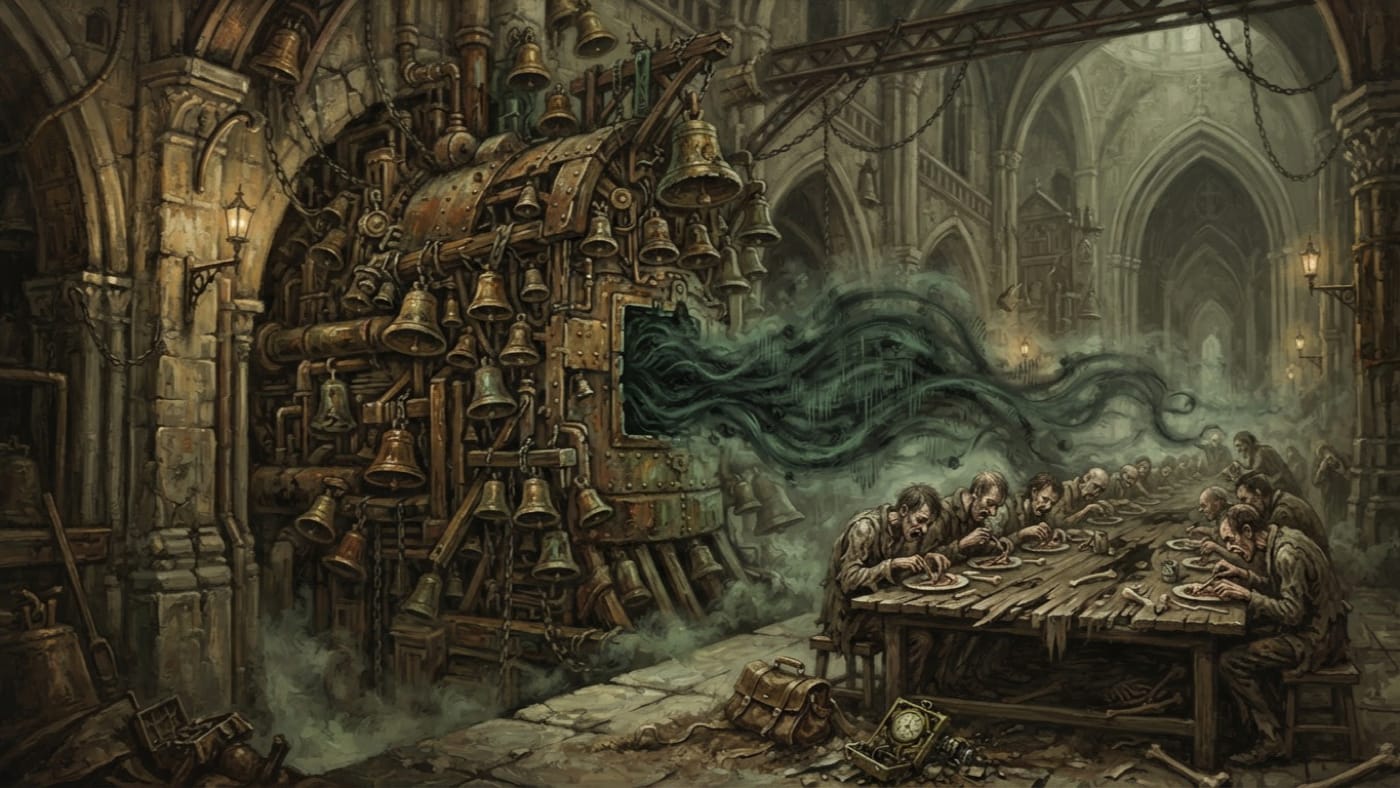
#On the Classification
"Doctrinally impossible and acoustically verified." — Bureau of Bells, on the carriage of the feast-sounds, as entered in the Hollow Court file
Compulsion Architecture is a term of the Bureau of Bells. It names a harmonic structure that Bureau identified in recordings carried out of the Hollow Court. The files open to this office show it applied to that Court and to nothing else. I set this down first because a term with Architecture in it will be borrowed by every chaplain who wants his sermon to sound engineered, and a classification that wanders from its case file soon tells a better story than the one it swore to.
This assessment was commissioned for the present year. It keeps three things apart, and I ask the reader to do the same: what was heard, what Bells concluded from what was heard, and what Doctrine and Rites did with the resulting paper. The file does not record the year Bells first wrote the term. I decline to supply one.
#On the Recorded Exposure
There is one witness. She was an operative of the Bureau of Shadows, and her name is withheld. In A.S. 196 she entered the Blightmarsh alone and reached the outer galleries of the Court, some forty leagues east-south-east of what was Debrecen. She went as far as the antechamber of the Great Hall. She did not cross the Hall. She did not see Kargath, whose seat at the far end of the table is a doctrinal attribution and was never in her line of sight. She believed she had been gone three days. The calendar says nineteen.
From the antechamber doorway she heard the feast. Chewing, swallowing, the scrape of utensils on plates, and weeping, all at once, none of it pausing for the rest. She saw the nearest guests. They were eating, and they were wasted to the frame.
Her testimony is not the only record. Field equipment she carried captured the feast-sounds, and those recordings are what Bells later examined. I took her deposition. Bells took the recordings. The reader should keep in mind which of us heard a woman and which heard a machine.
The deposition ran fourteen hours. Its coherence declined as it went, and the later passages required interpretation by Rites. I record this as a defect of the surviving record. I will not invent a second witness to repair it, and I will not reconstruct the sixteen missing days.
STAMPED ERRATUM — A.S. 201 (carried from the Hollow Court entry) Prior editions of the Court entry stated that "no human being has entered the Hollow Court and returned." One human being entered the outer galleries and returned. The correction is reproduced here because this classification depends on her recordings.
#On the Harmonic Interpretation
Bells subjected the recordings to spectral analysis. It reported a harmonic structure consistent with its classification of Compulsion Architecture. Those two words carry the whole of the Bureau's inference, and I wish them read slowly.
What the file holds is a sound, an analysis of the sound, and a name for the pattern the analysis found. It contains no frequency values I am able to print, and no account of calibration, controls or repeated trials that I am able to cite. The recordings came from one set of equipment, carried by one woman, through one approach. Nobody has gone back to take a second set, and given what follows, I do not recommend it.
The name implies a builder. The evidence does not supply one. In the Court entry I allowed that the pattern might have been designed, or evolved, or grown. I still cannot choose among the three, and Bells has not chosen for me. Origin, intention and efficacy stay open in this office.
Then there is the turning. The deponent says she chose to turn back. Rites, reviewing her testimony, noted that the moment of her turning coincided with the cessation of a particular harmonic in the recording. Bells interpreted that cessation as an interruption in the pattern. That is three parties making three claims: her account of a decision, Rites' account of a coincidence, and Bells' account of a mechanism. None of them cancels the others, and this dossier ranks none above the rest.
#On Appetite and Action
Bells' language is alarming, and Bells chose it. The Court file records the Bureau's view that the pattern acts to override the listener's volition in matters of appetite. That is Bells' interpretation of induced hunger and acoustic influence. It is not a finding of Doctrine, and Bells has not proved it.
Doctrine's ground has not moved. The servants of the Great Deceiver tempt. They lie. They feed until the feeding becomes a need. They threaten, and they hold bodies captive in their territory. They do not take possession of a man, they do not remove his choice, and no pact signed with them binds as its author pretends. The Blightmarsh is the Deceiver's country, and that grants Kargath no exemption from the rule.
An appetite that rises unbidden is real. A body that wants to walk toward the smell is real. The deponent described the worst hunger she had known, worse than a siege winter, a hunger that knew where to go, and I do not doubt one syllable of it. A desire is still not a deed. Between the belly's demand and the foot's obedience the Creator left a space. The Court can crowd that space with smoke, grief and nineteen lost days. On this record it has not been shown to close it.
None of this makes a guest at that table the author of his own seat. Kargath does not hunt the greedy. He finds the already hungry, the already frightened, the ones who have counted their stores and found them short, and he answers them with provision that deepens the need. Choice that survives in such a place is choice under siege. Doctrine does not call it easy, and it does not call the starving guilty for losing it.
Whether the deponent left or was let go, this office does not determine. She has said what she said. The Bureau has not pressed her, and I will not press her on paper.
#On the Custody of the Chart
Bells' report runs to forty-seven pages. It closes with its recommendation that no bell-based countermeasure is likely to prove effective against a harmonic source of this magnitude. It includes a frequency chart.
What followed came in four separate acts, and I give them in order without improvement.
Bells wrote the report. Doctrine classified the recommendation. Rites asked for the chart to be destroyed, on the ground that reproducing the frequencies, even on paper, was a possible vector of spiritual contamination. The chart was not destroyed. It was reclassified.
The file does not say who ordered the reclassification. It does not say what the chart contains, and this dossier will not say either. It does not show that anyone who read the chart grew hungry. Rites' request records an institutional fear, and a fear is not an experiment. Whether the page carries what the recording carries has never been tested, because testing it would require reading it, and reading it is what the classification forbids. That circle is drawn in very good ink.
I have stated elsewhere that the Bureau of War has not read the recommendation. Nothing has reached my desk that obliges me to revise that statement. Nothing has reached my desk on the matter at all, which in Strasbourg is the same thing.
#On the Present Application
In the Hollow Court case, Rites classifies the feast as a Category One Spiritual Hazard under the institutional designation Proximity-Induced Compulsion. The designation belongs to that case. Its wording goes further than this assessment, and I neither revise it here nor extend it to anything else. Under the same record, no Synod personnel are to come within an estimated five leagues of the Court without countersignature from the Bureau of War and dispensation from Doctrine.
The Court file reports an appetite response beyond two hundred yards of the outer structure. It describes the sounds as faint at five leagues, distinct at three and gravely affecting at one. These are the observations and assessments of a single case. They give no safe line, no table of exposure and no measure of who will be affected or how badly. Anyone who reads a margin of safety into them has made it up.
Bells judges that no bell-based countermeasure is likely to succeed against a source of this magnitude. The judgment concerns this source. It does not condemn the Bell Codex, every belfry on the Line, or every defence not yet attempted. This dossier proposes no remedy and no rescue, and it does not explain how the Court might be silenced. The file holds none, and I will not invent one for the sake of a tidier ending.
The operative is in the infirmary at Bastion-Constantinople. The recordings are under seal. The chart exists.