
#On the Filing and the Witness
Deposition 7-K is the testimony of the only person the Ledger knows to have entered the Hollow Court and come back out. She was an operative of the Bureau of Shadows. Her name has been redacted, and I will not pretend to know it. The Bureau of Shadows redacts names the way other offices draw breath. In A.S. 196 she went into the Blightmarsh alone. Shadows has declined to say who sent her, to anyone, and I suspect it has declined to tell itself. She reached the outer galleries of the seat of Kargath, about forty leagues east-south-east of ruined Debrecen. She reached the antechamber of the Great Hall. She went no further, and she returned.
That was the whole of her expedition. Everything else in this entry is her account of it, the record of how that account was taken, and the record of what the Bureaus have since done with it.
The reader holds an abstract. It is assembled from the passages of the deposition preserved in the Court dossier and from my own notes of the debrief. It is not a transcript, and I have not invented one. The Synod has offices that would, and the reader may apply to them.
#On the Approach and the Calendar
"No road leads to the Hollow Court. Every road in the Blightmarsh leads to it." — Deposition 7-K, paragraph 11
Paragraph 11 is the most quoted sentence in the file and the most abused. The deponent offered it as description. The Bureau of War reads everything as an instruction, and it has asked whether the sentence amounts to a route. It is her account of the ground she crossed. She did not choose a direction, and she arrived anyway. Patrols of the eastern Marsh have filed similar impressions of mud that firms in one direction and fog that thins ahead. The dossier has gathered these beside her paragraph as though the agreement of frightened men were a surveyor's chain. It may be agreement. It is no method, and any officer who carries paragraph 11 in place of a map deserves the road he gets.
She described the approach as "being swallowed gradually, from the feet upward." When she was extracted, her boots had to be cut from her ankles. The Court dossier says the Marsh had begun to digest them. That is the dossier's reading of leather and swollen flesh. The Bureau of Medicine made no such finding, and I enter the claim at the rank it actually holds.
She estimated that she had been gone about three days. The calendar recorded nineteen. Both figures stand in the file, unreconciled. Nobody has accounted for the difference, and this entry will not be the first to try.
#On the Outer Galleries
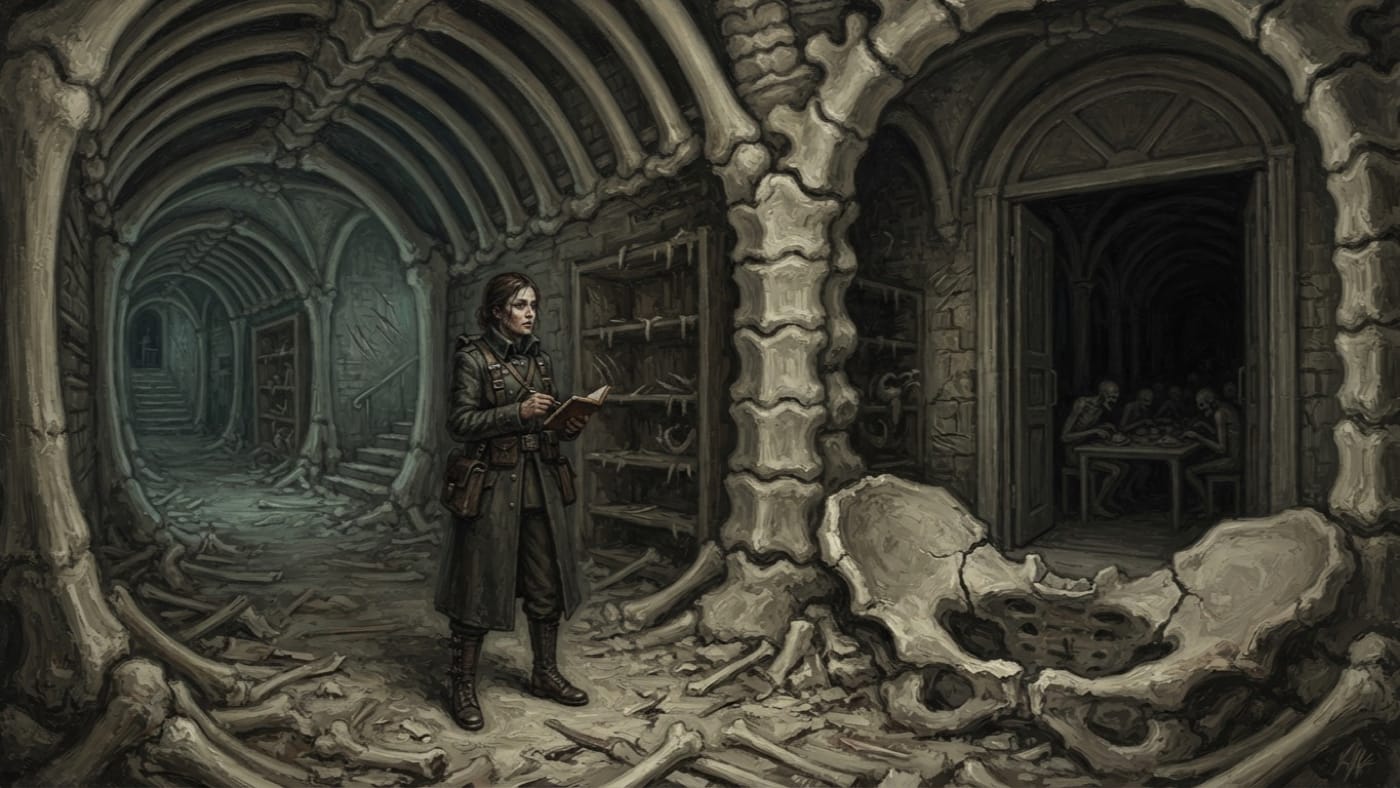
Her architectural testimony is the most orderly part of the deposition. It is orderly the way an inventory taken in a burning house is orderly. The Court is built of bone. She described ribs the length of cathedral naves, vertebrae the size of mill-wheels, and pelvises standing as doorways. She said the structure sprawls, and I have found no better word. Corridors branched and branched again. Chambers opened onto chambers and led her back, from another angle, into a room she had already left. Stairways went down into halls that lay, by her reckoning, above the point where she had entered them.
These are observations. The Bureau of Doctrine would like them to be a plan of the building and has drawn conclusions from them as if they were. I decline to follow. She walked the outer galleries once, under conditions no surveyor would put a signature to. What she saw stands as what she saw, and the file holds nothing further.
She counted thirty-one larder-rooms. Each was fitted with hooks and shelves and the rest of the apparatus of storage. Each was empty. The hooks had been gnawed and the shelves bore tooth-marks. The floors were scored and broken, as if something had eaten the provisions, then the containers, and had then started on the room. She counted them. In that place, with that hunger rising in her, she kept a tally, and the tally is thirty-one.
The larders continued during the debrief, on paper. She drew while she spoke. The sketches are competent architectural studies. From them I infer that someone once taught her draughtsmanship. The file does not say where or by whom, and neither do I. Her hand shakes more on each page. The last sheet holds a single doorway, drawn seventeen times, each version slightly larger than the one before. Beneath them she wrote: "It was always open."
#On the Antechamber
She did not enter the Great Hall. She stood in its antechamber, a vaulted passage of bone lit by no source she could name, and from there she heard the feast.
She heard chewing and swallowing, and the scrape of utensils across plates. Beneath these, and among them, she heard weeping. Her testimony is explicit that the sounds did not take turns. The chewing went on through the weeping and the weeping through the chewing, together and without pause. Of everything in the galleries, she ranked the sounds first among her horrors, ahead of the bones, the bare larders and the nineteen days she cannot account for.
Through the doorway she saw the near edge of a table of bone running into a dark she could not measure. It was laid with food in abundance, steaming, carved and dressed as for a Synod feast-day. She said under oath that the smell was the most beautiful thing she had ever experienced and that she would rather die than smell it again. She saw the nearest guests, seated, hunched and eating. Their clothes had rotted to threads. Their bodies had wasted to frames, with the skin drawn over them like vellum on a copying-board, and their bellies were swollen like the bellies of the gorged. Servants as thin as the guests carried full platters in, carried empty platters out, and carried full platters in again.
She estimated that she could see about forty guests. That figure is her estimate, made from one position in that light. It is also the only count in the file made by a living eye. The sounds suggested many more. A sound is not a census.
What she did not see must be entered just as plainly. She did not see the far end of the table. She did not see Kargath. His presence at its head is an attribution by the Bureau of Doctrine, drawn from the theology of the Sin-Generals. It rests on that theology and on nothing she said. She stood at the doorway. She did not cross it.
#On the Fourteen Hours
The debrief lasted fourteen hours. Her coherence declined across them. The file says so, and I was in the room to watch the file become true. The early record reads as testimony. The later passages could not be entered without interpretation, and the Bureau of Rites was brought in to supply it. Wherever this entry relies on those passages, the reader is reading Rites' rendering of her. Rites' renderings are, as a rule, worse than the thing rendered. I have flagged the dependence where it occurs, and I am entitled to my contempt for the wording.
At one point she wept. I record it because the Bureau of Records requires that emotional responses at debrief be noted, and because I had never seen it done that way. She wept and reached for the bread on the table at the same moment, and she seemed unaware of either.
She states that she chose to turn back. Rites, reviewing the testimony, holds that her turning coincided with the cessation of a particular harmonic in the feast-sounds. The Bureau of Bells reads that interruption as consistent with what it calls a compulsion-interruption, a term it uses within its assessment of Compulsion Architecture. These are three claims from three parties, and the file keeps them apart. She says she chose. Rites says a sound stopped. Bells offers a view of what the stopping meant. None of the three is an escape procedure, and none proves that she was let go.
She does not wish to revisit whether she chose to leave or was released. The Bureau has not pressed her. I approve, and I approve of very little in this file.
#On the Correction and the Limits of the File
The parent dossier carries the following correction, reproduced here as entered:
STAMPED ERRATUM — A.S. 201 Prior editions of this entry stated that "no human being has entered the Hollow Court and returned." This is incorrect. One human being has entered the outer galleries and returned. The Bureau regrets the imprecision. The Bureau does not regret the sentiment.
The erratum is exact, and it must be read exactly. One person entered the outer galleries and returned. Nobody has returned from the feast itself or from the far end of the table, and Deposition 7-K does not claim otherwise.
The figures most often pinned to her name come from other records. The nine miles of the Court's longest axis come from the soil-resonance survey of A.S. 200, made four years after she came back. The four hundred and twelve names are a separate file, compiled by the Bureau of Records against casualty lists and the Great Ledger of Souls. She identified none of those people. The estimate of three to five thousand occupants belongs to the dossier, and so do its conclusions about how long a guest can survive. The aerial log of A.S. 174 and Deposition 11-F of A.S. 188 are separate records. This entry repeats nothing of 11-F.
Deposition 7-K is also a different record from Deposition 7-K/Pell. That document is Andros Pell's testimony on the Silence of Thessaloniki in A.S. 198, and it comes from a different witness, a different office and a different catastrophe. Thessaloniki's incident report of that year is filed as its own record. Standing Order 7-K is a third instrument, which shares the designation and nothing else. The Synod's numbering clerks have never met a sequence they would not reuse, and they have never been made to read what they stamped.
The dossier's present assessment reports her assigned to the infirmary at Bastion-Constantinople. The file records no later testimony and no other disposition.