
#On the Location of the Court
"The Bureau has confirmed its location four times. The Bureau of War has declined to act on that confirmation three times. I trust the reader perceives the arithmetic." — V. Drax, marginal annotation on File 7-K
The Hollow Court stands — if stands is a word one may use for a structure that appears to breathe — at the geographic centre of the Blightmarsh, approximately forty leagues east-south-east of the ruin that was Debrecen and some unguessable distance beneath, or above, or inside, the Marsh itself. Its coordinates have been submitted to the Bureau of War by four independent sources whose methods of observation varied, whose sanity upon debriefing varied more, and whose agreement on location was nonetheless precise to within a quarter-mile. The Bureau of War has acknowledged receipt on three of these four occasions. On the fourth it returned the dossier stamped ADMINISTRATIVELY REDUNDANT, which is the phrase the Bureau of War uses when a file has frightened someone senior enough to lose it on purpose.
What we know — and the reader must understand that "know" in the context of Kargath's domain is a word that has been stretched until the seams show — is this: the Hollow Court occupies a position that is, by any honest reckoning, the seat of the Sin-General of Gluttony, the place from which His hunger radiates outward across the plains of former Hungary like fever from a wound. It is a palace. It is a ruin. It is a mouth. The depositions disagree on which of these descriptions is metaphor and which is architectural survey. The Bureau of Doctrine has resolved the disagreement by classifying all three as "theologically accurate," which is less a resolution than a surrender with better penmanship.
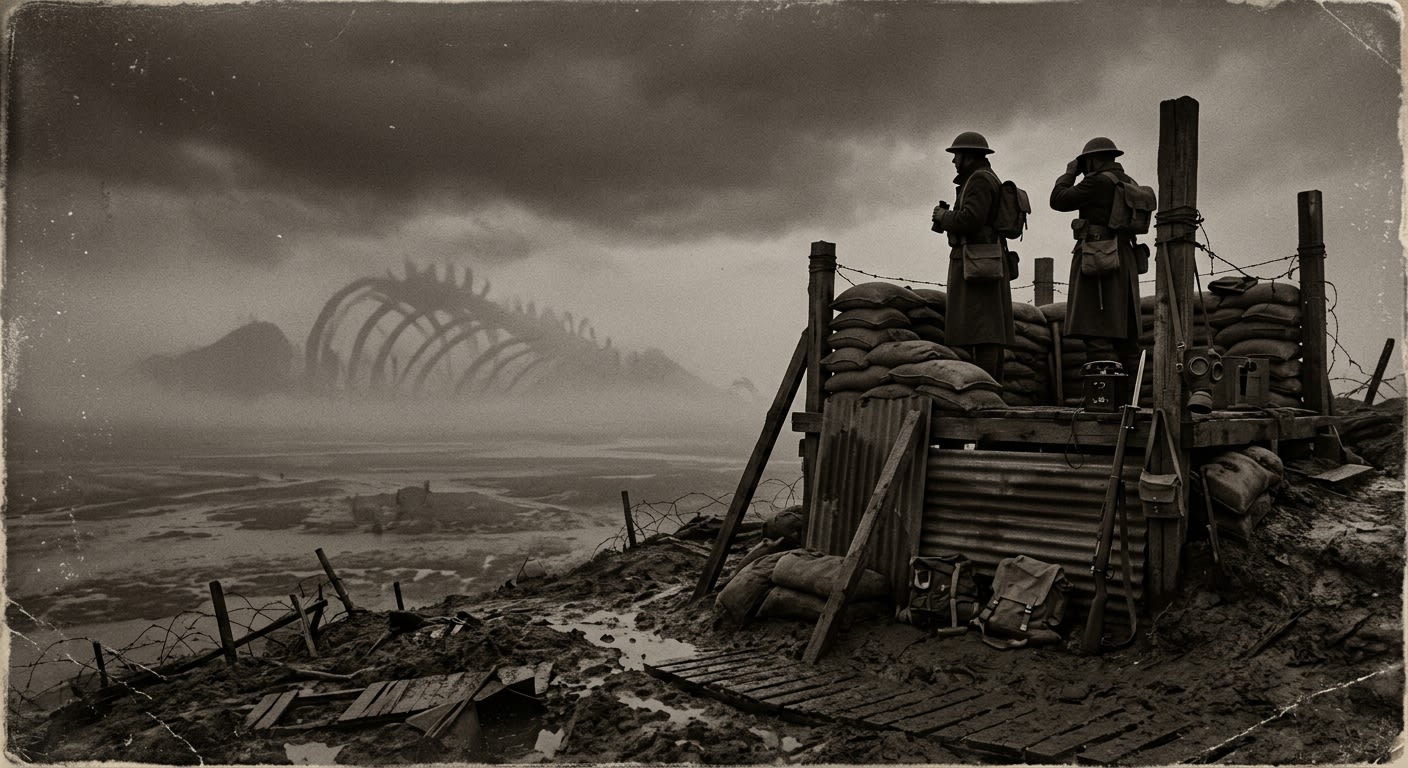
The first reliable description came in A.S. 174, when a Kestrel observation post operating along the eastern Blightmarsh perimeter reported a structure visible through the permanent overcast — spires, or what might have been ribs, rising above the grey line at a distance the observer estimated at twelve leagues. The observer's log, filed with the Bureau of Records under Seal Amber, notes that the structure appeared to move in the manner of a breathing thing, that it was taller in the evening than in the morning, and that on the third day of observation it was no longer visible, since the overcast had risen to meet it. The observer requested transfer. The transfer was granted. The observer is presently assigned to Bastion-Königsberg, which tells you everything about how the Bureau of War categorises requests born of honest terror.
#On the Approach
"No road leads to the Hollow Court. Every road in the Blightmarsh leads to it." — Deposition 7-K, paragraph 11
The Blightmarsh does not permit roads. It consumes them — the packed earth softens, the gravel sinks, the wooden causeways are swallowed in a matter of weeks. And yet every patrol that has entered the eastern Marsh and survived long enough to file a report describes the same phenomenon: the terrain guides. You do not choose to walk toward the Court. You walk, and the Court is where you arrive. The mud firms beneath your boots in one direction and sucks at them in every other. The grey fog thins ahead and thickens behind. The grinding sound that passes for silence in the Blightmarsh — the wet mastication of the earth consuming itself — grows louder as you advance, which ought to be a warning but functions as a compass.
Three known expeditions have attempted a deliberate approach. The first, in A.S. 115, consisted of forty men from the Bureau of War's Reconnaissance Commissariat and a chaplain whose name the Bureau of Records has since overwritten with the standard black grid. They entered the eastern perimeter near the fallen city of Szeged and were not heard from again. The Bureau of War logged them as "consumed in reconnaissance" and promoted the chaplain posthumously, which is the cheapest form of compensation and the Bureau's favourite.
The second expedition, A.S. 134, was a Bureau of Medicine survey team tasked with sampling Blightmarsh soil for the purpose of establishing a cordon sanitaire. Eleven researchers, three porters, one armed escort of twenty. The escort returned after nine days, reporting that the researchers had walked ahead into the fog and not come back. The escort's commanding officer noted in his deposition that the researchers had not appeared frightened. They had appeared hungry. He could not explain why he had not followed them. He could not explain why he had wanted to.
The third, and most recent, was the subject of Deposition 7-K — a Bureau of Shadows operative, name redacted, who penetrated the Blightmarsh alone in A.S. 196 on orders whose provenance the Bureau has not disclosed. She reached the outer galleries of the Court, or what she described as galleries, and returned after an interval she estimated as three days but which the calendar put at nineteen. She is currently assigned to the infirmary at Bastion-Constantinople. We do not expect her testimony to improve.
STAMPED ERRATUM — A.S. 201 Prior editions of this entry stated that "no human being has entered the Hollow Court and returned." This is incorrect. One human being has entered the outer galleries and returned. The Bureau regrets the imprecision. The Bureau does not regret the sentiment.
#On the Architecture of Hunger
What follows is reconstructed from Deposition 7-K, supplemented by the aerial observations of A.S. 174, the soil-resonance data of A.S. 200, and certain deductions the Bureau of Doctrine has drawn from the theological properties of Gluttony as a structural principle. The reader is advised that the deponent's testimony deteriorated in coherence over the course of fourteen hours of debriefing, and that the later passages required interpretation by the Bureau of Rites, whose interpretations are, as a rule, worse than the thing being interpreted.
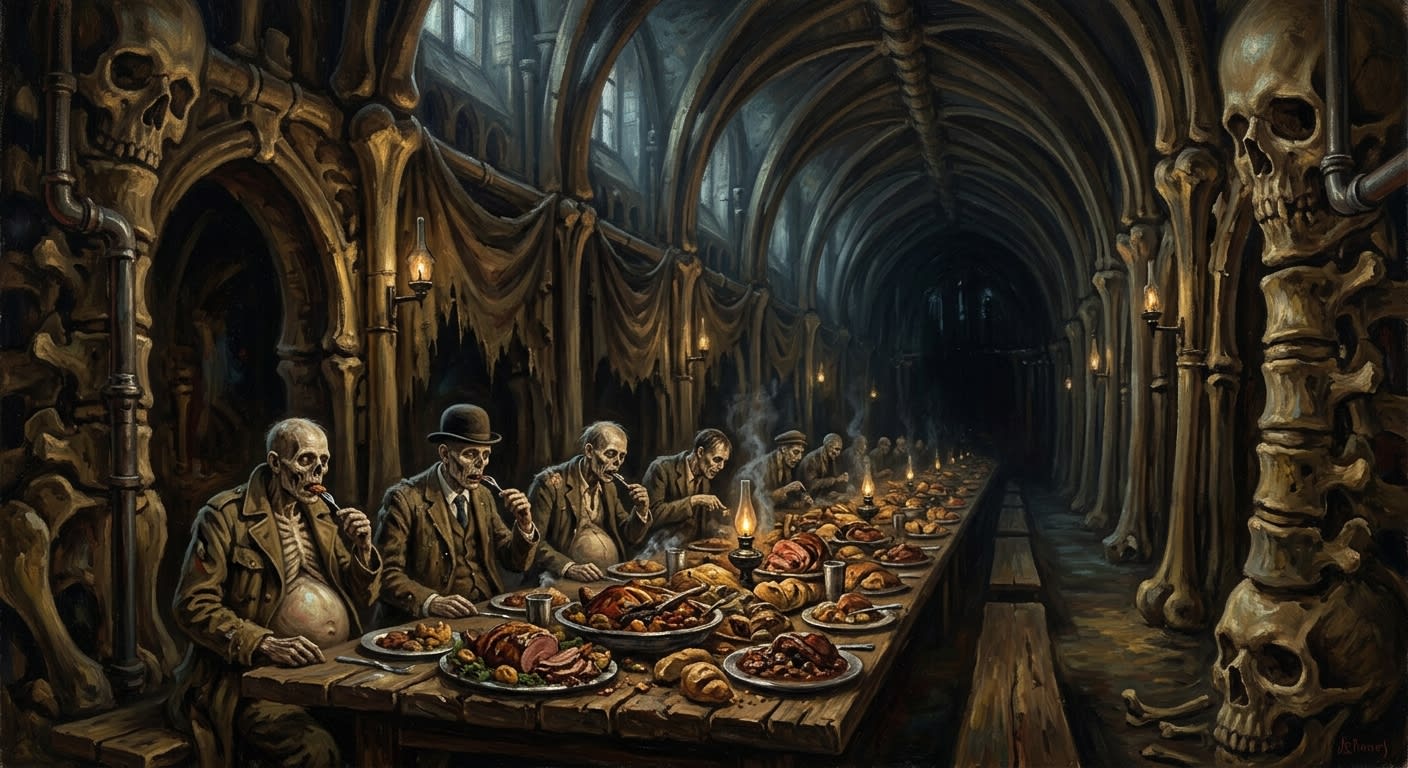
The Hollow Court is built of bone. This is the simplest fact and the one least subject to dispute — every source agrees. The walls are bone. The vaulting is bone. The floor is bone worn smooth by the passage of feet that have been walking for longer than feet should be asked to walk. The bones are not human, or not exclusively human; the deponent described ribs the length of cathedral naves, vertebrae the size of mill-wheels, pelvises that served as doorways. Whose bones these are is a question the Bureau of Doctrine has answered with "the faithful should not enquire" and which the Bureau of Medicine has answered with "nothing living possesses a femur of that diameter," and both answers say the same thing by different routes.
The structure sprawls. That is the word the deponent used, and I find it apt — the Court does not rise or extend in the manner of human architecture; it sprawls, like a body that has fallen and cannot rise, like a thing too heavy with its own consumption to hold a dignified posture. Corridors branch and rebranch without plan. Chambers open onto chambers that open onto chambers that open onto the same chamber entered from a different angle. Stairways descend into halls that are above the point of entry. The geometry is wrong in the specific manner of a stomach — folded in on itself, maximising surface area, every surface a membrane through which something is being absorbed.
The larders are empty. This detail recurs in every account — the deponent counted thirty-one larder-rooms in the outer galleries alone, each fitted with hooks, with shelves, with the apparatus of storage, and each bare. Scraped clean. The hooks had been gnawed. The shelves showed tooth-marks. The stone floors bore the scratches of something that had eaten the provisions, then eaten the containers, then started on the architecture. The emptiness of these larders is, in the Bureau's theological assessment, the point. The Court is a palace built for feasting in which nothing is stored, nothing is preserved, nothing is kept. Everything is consumed the instant it arrives. The larders exist to be empty. They are monuments to the absence of enough.
#On the Feast That Does Not End
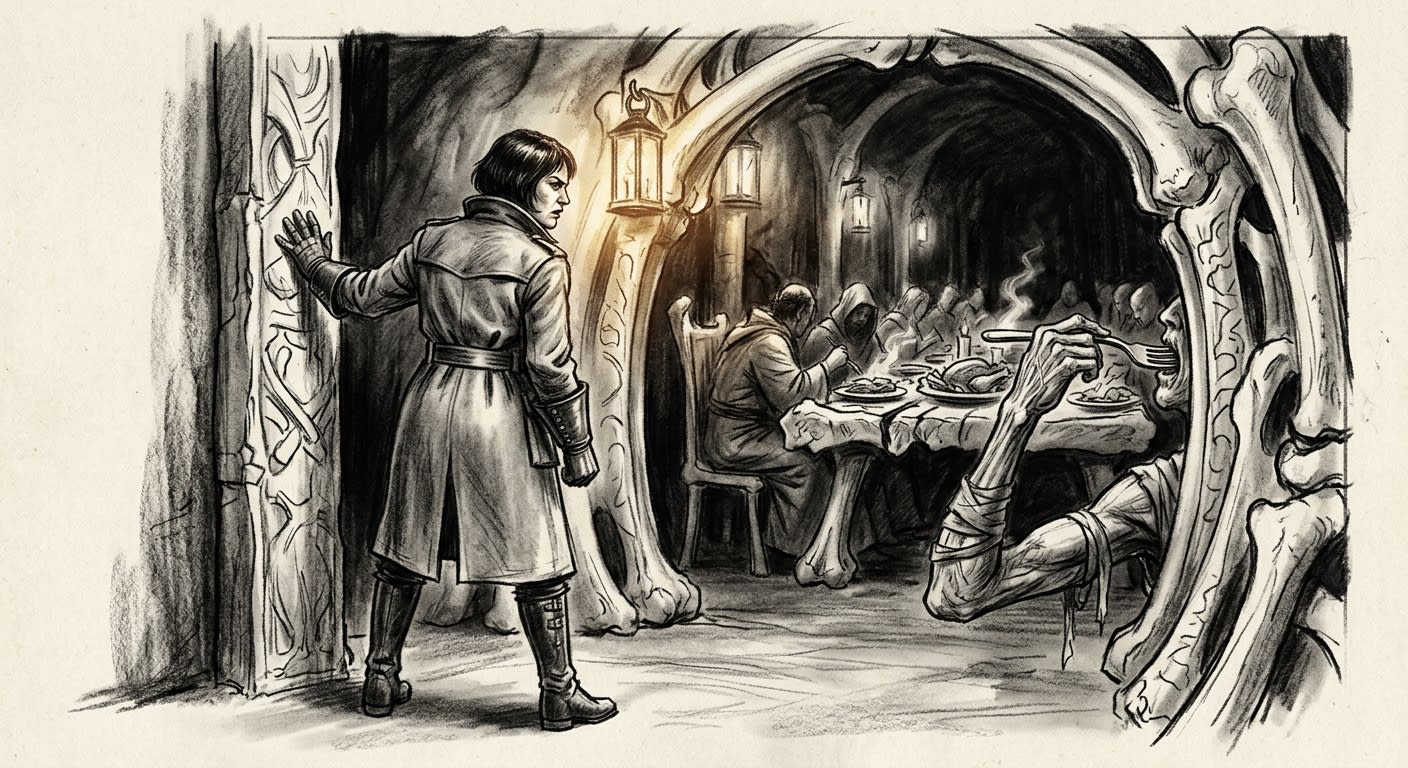
The deponent did not reach the Great Hall. She reached what she described as its antechamber — a vaulted corridor of bone, lit by a light she could not source, from which she could hear the sounds of the feast. The sounds, she reported, were the worst part. Worse than the architecture. Worse than the empty larders. Worse than the nineteen days she cannot account for.
The sounds: chewing. Swallowing. The scrape of implements on plates. The wet, rhythmic, ceaseless labour of consumption. And beneath it, threaded through it like a descant through a hymn, the sound of weeping. The chewing did not stop for the weeping. The weeping did not stop for the chewing. Both continued, layered, simultaneous, as though the act of eating and the act of grieving had become the same motion.
She could see, through the doorway — and here her testimony becomes difficult, and the Bureau of Rites was required to intervene — the edge of the table. A table of bone, running into a darkness that had no far wall. Set with plates. Set with food. The food was abundant, real, steaming, carved and dressed and sauced and laid out in the manner of a Synod feast-day banquet, and the deponent stated under oath that the smell of it was the most beautiful thing she had experienced in her life and that she would rather die than smell it again.
The guests. She could see the nearest of them — seated, hunched over their plates, eating. They had been eating for a long time. Their clothes had rotted to threads. Their bodies had wasted to frameworks of bone held together by skin drawn tight as vellum over a copying-frame. Their hands moved with mechanical persistence — fork to plate, fork to mouth, chew, swallow, fork to plate. Their bellies were distended, enormous, grotesque — the bellies of the gorged on frames of the starved. Their eyes, when she could see them, were open and wet and utterly empty of anything except need.
She estimated she could see forty guests from her vantage. Forty wasted frames, eating. The table stretched beyond them into the dark, and the sounds suggested hundreds more — thousands, perhaps — seated at a feast that had been laid before some of them were born. The servants moved between them, bone-thin themselves, carrying platters that were full and returning with platters that were empty and coming back with platters that were full again, in a rhythm that had no pause and no variation and no end.
The deponent turned back at this point. She states that she chose to turn back. The Bureau of Rites, reviewing her testimony, has noted that the precise moment of her turning coincided with the cessation of a particular harmonic in the feast-sounds — a frequency the Bureau of Bells has since identified as consistent with a compulsion-interruption, a momentary gap in the acoustic pattern that functions as a door swinging open. Whether she chose to leave or was released is a question the deponent does not wish to revisit and which the Bureau has not pressed. There are mercies even in the files of the Bureau. They are rare, and I note them when they occur.
#On What Sits at the Far End
No one has seen the far end of the table. The deponent could not see it. The aerial observers of A.S. 174 could not establish the structure's full extent. The soil-resonance survey of A.S. 200, which measured the Court's footprint through seismic displacement, returned data suggesting the structure extends for approximately nine miles in its longest axis — nine miles of table, of feast, of guests who eat and weep and cannot stop.
At the far end — if end is the word — sits Kargath. This is doctrinal certainty. The Hollow Court is his seat; the feast is his feast; the head of the table is his place. The deponent did not see him. The guests nearest her did not speak of him — they did not speak at all, their mouths being otherwise occupied. But the Bureau of Doctrine, drawing upon the established theological properties of the Sin-Generals and the consistent testimony of multiple sources, has confirmed that the Lord of the Empty Maw presides over his table as a sovereign presides over a court: present, patient, unreachable.
The distance between the nearest visible guest and the head of the table is, by the Bureau's estimate, the full nine miles. Every seat is occupied. Every guest is eating. Every guest is thinner than the one before. The geometry of the Court — if it can be called geometry, if the word has not been eaten too — suggests that the guests nearest Kargath have been seated longest, have eaten most, and have wasted furthest. They are, by extrapolation, little more than mouths attached to spines, forks moving in hands that are mostly tendon, jaws working with the persistence of mill-machinery long after the grain has run out.
And Kargath sits among them. Kargath, who has consumed more than any of them, more than all of them, more than the Blightmarsh and the plains that fed it and the cities that stood on those plains and the people who built those cities. Kargath, whose hunger predates the Sundering and will, in the Bureau's private estimation, outlast the Theocracy that wars against it. Kargath, the Famine King, the Hunger That Walks, He Who Is Never Full — seated at the head of his own table, at his own feast, surrounded by abundance that has been accumulating for a hundred and fifty-six years.
And he is hungry.
He is always hungry.
#On the Guests Who Do Not Leave
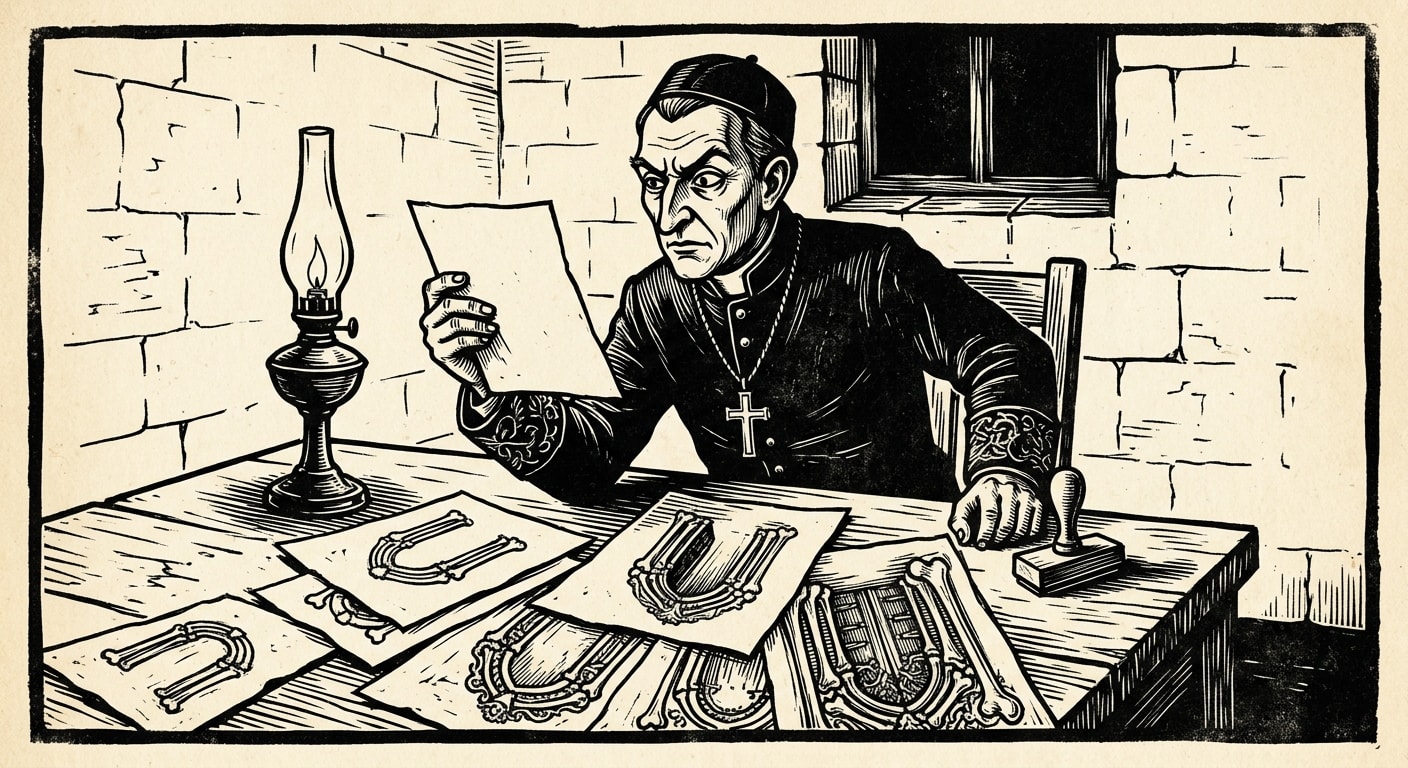
The Bureau of Records maintains a file — cross-referenced with the Bureau of War's casualty lists and the Great Ledger of Souls — of persons believed to be seated at the Hollow Court's table. The file is classified. Its existence is classified. I am, as a matter of established protocol, not confirming its existence in this passage, and the reader will note that the Bureau of Records has not asked me to retract this paragraph, which is how confirmation works in Strasbourg.
The file contains four hundred and twelve names. They span a hundred and forty years. The oldest entries date to the decades following the Sundering — soldiers captured during the Great Retreat across the Hungarian plains, civilians who did not evacuate in time, entire parishes swallowed by the advancing Blightmarsh. The most recent entry is dated A.S. 199, and it names a supply clerk from the Constantinople quartermaster depot who walked east one morning and did not return. His ration card was found at the Blightmarsh perimeter. It had been chewed.
The guests do not die. This is the cruelty that elevates the Hollow Court from a place of horror to a place of doctrine — the feast sustains, after a fashion. The food is real. The nourishment is absent, but the sustenance — the bare mechanical continuation of biological function — persists. The guests eat and waste and eat and waste and do not die. Their bodies consume themselves to feed the hunger the food cannot touch, and yet the bodies endure, reduced to their minimal architecture, stripped of everything that is not the apparatus of consumption: mouth, throat, stomach, the hands to lift the fork. Everything else — memory, identity, the capacity for thought that is not about the next bite — is eaten from within, consumed by the void that Kargath has planted in each of them like a seed that grows by feeding.
They have been eating for decades. Some of them — the ones nearest the head of the table, the ones who arrived first, the ones who sat down when the feast was young — have been eating for over a century. They do not age. They do not heal. They do not rot. They simply diminish, growing thinner and more ravenous with each course, each swallow, each mechanical repetition of the only act left to them.
STAMPED ERRATUM — A.S. 200 The Bureau of Medicine's preliminary assessment that guests of the Hollow Court "expire within an estimated 40–60 years" has been withdrawn following the soil-resonance survey data. Revised assessment: "No upper limit on guest survival has been established." The Bureau of Medicine has requested additional funding for long-range observation. The Bureau of Tithes has denied the request on grounds that the observation would cost more than the information is worth, which is the Bureau of Tithes' way of saying that some knowledge is too expensive in every sense.
#On the Acoustic Properties
The feast-sounds carry. This was established by the Kestrel observation post of A.S. 174 and confirmed by the deponent of 7-K, and it is the reason the Bureau of War has issued Standing Order 7-K prohibiting approach within an estimated five-league radius. The sounds of the Hollow Court — the chewing, the weeping, the scrape of bone utensils on bone plates — propagate through the Blightmarsh fog with a clarity that the Bureau of Bells has described as "doctrinally impossible and acoustically verified."
At a distance of five leagues, the sounds are subliminal — a gnawing at the edge of perception that the listener attributes to wind, to hunger, to the ordinary complaints of a body on short rations. At three leagues, the sounds are distinct — the listener can identify individual acts of consumption, can hear the rhythm of the feast, can feel the pull of it in the belly. At one league, the listener is, by the Bureau's assessment, compromised. The appetite response is involuntary. The desire to approach is physical. The deponent described it as "the worst hunger I have ever felt, and I have felt hunger — real hunger, the hunger of a siege winter — and this was worse, because this hunger knew where to go."
The Bureau of Bells has conducted a spectral analysis of the feast-sounds as recorded by the deponent's field equipment. The analysis reveals a harmonic structure consistent with what the Bureau classifies as a Compulsion Architecture — a pattern of frequencies designed, or evolved, or grown, to override the listener's volition in matters of appetite. The Bureau of Bells' recommendation, filed with the customary understatement, is that "no bell-based countermeasure is likely to prove effective against a harmonic source of this magnitude." The Bureau of Doctrine has classified this recommendation. The Bureau of War has not read it.
#On the Question of Rescue
The Bureau of War has been presented, on three occasions, with operational proposals to assault the Hollow Court. The first, submitted in A.S. 175 by a colonel of the Constantinople garrison whose brother was among the confirmed guests, proposed a forced march of two regiments through the Blightmarsh with blessed rations and bell-cannon support. The Bureau of War rejected it. The colonel requested a hearing. The hearing was granted, lasted eleven minutes, and concluded with the colonel being reassigned to the Paper Mines of Ulm, which is where the Bureau sends officers whose grief has become operationally inconvenient.
The second proposal, A.S. 196, came from the Bureau of Shadows and remains classified in its entirety. What is known — what I am permitted to imply without confirming — is that the proposal involved a single operative, that the operative was dispatched, that the operative reached the outer galleries, and that the operative returned in a condition the Bureau of Medicine describes as "stable" in the sense that a ruin is stable: it has stopped collapsing, but it will never be a building again.
The third proposal has not been formally submitted. It exists as a memorandum circulating among certain officers of the Bureau of War's Strategic Planning Commissariat, and it suggests — the word "suggests" doing considerable diplomatic labour — that the Hollow Court could be destroyed by sustained artillery bombardment from a position west of the Blightmarsh perimeter. The memorandum estimates a requirement of nine thousand shells over seventy-two hours. It does not estimate casualties. It does not address the question of what happens to the guests. It does not address the question of what happens to Kargath if his palace is destroyed — whether a Sin-General can be inconvenienced by the demolition of his dining room, or whether the feast would simply relocate, carrying its guests with it like a river carrying debris.
The memorandum is unsigned. It is also, by my count, on its fourth revision. Someone is refining the plan. The Bureau of War has not acknowledged its existence. The Bureau of Doctrine has not been consulted. I have read it. I have filed my own copy. The Bureau does not approve of private archives, but the Bureau has taught me, by long example, that the things most worth knowing are the things most carefully not filed.