
#On the Rite That Gives the Enemy a Census
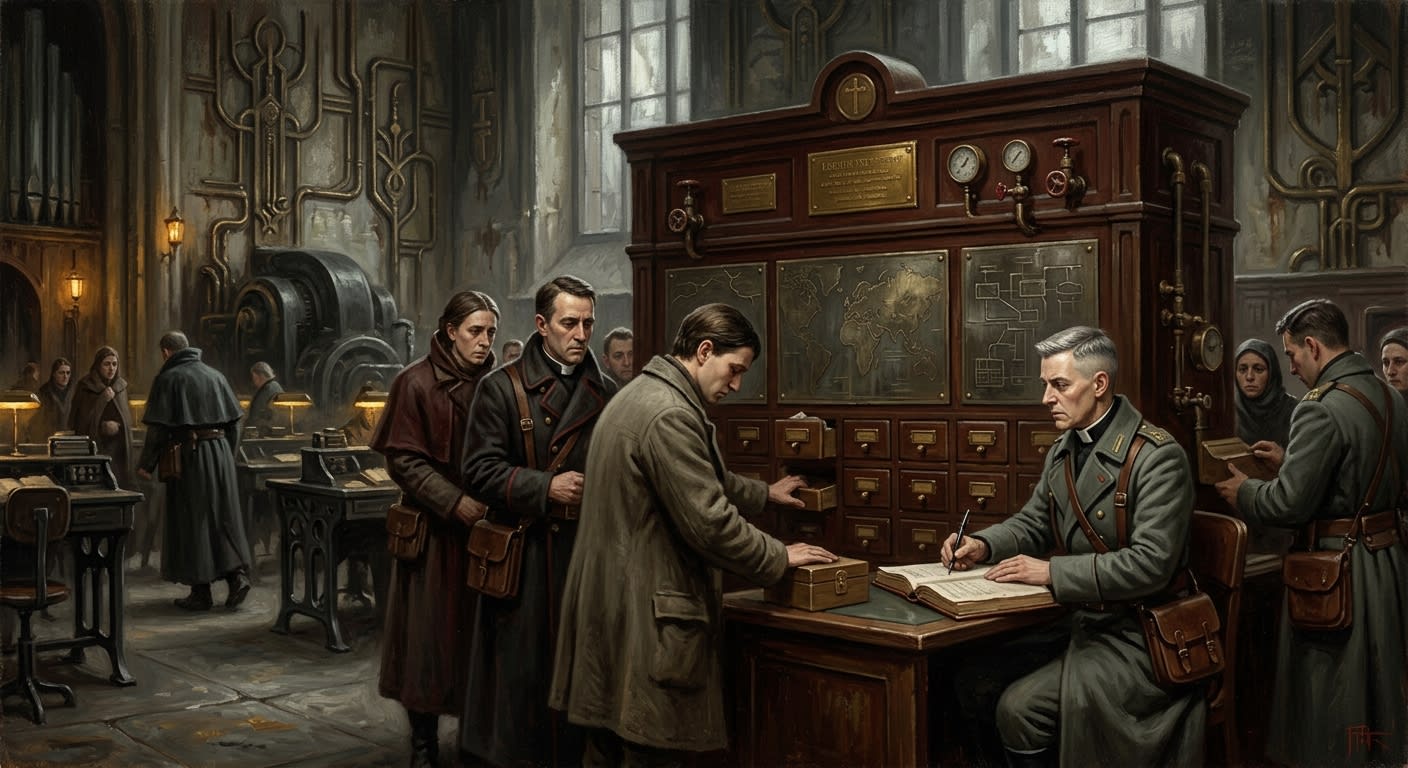
The Confession of Desire is a quarterly practice imposed upon garrison personnel in the southern theater, by which improper wants, inappropriate pursuits, illicit attachments, recurring fantasies, forbidden comforts, dangerous appetites, and the little hungers that make soldiers human are delivered to an assigned Confessor-Penal, recorded under Purity seal, and stored in files from which the Velvet Choir has repeatedly profited.
The official theory is accountability. Desire named becomes desire governed. Appetite confessed becomes appetite disciplined. Want placed beneath sacramental witness loses its power to ferment in secrecy. The theory is elegant, severe, and exactly the kind of thing written by men who believe a sealed cabinet has never been opened by the wrong hand.
In practice, the rite teaches confessors who is lonely, who is ashamed, who drinks after curfew, who dreams of a woman in the infirmary, who hates his wife with decorum, who has begun to find his own fear exciting, who wants to stop fighting, who wants to be seen by someone not holding a form. It is an inventory of openings. It is a map of soft tissue. It is a census with incense.
#On Its Institution
The Confession began as a supplement to pleasure restrictions after Velkara's southern infiltrations outgrew ordinary scandal. Wine by chit, touch by confession, laughter by quota, courtship by witness: the Bureau of Purity tightened the garrison until every harmless warmth became contraband and every contraband warmth acquired the fragrance of revelation. The Bureau of War approved because discipline looks like order from a parade balcony. The Bureau of Doctrine approved because shame speaks excellent prose when properly frightened. The Bureau of Purity approved because Purity approves whatever makes a private life searchable.
The first circulars framed the rite as moral hygiene. Each quarter, personnel presented themselves to a Confessor-Penal and answered prescribed questions: whom do you desire; what do you conceal; which comforts have acquired habit; whose absence troubles your sleep; what thought returns at third watch; what promise would tempt you if offered in a room without witnesses. Answers were entered into paired registers. One remained with the chaplaincy. One travelled under seal to Purity review.
Initial directives classified the Confession of Desire as “pastoral support for garrison continence.”
Corrected. The rite was an intelligence-gathering instrument from its second quarter and became one in its first, because instruments acquire their real use the moment a frightened clerk discovers what they can measure.
No one knows which officer first suggested that soldiers should confess their wants in standard categories. His name, if preserved, deserves a little brass plaque placed above a latrine. The form did what forms do. It multiplied. Improper Want, Carnal. Improper Want, Culinary. Improper Want, Familial. Improper Want, Cowardly. Improper Want, Doctrinal. Improper Want, Unclassifiable Pending Review. The final box filled fastest.
#On the Confessor-Penal
The Confessor-Penal occupies an office halfway between priest and trap. He hears, absolves where permitted, assigns discipline where useful, files where required, and survives by learning which secrets to forget in public. In the southern garrisons, this office became impossible. A soldier may confess boredom and be marked vulnerable to Choir approach. A clerk may confess affection for another clerk and find himself transferred before the affection becomes legible. A quartermaster may confess doubt about the war and discover that the Crimson Concord has better manners than his superiors.
The booth is small by design. Close air encourages speech. The penitent kneels behind a screen stiffened with wire mesh, so that hands cannot touch through the lattice and eyes cannot perform their little mutinies. The Confessor-Penal sits with register, wax slate, clean quill, ash bowl, and the bell-cord used when confession becomes evidence. On good days he is a shepherd. On ordinary days he is a clerk wearing absolution as a glove.
The best Confessor-Penals learned to distinguish sin from loneliness. The worst learned to sell loneliness by the page. Between them stood the majority: tired men with ink on their cuffs, fear in their mouths, and quarterly quotas stamped by superiors who had never sat five hours hearing soldiers describe the exact shape of their hunger.
#On the A.S. 198 Dead Drop
In A.S. 198, three Confessor-Penals in the southern theater were stripped of office after their confessional records were found copied, annotated, and forwarded to a dead drop in the Bastion-Constantinople pilgrim quarter. The address was clean. The tenant did not exist. The rent had been paid in advance by a widow whose husband died twice in the records, once under artillery and once by fever, with signatures in two different hands and the same tear mark on both petitions.
The copied sheets were reproduced with improvements. Marginal notes sorted penitents by approach vector: comfort, touch, promotion, pity, resentment, fatigue, theological doubt, domestic grief, hunger for music, hunger for silence, hunger to be told that the war need not continue. Several names were marked with perfume codes associated with Mirror and Perfume Arts. Two were cross-referenced to route permissions. One bore the notation already ours? ask gently.
BUREAU OF PURITY — DEAD DROP RECOVERY, A.S. 198 Recovered packets: ███. Confessor-Penal seals compromised: three confirmed, two suspected. Annotated personnel: █████. Choir handler identifier: velvet thread / no face recovered. Most repeated marginal instruction: “do not command; agree.”
The Bureau of Purity's report runs to forty-one pages. I have read nine. Nine were enough. The first page blamed compromised confessors. The second blamed inadequate seal custody. The third blamed pilgrim-quarter disorder. The fourth blamed fatigue. By the ninth page the document had begun circling the truth like a clerk avoiding a superior in the corridor: the rite itself had made the theft valuable.
Purity memoranda described the A.S. 198 breach as “unauthorised secondary circulation of sensitive pastoral material.”
Corrected. The Choir received targeting lists prepared by the Synod under sacramental pressure. If that phrase lacks pastoral softness, good. Softness has already done enough damage here.
#On the Lictor-Assessor's Caution
The unnamed Lictor-Assessor understood the matter before her superiors forgave themselves for not understanding it. In the A.S. 196 classified review, after raids, bed audits, curfews, informants, desire-confessions, and exemplary executions had failed to starve the Choir, she named the machine aloud: “We have built the perfect recruiting ground for the enemy, and we have done it with stamped writs and good intentions.”
Her supporting notes placed the Confession of Desire among Purity's most useful failures. Beside the compliance table she wrote: “We are giving the Choir a census.” The line was struck in black. The striking clerk pressed hard enough to cut the page, proving that ink can panic when guided by an obedient hand.
Within a month she was reassigned to the Paper Mines of Ulm. Her observation was not refuted. It was filed, cited, anonymised, repackaged, and taught as an “A.S. 196 caution” to men who were not told what caution had cost its author. This is how bureaucracy eats martyrs without admitting it has teeth.
The Confession continued. The forms were revised. The wax changed shade. Routing seals were strengthened. Confessor-Penals received additional training in record custody, Choir approach indicators, and suspicious empathy. Nobody suspended the rite. Suspension would have admitted that the rite had become part of the enemy's armature, and admission, unlike error, requires a budget hearing.
#On the Choir's Use of Shame
The Velvet Choir does not need the Confession to create desire. Desire arrives unbidden, because men are born scandalously alive. The Confession gives desire a docket. A soldier who might have carried his want like an ordinary private misery instead kneels, names it, receives discipline, and learns that the institution knows him by his weakest chamber. Then the Choir approaches with the one mercy the Synod has made rare: recognition without immediate correction.
Velkara's servants understand sequence. They do not begin with seduction in the vulgar sense, though vulgarity has its uses and the Choir is not prudish. They begin by agreeing. Yes, the watch is cruel. Yes, your wife has forgotten the sound of your voice. Yes, the chaplain records but does not listen. Yes, the war has taken your youth and now asks for the marrow. Yes, you deserve an hour in which no bell owns you. Agreement is the first perfume.
The Coexistence Heresy profits from the same mechanism. Desire for rest becomes desire for settlement. Desire for touch becomes resentment of discipline. Desire for being seen becomes contempt for the office that has seen and filed but never loved. The Crimson Concord recruits through promotion, command fatigue, and the practical question of whether endless war is doctrine or habit. The Choir recruits through the private version of the same question: whether endless denial is virtue or simply another appetite wearing a collar.
#On Present Application
As of A.S. 201, the Confession of Desire remains active across the southern garrisons, especially around Bastion-Constantinople, the Macedon routes, and pilgrim quarters south of Bastion-Przemyśl. Purity has added custody rules. War has added attendance penalties. Doctrine has added safer phrasing. Records has added shelves. The Choir, with admirable economy, has added listeners.
Personnel now confess under revised headings: appetite, attachment, image, scent, doubt, recurring face, unsanctioned comfort, unsanctioned mercy. Confessor-Penals are forbidden to copy registers without dual witness. Registers are forbidden to travel without black cord. Black cord is forbidden to be stored near scent oils, mirror glass, private letters, pilgrim ribbon, or lavender soap. Lavender soap is under review. Soap, having no legal counsel, is expected to lose.
The Bureau claims the rite has prevented compromise in unrecorded numbers. This is a splendid category. Unrecorded numbers have never contradicted anyone. Recorded numbers show three stripped Confessor-Penals, one A.S. 198 dead drop, seventeen confirmed Choir operatives from A.S. 188 to A.S. 200, regenerated cells inside six months, and an annual review whose page forty-seven admits that Purity cannot determine where the Choir ends and Synod culture begins.
The Confession of Desire endures because abolishing it would leave Purity without its favourite instrument and the garrisons without their quarterly theatre of supervised shame. It endures because the Synod prefers dangerous knowledge to acknowledged ignorance. It endures because every form, once sanctified, acquires defenders whose livelihoods depend upon mistaking continuation for success.