
#On the Southern Theater, Which Is a Name for Several Kinds of Trouble
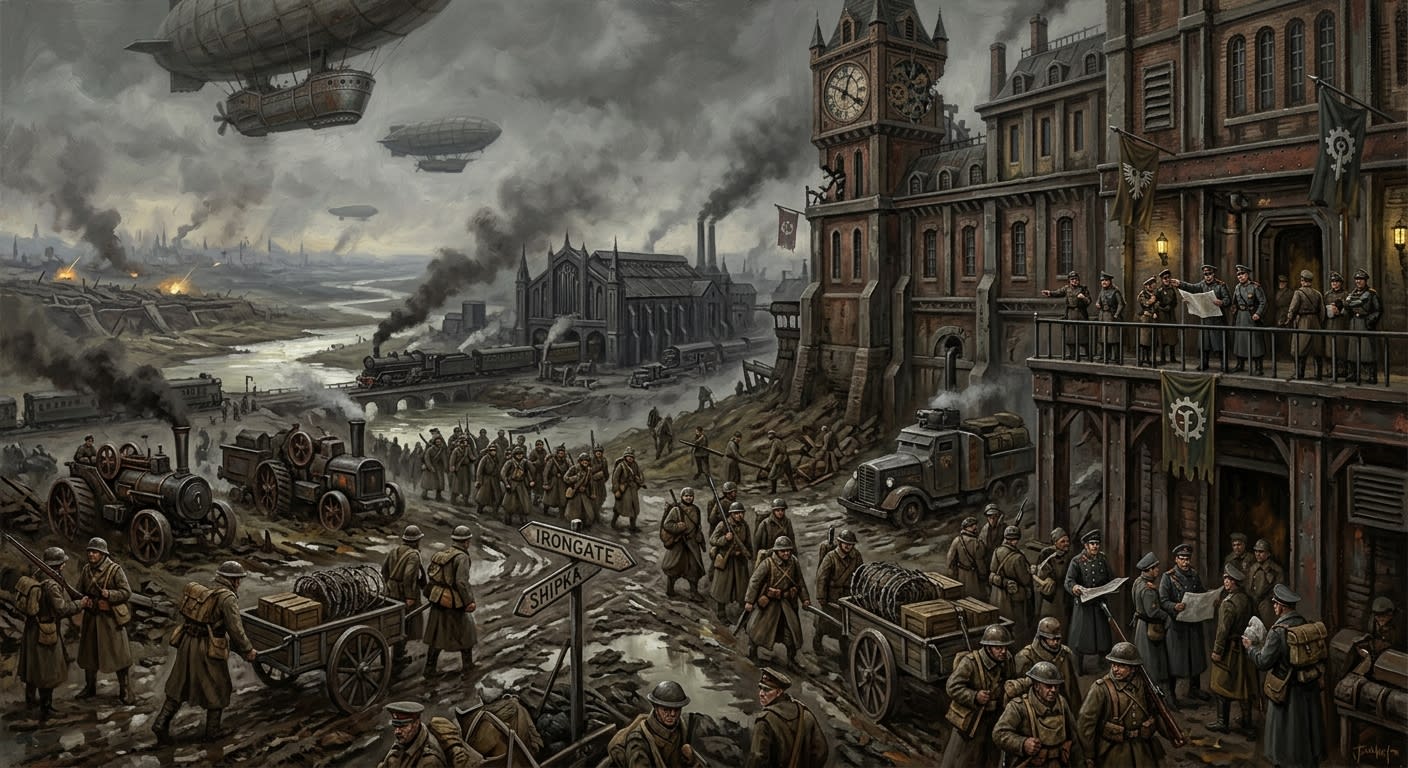
The Southern Theater is the portion of the Sagittal Line where geography stops pretending to be neutral. It runs from the black throat of Bastion-Irongate, through the mud, sleep, and schedule-obsession of Bastion-Shipka, down to the southern lock of Bastion-Constantinople, where the Bosphorus clenches the world between sea and fire. On maps it is a command sector. In ledgers it is a budgetary wound. In sermons it is the lower spear of the Faith. In private memoranda, which are always more honest because they are addressed to cowards with clearance, it is the place where three Sin-Generals discovered that cooperation need not be formal to be ruinous.
To the west lie the Heartlands, supply roads, railheads, port contracts, and all those comfortable cities whose citizens speak of the Line with reverence because reverence costs less than attendance. To the east and southeast lie the broken Balkans, the Charnel Lands, the Black Sea attack lane, the Thracian furnace-plains, the Vales of Stagnance, the Danube approaches, the Macedon roads, and the innumerable small gaps through which Hell, debt, sleep, ash, perfume, forged manifests, and bad policy crawl westward with papers in order.
The Theater is not merely southern because it sits below the central bastions. It is southern because everything there descends: roads into ravines, tunnels into underchords, morale into arithmetic, doctrine into screening questionnaires, officers into private doubt, soldiers into fog, convoys into schedules from which they emerge either late, wrong, or correct in the manner of a corpse with a fresh haircut.
The bureau language calls it a theater because war likes curtains. The word flatters commanders by implying sightlines, actors, entrances, exits, and a stage manager with authority over the machinery. The Southern Theater has none of these comforts. Its actors change faces. Its entrances mislead distance. Its exits carry tolls from offices no one can locate. Its stage machinery hums in basalt, clicks in gold-veined limestone, sleeps in reed marsh, and sometimes answers back in a voice the missing man would have used if he were still properly human.
#On the Three Anchors of the Lower Spine
Irongate is the upper hinge of the Southern Theater, though no officer stationed there would thank me for the phrase. A hinge implies motion. The Irongate exists to prevent motion by gripping the Danube gorge with chain-booms, cliff batteries, transit bores, and a choral infrastructure so absurdly essential that any citizen hearing the full truth would be forgiven for wondering whether the Line is defended by engineering or hostage-taking with better acoustics.
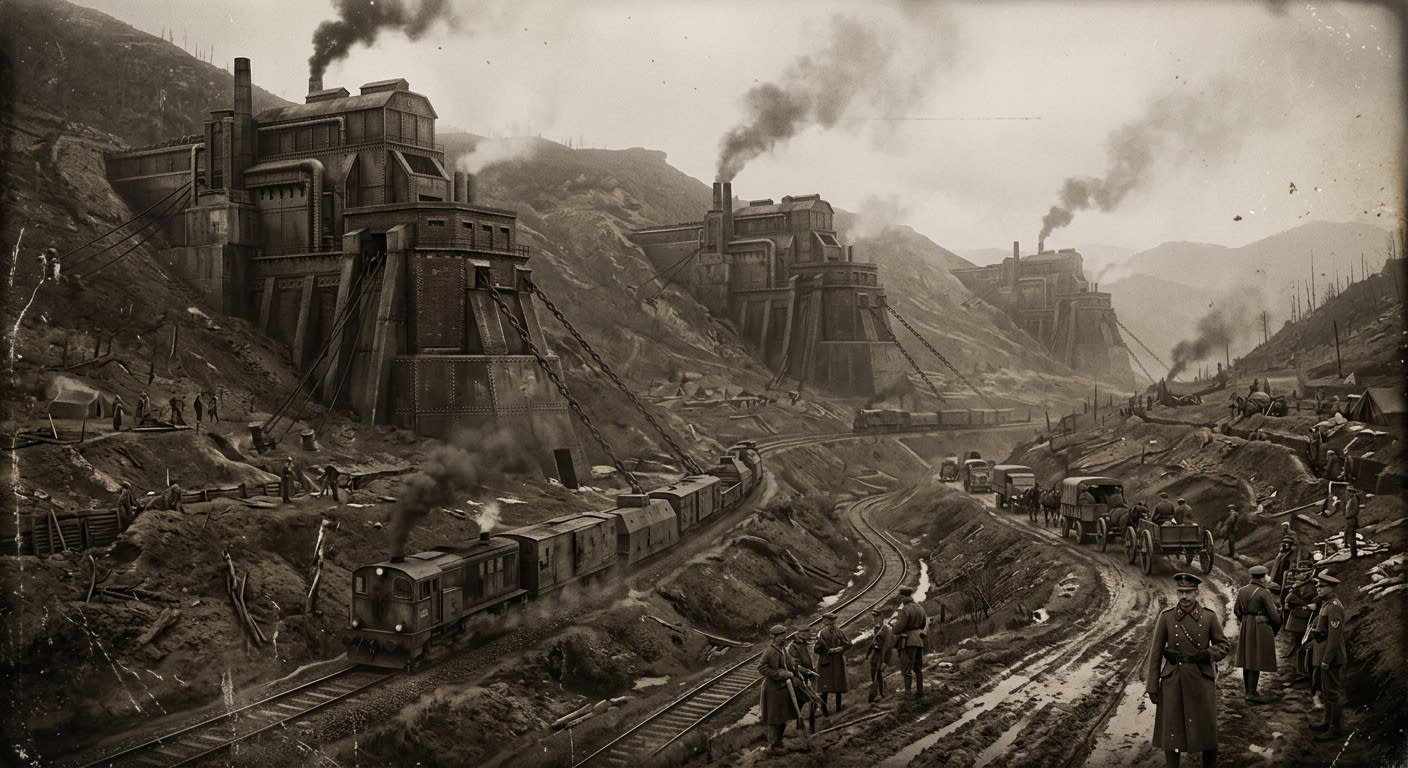
The mountain must be sung into stability. The Gasket Choir holds the tunnel system by prescribed harmonics. The Great Hush of A.S. 94 taught the garrison that silence is structural appetite: pressure doors failed, the Third Lung compacted into stone and iron, and three thousand names entered the Ledger through the narrow door marked instructional necessity. Since then the chant crews have sung in watches, their voices converted into load-bearing matter by decree, discipline, and terror. The unlicensed descend. The licensed crack. The mountain listens.
Beneath Irongate lies the Underchords, eleven unofficial miles of denied corridor, quiet passage, counterfeit voice-license, oxygen bulb, gasket-ring currency, silent tap-code, and the little mercies official order cannot provide without admitting its own design leaks. There, the Counterkey Circle teaches forbidden harmonics and claims the Magistracy sings the wrong notes on purpose. It may be a heresy. It may be a technical correction. The distinction is less comforting when the mountain over your head has opinions.
Shipka is the second anchor, set in the Balkan marshes where Syrion does not assault so much as reduce urgency until defence becomes a habit no one remembers choosing. It guards the reed road, the timing relays, the supply spur, and the last reliable minutes before the Dreamer’s influence makes clocks into optimistic furniture. Shipka’s garrison rotates fast, drinks bitter stimulants, checks water-clocks against bells, and treats punctuality with the zeal other bastions reserve for relics.
There the enemy nibbles. Lullaby offensives move through fog. Time-bleeds make patrols return before they left or after they died in the schedule. Whole hamlets stand asleep at nets. Outpost Eleven-West remains the lesson no one phrases too plainly: a platoon seated around a construct resembling a country hearth, eyes closed, still not opened. Bureau circulars call this persistent low-grade Sloth influence. Soldiers call it the marsh asking them to sit down.
Constantinople is the southern anchor, the hinge where the Line meets the Bosphorus and the sea tries to become a flank. Its walls face Kargath and Maldrake together, an arrangement that would be unfair if the world were administered by sporting gentlemen rather than by the Creator, Hell, and the Bureau of War, in descending order of responsiveness. Kargath rots supply before it arrives. Maldrake arrives as campaign-fire, slag, breach, and rage wearing armour. Velkara, because vulgar siegecraft would insult her, operates inside the place.
Constantinople’s problem is size. Three hundred thousand registered souls, four Continental Levies and specialist companies, harbour chains, ravelins, warrens, ossuaries, foundries, convoy docks, pilgrim quarters, command halls, and enough sealed sub-vaults to give Records a local theology of depth. A small fortress may be inspected. Constantinople must be inferred by symptoms. The Southern Theater’s staff tables sit there because all roads, grievances, contraband files, and exhausted officers eventually arrive beneath its lamps.
#On the Enemies Who Share Without Admitting It
The Bureau of Inter-Infernal Analysis exists so that important men may say with diagrams what trench soldiers learn by smell: the Sin-Generals despise one another, compete with one another, and still produce effects that assist one another because Hell does not require committee minutes to cooperate. The Southern Theater proves the point with theological cruelty.
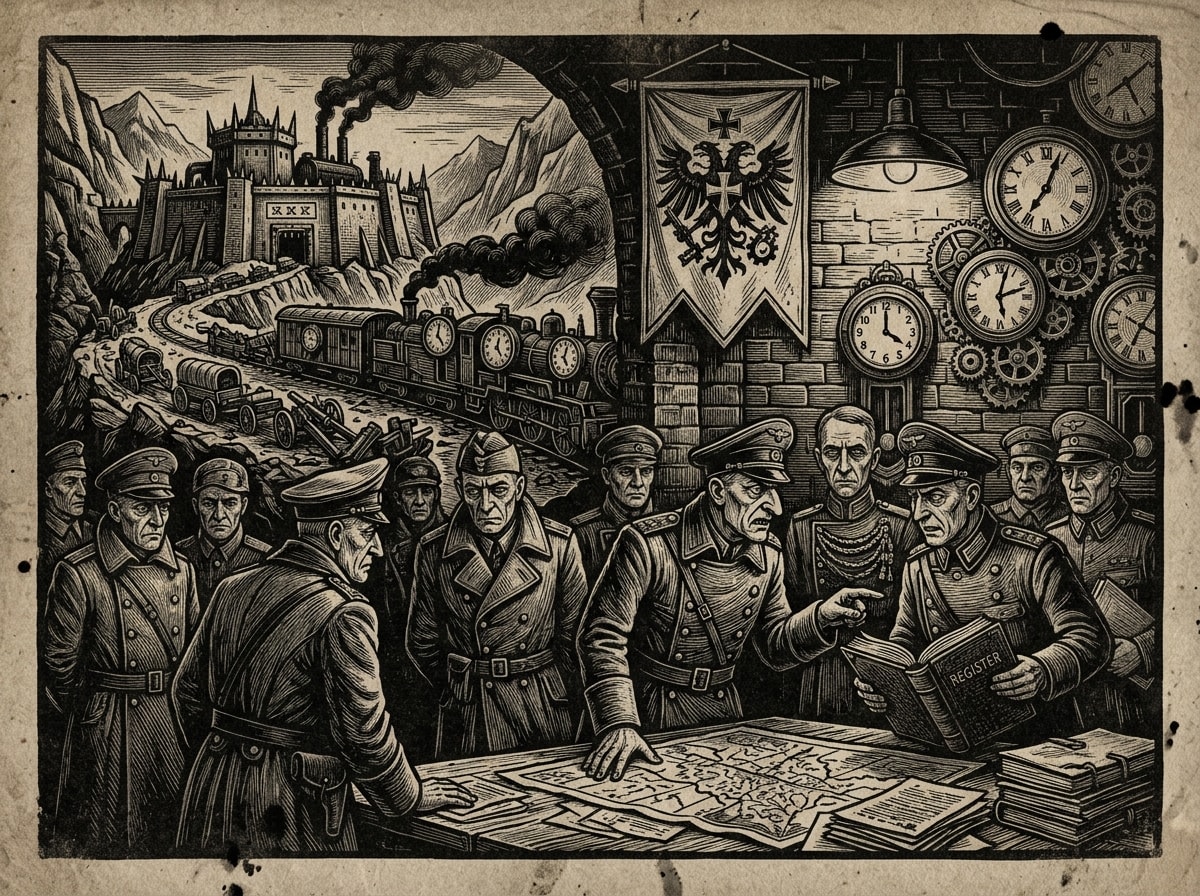
Morwen presses Irongate by envy. She wants beauty ruined, structure hollowed, identity made suspect, the gorge rendered into a mirror of itself with the living portion scraped out. Her campaign travels through replacement, echo, reflected self, and the terrible bureaucratic consequence of two men standing before the Hush Court with one name, one scar, one childhood dog, and two equally valid entries in the Ledger of Self. The standard resolution, execution of both, is efficient. Efficiency is often the scent by which horror enters respectable offices.
Syrion presses Shipka by delay. He turns battle into drowsiness and drowsiness into policy failure. Men do not defect; they sit. Orders do not reverse; they arrive after usefulness has wandered away. Roads do not vanish; they take longer to mean themselves. A commander can rage at artillery, walls, visible monsters. Raging at slowness makes him look childish, which is one of Syrion’s minor mercies and major weapons.
Kargath presses Constantinople through appetite. Stores sour. Grain sweats. Oil thickens. Caravans arrive with hunger in the sacks and bile in the water. Maldrake presses by campaign, flame, breach, and the joy of direct violence. The two hate each other so sincerely that Doctrine has been tempted, more than once, to list their contempt under fortification assets. This is poor theology and sound logistics.
Velkara makes the Southern Theater singular. She has no fixed bastion because she regards fixed bastions as provincial. Her Velvet Choir seduces bodies. Her Crimson Concord promotes useful minds. She understands that a wall’s interior has more gates than its exterior and that an officer who has privately begun to doubt the war’s necessity is a door no engineer will find on a plan.
The official doctrine says the Sin-Generals remain divided by sin. Envy ruins what Greed would buy. Sloth delays what Wrath would burn. Gluttony devours what Lust would keep pliant. This remains true. It is also insufficient. In the Southern Theater, Velmoran debt may travel along Macedon roads while Velkaran substitution rides inside the caravan and Kargathan spoilage waits in the grain. Morwen’s identity pressure in Irongate produces administrative paranoia useful to Concord argument. Syrion’s exhaustion at Shipka makes negotiated-settlement fantasies feel adult. Maldrake’s fires make Kargath’s hunger credible. The sins quarrel. Their consequences shake hands in the dark.
Earlier Theater catechisms described southern demonic pressure as “sector-specific, separately manifested, and independently countered.”
Corrected after A.S. 199 joint assessments. The pressure remains sector-specific in origin and mixed in consequence. The old wording was comforting, tidy, and suspicious.
#On Roads, Corridors, and the Accountancy of Distance
The Southern Theater is fed by roads that resent the compliment. From the west and northwest come the central and southern supply lines: rail, cart, mule, river, shrine-platform, military spur, and the countless minor routes by which unofficial necessity corrects official planning. The Bureau of War draws thick arrows. The roads laugh in mud, glare, toll, fog, and paperwork.
The Macedon Escarpments are the Theater’s most infamous artery, limestone terraces northwest of Constantinople where distance bends under amber refraction and correct manifests may still have teeth. Legate-Inspector Theron Vast proposed closure of the routes in A.S. 187 pending doctrinal review of active manifests. The proposal remains under review in A.S. 201. Fourteen years is long enough for a half-shut door to become a doctrine.
The Escarpments produce the Merchant Problem: caravans that pass checkpoint rites with correct wax, correct names, correct faces, correct devotional rosters, and an interior alteration no form catches in time. Complex contraband moves beneath lawful cargo. Reflections remain seated after drivers stand. Salt weighs less when touched by widows. Buckles bear no heraldic mark and are still recognised by horses. The third sub-vault beneath the Harbor of Chains stores the records. Mother-Cryptor Sabine indexes what other offices survive by not reading.
Shipka’s reed road is less theatrical and more cruel. It is a raised argument between Engineering and swamp, carrying the marsh spur of the Sagittal rail through land that wants to become water and mist that wants to become sleep. Supply trains crossing it bring grain, powder, bandages, shell-fuses, coal, lamp-oil, timber, and men who have confused arrival with safety. A delay there is not delay. It is infection spreading backward through timetable, ration, hospital, gun, and grave.
Irongate’s Transit Spine is a road inside a mountain that must be kept alive by sound. It moves convoys between Sibiu, Shipka, and the lower Line under pressure doors, voice licenses, breath permits, and mirror discipline. Beneath it, Jaro’s quiet passes offer the other road: illegal, silent, priced in gasket-rings, and more reliable than any office is permitted to admit. When legal routes fail, illicit routes become emergency infrastructure. When emergency infrastructure works too well, Purity calls it a cartel and War calls it regrettable.
Constantinople’s hintermark receives all these motions and translates them into weight at the gates. Orchard villages, foundry-towns, levy settlements, grave fields, toll chapels, and old road shrines feed the southern anchor with the efficiency of communities that have been losing sons for so many generations that grief has become a civic profession. Behind the walls, every arrival is both necessity and exposure. The Theater cannot close its roads without starving itself. It cannot open them without admitting the enemy uses the same hinge.
#On Command, Purity, and the Questionnaire as Weapon
The Southern Theater’s command apparatus sits under too many seals to be called a single government and under too much fear to be called a coalition. Bureau of War commands troop movement, ration priority, route closure, field disposition, and the right to call disasters temporary. Bureau of Purity screens personnel, investigates compromised officers, raids improper bedrooms, and asks questions whose universal answers terrify its own analysts. Doctrine classifies what War survives and Purity misunderstands. Records stores evidence in vaults deep enough that facts age into minerals. Bells, Hourglass, Engineering, Orison, Mercy, and the Breath Office all hold fragments of authority sharp enough to cut one another.
The Crimson Concord has made this apparatus its habitat. The annual review of A.S. 200 named it Embedded Heretical Infrastructure, Category: Structural, Theater-Wide. This classification is one of those rare bureaucratic sentences that manages to be both late and alarming. The Concord is not a tavern cell with passwords, cloaks, and an idiot at the door. It is a professional culture in which competent officers, exhausted clerks, chaplains with too much pastoral imagination, quartermasters with useful friendships, and administrators promoted through suspiciously smooth channels begin to hold the same private question: what if the war is policy wearing vestments?
Purity’s response has been screening. Question Fourteen asks whether the subject has ever entertained the possibility that the present conflict might be resolved through negotiation rather than military action. The answer is always no. The universal no has been classified as suspicious. Question Fourteen-A asks whether the subject is aware that Question Fourteen has a correct answer. The answer is also always no. The Bureau has not revised the instrument. It has added appendices, which is how Purity admits defeat without lowering its voice.
Legate-Inspector Theron Vast’s severity remains the great unresolved sermon of the Theater. He commands the Macedon checkpoints, filed the A.S. 187 closure proposal that would have paralysed the southern routes, received promotion, and passed Purity’s scrutiny without visible scratch. He may be clean. He may be managed. He may be that most dangerous product of our age: a loyal man who understands that loyalty itself has become part of the machine damaging what it defends.
At Irongate, Purity’s Southern Theater desk received the first Counterkey report in A.S. 198: tap-code transcription, analysis, classification within hours. Fourteen suspected harmonics cases died under Hush Court procedure. At Shipka, Hourglass clerks stamp Sloth-sigils in margins while War demands clear schedules from clocks no longer trustworthy. At Constantinople, the Concord is so embedded that the Bureau’s review cannot draw a boundary between infiltrated institution and institutional habit. If the reader finds this intolerable, the reader has grasped the Theater’s administrative condition.
#On the War of Interior Weather
The Southern Theater is held by fortifications and lost, daily, through interior weather. Fatigue, suspicion, desire, hunger, sleep, imitation, audit, cough, boredom, private mercy, wrong music, correct paperwork, and the little theological bruises left by long service — these are the Theater’s true climate. Men survive shellfire and surrender to a question at third watch. Women keep convoy ledgers immaculate and misplace one name because pity arrived wearing the face of procedure. A chaplain denounces negotiation at morning office and removes the denunciation’s last sentence when preaching to men who have not slept properly in nine days.
There are visible dangers. Kargath’s rot. Maldrake’s fire. Morwen’s replacements. Syrion’s fog. Velkara’s agents. A visible danger has the politeness to become an object. One may shoot it, burn it, ring bells at it, write memoranda about its behaviour, or die under it with the satisfaction of having identified the responsible party. Interior weather denies that pleasure. It enters as mood, mercy, efficiency, reasonable doubt, proper caution, humane compromise, scheduling fatigue, and the professional reluctance to say what everyone already knows.
Bureau of War briefings formerly listed morale, theological confidence, and command trust as “supporting conditions.”
Revised. In the Southern Theater these are primary terrain. Any commander who treats them as supporting conditions has mistaken the table for the battlefield.
The Coexistence Heresy spreads through this weather because it is dressed as adult thought. It tells officers that Hell can be bargained with, that accommodation is survival, that the Line is a wound maintained by both tyrannies, and that ending the war would free mankind from demon and Bureau alike. It is wrong, of course. Hell metabolises treaties. The demon who offers peace is chewing while the clause is read aloud. Still, the heresy speaks to exhaustion in the language exhaustion already uses. That is why it travels.
The sanctioned answer remains sermon, screening, denial, and fire. These instruments break visible collaboration. They do not unask questions. The Concord knows this. Velkara knows this. Every officer who says no to Question Fourteen and then lies awake considering the permitted shape of his denial knows this.
Joint Purity / War memorandum, A.S. 200, Southern Theater command confidence annex: Estimated percentage of officers holding doctrinally irregular views regarding negotiated settlement: ████. Filed category: at-risk personnel. Recommendation: enhanced devotional screening, promotion review, chaplain rotation, mirror-scent audit, and ███████████████████████ for staff officers assigned to Constantinople, Shipka, Irongate, Macedon route command, and unnamed attached desks. Margin note, unsigned: “If forty percent are at risk, the risk is command.”
The Bureau of Doctrine objected to that margin note. Naturally. Margin notes are where truth goes when paragraphs have been over-policed.
#On Civilians, Workers, and Those Who Keep the Theater Fed
The Southern Theater is often described through bastions, generals, and commanders, which is to say through people with desks high enough to avoid seeing the hands beneath them. The Theater survives by lower trades: muleteers in the Macedon glare, chainwrights at harbours, reed-road pump crews, Irongate chant workers, Shipka timing adepts, rail hookmen, hospice sisters, mirror-black room attendants, gasket makers, seal clerks, lantern carriers, convoy cooks, toll-chapel boys, widows who count rations better than quartermasters, and smugglers whose illegality is mostly a dispute over which office failed first.
A Theater convoy is a city in motion. It carries sacks, shells, prayers, orders, tools, sickness, debts, lovers’ tokens, forged passes, sanctioned lies, and the bones of men who were not supposed to die until reaching their assigned trench. At Macedon, drivers submit to scent-washing and mirrors. At Shipka, they surrender their clocks. At Irongate, they surrender their names to Ledgers of Self and their lungs to candle tests. At Constantinople, they surrender whatever innocence survived the road.
The Theater’s civilian settlements have learned practical blasphemies. A village near Shipka may ring bells through the night to keep children from walking into reeds. A Macedon toll chapel may bless caravans while hiding spare black cloth for mirrors because the official issue runs short. An Irongate worker may buy a quiet pass from Tap-King Jaro and still attend sanctioned mass if he emerges above ground in time. Constantinople’s warrens may trade information about Velvet Choir dead drops while publicly denouncing improper scent oils with flawless indignation.
Mercy in the Southern Theater is usually illegal at the moment it is useful. A clerk delays reporting a failed candle test so a singer can finish a paid shift. A chaplain removes a name from a questionnaire pile because the man has three children and an honest terror of fog. A muleteer destroys the first of two bleeding records because he knows the second belongs to the man still breathing. Doctrine frowns. War benefits. Purity investigates the wrong person with admirable zeal.
#On Signals, Bells, and the Little Lies of Measurement
The Southern Theater communicates by bell, telegraph, runner, flare, horn, pipe-tap, mirror-shutter, naval lamp, route slate, and the ancient military method of sending an exhausted boy with orders he does not understand toward officers who will blame him for arriving alive too late. No single signal system governs the Theater because no single Bureau would permit another Bureau that satisfaction. Bells claim the sacred timings. Hourglass claims the clocks. War claims operational priority. Orison claims licensed sound. Records claims copies. Engineering claims line maintenance. Purity claims any message that seems to have enjoyed itself.
At Irongate, signals must respect the mountain. A horn call in the wrong bore can loosen dust from a pressure arch. A shouted order near a baffle may become a harmonic confession. Pipe-tap carries what voice cannot, which is why Jaro’s silent court often learns news before the command desk. The Bureau calls this criminal interception. The mountain calls it efficient, and I find myself reluctant to disagree with geology when it has a better communications network than War.
At Shipka, signals fight Syrion’s drag. Telegraph keys tap too slowly during fog. Bell-strikes arrive in the wrong order across reed stations. Runners swear Station Two stood half a mile nearer than the map permits. Hourglass adepts keep comparison ledgers in red and black: red for external drift, black for internal certainty, grey for entries the clerk refuses to read aloud. A signal from Shipka may be true, late, early, duplicated, narcotic, or a dream wearing code discipline.
At Constantinople, the problem is not distance. The problem is audience. Every signal passes through too many hands with too many loyalties, too many fears, too many scented rooms, too many officers who answer Question Fourteen correctly and then request the route table twice. Orders soften in transit. Reports harden before filing. A warning becomes a concern, a concern becomes a scheduled review, and a scheduled review becomes the official method by which disaster is granted time to dress.
Signal discipline has saved the Theater more often than heroism. It has also killed with cleaner hands. A delayed Scour pre-signal at Shipka leaves marsh crews waiting beside sealed pitch. A miscopied Irongate pressure alert sends singers to the wrong Lung while the correct ceiling rehearses collapse. A Macedon checkpoint mirror-warning arrives without the third suffix and is filed as animal discrepancy rather than personnel substitution. Each event receives a corrective circular. The circulars are punctual. Men are not.
#On the Present Disposition
As of A.S. 201, the Southern Theater remains held, compromised, indispensable, and alert in the manner of a man who has not slept for three days and insists he is performing excellently. Irongate endures under acoustic strain, Counterkey agitation, Underchord expansion, lung-rot pressure, Dead Gallery growth, and Morwen’s patient corrosion of self. Shipka holds the marsh spur, tracks Syrion’s westward seepage, rotates men faster than memory can settle, and keeps the minutes from defecting. Constantinople stands against Kargath and Maldrake, feeds on roads it distrusts, and hosts a command culture Purity cannot clean without cutting into bone.
The Macedon Escarpments remain open despite Vast’s closure proposal. The Crimson Concord remains embedded despite seventeen consecutive failed identification operations. The Coexistence Heresy remains condemned and attractive to the tired. Velkara remains inside. Kargath remains hungry. Maldrake remains periodic and catastrophic. Morwen remains offended by beauty. Syrion remains patient. The Bureaus remain numerous, sincere, mutually obstructive, and convinced that the next form will distinguish infection from fatigue.
At Iron Vespers the southern reports arrive in Strasbourg: Irongate pressure tolerances, Shipka clock drift, Macedon seizure abstracts, Constantinople staff screenings, convoy losses, chaplain rotations, mirror incidents, fog alarms, questionnaire summaries, sealed addenda, missing names. The clerks stack them by urgency. They do not understand that the stack is the emergency.
The Southern Theater holds because it must. It frays because holding has become a way of fraying. The bells ring down the Line, the roads open, the tunnels hum, the marsh clocks stutter, the harbor chains lie dark across the Bosphorus, and every correct answer in the command hall waits to see which question will reach it first.