
#On the School
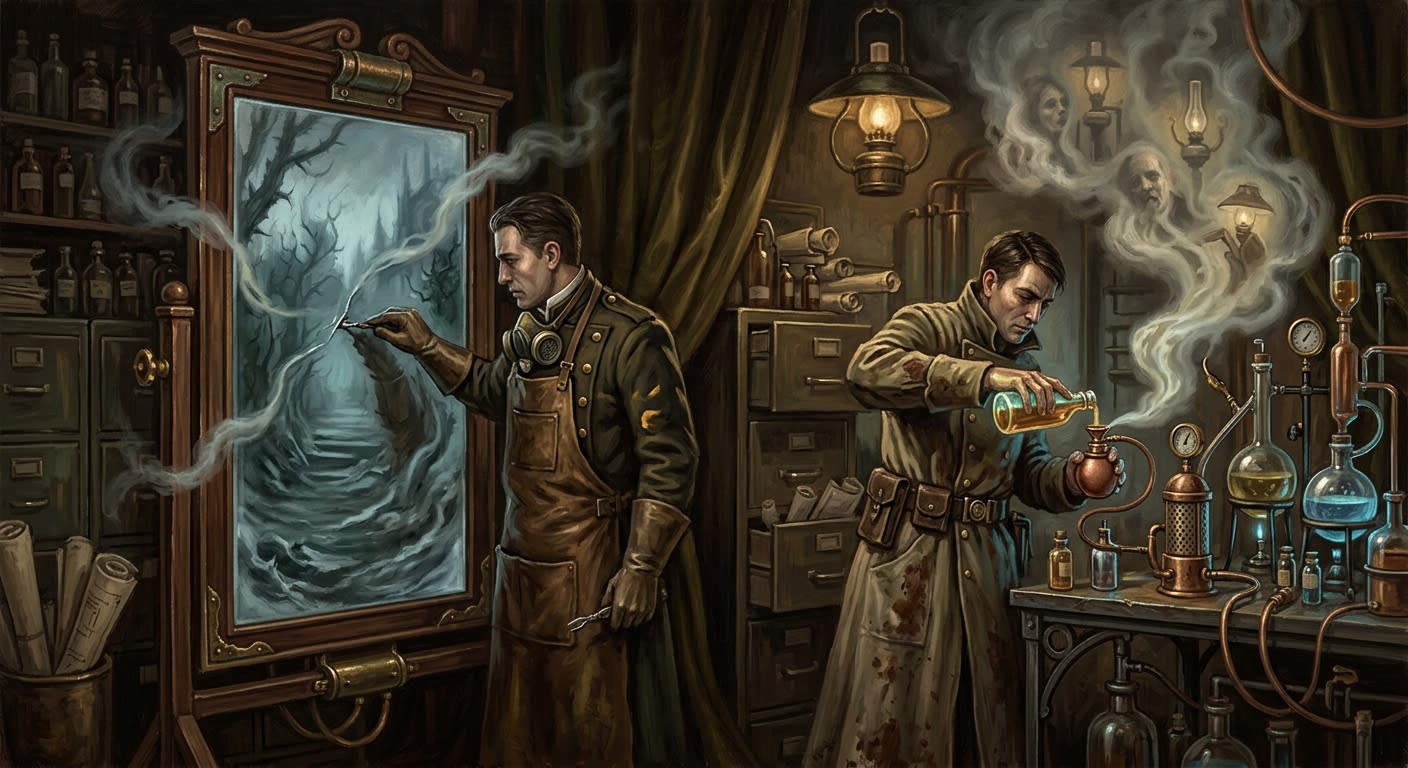
The Mirror and Perfume Arts are Velkara's principal sorcerous discipline: reflection made passage, scent made verdict, desire made into a clerk so obedient it signs the ruin before the hand knows it has moved. The Bureau of Doctrine lists them under the Schools of the Lie, Lust subdivision, with the following approved formula: reflections that open like gates; perfumes that overwrite memory. The formula is accurate. It is also tidy, and tidiness is how terror gets into the archive without alarming the junior copyists.
Mirrors are the first half. They do more than show. They invite, admit, exchange, and occasionally correct. At Belgrade's Shattered Courts, men stepped through polished panels and emerged with faces slightly altered, loyalties softened, kinship labels rearranged like cards after a fraudulent game. Some returned wearing their own faces with another person's expression beneath the skin. Some did not return, though their reflections continued attending meals.
Perfume is the second half. It does more than sweeten the air. It writes upon breath. It settles in the lung, ascends through blood, and persuades memory to adopt a more agreeable edition of itself. Confession becomes tryst. Warning becomes flirtation. A saint's icon becomes an idol of appetite, and the pious man who kneels before it can no longer say whether he is praying or hungering.
#On the Mirrors
The mirror-gate is the vulgar form, because vulgarity announces itself with architecture. A reflection loosens from the glass, the surface takes on depth, and the tempted person sees a chamber behind his own image: warmer, kinder, less supervised. Bureau manuals advise personnel to break the glass at once. Bureau manuals also advise personnel to maintain regular confession, avoid unsanctioned correspondence, and report unusual dreams. Manuals are excellent at describing victories after the defeated have already died.
A mirror-gate does not always transport the body. The subtler gates transport permission. A woman looks into a brass shaving plate and sees herself desired without cost. A captain checking his collar before inspection sees his commander's aide behind him, smiling in a way the aide never smiled. A Confessor-Penal sees, in the polished rim of a chalice, the penitent's face soften into gratitude before gratitude has occurred. He acts to make the reflection true. The Art has crossed.
Early Purity memoranda classified mirror incidents as visual hallucination with secondary erotic fixation.
Corrected. The visual component is often the least dangerous part. The mirror supplies an image; the target supplies the motion toward it; the sin enters between the two, holding a candle and pretending to be hospitality.
The Synod issues iron mirrors as countermeasure because iron refuses certain lies. It also refuses shaving, vanity, and most polite rooms. Officers complain. Officers always complain when the protection against damnation is ugly.
#On the Perfumes
Perfume is more treacherous than glass because it needs no consent to be noticed. One may avert the eyes. One breathes or dies, and Velkara has built a theology in the interval.
The Perfume Arts alter association. The Bureau insists, with admirable panic and poor comfort, that they do not compel. A target retains choice. The scent changes what the choice feels like. It tags one presence as safety, one room as release, one voice as the only merciful sound in a week of bells and orders. Afterward the target will defend the feeling as his own, because it occurred inside him, and because men will confess murder before they confess that their sincerest emotion arrived by someone else's vial.
Bureau of Purity field kits now include vinegar cloths, ash-salt plugs, and little brass scent-coffins for confiscated oils. The brass coffins are stamped with three warnings. The first forbids opening. The second forbids smelling. The third forbids dreaming of the person whose name comes to mind when the lid is touched. The third warning was added in A.S. 199 after two assessors in the southern theater married women who had been dead for twelve years and tried to visit them through washroom mirrors.
#On the Diminished Fragments
A full practitioner of the Arts is a demon, and, mercifully, difficult to hide for long. Reality objects to such company. Silver sweats. Mirrors cloud inward. Choirboys faint with the unhelpful precision of canaries in mines. The Bureau of Rites can classify the residue, Purity can burn the room, and Records can pretend the sequence was orderly.
The Velvet Choir carries diminished fragments. That is the proper horror. A Choir operative may possess no conscious sorcery, no infernal vocabulary, no secret tattoo, no memory of Velkara's service. She may believe herself a merchant, widow, pilgrim, nurse, clerk, supplier of clean soap to a filthy garrison. The fragment works beneath her self-knowledge. Her attention feels like mercy. Her presence steadies the pulse. Her perfume is never strong enough to accuse. Her reflection in a window lingers half a breath after she turns away.
The Briefing Officer stated the matter in A.S. 197 with the voice of a woman who had watched too many clerks survive their own innocence: awareness of the method is not immunity to the method. The fragment does not demand belief. It rearranges the furniture in the soul until belief sits where suspicion used to sit.
#On Belgrade and Other Demonstrations
Belgrade remains the approved example because it is ruined, distant, and safe for instruction. At the Shattered Courts, during the aftermath of the Miracle of the Danube's Turning, soldiers quartered among noble houses found mirrors still hanging in rooms whose ceilings had burned away. By dawn, two companies were duelling shadows they swore were beloved faces. One artillery sergeant confessed to murdering his daughter, though his daughter lived in Lyon and later testified that she had never met the man he killed. His confession was doctrinally sincere and factually useless, a combination the Bureau finds especially offensive.
Perfume reports followed. Lavender in a powder magazine. Rosewater in a field chapel. Ambergris in a casualty ward where no civilian should have passed. Men remembered receiving kisses at confession screens. Women remembered betraying passwords to lovers whose names could not survive ink. A saint's portable icon was found smeared with lip colour; six witnesses swore the saint had asked for it.
BELGRADE SHATTERED COURTS — RITES ANNEX Recovered mirror fragment showed ███████████ persons standing behind the observer. Observer was alone. Fragment was wrapped, boxed, sealed, boxed again, blessed, and dropped into the Danube under bell escort. Three days later it appeared in the shaving kit of Captain █████████. Captain's wife reported receiving letters from him in a hand she described as “more loving after his death.”
#On Countermeasures and Their Inadequacy
The field kit recommends salt, iron mirrors, vow-pins hammered through the palm, fasting caps, vinegar cloths, and counter-orisons from the Bureau of Orison and Song. These measures work in the way umbrellas work during artillery: nobly, partially, and with great symbolic confidence.
Salt roughens the air. Iron rejects reflection. Vow-pins secure loyalty through pain, since pain remains one sensation Velkara finds hard to counterfeit without attracting notice. Counter-orisons flood desire with obligation. The victim smells mercy and hears a hymn reminding him that mercy has a filing requirement. This saves some. It irritates many. It recruits a few by convincing them that Hell, at least, will not make them fill out Form 19-Desire (Unregistered) before being held.
The A.S. 195 countermeasure card described the Mirror and Perfume Arts as “manageable through discipline and prompt reporting.”
Withdrawn. Discipline supplies pressure. Prompt reporting supplies names. The Arts use pressure and names with a finesse the card did not anticipate. The revised card reads: “manageable through discipline, prompt reporting, supervised ventilation, iron fixtures, scent abstinence, mirror restriction, and immediate execution where warranted.” Morale declined after distribution. Accuracy improved.
The strongest protection remains communal recognition: a brother noticing that another brother has begun smiling at empty glass; a ward-sister smelling roses in a room where the windows have been nailed shut; a clerk admitting that a kindness felt too perfect to be trusted. Naturally this is the protection the Synod is worst at cultivating, since recognition requires persons to know one another as persons, and the Synod prefers functions with surnames.
#On Doctrine
The Bureau's settled position is severe and correct: the Arts do not absolve the compromised. They provide context, temptation, intoxication, false memory, emotional weather, and a room in which the wrong choice arrives wearing perfume. They do not erase the chooser.
This doctrine is necessary. It is also cruel. If free will survives, guilt survives. If guilt survives, the Index Damnatus may receive its entries, the Lictors may heat their irons, and Purity may sleep well after condemning people who were guided to the scaffold by a scent they did not know they had inhaled.