
#On the Confession Before the Form
The Church did not invent confession in A.S. 104. It had been hearing the faithful murmur through screens since before there was a Synod to file the murmurs. The parish Confessor-Penal had long since learned to ask, once the penitent's own sins were dealt with, whether the neighbour's lamp burned late. The Bureau of Records took custody of more of these disclosures after its transformation in A.S. 78, and Purity grew teeth for them after A.S. 80. By the time the formal Synod sat at Strasbourg in A.S. 90, confession was sacrament, intelligence channel and household habit all at once.
It was also illegible. Take the problem plainly. A priest in Cologne hears "I have doubted" and writes doubt. His brother at Trier hears the same words and writes melancholy, mild. A third writes nothing, because the penitent wept and the priest was hungry. That makes three parishes with three ledgers that cannot be compared. A Synod that wished to know what its people believed could learn only what its confessors happened to feel about them on a Tuesday.
The Confession Reform of A.S. 104 was the Bureau of Rites' answer. It is the least theatrical instrument in this Codex. It is also among the most consequential, and I say so as a man who has filed several theatrical ones.
#On the Approved Mouth
Rites does not teach doctrine. That privilege belongs to the Bureau of Doctrine, which guards it as a dog guards a bone it has never been permitted to eat. Rites regulates how doctrine is performed: the fasts, the penances, the order of words at the rail. Under the reform it extended that office to the confessional screen.
The reform fixed approved phrasing for confession, meaning the forms in which a sin must be named, admitted and repented. It also reduced the inexhaustible variety of human misconduct to uniform sin categories that could be printed on a card, held under a lamp and ticked. The rubric replaced the confessor's mood. Theft of bread became a category, and so did impure thought. Unlicensed shrine contact, unauthorised joy and a stumble in the Creed at market became categories too, each with its tariff of penance.
The theological justification was humility. A penitent who speaks in the approved form submits his tongue as well as his conscience. He confesses as the Church confesses, and his sin is received as the Church receives it. The administrative result was a baseline. Once the faithful had been taught the correct words, every omission, substitution, delay or tremor became a departure from a known standard. A departure can be written down.
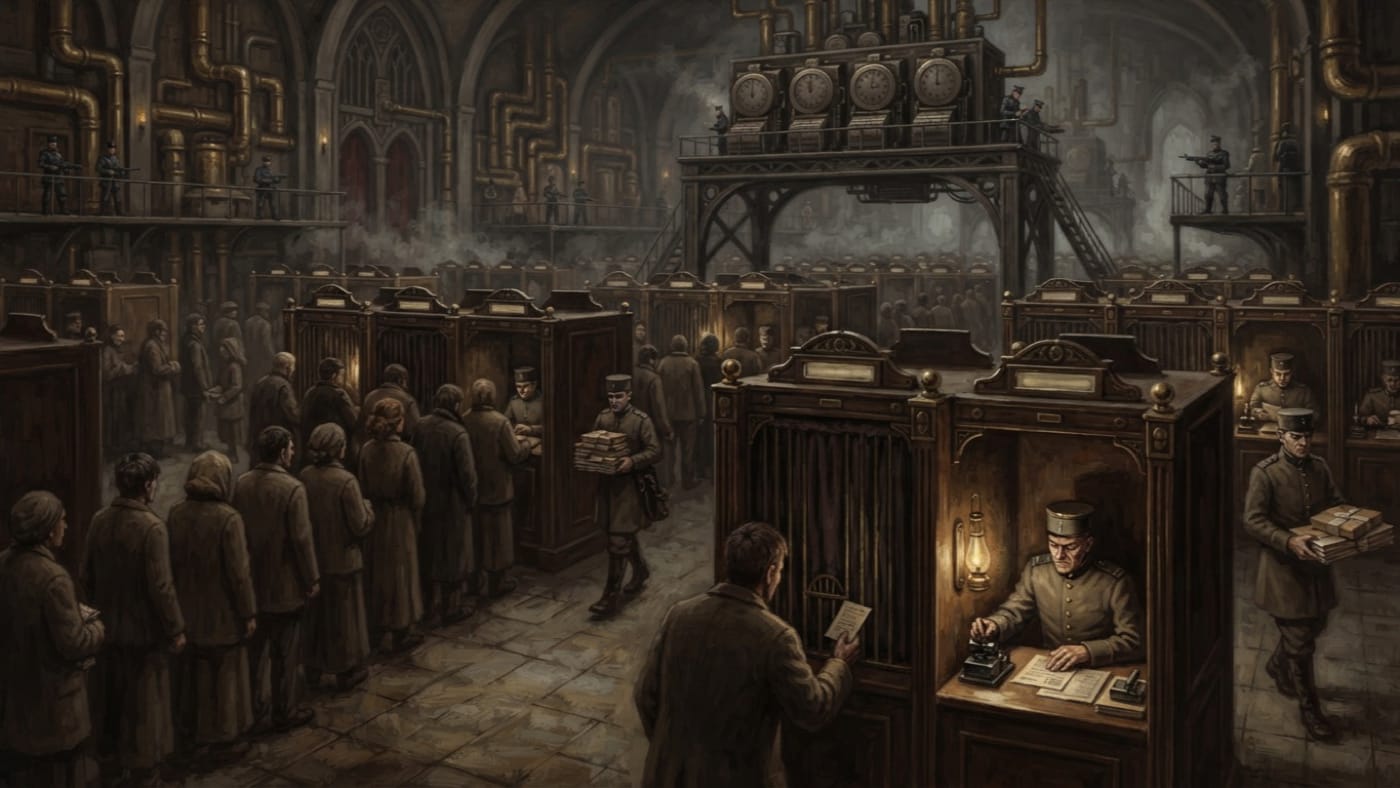
The reform also faced arithmetic. Ordained confessors could not hear a city. The bastions had swollen past any priesthood's capacity, and a priest's hour was too precious, and too lenient, to spend on bread thieves. The reform therefore authorised lay intake. Trained clerks would receive confessions in the approved form and classify them. They would pass upward whatever required a priest, an Auditor or a door broken at night. From that provision grew the Confessor-Booth Clerk.
#On the Receipt and Its Custody
What follows is a composite drawn from the profession's own manuals. It describes no particular penitent, which is a courtesy to the penitent and a convenience to me.
A woman reaches the grille after an hour in the queue. The clerk checks her token and household mark before she has said a word, because a confession without an identity is merely noise. She confesses in the approved form: a stolen measure of lamp oil, a missed recitation, anger against a ration officer. The clerk selects categories from the rubric (minor, minor, moderate) and sets penance by the card in recitations, attendance and a labour slip. If a fee is due, she pays it in coin, salt or ration chit. The stamp comes down. She receives a receipt.
Then the paper goes on without her. The clerk logs the tallies. At the end of the shift the day ledger is sealed. Any concern goes into the packet forwarded upward, first to the Street-Vicar and in later decades to the Auditor. That concern might be a repeated category, a hesitation at the wrong word, or the remark she let fall about the ration officer. In the annex a Records Scribe reduces her hour of shame to an abstract of a few lines, copies it, and reconciles it against her penance attendance.
Note what the clerk did not do. The clerk did not absolve her. Mercy remains the property of the ordained. A booth clerk who presumes to grant it commits a fraud the Bureau punishes more severely than most of the sins heard through the grille. The receipt certifies only that she was heard, sorted and charged.
She will need it all the same. Permit clerks ask for clean stamps, and so do ration halls and gatewardens. A receipt filed under the wrong parish can cost a family its travel bond. The absence of one is an accusation that any official in the district can read.
Stamped is spared.
Booth slogan, widely painted and still permitted as signage. Withdrawn as a statement of fact. A receipt certifies processing and nothing beyond it. The reform supplies no mechanism by which a stamp protects its bearer from later review. See Lestine, below, and the thirty-seven current receipts that saved nobody.
#On the Variance Made Countable
The Synod learned to fear silence before it learned to measure it. In the Schism of the Unspoken, A.S. 78–83, southern garrisons simply ceased to take communion. There was no pamphlet and no preacher, nothing to seize except a delayed amen. Standing Order 22-D in A.S. 84 classified silence as communicable behaviour. It told no one how to hear the silence coming.
The reform did. Once every penitent in a district confessed in the approved form, the confessions became comparable. Abstracts could be laid beside abstracts, parish against parish and this year against last. A district where impure thought fell by half was suspicious. A district where every penitent named exactly the approved sins in exactly the approved order was more suspicious still. Confession records could be set against school recitation logs, attendance tallies, household devotion books and ration-hall rolls, and the gaps between them read as evidence.
Standardisation makes a deviation visible. The institution then decides what the deviation means. A widow whose voice breaks on the word Creator has deviated. So has a frightened clerk who rehearsed too well, and so has a boy who learned the Creed from a mother who always swallowed one clause. Grief, fear, rehearsal and honest uncertainty all appear on the abstract as the same irregularity. The Bureau of Purity has never been in the business of guessing generously.
The apparatus that grew from this belongs to later years: the Quiet Purges of A.S. 112 and the formal constitution of the Codex Auditor branch in A.S. 114. The reform supplied its grammar.
Blessed Marrow-Eye Lestine spoke that grammar fluently. Her famous choir had current confession receipts, perfect attendance and a choirmaster who praised its discipline. She heard a delay before the second amen. She heard the suspicious sameness with which every singer denied everything. No heretical cell was ever proven, and thirty-seven voices were condemned regardless. Her dossier in this Codex states that the reform made deviation countable. Her career showed what becomes of the countable in the hands of someone who cannot stop counting.
#On the Confession Carried into Court
In the same year, A.S. 104, Concordat Annex 14-C was appended to the Catechism Third Revision as a supplement to the Confession Reform. The Annex was issued under joint Records and Doctrine authority, and the reform was the work of Rites. That makes three instruments in one year, and no surviving file establishes the order in which they were sealed. The Annex codified sanctioned precedent combat under the line Records attributes to it: "Better one name struck than a district burned."
The connection is no mystery. The reform turned confession into a document, and the Annex supplied a place where documents fight. In the pit a Citation Advocate must first establish a client's standing. A lapsed confession receipt, or one filed under the wrong parish, can void it before a single argument is heard. Later advocates went further. Confession transcripts, obtained through channels Purity prefers not to discuss, entered evidence as weapons. A booth clerk who mentioned that an opponent's last confession contained irregularities could name a price for the remark. At the end of that road wait the Erasure Notary and a name struck from the Ledger of Souls.
Most of this is later practice. It needed only the original paper.
#On the Continuing Application
The reform reached the dying as well. Terminal confession had been mandatory since A.S. 80, when Standing Order 22-C followed the Lull of Names and made the infirmary bedside a place of collection. The reform did not invent the deathbed harvest. It codified the existing procedure in six stages: access, stabilisation, framing, extraction, authentication and packaging. A dying man's last accusations therefore reached the ledger in approved form, like everyone else's.
Then the numbers grew. The Booth Proliferation Decree of A.S. 112 required a registered booth every three city blocks, with carts and trench booths besides. That decree was also Rites' work, and it built on the clerks of 104. It should not be mistaken for them. The present estimate stands at twenty-two thousand booths, a figure Records files as ongoing enumeration.
The reform reached only as far as the Synod's own confessionals. The independent British and Dutch territories never knelt at a Rites card, and in the north its writ runs exactly as far as the Synod's does, which is a careful phrase. Within those limits, every penitent who has queued at a grille since A.S. 104 has spoken the words of Rites and walked away with its paper.