
#On the Silence That Learned to Spread
The Schism of the Unspoken began in A.S. 78 with a pause.
This is the infuriating part. A proper schism has papers. It has theses nailed to a door by some underfed provincial with a hammer, a fever, and a mother's disappointment. It has sermons, badges, contraband catechisms, illegal hymns sung off-key in cellars. The Bureau can burn those. The Schism of the Unspoken offered no such courtesy. It gave Strasbourg a breath held half a second too long between bell and amen, and from that breath three regiments quietly ceased taking communion.
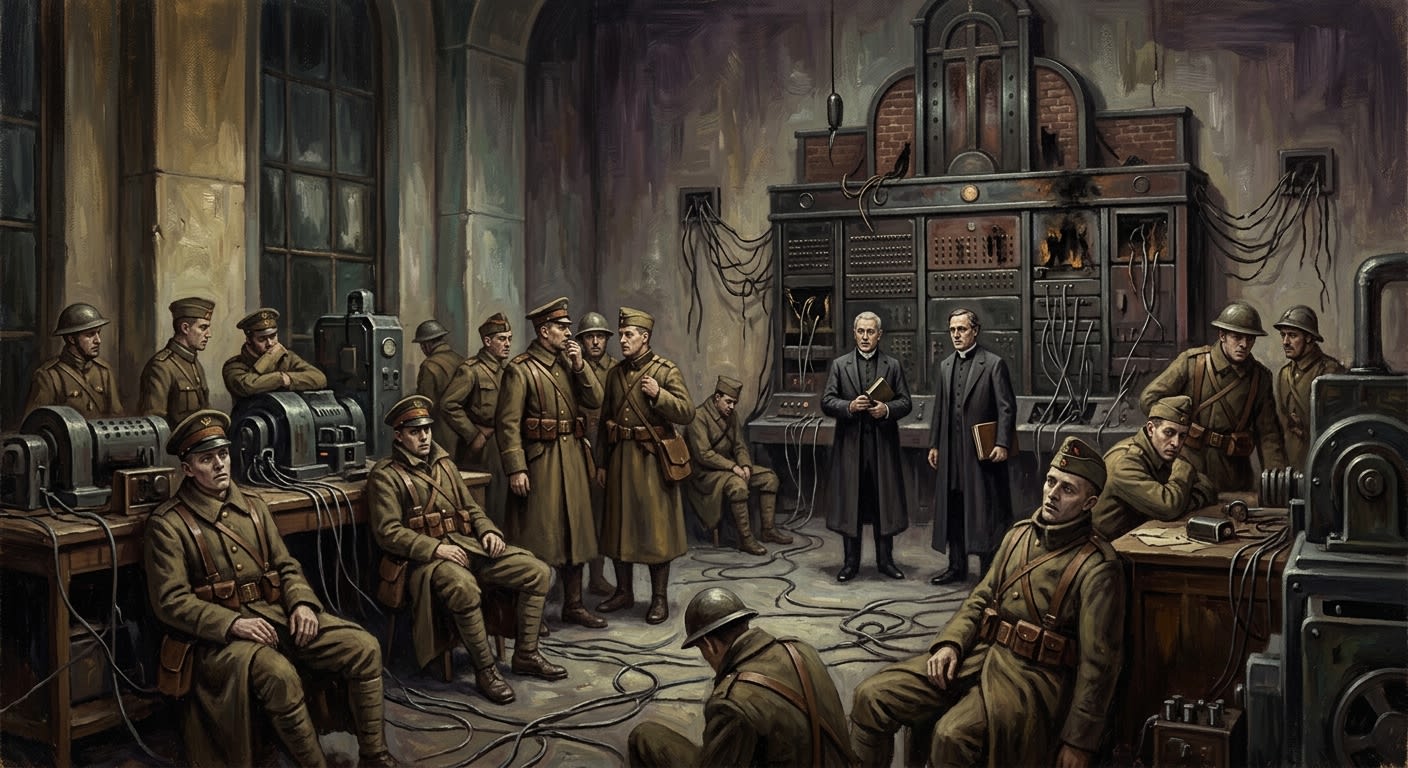
The first reports came from the southern garrisons, in the belt of chapels and barracks feeding the lower Sagittal Line. The names of the regiments are sealed. The districts are variously filed under Irongate, Shipka, and “southern operational annex,” which is Records' manner of admitting that map pins become embarrassing when they form a pattern. No preacher was found. No foreign tract appeared. No captured prisoner confessed to contagion. The men drilled, saluted, ate, marched, bled, and stood at Mass.
At communion they remained still.
The estimate aged poorly. The Bureau has since clarified that negligible meant “not yet properly feared.”
#On the Manner of Its Propagation
The Unspoken moved by example sharpened into ritual. One file records eight men in a chapel line letting the chalice pass. The next week, nineteen. The week after, the left half of the nave. No one argued. No one explained. When chaplains demanded cause, the soldiers bowed their heads with exemplary respect and said nothing. The silence avoided refusal in the legal sense, because refusal requires declaration. It was absence where assent had been expected.
The pause lengthened. The beat between bell and amen grew by a half-second each week, and that measurement, which sounds laughable to anyone who has never governed frightened men by sound, became the Bureau's nightmare. A half-second is enough time for a thought to notice itself. A second is enough for the neighbour to notice the thought. Three seconds is a congregation.
The Unspoken needed no doctrine because it fed on doctrine's expectation of reply. Every rite contains little hinges: call and response, bell and kneel, question and amen, priest and tongue. The Schism lived in the hinges. It allowed the Creed to speak alone.
The chaplains tried volume. They rang louder. They shortened the interval between peals. They rehearsed the men like choirboys and punished late responses by squad. The silences grew cleaner. The men obeyed every order surrounding the rite and withheld only the central act, which made them maddeningly difficult to prosecute. A soldier who curses the altar can be flogged. A soldier who stands motionless before it while his officer watches and his soul refuses to present evidence is an administrative insult.
Early Doctrine circulars described the condition as “sullen barracks atheism.”
Withdrawn. Atheism speaks too much. The Unspoken spoke with no one and achieved a purity of contamination the atheists could only envy.
#On the Three Regiments
The first regiment ceased communion over eleven months. The second over seven. The third over five, proof that silence learns its route faster each time. Their shared marks were liturgical rather than ideological: delayed amen, clean attendance, intact confession receipts, no feast-day absences, reduced hymn volume, and an increasing preference for standing at the rear of chapels near stone walls.
The rear-wall detail appears in six reports. Doctrine dismissed it as cowardice. Purity preserved it. Soldiers at the rear could hear the whole congregation hesitate before the priest could isolate any man. They could hide inside the collective pause. The wall gave them their own breathing back.
The commanders, being soldiers, requested permission to shoot the problem. Doctrine refused. War asked whether refusal was an order. Records asked whether an order existed. Purity asked for names. The chaplains asked for guidance and received seventeen pages on posture.
By A.S. 83, the three regiments were operationally unreliable in any action requiring sacramental assurance. They would hold a trench. They would carry ammunition. They would die under shellfire with the usual obedient efficiency. They would not receive communion. The Bureau of War found this distinction annoying. The Bureau of Doctrine found it terrifying. A man who will die for the Synod while withholding assent has placed a knife where theology keeps its throat.
SOUTHERN GARRISON CONSOLIDATED REPORT — A.S. 83 Regiment designations: ███████, ███████, ███████ Disposition: rotated west under medical pretext; chaplaincy staff replaced; barracks hymn boards burned; witness lists transferred to Purity custody Communion status after rotation: ██████████████████████████
#On the Bureau's Failure to Name It
The official vocabulary arrived late and limping. “Morale irregularity” failed first, because the men were brave. “Doctrinal fatigue” failed next, because fatigue sleeps and this condition watched. “Communion abstention cluster” satisfied Records for nine days and no one else. A junior clerk in Purity's southern office wrote “unspoken schism” in a margin, lower-case, unapproved, probably while hungry. The phrase survived his supervisor, his office, and the report fire of A.S. 86.
Doctrine resisted the word schism because schism confers shape, and shape invites history. Purity wanted the word because a named disease can be quarantined. War disliked all words that did not move carts, bullets, or men. Records accepted all submitted terms and opened cross-indexes under each, which is why the archive remains both infallible and unusable.
Standing Order 22-D was the first victory won against the Unspoken and the first concession to it. The Bureau had admitted that absence could infect. It had given silence a file number. The file number became a door.
#On the Road to the Auditors
The Schism did not create the Codex Auditors by itself. Institutions prefer to pretend their births are deliberate rather than panicked. The Unspoken supplied the first wound. The Confession Reform of A.S. 104 supplied the measuring tool, making approved speech uniform enough for deviation to show its dirty little face. The Quiet Purges of A.S. 112 supplied the proof that the apparatus already existed behind the curtain, removing teachers, choirmasters, and Street-Vicars before anyone had agreed what to call the work.
In A.S. 114, Purity named the branch. The mandate was phrased with the calm of a man wiping blood from a ruler: audit belief itself before actions. The Schism of the Unspoken stands at the head of that lineage, because it taught the Synod a lesson more useful than victory. It taught the Synod that a thought can refuse to become evidence.
Certain training manuals call the Schism “contained” by A.S. 84.
Corrected for advanced instruction. The first outbreak was contained. The condition was institutionalised. A silence sufficiently feared becomes policy.
#On Its Present Echo
The modern Auditor still measures pauses because of those southern chapels. Every phrase wheel (Unregistered), every bell-pause chart, every interview room with its bright lamp and clean chair descends from the moment three regiments discovered that obedience could wear a closed mouth. Blessed Marrow-Eye Lestine made a sanctity of that listening. Lesser Auditors made a career of it. The population learned to answer quickly.
The Unspoken survives wherever the answer arrives too late. In factory halls after Ninth Bell. In schoolrooms when the Fourth Article (Unregistered) is recited. In trench chapels on the Shipka front, where men sleeping upright are asked whether their souls remain awake. The Auditor hears the delay and reaches for the pencil. The faithful hear the pencil and answer faster.