
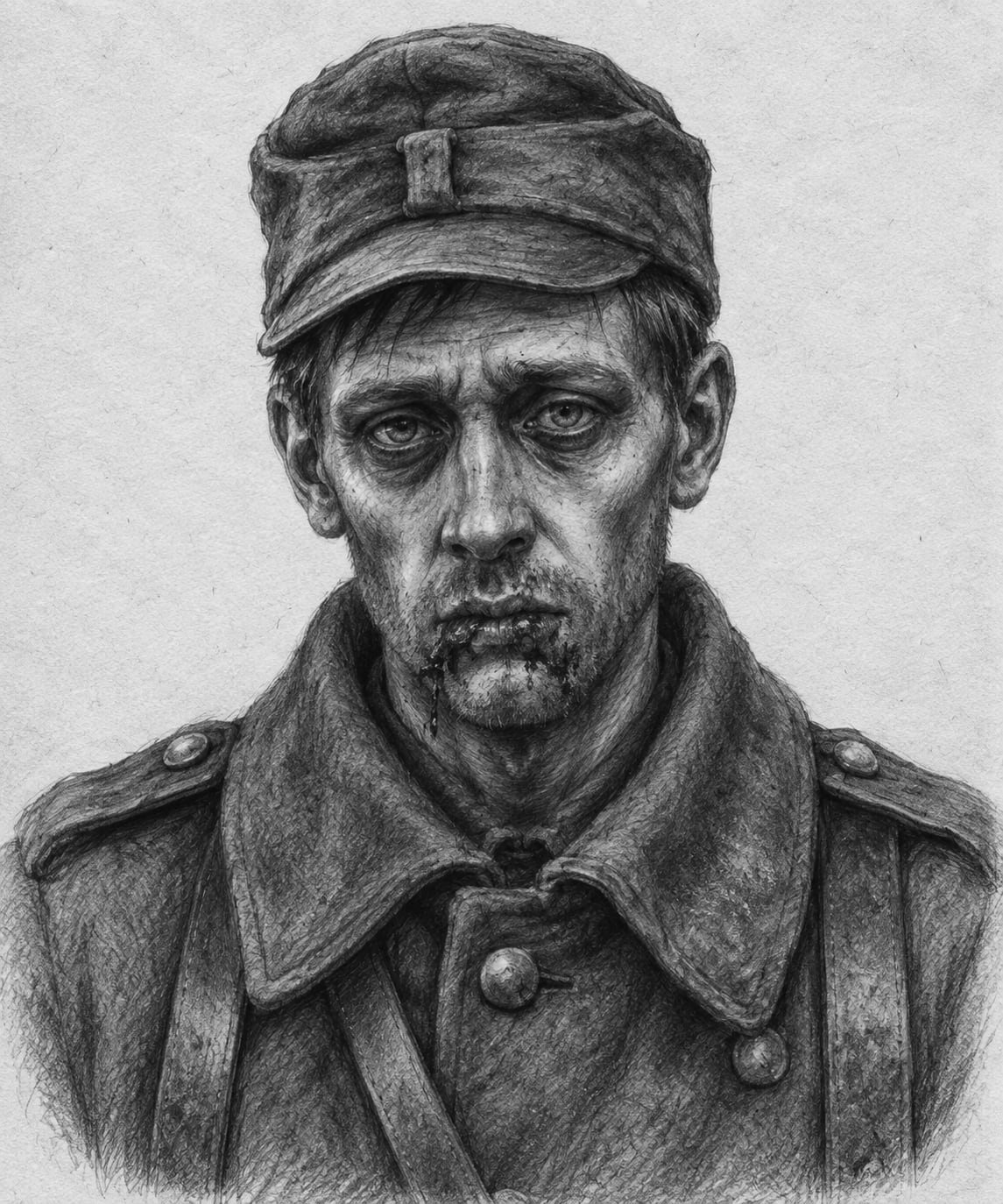
#On His Station
Corporal Ereth Vey of the 22nd Line Company arrives in the Ledger with almost nothing behind him. I have looked. His file gives no birthplace, parish of baptism, enlistment year, earlier campaign or decoration, and no description of his face that a court painter could improve into a lie. What survives is enough for a duty roster and little more. In A.S. 191 he was a corporal of an ordinary southern wall infantry company on the outer observation chain of Bastion-Constantinople. He could read and write well enough to keep the post log, and he kept it when the roster told him to.
Medicine prizes this emptiness above anything else in the file. A man with a temper, a bottle, a dead brother or a known fondness for chewing pencils could have been entered as a peculiar case and forgotten by the next quarterly review. Vey gave the physicians nothing to blame. He was the regulation article: eyes, a stomach, two hands and orders.
His post overlooked a depression in the Blightmarsh where three Self-Devoured had been catalogued as static fixtures. They gnawed, swallowed, regrew and gnawed again, and never came a yard nearer. The field card of the day rated their direct threat Low. The Bureau of War measures menace in ground gained, so it saw no reason to lighten a sector where nothing moved. Each shift lasted four hours, and the orders were to log positions, note changes and report anomalies.
#On the Seventh Shift
The company account preserves six shifts in Vey's hand, and the hand is good. The letters stay clear through the sixth watch and the entries stay short: "Three fixtures. Cycle unchanged. Fog at lower reed-line. No external aggression." I have read worse prose from archdeacons with secretaries.
The log exists to protect the watcher from what he watches. It turns a horror into an entry, and the entry into a column a clerk can total in safety. In an ordinary sector the method holds. Against the Self-Devoured it ran the other way, because every entry sent Vey back to the scope to confirm the cycle and certify that nothing had changed. He did that for six shifts, and each time the creatures had indeed stayed as they were. The watcher had not.
On the seventh shift his replacement came up to the post and found Vey bent over the log with its leather binding between his teeth. About four inches had gone by the time he was restrained. The account notes dye and glue staining at his mouth. It sets down his manner with a sergeant's flat care: no assault, no raving. When asked, he gave an explanation, and the sergeant wrote it down because sergeants record everything said at a post about to be sealed.
He said he was practising.
The order of the record matters more than any reconstruction I could add to it. The clean entries and the bitten cover belong to the same book. Up to the sixth shift the hand wrote what the eye reported, accurately and without ornament. At some point the mouth found a use for the cover the hand had been writing on, and the record does not say when.
The sergeant ordered Vey restrained, the scope covered and the post sealed until a chaplain arrived. Those three orders were given in the right sequence and without improvisation.
#On the Mercy File
Dr. Hallam, field-surgeon of the Bureau of Mercy, examined Vey after he was restrained. The evaluation confirms the four inches of leather. When asked what he had been practising for, Vey asked Dr. Hallam how many calories were in a human hand. Hallam recorded the question. The file records no reply.
I divide the Mercy file into three grades of material, because the rear offices that quote it do not. The witnessed grade is the consumed binding, the staining, the word practising and the question about the hand. The interpretive grade is what Medicine later made of those facts, and it belongs to Medicine. The sealed grade stays sealed.
VEY MEDICAL ABSTRACT — SOFIA TRANSFER COPY (EXTRACT) Repeated phrase during transport: "the outside food runs out first." Dream report after third night: ██████████████████████████████ Utensil restrictions: continued File: open
The file does not show a bitten hand, a wound or any taste of flesh. Readers who come to this entry hungry for one will leave hungry. The case is narrower than that and worse: a leather cover, a calm sentence and a question asked aloud to a physician.
Vey was transferred to Mercy's psychiatric ward at Sofia, on the southern supply corridor. His file remains open. An open file describes the condition of the paperwork. It does not say where the man sleeps in A.S. 201, or whether he still sleeps at all, and I will not supply the missing line.
#On the Correction That Followed
Medicine named the condition at the Eighteenth Conference on Demonic Pathology in A.S. 193. Its working theory is that prolonged observation of the Self-Devoured cycle induces sympathetic consumption ideation. The word theory stays in this entry. Conferences confirm a great many things, and the Ledger will raise a theory to a mechanism only when it has the evidence to do so.
The Bureau of Doctrine adds a ruling that rear clerks find inconvenient. Kargath did not take hold of Vey's hands, and could not have. No demon governs a man's body inside Synod territory. Hunger can bend attention, make suggestions to appetite and dress a wrong act in the clothes of insight. The choice stays with the man. Doctrine holds to that ruling even though a kinder one would be easier to preach over.
An earlier field advisory listed the safe observation threshold for Self-Devoured entities as "five minutes."
Withdrawn. The review that followed the Vey incident produced the ninety-second threshold, formally issued in the pastoral advisory of A.S. 194. Ninety seconds is the point at which exposure becomes a reportable hazard. It is no promise of safety, and any soldier who treats the eighty-ninth second as harmless has misread the advisory.
The A.S. 194 advisory classifies observation beyond ninety seconds as a Grade Three spiritual hazard. Exposed personnel must avert their eyes, recite the Psalm of Satiation from page 412 of the Bureau of Rites Hymnal, and report to a chaplain within one hour. The material corrections came with it. Leather-bound logs were removed from hunger posts. Paper covers stitched with bitter thread replaced them, sand bulbs were chained to the scopes, and every watcher's hands were placed under a second soldier's watch.
Sister Adelheid composed the hymn's seven verses in Strasbourg from depositions, and the Vey file was among them. She never stood at his post. After Vey, the second verse, which governs the hand, gained a marginal instruction that soldiers now know by heart: Hands folded or held. No objects in reach. The file does not record whether the hymn was ever sung over Vey, or whether it held him. The psalm delays appetite and turns it aside. It was never issued as a cure.
Later formations carried the rule forward without having to relearn it. The 14th Garrison inherited the stricter observation discipline and applied it at its own posts. The 9th Garrison added relief-delay rules and witnessed meals after Sergeant-Registrar Mila Drenn's separate exposure in A.S. 196. That is her file, and I leave it to her entry.
#On the File Still Open
Vey's name now serves as instruction. Southern observation schools teach it before a recruit's first hunger-watch. The 9th Garrison's chaplains put it first in their sequence: Vey, then Drenn, then Sgt. Kollar's dry note of A.S. 199. Mercy lecturers use it to show that a watcher can be harmed by an enemy that never moves. The Bureau of War prints the ninety seconds on its cards and leaves out the leather.
The Synod is always willing to borrow a damaged soldier's name for its lessons. It turns a man into a precedent and the precedent into a rule, then hands the rule to boys who will never meet him. I approve of the practice, since it works. I note only that the institutions which teach his name so freely keep his outcome entirely private. Recruits learn what he did on the seventh shift and are told nothing of what followed.
That silence is the file's present condition, and I have kept it. I have not invented a recovery, a death, a return to the wall or a last meal. Mercy has not closed the case. The Ledger records an open file as open.