
#On the Conference's Remit
Being the Bureau of Doctrine's entry on one paper presented in A.S. 193, and on the four inches of cowhide that came before it.
The Eighteenth Conference on Demonic Pathology met in A.S. 193, the year 1903 by the old reckoning. Beyond that the Ledger can say very little. The ordinal promises seventeen earlier conferences. It does not say they met yearly, where any of them sat, or who poured the water. The public record of this one keeps a single item that concerns the Codex. The Bureau of Medicine presented its working theory of sympathetic consumption ideation, and nobody contested it.
I have the abstract. I do not have the room. A reader who wants a seating plan, the chairman's cough, the order of papers, or a chained specimen behind a velvet curtain will not find any of them here. This entry records what was said and which institution said it. It declines everything else, and declining things is a skill the Bureau of Doctrine has practised since before the reader was baptised.
#On the Case Already Recorded
The paper had a precedent, and the precedent had teeth.
In A.S. 191 Corporal Ereth Vey of the 22nd Line Company held a post on the southern observation chain of Bastion-Constantinople's outer wall. Below him, in a depression of the Blightmarsh, three Self-Devoured had been catalogued as static fixtures. For the reader spared the bestiary, these are the sixth class of Kargath's legions. They eat their own bodies, regrow what they have eaten in forty seconds to three minutes depending on the mass consumed, and then eat again. Their direct threat is rated Low and their proximity threat Extreme. This entry concerns the slash between those two words.
Vey watched them through six consecutive four-hour shifts and logged them in a clean hand: position, cycle, no change. On the seventh shift his relief found him with the leather binding of his observation log in his teeth. Dr. Hallam, a Mercy field-surgeon, examined him and recorded approximately four inches of leather consumed. Vey said he had been practising. When asked what for, he asked the doctor how many calories were in a human hand.
That is the whole of the evidence: a binding, a word and a question. Vey did not bite his own hand, and anyone who cites the case as if he did has been reading something other than the file. He was transferred to Mercy's psychiatric ward at Sofia. His file remains open. The Ledger does not know how he is, or will not say.
I keep the grades of evidence apart because the rear offices keep mixing them. What the relief saw, what Hallam wrote and what Vey said form the witnessed record of A.S. 191. Any claim about what those facts mean belongs to whoever made it. The first institution to make one systematically was Medicine, two years later.
Vey was the first documented case of what the Bureau now calls the proximity effect. He was not the first soldier to learn that one does not stare at these things. The men on the wall knew that already. They had no name for it, and in the Theocracy a thing without a name has not been officially known.
#On the Name Medicine Supplied
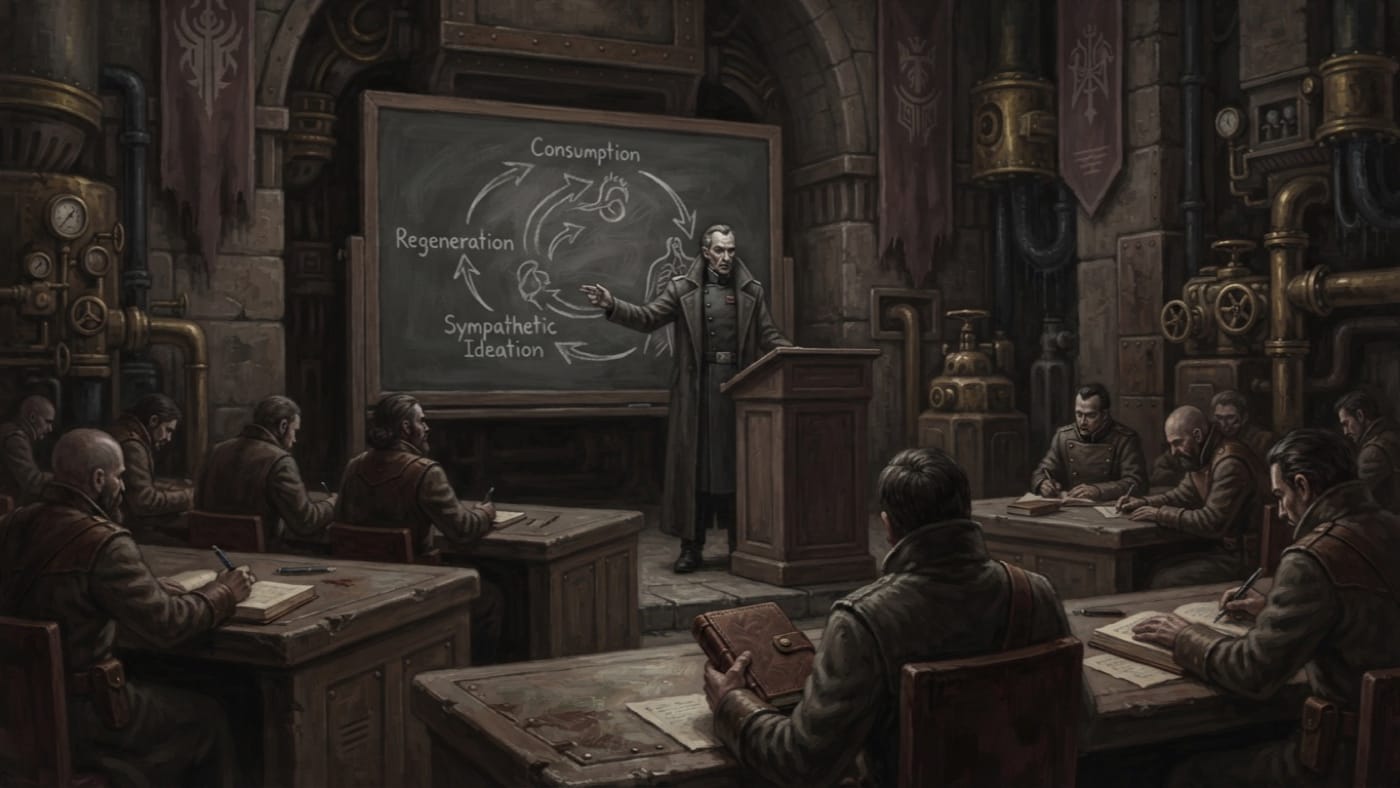
The working theory holds that prolonged observation of the Self-Devoured's cycle (consumption, regeneration, consumption) induces sympathetic consumption ideation in the observer. In plain words, the watcher begins to think about eating in the way the creature eats. The ideation is called sympathetic because it follows the thing observed. It is called ideation because the thought comes before the act, and sometimes in place of it.
A corporal chewed his stationery, and Medicine answered with a term of art long enough to be filed under three initials. I admire the work. The term does what Medicine's terms always do. It turns a horror into a category, and a category can be cross-referenced, budgeted and handed to someone else.
The status matters. The phrase working theory stays in the Codex. The theory was contested by exactly no one, and that proves only that no one contested it. The record shows no experiment demonstrating the mechanism and no proof. It shows no vote and no resolution with physicians' hands raised in ratification. Certain index clerks have since entered the theory as a "confirmed mechanism." They did so on their own authority, which is small.
The record does not say why no one objected. I could offer reasons, such as fatigue, deference, or a physician's natural reluctance to stand up in public and defend staring. Every one of them would be my invention. The silence is entered as silence.
The term is Medicine's. By standing arrangement, everything that follows from it belongs to someone else. Since A.S. 158 Medicine has appended a disclaimer to every field report: it provides observation, measurement and classification, and it does not recommend. So the work divided along the usual seams. Mercy keeps the patient and the treatment record. War keeps the posts, the rosters and the discipline of the eyes. The Bureau of Doctrine decides when looking becomes a spiritual hazard. The Bureau of Rites supplies something to sing. Medicine supplies the noun, and the noun is the only item on that list for which nobody can be court-martialled.
Doctrine adds one ruling of its own. The theory describes pressure on attention and appetite. It does not describe possession. Kargath did not take Vey's hands and could not have, because no demon governs a man's body inside Synod territory. The ideation suggests, and the man decides. Doctrine holds to this because the alternative would be kinder to the soldier and ruinous to the catechism.
#On the Instructions That Followed
The conference issued no instruction, since Medicine does not issue instructions. The instruction came from Doctrine in the following year.
The pastoral advisory of A.S. 194 states that observing Self-Devoured entities for more than ninety seconds is a spiritual hazard equivalent to exposure to Grade Three heretical material. Personnel must avert their eyes, recite the Psalm of Satiation from page 412 of the Rites Hymnal, and report to their unit chaplain within one hour.
Ninety seconds is a reporting line. It has nothing to do with the creature's own regrowth interval of forty seconds to three minutes, and I have twice corrected garrison clerks who thought one figure was derived from the other. It is not a guarantee either. A soldier who stops at eighty-nine seconds and congratulates himself has misread the advisory, and he may be misreading his own appetite as well.
Sister Adelheid composed the psalm's seven verses in Strasbourg from depositions. She has never seen a Self-Devoured, and her requests to go and look have been denied. The psalm delays appetite and turns it aside long enough for a comrade to notice. It was never issued as a cure, and nothing in Medicine's paper suggested that a cure existed.
An earlier field advisory listed the safe observation threshold for Self-Devoured entities as "five minutes."
Withdrawn. The review that followed the Vey incident replaced it with ninety seconds, formally issued under Doctrine's pastoral advisory of A.S. 194. The Eighteenth Conference did not set this figure and should not be cited as having done so. Ninety seconds marks a reportable hazard. It does not mark safety.
The posts changed in the years that followed. Leather-bound logs were withdrawn from hunger watches and replaced with paper covers stitched in bitter thread. Sand bulbs were chained to the scopes. Each watcher's hands were placed under a second soldier's eye. None of these was a conference resolution. They are what the wall did with the term once it had one. In practice the wall had wanted these changes in A.S. 191, and with a name in hand it could now requisition them.
#On the Questions Left Open
In A.S. 196 Sergeant-Registrar Mila Drenn of the 9th Garrison watched a Self-Devoured for approximately two minutes and forty seconds while she waited for her relief. Mercy treated her, and she returned to duty. She eats only in company and has asked that no mirror be placed in her quarters. Her case prompted a proposal to cut the threshold to thirty seconds. The proposal was tabled, and the ninety-second advisory stands.
Drenn's case did not test the theory, because nobody had designed a test. It added a second file to the first. A clerk calls two files a pattern. A physician calls them an anecdote, and Medicine remembers that it is a physician whenever that suits it.
The term never touched the larger question. Medicine named what happens to the watcher and said nothing about the watched. Doctrine's committee on whether the Self-Devoured experience their own consumption has met four times and produced no finding. Sympathetic consumption ideation may explain a corporal and his binding. It cannot say whether there is anyone inside the thing the corporal began to imitate.
Eight years after the conference, the theory is still a working theory and still unopposed. Vey's file is open in Sofia. Drenn's is held by the 9th Garrison.