
#Sofia
On the city that waits between two bastions, expecting the worst and receiving, on most days, something marginally less.
The Bureau of Settlement classifies Sofia as a Category Three Urban Holding — fortified, essential, expendable in extremis. The citizens of Sofia are aware of this classification. They were made aware of it in A.S. 142, when a filing error at the Bureau of Records' Strasbourg annex caused their municipal status document to be distributed to the city council rather than sealed in the appropriate administrative folio. The document contained the phrase "acceptable losses in the event of southern-corridor breach: total." The Bureau issued a correction the following week. The correction stated that the phrase had been a typographical artifact. The correction did not specify what the correct phrase should have been.
Sofia has not forgotten. Sofia's municipal motto, adopted A.S. 143 by unanimous council vote, is Adhuc Stamus — "We Still Stand." The Bureau of Heraldry approved it without comment. The Bureau of Heraldry approves most things without comment when the alternative is acknowledging that a city of two hundred thousand souls has declared its continued existence a form of defiance.
#Geography and Fortification
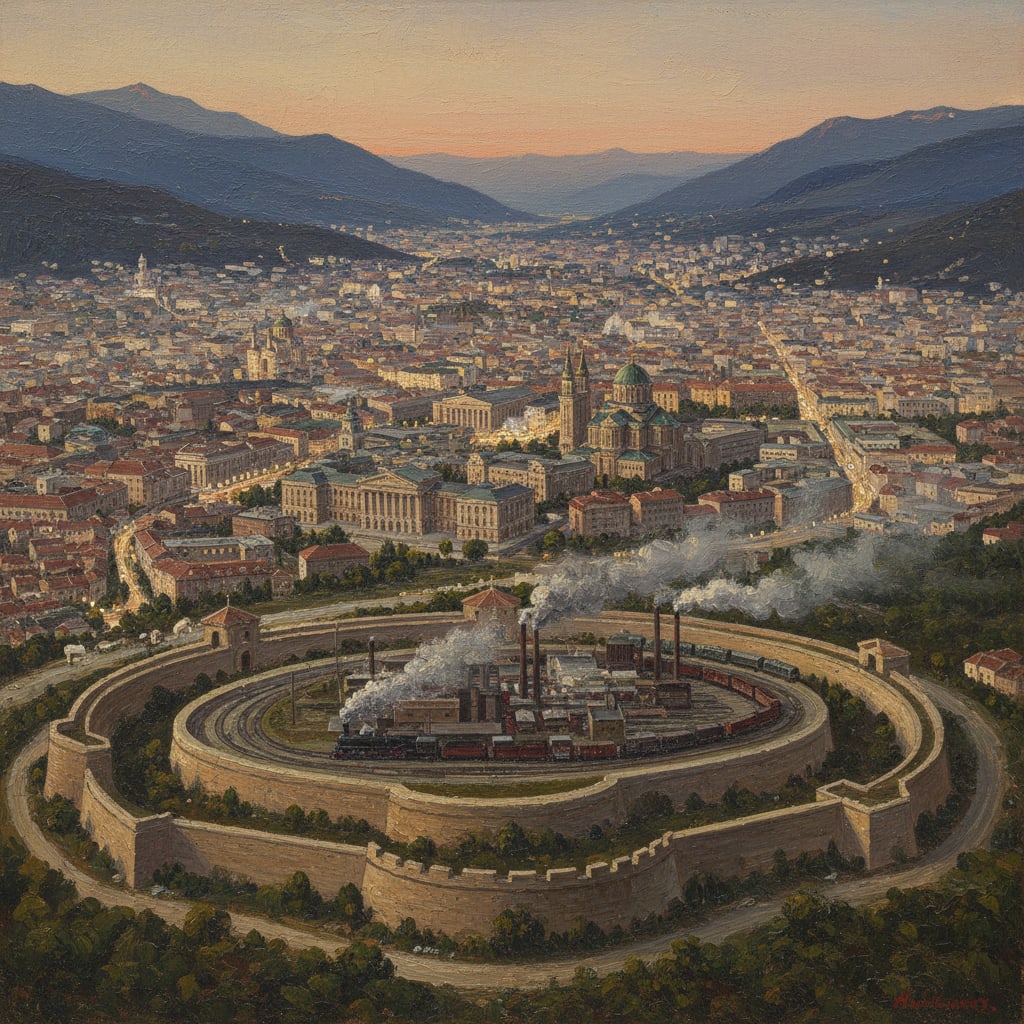
Sofia sits in a wide valley cradled by mountains on three sides — the Vitosha massif to the south, the Stara Planina foothills to the north, and lesser ridges east and west that funnel any approach into corridors the Bureau of Engineering has spent eighty years fortifying. The city occupies the convergence point of two roads that matter and seven that do not. The two that matter are the Irongate trunk road running southeast from the Danube, and the Shipka approach road running northeast toward the pass. Everything that moves between these two bastions passes through Sofia. Every munitions train, every levy column, every chaplain's convoy, every sealed dispatch from the Bureau of War — all of it funnels through Sofia's rail junction and road nexus before dispersing toward the forward positions.
The fortifications are concentric, old, and ugly. The outer ring dates to the emergency works of A.S. 68, when the southern corridor was still being consolidated after the Great Retreat, and bears the architectural signature of desperate men building with whatever stone was available: church rubble, villa foundations, Ottoman masonry pulled from the ruins of the old city. The second ring was constructed properly in A.S. 94 under Bureau of Engineering specifications and looks it — regular bastions, regulated fire-angles, hymn-channels cut into the parapet stone so that bell-broadcast equipment can be mounted at standard intervals. The third ring, innermost, is the citadel district — government buildings, the Bureau of Records filing annex, the Bureau of Mercy facility, the garrison headquarters, and the rail terminus.
The garrison is the 9th Southern Levy Division, supplemented by three Bureau of War regular companies and a rotating detachment from the Bureau of Purity's enforcement arm. The levy troops are local — Bulgarian conscripts who know the terrain because they grew up on it, fight adequately because the alternative is worse, and desert at a rate the Bureau of Records classifies as "within acceptable parameters" and the garrison commander classifies as "a problem I address on Tuesdays." The regulars are rotated in from the heartland every eighteen months and regard Sofia as a punishment posting. They are correct. It is a punishment posting. The Bureau of War assigns its disciplinary cases here — officers who embarrassed their superiors, clerks who filed inconvenient reports, chaplains whose sermons were too accurate. Sofia collects the Synod's castoffs and makes soldiers of them, or at least makes people who stand on walls and do not run.
#The Filing Annex
The Bureau of Records maintains a filing annex in Sofia that has, over three decades, become something else entirely. On paper, it is an administrative sub-office responsible for the archival processing of southern-corridor personnel records — transfers, levy enrollments, casualty reports, pension calculations. In practice, it is where the Bureau sends people who have seen things the Bureau cannot explain and does not wish to discuss.
The annex occupies a converted seminary on Tsar Boris Boulevard — a three-story building with thick walls, small windows, and a courtyard garden that the current staff maintain with a devotion that suggests they find growing things therapeutic. The staff roster lists forty-two clerks, eight archivists, and a superintendent. The clerks file. The archivists organize. The superintendent signs requisition forms and writes quarterly reports that the Bureau acknowledges without reading. The filing is real. The files are real. The work is real. The fact that it could be performed by six competent clerks rather than forty-two is a detail the Bureau has chosen not to address.
The sergeant from the 14th Bellwarden Cohort is here — the one who entered a Drag Corridor near Shipka in A.S. 181 and emerged in A.S. 196, kit pristine, rations fresh, fifteen years older than the calendar said he should be and fifteen years younger than everyone who remembered him. He files transfer requests. He is efficient. He does not discuss the corridor.
The soldier who sketched a Still One on the Shipka approach road is here. He was a tolerable artist before his reassignment. He no longer draws. He processes pension calculations for the widows of men who died in fog, and his handwriting is steady, and he does not look up when the wind changes direction, and his colleagues have learned not to mention weather.
There are others. The annex does not advertise its function. The Bureau of Records does not acknowledge its function. The people of Sofia know its function the way they know which buildings not to enter after dark — through the accumulation of small observations over many years, none of which individually constitute proof, all of which collectively constitute certainty.
#The Bureau of Mercy Facility
The Bureau of Mercy operates a long-term care facility on the eastern edge of the citadel district — a compound of low stone buildings behind a wall that is too high for a hospital and too low for a prison. The facility houses patients whom the Bureau classifies as "non-responsive to standard therapeutic intervention" and whom the attending physicians classify, in private, as "gone somewhere we cannot follow."
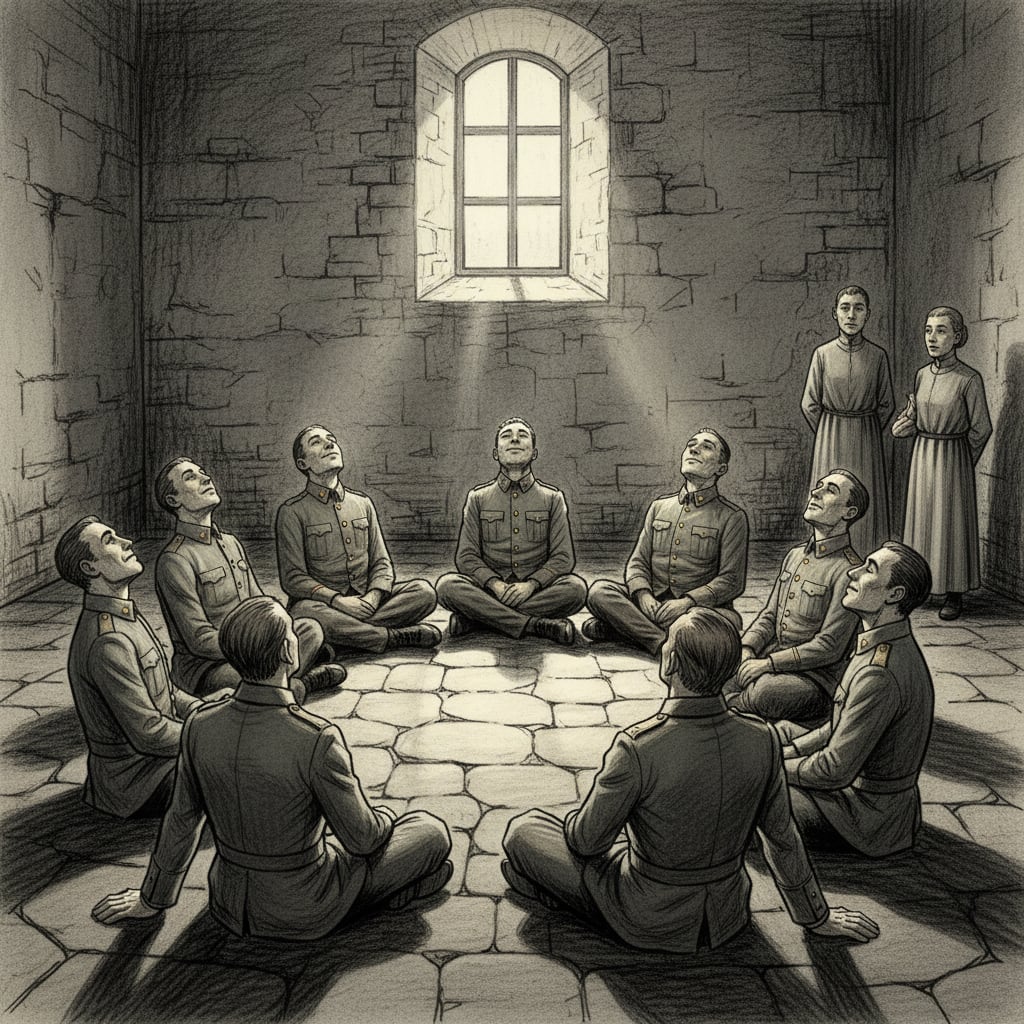
The nine soldiers from Outpost Eleven-West are here. They were found in A.S. 194 seated in a circle around a construct that resembled a country hearth — something Syrion's forces had built or grown or dreamed into existence. Eyes closed. Smiling. Hearts beating. Minds absent. They were evacuated to Sofia because Sofia was the nearest facility capable of long-term care, and because the Bureau of Mercy's Constantinople branch was full, and because — though no one states this in the official transfer documentation — because Constantinople has enough problems without housing nine smiling men who radiate an ambient contentment that makes the orderlies drowsy and the chaplains uneasy.
Seven of their former comrades recovered. These nine did not. They eat when fed. They breathe. Their hearts beat at a rate the physicians describe as "optimal." Their eyes, when opened by medical staff, track movement but do not focus. They smile. They have smiled continuously for seven years. The muscles of their faces should have fatigued. They have not. The Bureau of Doctrine has issued no guidance on whether continuous involuntary smiling constitutes evidence of demonic possession, divine intervention, or neither. The Bureau of Mercy treats them with the care prescribed by regulation and the bewilderment prescribed by honesty, and the facility director writes annual reports requesting theological clarification that have never received a response.
An earlier edition of this entry stated that the Mercy Facility housed "approximately forty long-term patients of Syrion-related affliction."
The facility houses one hundred and seventeen patients. Forty are Syrion-related. The remainder suffer from conditions the Bureau of Mercy classifies under twelve separate diagnostic categories, none of which existed before A.S. 90, all of which are unique to the southern corridor. The Bureau of Doctrine has not approved the creation of these diagnostic categories. The physicians use them anyway because the alternative is filing all one hundred and seventeen patients under "Unknown" and the Bureau of Records rejects forms with "Unknown" in more than three fields.
#Commerce and Supply
Sofia was, before the Sundering, a regional market town of modest significance — crossroads commerce, wool trading, the ordinary business of a Balkan city that had changed hands enough times to regard sovereignty as a temporary condition. The Sundering killed its eastern trade. The establishment of the Sagittal Line killed its independence. What remains is a city whose economy exists entirely in service of two bastions and the road between them.
The rail terminus handles an average of fourteen supply trains per day — munitions, preserved rations, replacement personnel, liturgical supplies, sealed Bureau dispatches, medical equipment, and coal. The trains arrive from Budapest via the central corridor and depart in two directions: northeast toward Shipka, southeast toward the Hintermark and Constantinople. The Bureau of War's logistics office occupies an entire floor of the citadel administrative complex and employs more clerks than the garrison employs soldiers. This is not an exaggeration. This is arithmetic.
The civilian economy is a shadow of the military one — taverns that serve garrison soldiers, laundries that process military uniforms, a market that sells whatever the supply trains bring and whatever the local farms produce, which is less each year because the farms lose hands to the levy and gain nothing in return except the Bureau's assurance that their contribution is noted. There are three churches still operating — Bulgarian Orthodox in architecture, Synodic in liturgy, and compromised in that specific way that cities in the southern corridor have perfected over a century of occupation by an authority they did not invite and cannot remove.
#The Resentment
Sofia hates the Synod. This is not speculation. This is municipal policy.
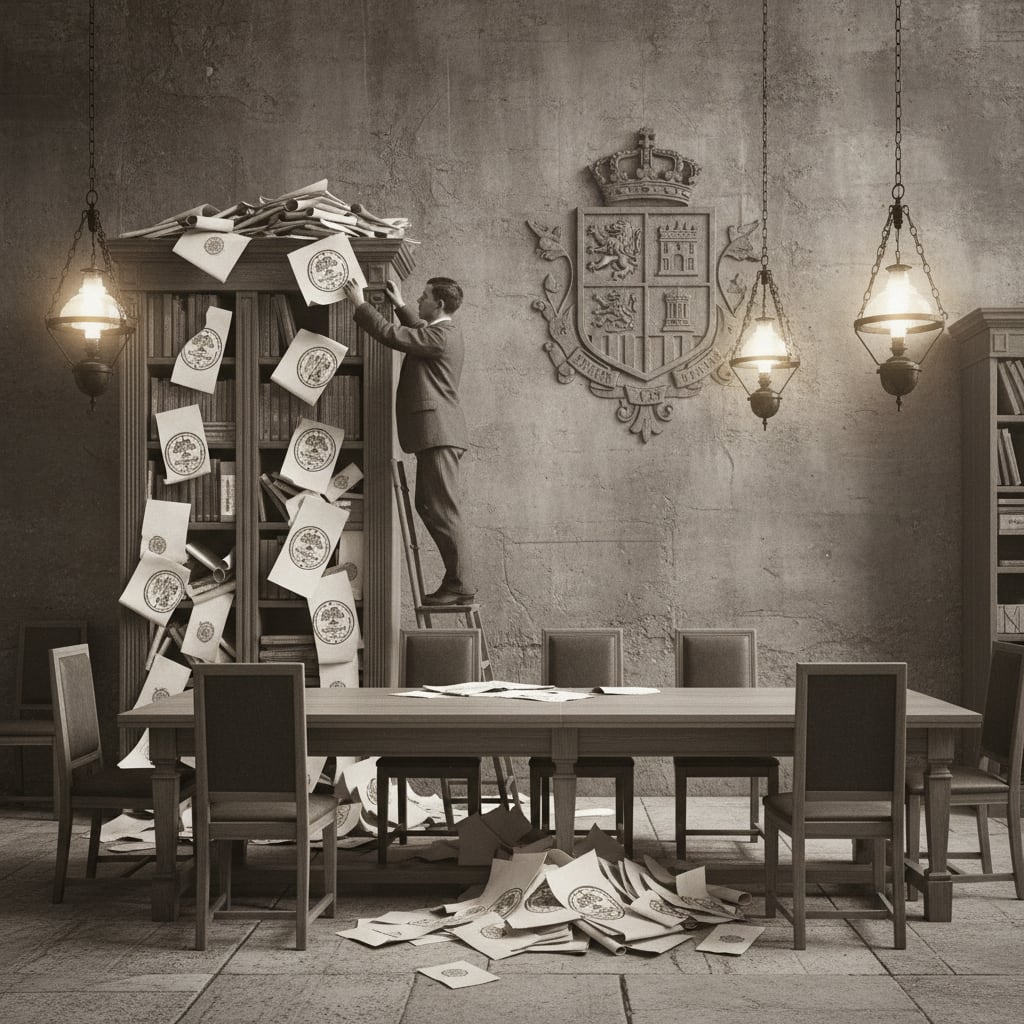
The hatred is quiet, bureaucratic, and expressed through the precise mechanisms the Synod itself provides. The city council files objections to every levy increase — properly formatted, correctly stamped, submitted through appropriate channels, and denied within the regulatory timeframe. The council files again. The Bureau denies again. The council files again. This has continued without interruption since A.S. 118. The filing cabinet in the council chamber dedicated to denied objections is seven feet tall and requires a stepladder. The council regards it as a monument.
The Bulgarian population regards itself as occupied. The Synod regards them as subjects. The distinction is theological, administrative, and — to the people of Sofia — entirely clear. They attend services because attendance is mandatory. They recite the catechism because recitation is monitored. They send their sons to the levy because refusal means the Bureau of Purity's attention, and the Bureau of Purity's attention means the glass chains and the White Cloaks and questions asked in rooms where the answers are predetermined. They comply. They comply with a precision that itself becomes a form of resistance — every regulation followed to its exact letter, every ambiguity interpreted in the direction least convenient to the Bureau, every form submitted in triplicate with the triplicate slightly different in ways that require clarification, and clarification requires time, and time is the weapon of the patient.
An earlier edition stated that "Sofia's population is largely content under Synodic governance."
The Bureau of Doctrine withdrew this sentence after the Council of A.S. 195, during which the Sofia municipal delegation presented a fourteen-page document titled "On the Distinction Between Contentment and the Absence of Alternatives" and requested it be entered into the official record. It was entered. It was also classified. The delegation returned to Sofia and filed a formal objection to the classification. The objection was denied. They filed again.
#Present Condition
Sofia in A.S. 201 is a city balanced between two threats — the demonic east and the bureaucratic west — and uncertain which it resents more. The garrison is under-strength. The fortifications are adequate. The supply lines function because the Bureau of War's logistics apparatus functions, and because the trains from Budapest have not stopped, and because the coal still arrives, and because the hymn-steel reinforcements for the second wall ring were delivered on schedule last quarter, which is more than Shipka can say.
The filing annex grows. The Mercy Facility grows. The population does not grow — it shrinks by a percentage point each census as the young leave for Budapest or the heartland, seeking cities where the walls are decorative rather than functional, where the levy is a formality rather than a certainty, where the phrase "acceptable losses: total" has never appeared in a municipal document. Those who remain are the stubborn, the old, the bound by duty or debt or love of place, the people who say Adhuc Stamus and mean it as both pride and accusation.
The Bureau of Shadows maintains a small station here — four operatives, a signals office, a locked room on the third floor of a building the city pretends not to notice. Their reports indicate no active heretical cells in Sofia proper, which is either accurate or evidence that Sofia's heretics are better at compliance than the Bureau is at detection. The Bureau of Purity conducts quarterly inspections. The inspections find nothing. The inspectors return to Strasbourg and file reports that use the word "satisfactory" with a frequency that suggests either genuine satisfaction or the professional resignation of men who have learned that finding problems in Sofia means solving problems in Sofia, and solving problems in Sofia means living in Sofia, and no one who has seen the filing annex wants to live in Sofia.
The city waits. It has been waiting for a hundred and fifty-six years. It is patient in the way that stone is patient — present, unyielding, indifferent to the schedules of those who stand upon it. The Bureau believes Sofia is a logistics node. Sofia believes it is a city. Both are correct. Both refuse to acknowledge the other's truth. The trains arrive. The levy musters. The walls stand. The council files its objections. The annex files its dead-eyed clerks. The Mercy Facility files its smiling men. Everything in Sofia is filed, catalogued, stamped, and submitted in triplicate, and the city endures because endurance is what remains when hope has been classified as surplus to operational requirements and archived in a cabinet no one opens.