
#On the Council and Its Year
"Redundancy is sanctity, for heresy hides in gaps." — attributed to the Council of Seven Orders
The Ledger of Years gives the Council of Seven Orders one line, entered under A.S. 110 / 1820 CE: first explosive proliferation of bureaucratic offices. Six words for the event that taught the Synod to breed. I have read longer entries recording the replacement of a sacristy lock.
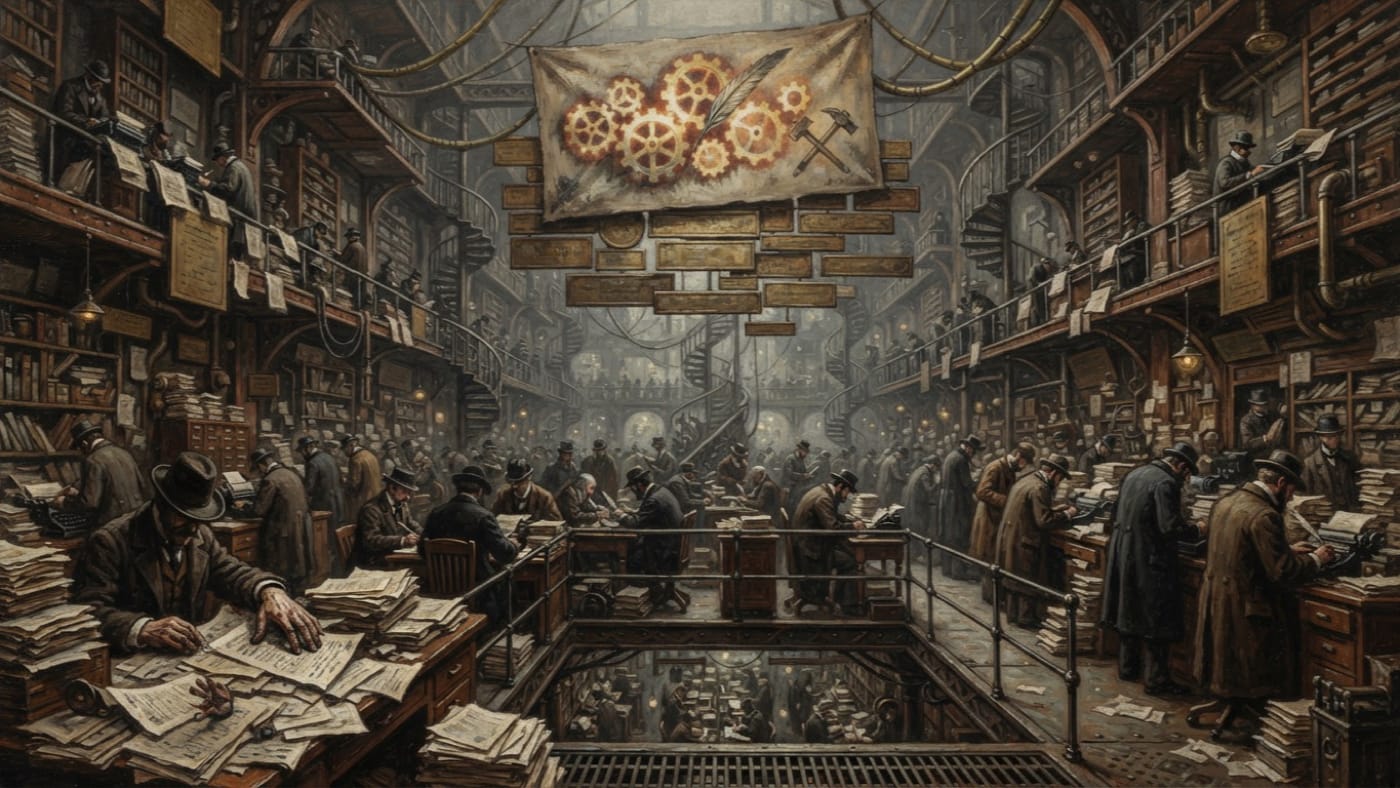
The Council's whole surviving doctrine is the maxim above, and its whole surviving monument is everything that followed it. No roster of the seven orders survives in any register open to this Codex. Neither does a chairman's name, a hall, a seating plan, or the length of the session. The Bureau of Records would call this an incomplete file. I prefer to call it a fitting one. A council that held that every function deserves a second office has left posterity a single sentence and asked the rest of the government to supply the duplicates.
That sentence was enough. Eight words have since justified more salaried positions than the Great Deceiver has justified sermons, and the sermon trade is not small.
#On the Government It Inherited
The Council met in a government that was twenty years constituted and about sixty years in practice. The hidden Church came into the open after the Sundering of A.S. 45. An interim council governed in fact from about A.S. 50, and it grew offices the way a damp vestry grows mould: steadily, in corners, without asking. The formal Synod was constituted at Strasbourg under the Concordat of A.S. 90. By then the founders were dead. Kratz died in A.S. 88, and Augustinus had gone before him.
The same year produced the First Continental Levy: one son in ten from every household between the Baltic and the Tagus, decreed under the joint seals of War and Doctrine. The Bureau of War was five years old. The Field of the Sixth Psalm filled with ploughboys who had never stood in a rank. The Ledger does not say whether the Council's delegates heard the mustering drums or merely shared a calendar with them. I decline to say it for the Ledger. That is a rare courtesy, and I expect it to be noted in my file.
I will observe only this. A government that has just taken a tenth of the continent's sons will need clerks to count them, more clerks to count the clerks, and a doctrine explaining why the second set is holy.
#On Redundancy as Sanctity
The Council's argument fits on a seal. Heresy is a solvent. It seeps into whatever space authority fails to occupy: the parish no visitor reaches, the tithe no assessor counts, the bell no inspector hears. Shrink those spaces and you starve the heresy. Two offices watching one parish leave less unwatched ground than one. Three leave less still. Carry the arithmetic to its liturgical conclusion and the ideal government is one in which every act of every soul falls under so many jurisdictions that it can never once be unobserved.
The Synod accepted the arithmetic and has gone on applying it. Beyond its core offices, Strasbourg keeps producing new titles, each proclaimed the "final safeguard of faith" until the next one is imagined. The Tribunes of the Poor claim dominion over alms, though the Bureau of Tithes has never conceded that a copper can leave a household without its notice. The Chamber of Bells decrees which tones a cathedral may sound, under the eye of a Bureau of Bells whose inspectors already travel with calibrated tuning forks. The Office of Pilgrim Purity grades shrines by the holiness of their dust. The Guild of Banner-Keepers regulates the colours of processional standards, so that a heretic cannot sneak out under the wrong crimson.
I do not credit the Council with founding any of these. No source does. They are its heirs, and an heir needs no birth certificate to collect an inheritance.
The cost is real, and I mean real money. Every new office needs a seal, every seal needs wax, and every wax-chit is countersigned by someone whose stipend comes from the same tithe that buys the wax. The Council took no position on this, as far as anyone can tell. Sanctity was never sold as cheap.
#On Rival Jurisdiction
Redundancy was meant to close gaps. In practice it turns one government into several, all occupying the same ground and all certain they own it.
The Holy Bureaus show the system at full size. The Bureau of Doctrine defines what may be believed. The Bureau of Purity decides whether that belief was held with sufficient enthusiasm, and brands it suspicious if it was not. The Bureau of Records keeps both rulings in triplicate under contradictory seals and adjudicates neither. The Bureau of War enforces whichever version can muster the most battalions on the day. Tithes, meanwhile, invoices all four.
A pamphleteer would call this chaos. The Hierarchy calls it providential design, and the pamphleteer's opinion is now held by the Bureau of Purity, which has catalogued it. A man accused under this arrangement has no single court to appeal to. He has a corridor of them, each of which may reopen what the last one closed. No rebel can cross that corridor unseen, and no innocent can reach the end of it quickly. The Council never claimed to be concerned with speed.
#On the Supplementary Directorates
One more entry from A.S. 110 belongs here. By that year an older Ledger phrase, ancillary offices for the maintenance of doctrinal security, had grown into supplementary directorates. The wording is all we have. No source says the Council drafted it, approved it, or knew of it. It shares the Council's year and nothing else on paper.
Still, set the two entries side by side. In public, the Synod was multiplying offices with trumpets: titles proclaimed, seals cut, the faithful told that every new chancery was another wall around their souls. Beside that noise, a phrase in the Ledger was quietly growing into something that would announce nothing at all.
What that phrase eventually covered is the Bureau of Shadows, which does not exist and has been confirmed not to exist fourteen times. Its Custodians do not arrest. They collect, and a collected man leaves a gap in the parish roll where his name used to be. Its Omission Notaries seal blank folios, and a properly sealed blank folio counts as evidence that a man was never there. Its Night Papers carry absolute authority from sunset to dawn and nothing afterward. They are filed nowhere and gone by morning.
I offer no theory of the Council's intent, because the record supplies none, and I am too old to start inventing councils. I offer an observation made from my own desk. The Council said heresy hides in gaps. Every office it inspired added seams where one jurisdiction met the next, and Shadows works in those seams, between Doctrine and Purity, between Records and War. The more offices there are, the more seams there are. Whoever wrote supplementary directorates understood that perfectly. I wonder, from time to time, whether the seven orders did.
Earlier editions of this Codex dated the Council of Seven Orders and its maxim to A.S. 20. An older compendium gives its founding as A.S. 211.
Corrected: the Ledger of Years records the Council under A.S. 110 / 1820 CE. A.S. 20 falls seventy years before the Synod it supposedly furnished with a doctrine. A.S. 211 falls ten years after the present, and the Bureau of Records declines to certify councils that have not yet convened. The maxim survives both errors intact. Maxims are hardier than dates.
#The Present Condition
In A.S. 201 the Council's doctrine has outlived every trace of the Council. Offices are still created and almost never dissolved. Old ones simply acquire rivals. The Lantern Brotherhood walks the lanes the Wardens cannot cover, and the justification for its overlapping patrols is the Council's maxim, quoted in shorter form. Strasbourg gets denser with every chancery, and each new door-plate goes up in the conviction that the gap it closes was the last one.
Whether the Council of Seven Orders still meets is a question no office has the jurisdiction to answer. I have checked. Four offices claimed the jurisdiction, three denied it, and one has not yet replied. The Council did its work in a single year and a single sentence. The Synod has been carrying out the rest ever since, in triplicate.