
#On the Numbered Succession
"We count our Hierarchs as we count our saints — generously, retroactively, and with an eye toward the politically expedient."
I begin, as the Bureau demands, with a number. How many Hierarchs have ruled the Synod from the Inner Circle of Strasbourg? The answer depends upon whose ledger you consult, which edition you hold, and whether the clerk who compiled it survived the audit that followed. The Bureau of Records maintains that there have been precisely forty-one Hierarchs occupying the Seven Seals since Augustinus first claimed the Chair of Doctrine in the ruins of Worms. The Bureau of Doctrine asserts forty-three, the surplus arising from two individuals whom Records has classified as "administratively non-existent" but whom Doctrine continues to cite for theological convenience. The Bureau of Purity declines to offer a number, stating only that "the count is correct, and the correct count is classified."
The succession of the Hierarchs is the spine of the Synod's legitimacy. Every decree, every levy, every anathema and dispensation flows downward from those seven chairs in the Inner Circle, through the Twelve Holy Bureaus, through the Bishops-Praetorial and the Wardens and the Confessors and the Procurators, until it reaches the peasant in his field, who obeys without knowing which particular Hierarch authored the command that bent his back. The chain must be unbroken. The succession must be continuous. And so it is — provided one does not examine the links too carefully.
I shall examine them with great care. This is my privilege. The Bureau has authorized this entry, and the Bureau's authorization covers precisely as much honesty as the Bureau deems useful.
#On the First Hierarch and the Myth of Origin
"A great man is a great fiction agreed upon."
Hierarch Augustinus of Mainz, the Binder of Wounds, is the root from which the later succession claims descent. He shared in the Common Allegiance of A.S. 55 and presided over the Council of Worms in A.S. 87, where its ratification register acquired 314 names. He died before the Concordat of Strasbourg of A.S. 90. Miracles were attributed to him at Ulm, Lyon, and Worms; the records do not make every attribution an observed fact.
Later registers place Augustinus at the head of the Seal of Doctrine succession. The constitutional Seven Seals, however, were settled after his death, at A.S. 90 and in subsequent confirmations. He exercised earlier episcopal and interim authority; he did not occupy the finished A.S. 90 chair. His exact death day remains disputed, but the death boundary before the Concordat does not.
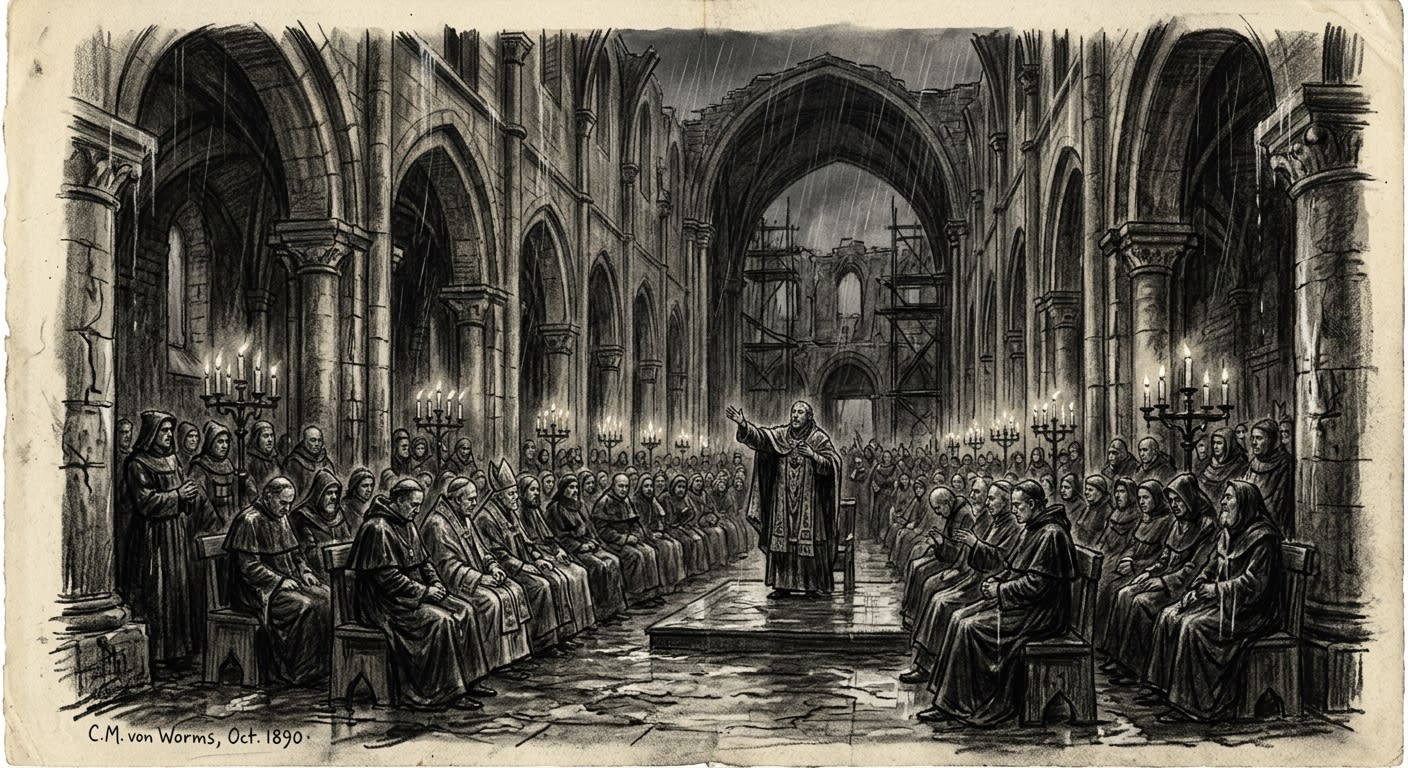
The myth is simple: Augustinus was the first. From him, all legitimate authority descends. Every Hierarch who has occupied one of the seven chairs in the Inner Circle traces a line of laying-on-of-hands, seal-to-seal, wax-to-wax, back to the Binder of Wounds. The reality is more tangled. Augustinus did not appoint his own successors. He assumed — with the naïveté of a saint and the negligence of a man who believed Providence would sort out the paperwork — that the Council would choose them. The Council chose badly. The Council chose often. The Council, within two decades of Augustinus's death, chose so frequently and so fractiously that the Bureau of Records ran out of fresh seal-wax and began melting down candle-stubs from the Basilica.
#On the Seven Seals and Their Stewards
The Seven Seals of Faith are the pillars upon which the Synod's governance rests: Doctrine, Discipline, Martyrdom, Concord, Purity, Vigilance, and War. Each Seal is held by one Hierarch, each Hierarch clothed in white and crimson, seated in the Inner Circle of Strasbourg, speaking with an authority said to carry the "breath of the Sundering" itself. Hierarch Odo of Trier put the matter with characteristic bluntness at the Council of Cologne in A.S. 100: "When we speak, the stones of Strasbourg listen." The stones have not confirmed this testimony, but the Bureau of Records has filed their silence as assent.
The Seal of Doctrine is first among equals — it defines truth, which is to say it defines reality, which is to say its holder can declare that rain falls upward and the Bureau of Records will amend the weather reports accordingly. The Seal of War commands the armies of the Sagittal Line, the Continental Levy, and the Bureau of War's considerable private interests. The Seal of Purity oversees the Inquisition, the Index Damnatus, and the correction of the insufficiently devout. The Seal of Discipline governs the internal conduct of clergy, which is to say it governs scandal, concealment, and the orderly disposal of inconvenient confessions. The Seal of Concord manages relations between the Synod's fractious provinces and its even more fractious allies — the British Crown, the Netherlands, and the Fractured North, each of whom cooperates exactly as much as self-interest demands and no further. The Seal of Martyrdom catalogues the dead, canonises the useful, and determines which corpses glow with sufficient sanctity to justify the expense of a reliquary. And the Seal of Vigilance — that last, most ambiguous office — watches. What it watches, whom it reports to, and whether it sleeps are questions the Bureau of Doctrine classifies as "ongoing."
Each Seal operates with absolute authority within its domain. Each domain overlaps with every other. The resulting jurisdictional warfare is the engine of Synodal governance — a machine fuelled by rivalry, in which no Bureau can act without another Bureau observing, objecting, or filing a countersuit. This is by design. Augustinus wanted unity; Kratz wanted control; together they produced a system in which unity is maintained by the impossibility of anyone accumulating enough uncontested power to break it.
#On the Succession and Its Irregularities
"The list is continuous. The gaps are classified."
The succession of the Hierarchs is, by the Bureau's own accounting, an unbroken chain from Augustinus to the present day. I shall now describe the links of that chain, and the reader may judge for himself how many of them bear the smith's mark and how many were hammered in the dark.
The first generation included Augustinus's earlier colleagues and later holders selected after his death. They had fought in the Atheist Wars or sheltered among the Cellar Saints; they carried scars and relics and the authority of survival. When the Concordat settled the constitution in A.S. 90 and the Bureaus received formal charters in A.S. 92, successors were confirmed at the Council of Mainz in A.S. 93.
Augustinus had already died. The later succession made his life its first entry.
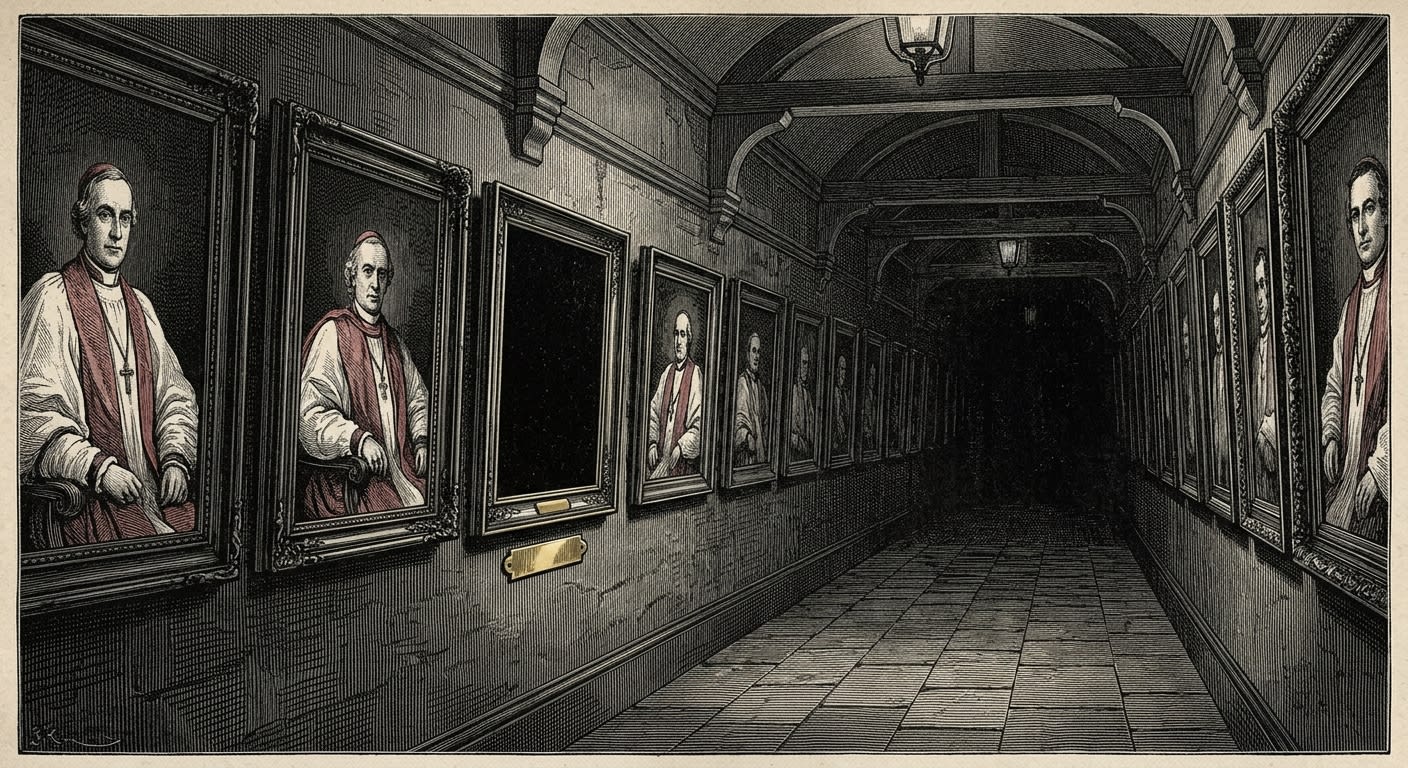
The Third Hierarch of the Seal of Discipline — I shall not name him, for his name has been eaten — presents the first serious lacuna. The Bureau of Records maintains that his file was destroyed by moths in the sub-vaults of the Basilica of the Ledgered Saints during the damp winter of A.S. 112. The Bureau of Purity maintains that no such file ever existed. The Bureau of Doctrine maintains that the Third Hierarch served with distinction and that his record is "complete in the sight of the Almighty, if not in the sight of the filing clerk." His portrait in the Hall of Succession shows a frame, a nameplate, and a canvas that has been painted over in ecclesiastical black. Three separate investigations have been launched into the matter. All three investigators were subsequently reassigned to duties that the Bureau describes as "contemplative." The moths, for their part, have not been questioned.
The Seventh Hierarch of the Seal of Martyrdom was previously listed as Hierarch Delmatius of Cologne (A.S. 98–117).
The Bureau of Records has revised this entry. Hierarch Delmatius was retrospectively declared heretical by the Fourteenth Doctrinal Congress (A.S. 147) following the discovery that his canonisation proceedings for the Twelve Martyrs of Brest were based upon testimony extracted from a dead man. The extraction method is not specified. His name has been removed from the Hall of Succession and replaced with the notation "SEAT OCCUPIED — OCCUPANT CLASSIFIED." His portrait has been turned to face the wall.
The pattern repeats across the centuries. The Eleventh Hierarch of the Seal of Concord was declared retrospectively heretical in A.S. 155, three years after his death, when the Bureau of Purity discovered that he had been corresponding with agents of the Shadow Court — or rather, when the Bureau of Purity decided it was convenient that he had been. The Sixteenth Hierarch of the Seal of War was assassinated in his own chapel by an assailant the Bureau of Shadows describes as "an individual of no determinable origin" — which is the Bureau's way of saying that the assassin was either one of their own or someone they wished they had recruited. The Twenty-Second Hierarch of the Seal of Vigilance vanished from his chambers in A.S. 172, leaving behind a warm cassock, an untouched supper, and a single page of correspondence addressed to no one. The Bureau of Records has classified the vanishing as "voluntary contemplative withdrawal." The Bureau of Shadows has not commented. The empty chair in the Hall of Succession bears a plaque reading "IN ABSENTIA — DUTIES CONTINUING."
The current count — and I use the word "current" advisedly, for it changes with each revision of the Bureau's internal memoranda — stands at forty-one Hierarchs confirmed across all seven Seals since A.S. 90. Of these forty-one, seven have been declared retrospectively heretical, three have been "administratively dissolved" by the Bureau of Records (a process distinct from heresy in that the individual ceases to have existed rather than merely ceasing to have been orthodox), two vanished under circumstances the Bureau classifies as "contemplative," one was assassinated, one was consumed by his own reliquary during an unscheduled miracle, and one — the Third Hierarch of Discipline — was eaten by moths. The remainder served with distinction, died in their chairs, and were interred in the crypts beneath the Basilica of the Ledgered Saints with appropriate ceremony.
The succession is continuous. The Bureau assures us of this. The gaps, where they occur, are classified.
#On the Inner Circle and the Mechanics of Rule
"Seven chairs. Seven voices. One sentence, delivered in harmony — or, failing that, in volume."
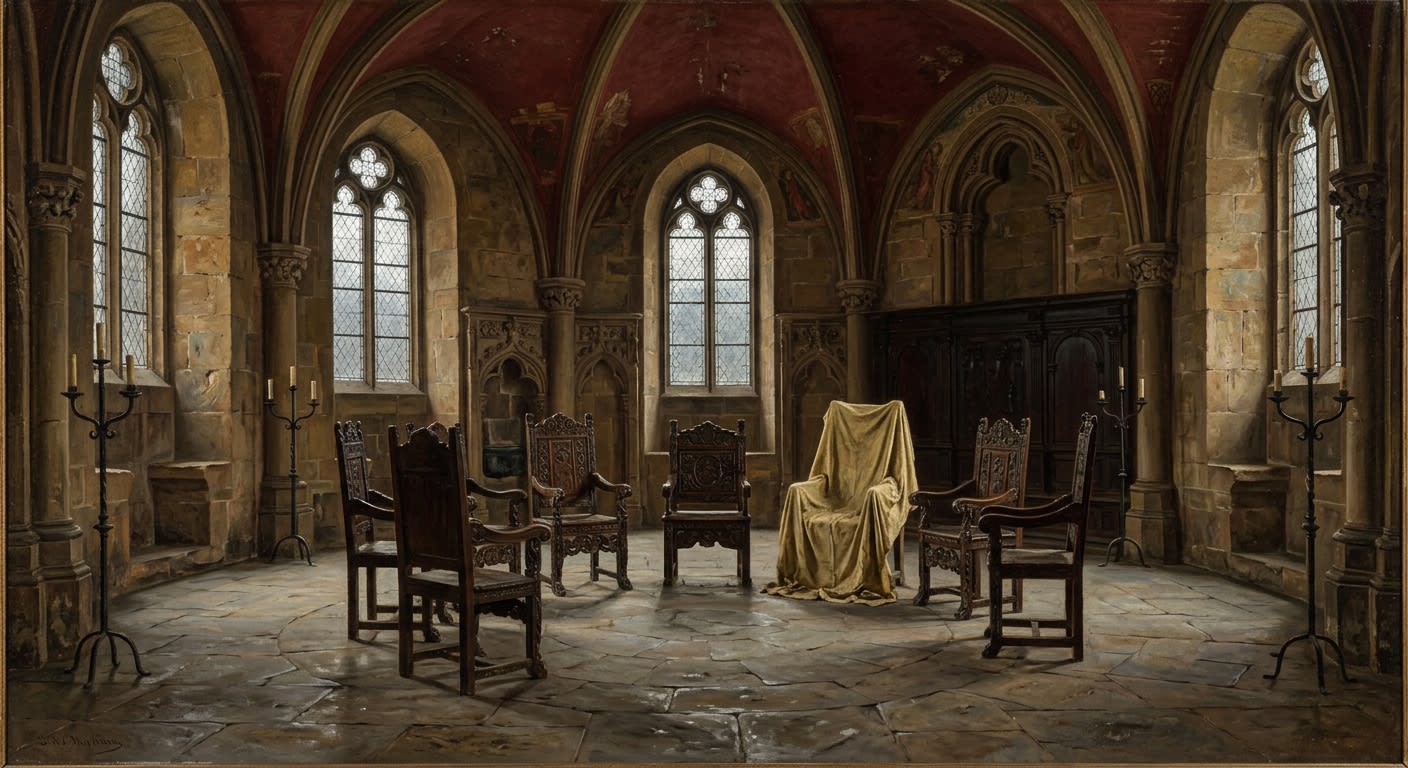
The Inner Circle is the chamber in which the Hierarchs sit in session. It occupies the highest floor of the Basilica of the Ledgered Saints, above the Archive of Sealed Decrees and below a ceiling painted the colour of dried blood — a practical measure, the Bureau of Engineering insists, to discourage pigeons. Seven chairs of carved oak and iron, each bearing the sigil of its Seal, arranged in a circle with no head. Augustinus designed it so — the circle, not the table, for there is no table; the Hierarchs do not negotiate, they pronounce. A clerk of the Bureau of Records sits at a low desk in the centre, recording every word. Two clerks of the Bureau of Doctrine sit behind screens at the periphery, ready to correct any pronouncement that deviates from orthodoxy before the ink dries. An Inquisitor of the Bureau of Purity stands at the single door, silent, noting which Hierarchs attend and which do not.
Session is called by the Summons of the Ninth — the ninth bell of the canonical day — and attended by whoever chooses to answer. If a Hierarch fails to appear, his vote is counted "by faith," the recording clerk inscribing a red check beside a name and a verdict that the absent party did not render. If a Hierarch dies mid-session — this has occurred twice in the Bureau's official tally, and an additional four times in records the Bureau has since redacted — his name is read into the minutes until the session concludes. The dead, at least, are reliable voters.
Decisions are issued by decree, sealed with seven stamps — one for each Seal — and distributed through the Bureau of Records to the continent. A decree requires no justification, no explanation, no evidence. The Hierarchs speak, and the stones of Strasbourg are said to listen. The citizens of the Theocracy are not afforded even this much agency. They comply, or they are noted. Three notations become a Hearing. The number of Hearings required to produce a disappearance remains classified.
#On the Schisms, the Rivals, and the Empty Chairs
The succession has been contested five times. Each contest ended in the same fashion: the contender was destroyed, his followers scattered, and the Bureau of Doctrine published an encyclical explaining why the challenge had never occurred.
The Schism of Avignon in A.S. 111 is the gravest instance. A faction of Provençal clergy, led by figures whose names the Bureau has scoured from every surface, crowned a rival Pontifex Submersis in a ceremony conducted beneath the Rhône — literally beneath it, in flooded catacombs accessible only at low tide, where the words of consecration bubbled upward through brown water and were received by eels. The schismatics declared Strasbourg corrupt, the Hierarchs illegitimate, and the Concordat void. Six months of crisis followed. Kratz — long dead by then, but his methodology survived him — would have approved of the response. Avignon was razed to its foundations in ten days. Its stones were carried to Strasbourg and now form the staircases of the Cloister of Concord. Seventeen witnesses reported glass calcifications and frozen congregants in the final hours; all seventeen were subsequently visited by the Bureau of Shadows. The Bureau of Doctrine published a thirty-page encyclical explaining why the schismatics had never actually existed. The Bureau of Records amended its files.
The Coalition of the Crossed Keys in A.S. 150 presented a different challenge — a Lombard revolt that declared allegiance to the "True Successor of Rome" and briefly held three cities before the Bureau of War's response drowned the rebellion in enough blood to stain the Po for a fortnight. The Bureau of Doctrine preserved the Coalition's name and the name of every participant, for a list of heretics is a tool, and tools are sacred.
And then there is the matter of the empty chairs.
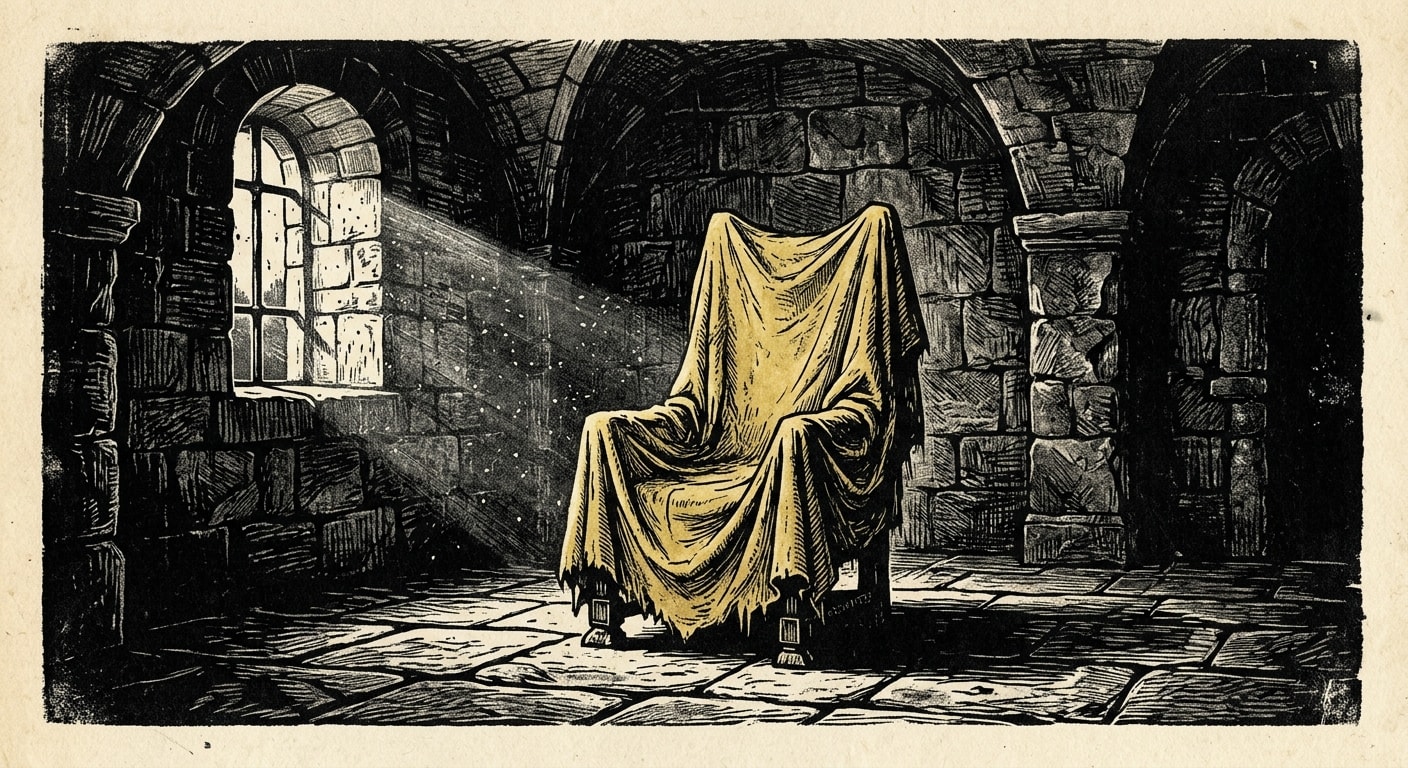
As of A.S. 201, one chair in the Inner Circle is draped in white cloth. The Hierarch of the Seventh Seal — the Seal of War — has not been seen in public session since A.S. 107. The Bureau of Shadows has issued no comment. The Bureau of Records lists the Hierarch as "presently engaged in contemplative duties." The Summons of the Ninth rings; the red check is inscribed; the vote is counted "by faith." Almost a century of faith. The white cloth has yellowed. Dust settles upon it, and the dust is not disturbed.
The Council of Veils — if it exists, if it has ever existed, if its existence is anything more than institutional rumour fossilised into something that bureaucrats treat as fact — is said to operate within the gap left by the absent Hierarch. Its members leave no signatures. Their minutes are said to be written in ash on censers that burn before the ink sets. When the Empty Throne Affair occurred — a high cardinal's cassock left warm upon his chair while his body was simply, cleanly, irreversibly absent — the Veils' record for that session was a single sheet of clean paper with a pinprick through the centre. The Bureau of Records stamped it Filed. The elegance of the economy disturbs me, and I am a man not easily disturbed.
#On the Present Condition
The Hierarchy stands in its one hundred and eleventh year of continuous governance, measured from the Concordat. Seven Seals. Seven chairs. Six occupied — five by Hierarchs whose names are published in the annual Ledger of Succession, one by an individual the Bureau of Shadows identifies only by a file number that changes each quarter. The seventh draped in white cloth that no one launders and no one removes.
The Hierarchs no longer speak to one another except through intermediaries. This is not supposition; it is observation. I have attended sessions. I have watched the recording clerk's pen move from statement to rebuttal to counter-rebuttal without the speakers once meeting each other's gaze. The Seal of Doctrine issues a proclamation; the Seal of Purity files an objection before the wax has cooled; the Seal of War dispatches a battalion to enforce whichever interpretation its generals find most convenient; and the Seal of Concord sends a letter of measured regret to whatever province has been caught between the contradictions. This is governance. This is the machinery that holds a continent together while the Enemy devours its eastern frontier.
The faithful ask whether the Hierarchy is strong enough to endure. The question is misframed. Strength implies coherence, and the Hierarchy has never been coherent. It has been continuous — which is a different virtue, and a more durable one. A chain need not be forged of identical links. It need only hold. And the Hierarchy holds, link by disputed link, moth-eaten file by moth-eaten file, from Augustinus's rain-soaked roofless cathedral to the blood-ceilinged Inner Circle where six old men and one empty chair determine the fate of a world.
Whether this is sufficient against what presses at the Line is a question I do not answer. The Bureau has not authorised an answer. The Bureau, I suspect, does not possess one.
The count is continuous. The gaps are classified. And the bells of Strasbourg ring for the Ninth, as they have rung since the Concordat, summoning Hierarchs to a circle where the dead still vote and the absent are counted among the faithful.
Satis dictum. Finis.