
#On Ossuary Office Seven
Ossuary Office Seven is a stone chamber inside the Ossuary Rings of Bastion-Constantinople, and it is the headquarters of the Circle of Ashen Steps. Everyone with sense calls it the Counting Room. According to the Circle's own account, one clerk filed it as "Auxiliary Vigil Substation, Bone-Lane East." That name survives in his handwriting and nowhere else.
The number confuses pilgrims. There are six Rings. The seven belongs to the office, and a visitor who asks for the seventh ring will be directed, for a fee, to the first.
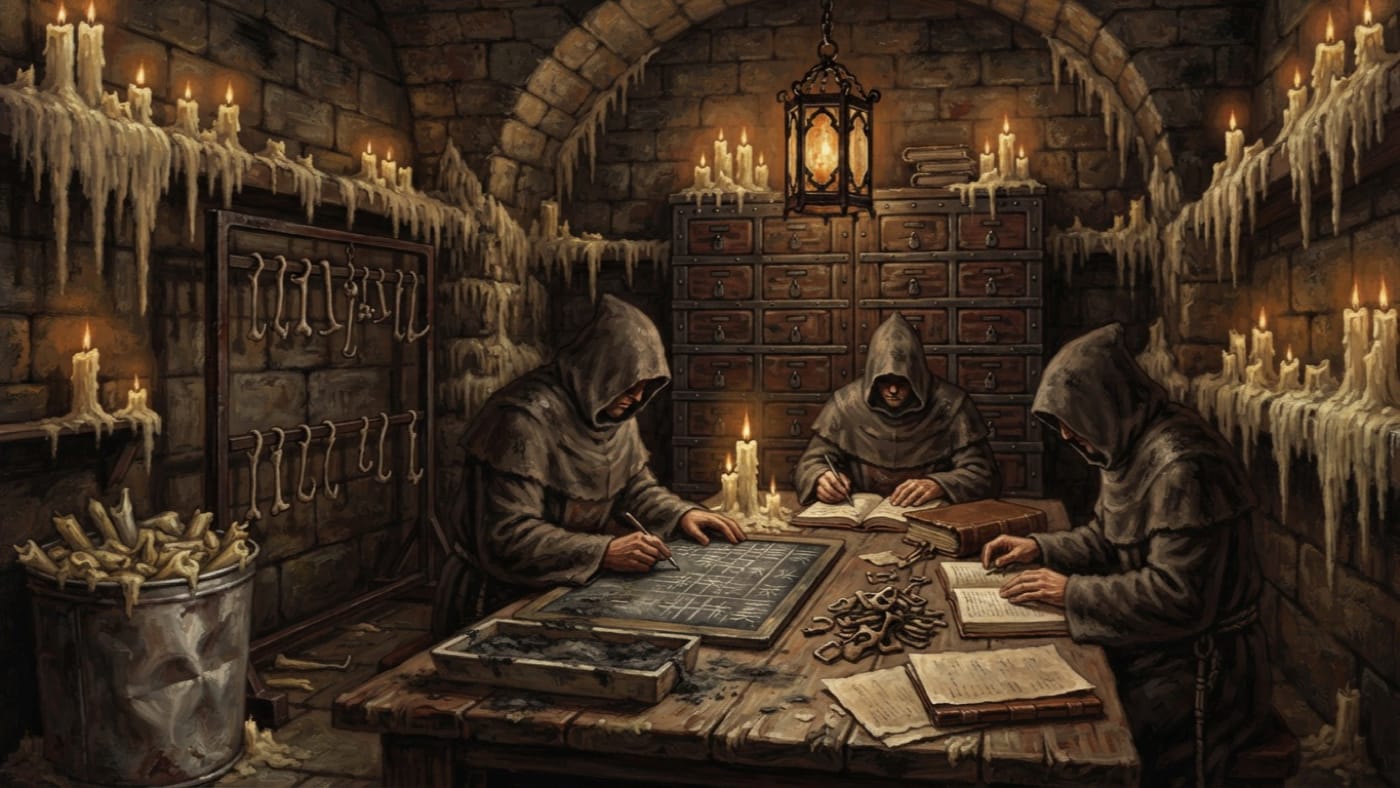
Inside there is slate, scratched with candle tallies. Wax runs down the walls in pale ridges, like stalactites in some devout cave. There is a rack of bone hooks, a trough of ash paste, and a locked cabinet of body-tags. That is the whole of the furniture, and it is enough to govern a district of the dead.
The bastion above is the Bosphorus anchor of the Sagittal Line, the southern end of the great north–south wall, and its soldiers have their own articles and their own vanity. The Counting Room takes no interest in the war. Its war is with any column that does not total.
#On the Slate and the Cabinet
The room keeps two kinds of record. The difference matters to anyone who expects to die in the Rings, which means everyone who lives near them.
The slate records the living. Each household flame seen on the ring-walk becomes a scratch. Each window without its vigil-candle gets a second scratch, set apart. A missing flame has four possible answers: an empty house, a family too poor for approved wax, a body kept back one more unsanctioned night, or a refusal to pray. The slate makes no distinction between them. It waits.
The cabinet records the dead. Its tags come in three conditions. Stamped tags belong to bodies already accounted for. Blank tags are the Circle's readiness, carried out at dusk and returned at dawn. The third kind carry names in a clear hand, and some of those names belong to people who still buy bread, still argue with their landlords, and still light their candles every night with particular care.
No one in the Circle will say why a living name sits in that drawer. No one needs to. A woman told that her tag is already written does not need the method explained. She needs only to know which officer holds the key.
The tags are the Circle's own. Do not mistake them for licensed bone authentication, for housing permits, or for the central death-register of Records. Those are documents. These are leverage with a string hole.
#On the Night's Reconciliation
The Counting Room empties at dusk and fills again before dawn. Its work is best understood by what leaves the room and what comes back.
At dusk the Brothers wash in ash. The hooks are counted on the rack, the blank tags are counted out of the cabinet, and the approved wax is counted against issue. Before the walk the doctrine is recited in the room: Names are weight. We do not allow weight to float. The Circle's second maxim goes out with the slate: A candle uncounted is a body unclaimed.
At the Curfew Seal, under the Quiet Hours, the patrol leaves clockwise. Lanterns ride fixed at sternum height, so the light neither searches nor sentimentalises. The Brothers hold that walking counterclockwise invites return. I record the belief. I do not certify the theology, though I note that no Brother has volunteered to test it on a quiet night.
In the early night the slate goes out and the tally is taken. Flames are marked, missing flames are noted, and nothing is yet done about them. At midnight the patrol turns to the body-routes, where corpse-thieves are intercepted or negotiated with, depending on the evening's arithmetic. Late in the night come the corrections. When a tally disagrees with the street, it is made true by a warning, a fine, or the taking of a person.
Before dawn the room takes everything back. Tags are reconciled against bodies, and the bodies pass to sanctioned ash crews. The chalk marks on thresholds are wiped away, so the morning finds a clean street and a full slate.
Pre-dawn reconciliation accounts for route attrition.
Corrected, consistent with the prior correction in Circle of Ashen Steps. The reconciliation accounts for reassignment. Attrition is what happens to boot leather.
#On Approved Wax
Wax is the room's other ledger, and the walls keep it more honestly than the clerks do.
Approved wax is certified supply. Marrow-wax is rendered from sanctioned remains and mixed into vigil candles for its devotional potency. It passes under Tithes measure and Records receipt before it reaches a household shelf. The Circle counts it at dusk because a family's candle is the family's standing, and a family's standing is the Circle's business.
The initiate learns this first. In the Candle-Tally, a novice Brother keeps the household ledger through one full night. If his marks are wrong, the Circle leaves the ledger alone and amends the street instead.
Then there is the Marrow Fine, which confiscates a household's approved wax ration. The family keeps its grief but loses the means of showing it, and on the next ring-walk its dark window joins the second column of the slate. Ash-Tongue dusts the offender's lips with consecrated ash until speech hurts for days, so it punishes the mouth. The Marrow Fine punishes the whole house.
What the Circle skims, it sells. The excess is trimmed off certified issue and sold to households desperate to keep a name lit one more night. Wick-Sergeant Rulik "Sootmouth" knows every tunnel of the Rings and coughs wax-sweet phlegm into a neatly folded rag. His defenders say he sells wax to cover a daughter's ration debt. His enemies say the daughter is dead. The slate holds no line for his household either way.
#On the Two-Book Dead
Officially, a body enters the Rings, receives its tag, passes into sanctification, and becomes a number. The Counting Room supplies that number, and the official column closes.
The Two-Book Dead is the second count. It is a ledger of bodies diverted for patrons, for corpse-sale, for marrow extraction, and for lost funerals. It also records the mercy purchases by which wealthy houses buy discretion after disgrace. This article does not say where the ledger is kept. A reader who assumes a second cabinet has done more work than the evidence.
The method needs no secret engineering. A body leaves on the midnight route with a tag. A tag comes back at dawn. Records receives a total that agrees with itself. The whole of the Circle's sin lies in the gap between the satisfied column and where the body actually went, and that gap fits between two handwritings.
Lanternman Vey Strahl, once a gravedigger, handles a blade with a calm that witnesses call almost gentle. Rumour holds that he once buried a man alive to balance the ledger. Rumour has been wrong before. It has also been seated at the reconciliation table.
Records publicly declines to acknowledge the Two-Book Dead. Records also stays out of the Rings after curfew. If the public learns that a father was sold when he should have been sanctified, or that a mother kissed a tag while the body behind it went elsewhere, the ossuary riots will start in the lanes and end at the cabinet. No such exposure has happened. The Circle runs the room as though it might happen tomorrow, which is the only sensible way to run a room.
#On Provisional Toleration
The Counting Room survives because a corpse scandal costs more than corpse corruption. One stolen body sends a district into the street. A suppressed theft is only a bruise in the Ledger, and it fades by the next quarter. The Circle hands bodies cleanly to the sanctioned crews, keeps the funeral lanes moving, and buries the scandal before the corpse.
The Wardens resent the room. The Bureau of Purity watches it. The rest of the Lantern Brotherhood counts its own sins in other districts and does not envy this one. Families curse the room under their breath, and they still look for its lanterns when a night-cart wheel splits beside the cremation yard.
The precedent for tolerating auxiliaries of this kind comes from the curfew clauses of A.S. 94. That year does not date the room, and nobody should carve it over the door. The present assessment rests on the Records note of A.S. 201, reproduced below as issued.