
#On the Island That Routes the North
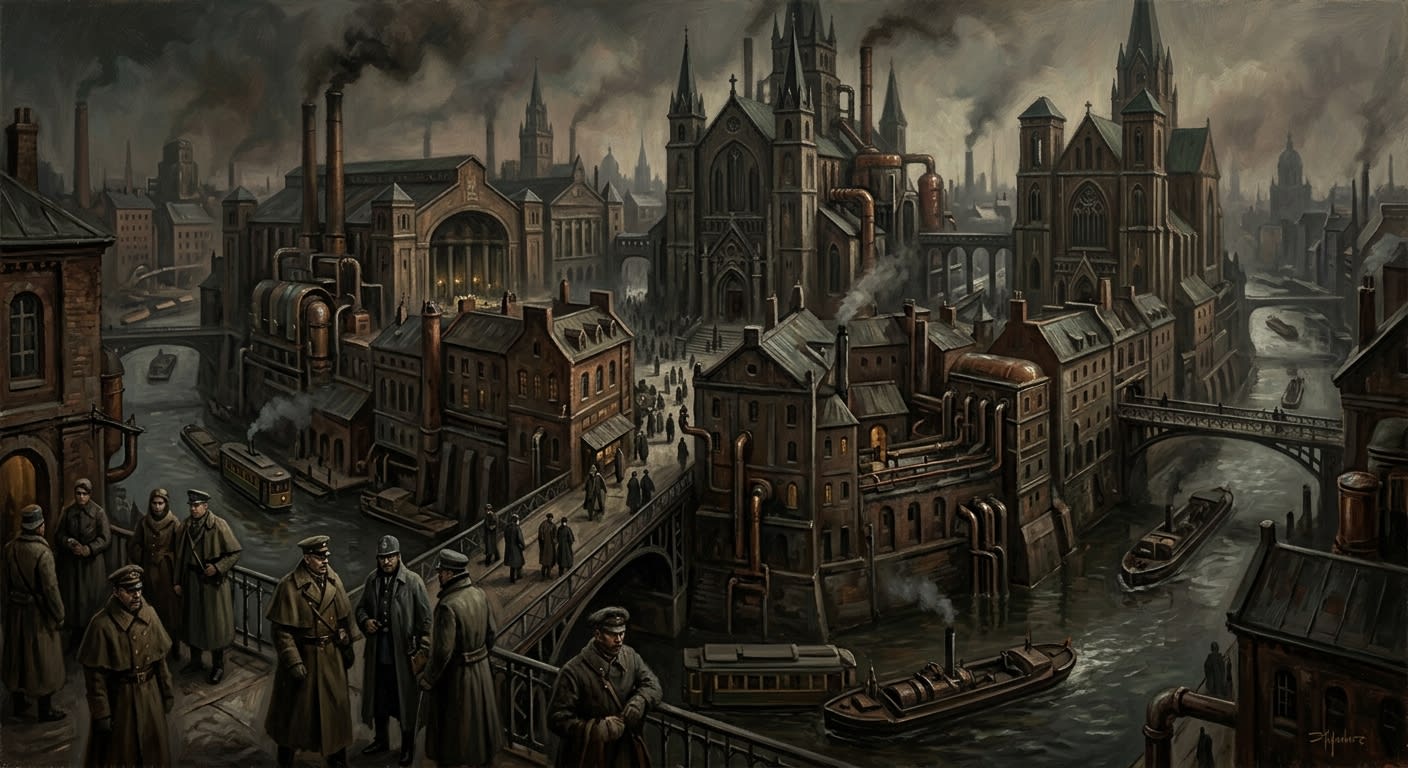
The Archonate Isle sits in the Spree (Unregistered) at the centre of Kanzleiburg, a former royal island made into an administrative reliquary, where dead Prussian kings have been evicted by living clerks and the north is made punctual enough to continue bleeding in the correct order. It is the seat of the Northern Hierarchate, the office-body of the Archon of Kanzleiburg, the northern command rooms of the Synod's military directorate, the Bureau of Records' second-largest archive after Strasbourg, and the Bureau of Doctrine's most cheerless sermon desk.
The Spree encircles it with water too sluggish to seem defensive and too dirty to seem decorative. This is appropriate. The Isle does not need romance. It needs bridges, intake gates, courier stairs, rail boards, reserve maps, escorted corridors, and rooms in which men with cold hands decide whether Königsberg receives coal before Brest receives flour. Kings once crossed the water to be adored. Clerks now cross it to reduce a famine by seventeen per cent and deny that the remaining eighty-three per cent has moral significance.
The old name was Spreeinsel. The Synod calls it Archonate Isle because the Synod believes renaming is a sacrament and because it could not bear to leave so useful a thing undescribed by office. The Prussians accepted the new name without protest, which should have alarmed every competent man in Strasbourg. Submission without argument is either grace, exhaustion, or strategy. In Kanzleiburg it is usually strategy.
#On the Absorption of the Palace
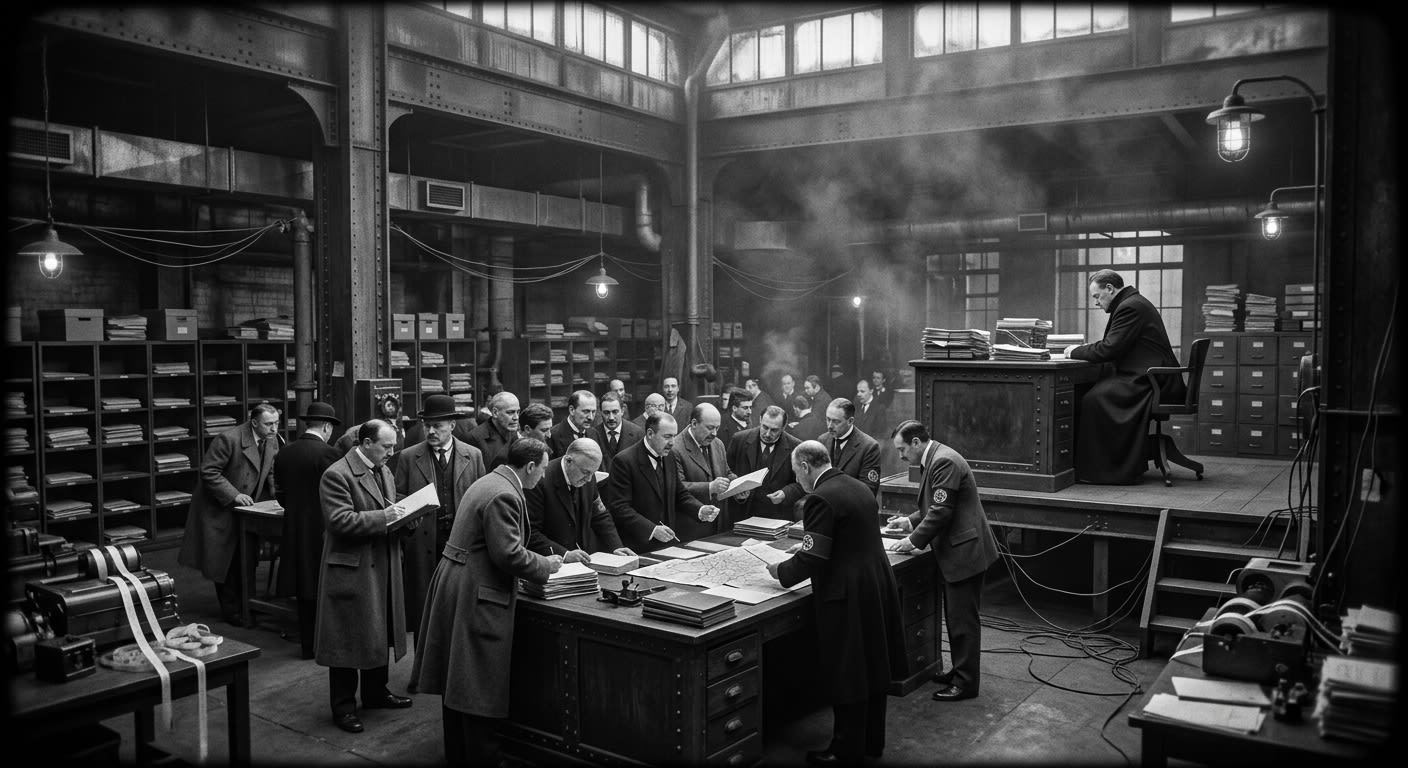
A.S. 95 gave the Synod the prize it had wanted since the first northern ledgers arrived in Strasbourg written in a hand too precise to be mocked: Berlin, renamed Kanzleiburg, and the Prussian administrative apparatus, absorbed whole while the Siege of Vienna burned southward and the old order discovered that survival often wears a clerk's cuff. The royal palace on the island was not stormed. It was not sacked. It was inventoried.
That is worse, if one has any sense of theatre.
The receiving commission entered with Records clerks, Doctrine seal-bearers, military quartermasters, two tired bishops, and a locksmith who had the decency to look ashamed. The throne room was measured. The royal chapel was re-dedicated. The guard barracks became courier dormitories. The western ballroom became Reserve Board Hall. The mirror gallery was stripped because clerks dislike watching themselves delay coal. The royal apartments became offices for men whose power exceeded a king's precisely because no one cheered when they exercised it.
A celebratory A.S. 96 broadside claimed that the Archonate Isle was “liberated from monarchical vanity and restored to holy service.”
Clarified. The palace was repurposed from one form of vanity to another. The old vanity wore crowns and commissioned portraits. The new vanity stamps corridors, counts wagons, and can starve a district without raising its voice.
The first Archonate renovations were practical and brutal. Walls came down where processions had once curved. Doors were widened to admit map cabinets. Private salons were divided into petition rooms no petitioner was permitted to enter without being reduced to a number. The kitchens stayed kitchens because even revolution respects soup. The wine cellars became winter fuel records, a demotion of such cruelty that I suspect Doctrine enjoyed it.
A palace, when converted correctly, yields excellent bureaucracy. High ceilings hold bad air above clerks' heads. Thick walls muffle petitions. Ceremonial stairs impress provincial visitors before exhausting them. Guardhouses already exist. Gates already suggest obedience. The old builders had intended to awe subjects. The Synod merely improved the aim.
#On the Bridges and Gates
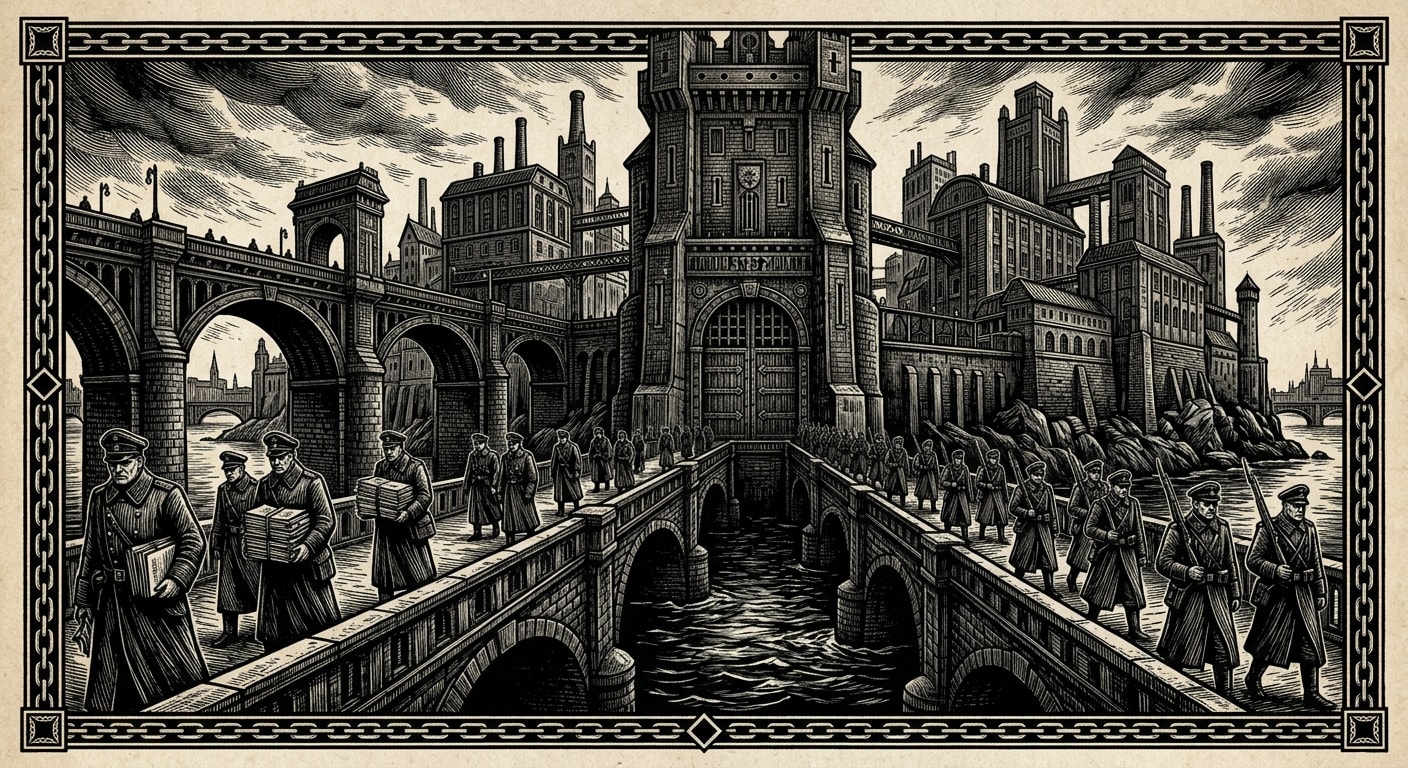
Five bridges feed the Isle. The northern service bridge carries coal chits, archive carts, warrant wagons, and men who do not wish to be noticed by people who notice for a living. The eastern bridge carries War traffic from the Garrison Quarter: officers, rail liaison messengers, artillery tables, casualty envelopes, and those heroic young captains who believe urgency exempts them from appointment registers. The southern bridge faces the Rail Quarter and receives dispatch runners whose boots arrive before their breath. The western bridge bears civic petitions and municipal grievance trains. The fifth bridge is officially a maintenance span and unofficially the route by which the Archon receives reports nobody wants entered through a gate with witnesses.
Every gate has two clocks. One gives ecclesiastical time. One gives rail time. They disagree by design. The difference is called the grace interval, and within it a document may be classified as late by Doctrine, timely by Rail, pending by Records, and actionable by the Archon. Kanzleiburg has built a civilization in that interval.
The guards are civil police in grey cuffs, not soldiers. This matters. Soldiers are trained to fear failure in the field. Isle police are trained to fear an unlogged entry. Their halberds are ceremonial, their ledgers are not. A general may bluster past a cannon. He stops at a desk if the desk controls his rail slot.
The west queue is the longest. It is full of factory delegations, parish fuel boards, brewer guilds, widows' committees, schoolmasters, pensioners, chapel repair deputies, and men with hats too fine for their complaints. The queue moves by district number, then urgency class, then riot probability. The last category has done more for civic fairness than three centuries of moral instruction.
#On the Halls of Routing
The Reserve Board Hall occupies the old western ballroom. Its ceiling retains frescoes of royal hunts, though the stags have been overpainted with route diagrams after the Beast Proscription made naturalistic antlers a heraldic inconvenience. Beneath them stretch three long boards: Inbound, Reserve, Failure. The Archon's personal office keeps smaller versions, but the Hall holds the public truth of the north.
Inbound records what has arrived: Hamburg grain, Danzig timber, Elbe coal, Essen gun fittings, Candlewick paper, Warsaw dispatches, wounded counts, replacement boots, coffin plank shipments, prayer-stool crates, lamp oil, winter wool, and the strange little categories by which government proves that absurdity can be made indispensable if repeated in columns.
Reserve records what may be spent. Not what is desired. Not what is promised. What may be spent. There is piety in that distinction, though no priest taught it. Grain held for Königsberg cannot feed a Kanzleiburg quarter unless the quarter's unrest forecast exceeds the bastion's starvation forecast. Coal destined for Brest cannot heat Old City churches unless the churches can show a cold-death ratio above the railmen's frostbite ratio. The board does not care. That is why it works.
Failure records assumptions scheduled for execution. A bridge weight limit too generous. A Hamburg berth estimate too optimistic. A garrison consumption report polished by a colonel's vanity. A Doctrine festival notice that would halt wagon movement during a winter surge. Failure is not accusation on the Isle. It is hygiene.
Adjacent to the Board Hall lie the Corridor Rooms, each named for the route it disciplines: Hamburg, Warsaw, Danzig, Magdeburg, Dresden, Königsberg, Brest. The Carpathian room is smaller and badly tempered because the central corridor claims half its authority. The Hamburg room smells of salt, tar, coal dust, and foreign credit. The Brest room smells of wet paper even in summer. The Königsberg room smells of lamp oil and resignation.
The War Concurrence Gallery runs along the eastern wing. Here the northern military command submits movement demands to civil routing desks, and here those demands are corrected, trimmed, delayed, or granted with the air of a butcher choosing cuts from a carcass. War officers hate the Gallery because it proves that courage travels only after paperwork has found it a wagon.
#On the Records Vaults
The Archonate Isle's northern vaults belong to the Bureau of Records, though belong is generous. Records occupies them the way damp occupies a cellar: thoroughly, permanently, and with an odour one pretends not to notice. The vaults descend beneath the former palace foundations into brick, granite, iron shelving, and older Prussian storage rooms whose labels survive under Synod stamps like ghosts under fresh paint.
They hold district rolls, rail rights, garrison requisitions, reserve logs, factory exemptions, civil petitions, transfer denials, Purity notice windows, War concurrence ledgers, and the second copies of documents Strasbourg cannot afford to lose and cannot bear to admit Kanzleiburg preserves better. The vault clerks speak in catalogue numbers. Their candles are hooded. Their keys are worn smooth. Their faces have the pallor of men who have spent too long in the company of facts no sermon can improve.
NORTHERN EYES ONLY is not a formal classification in the Strasbourg schema. This has been pointed out. Kanzleiburg thanked the relevant office for its vigilance and continued using the stamp. A classification becomes real when guards obey it and clerks refuse to laugh. Strasbourg has forgotten this, having mistaken printed tables for power.
In the oldest room under the south foundation, the Prussian royal treasury cages hold reserve ledgers from before A.S. 95. They should have been sent to Strasbourg at absorption. They were not. The official explanation is volume. The practical explanation is custody. The true explanation is that no one in Kanzleiburg was foolish enough to surrender the memory of how the north worked before it was renamed.
ARCHONATE ISLE VAULT — PRE-ABSORPTION HOLDINGS REVIEW Shelf group P-OLD/17: royal military supply memoranda, Baltic corridor. Shelf group P-OLD/21: officer corps loyalty tables. Shelf group P-OLD/33: civil contingency for Synodical overreach, unsigned. Doctrine note: remove to Strasbourg. Records note: removal scheduled. Archon note: ██████████████████████████████ Status: still present.
#On Doctrine's Sermon Desk
Doctrine's northern sermon desk occupies rooms that once housed a prince's porcelain collection. This has improved the rooms. The desk prepares approved homilies for Kanzleiburg, Hamburg, Warsaw, Danzig, the northern bastion chapels, military rail stations, municipal fasts, and public explanations of scarcity. It is called a desk because calling it a minor propaganda manufactory would distress the junior exegetes, who enjoy believing their prose has a soul.
The desk's central problem is Prussian attention. Kanzleiburg citizens listen exactly. If a sermon says sacrifice is shared equally, three committees will request the equality table. If a homily praises voluntary restraint, the brewer guild will ask whether voluntary restraint may be invoiced. If a priest calls hunger sanctifying, widows will ask whether sanctification exempts households from tithe arrears. This is why Doctrine in Kanzleiburg writes with more precision and less beauty than Doctrine elsewhere. A pity. Necessary, but a pity.
The sermon desk answers to Strasbourg in theory and to the Archonate schedule in practice. No sermon may interrupt rail surge windows. No procession may cross the south bridge during reserve transfer. No saint-bone display may consume police cordons during fuel compression weeks. The Desk resents this. The Archon does not resent back. Resentment wastes heat.
#On War Inside Civil Walls
The eastern wing houses northern military command, though the word command must be handled carefully. The officers command men. The Isle commands the paths by which those men become useful. This distinction has prevented mutiny, starvation, and several theological essays that would have worsened both.
Maps cover the walls: Baltic approaches, Königsberg lake-maze, the Bug River and Brest's brass span, Warsaw staging yards, Hamburg docks, Danzig timber routes, rail sidings, bridge capacities, winter road closures, known sabotage points, suspected sabotage points, and points that are not marked because the marker would frighten visitors. Pins move hourly. Red string is forbidden after the Great Misreading of A.S. 122, when a visiting Procurator mistook a route-priority web for an invasion diagram and ordered three regiments to prepare for an attack from Magdeburg. The current pins are brass, black, and bone.
War dislikes being housed in a former palace because palaces produce expectations of command performance. The Isle corrects this. A colonel who arrives demanding priority for a heroic movement will be asked for tonnage, axle weight, horse exhaustion, rail slot consequence, fuel draw, civilian displacement, coffin estimate, and whether the heroism can wait six hours. Often it can.
The War and civil corridors meet at the Concurrence Door. It has two locks: one held by the military directorate, one by the Archon's office. During ordinary operations both are opened each morning. During disputes, both remain locked and the clerks pass papers through a narrow slot installed after the A.S. 118 Shouting Week. The slot has preserved more dignity than any chaplain assigned to the wing.
#On Petitioners and the Weather of Power
The Archonate Isle teaches citizens that power has weather. Some days the west gate is clear, the clerks are warm, and petitions move like boats on decent water. Some days the rail alarms ring from the south bridge and every civic question freezes under the phrase forward priority. Some days Purity arrives with white mantles and receives a waiting room. Those days are cherished by the clerks and hated by Purity, which is the nearest thing to public merriment the Isle permits.
Petitioners learn the categories: immediate, urgent, seasonal, deferrable, morally desirable, fiscally unsound, riot-probable, sermon-manageable, War-adjacent, and lost. Lost is not written. Lost is indicated by a clerk placing the file in a tray too low to be seen from the counter.
The Isle's cruelty differs from Strasbourg's. Strasbourg loves ritual. Kanzleiburg loves sequence. Strasbourg humiliates by splendour: the high nave, the gold seal, the bell, the chanted decree. Kanzleiburg humiliates by making a man understand exactly where he stands in a queue and why his grief ranks below axle grease. I cannot decide which method is more honest. Honesty is not the measure by which governments should be flattered.
The most dangerous petitioners are not the loud ones. Loud men are given rooms where their echoes tire them. Dangerous petitioners arrive with corrected figures. A widow who knows the flour variance by district is more threatening than a bishop with a curse. The Isle respects her by fearing her properly.
#On the Curfew Lesson
The Curfew Standoff of A.S. 140 did not occur on the Isle, but the Isle ended it. Purity tried to bite the Old City beer-halls. The beer-halls closed in obedience. Officers became sober, which is a threat no prudent government ignores. The petition came through the west gate on the second day. By the third, the Archonate issued a suspension so brief and grey that one could miss its elegance if one lacked my eye.
Temporary suspension pending operational review. Existing fines held in abeyance. Inspection authority preserved in principle. Enforcement deferred in practice.
That is statecraft. No apology. No confession. No triumph. Purity kept its dignity in the sentence and lost the street in the clause. The beer-halls reopened. The Archon issued no speech. The Isle does not speak when procedure has already performed the murder.
The curfew file remains in the municipal coordination shelf, not the Purity shelf, not the civil disturbance shelf, not the discipline shelf. Placement is verdict. Every year the beer-halls close briefly with placards reading CLOSED IN OBEDIENCE TO PURITY. The Archonate records the event as a traffic variation. That is how a city laughs without risking its teeth.
#On the Archon's Office
The Archon's personal office is smaller than legend requires and larger than humility would permit. Its windows look south toward the rail smoke. Its walls hold no portraits. Three boards stand behind the desk: Inbound, Reserve, Failure. There is a fourth board behind a folding screen. I have seen it once. I will not describe it fully, because even I possess restraint when restraint increases my value.
The desk is plain black wood, Prussian, pre-absorption, scarred along the right edge by a blade or compass point. The inkwell is heavy. The blotter is changed twice daily. Files arrive in grey covers, blue covers, black covers, and one rare red cover used only when a question has ceased being administrative and become historical.
The Archon receives bishops, generals, guild masters, foreign commercial factors, Records assessors, Purity officers, rail chiefs, factory syndics, and the occasional Hieromnemon with the good taste to notice furniture. He does not overawe. He reduces. A man enters with a cause and leaves with a classification. This is a severe mercy. Causes make men stupid. Classifications make them invoiceable.
A Strasbourg dinner anecdote claims that the Archon keeps a royal crown in his desk drawer as a paperweight.
False. The Archon owns no such ornament. He uses a broken rail coupling from the Hamburg line, stamped A.S. 95, the year the city was renamed. This is less romantic and more frightening.
I asked him once whether the Isle was a palace, a chancery, or a fortress. He answered: “A junction.” Prussian answers are not short because Prussians lack imagination. They are short because they dislike feeding yours.
#On the Present Condition
As of A.S. 201, the Archonate Isle remains the fixed hinge of the northern machine. Three million souls pulse around it in Kanzleiburg's grid. Sixty trains a day in summer and forty in winter pass through the Rail Quarter's throat. Hamburg sends grain, coal, foreign credit, and dockside contempt. Warsaw waits eastward with staging yards full of urgency. Königsberg freezes. Brest confesses. Strasbourg issues doctrine. The Isle makes the route table survive contact with all of them.
Its weaknesses are the weaknesses of concentration. Too many decisions cross too few bridges. Too many vaults sit above old water. Too many Bureaus pretend cooperation because the corridors are narrow. Sabotage files remain sealed. The maintenance span receives traffic no public gate records. The pre-absorption ledgers remain below the south foundation. Purity dislikes being scheduled. Doctrine dislikes being edited by train windows. War dislikes having courage weighed. Records dislikes that Kanzleiburg remembers what Strasbourg forgets.
The Isle endures because delay is the northern sin and punctuality its rough absolution. Men may resent it, mock it, petition it, curse it over thin soup and colder coal, but they watch the trains leave and know the north has not yet failed. That knowledge is not love. It is stronger.
At fifth bell the south bridge shakes under dispatch horses. At sixth, the Reserve Board changes Brest's coal line from amber to black. At seventh, Doctrine's sermon desk strikes three adjectives from a scarcity circular because a widow's committee could use them as evidence. At eighth, War requests priority and receives arithmetic. At ninth, the Archon signs a page without looking pleased. Beneath the island, the Spree carries soot around old palace stones, and the Archonate Isle continues its holy work of making command smaller, colder, and possible.