
#On the Scope of This Survey
This survey describes the Day of Zeroing as the Synod keeps it in A.S. 201. It is the adopted feast of Saint Calibrus, the Level Hand, and the Tariff-Chapel Division observes it over every licensed scale in its custody. The files do not say when the first such feast was kept, who presided over it, or what day of the year it belongs to. I have no intention of supplying any of the three. A ledger with a blank in it has at least told the truth about its blank.
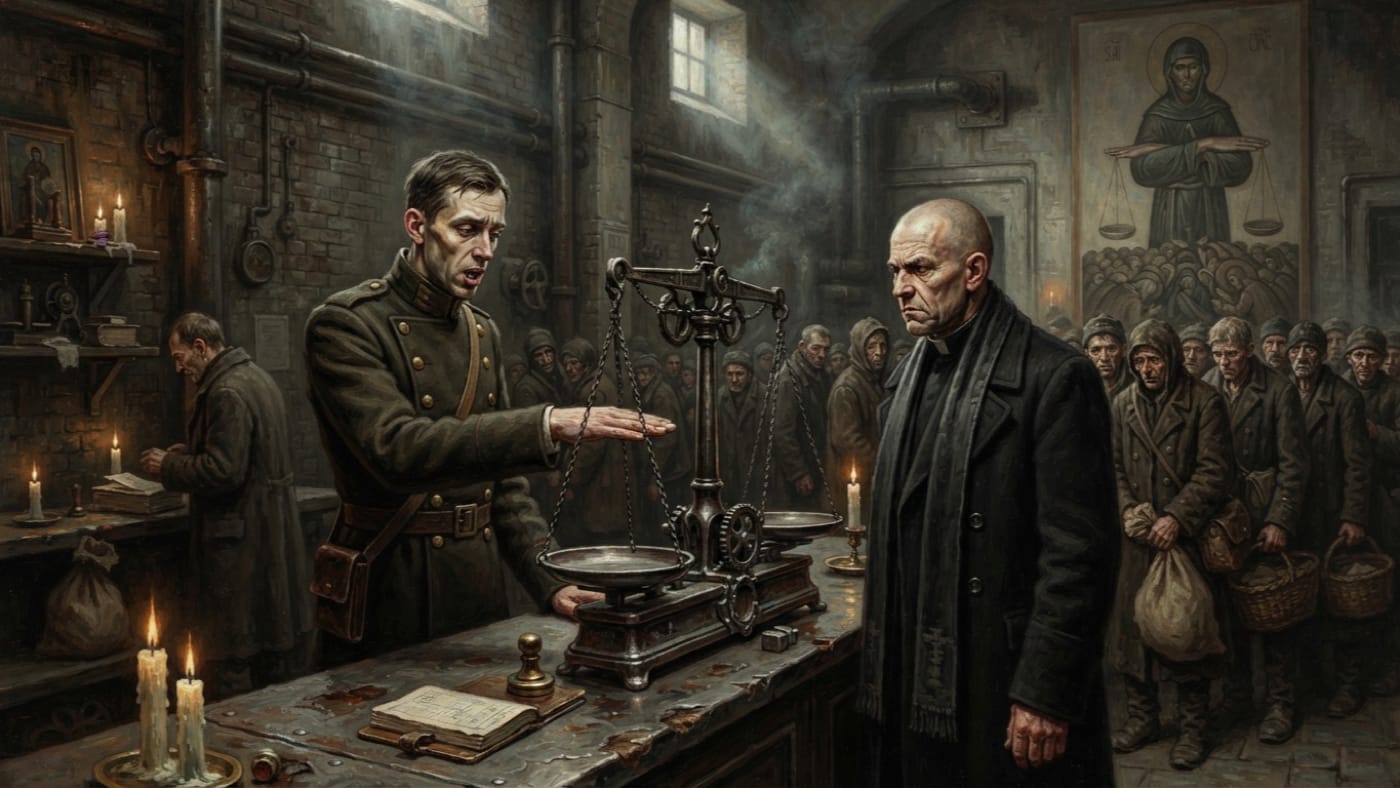
What can be surveyed is the pan. On the feast, each licensed scale is cleaned, checked, blessed and re-zeroed while a witness watches. The clerk holds the right hand above the empty pan and recites the Level Prayer. That is the observance. Everything else in this tract is commentary, and commentary is my office.
#On the Origin of Licensed Measure
Before A.S. 97 a scale belonged to whoever owned it, and so did its opinions. The Bread-Scale Uprising ended that arrangement. At the southern gate of a Line bastion that the file declines to name, the grain guild had poured lead into the civic weighing pans. Every sack weighed heavy and every tariff rose. Every receipt was correct. The city went on paying lawful prices for grain it never received until it was eating chapel sweepings, and then it burned the gate.
Strasbourg answered quickly. Private measurement was prohibited. The civic scales were seized, catalogued, sanctified and placed in licensed custody. Weighing became a sacramental act. The Bureau of Doctrine declared false weight a heresy against Order, the Bureau of Tithes called unsanctioned scales theft from the common ledger, and the Bureau of Purity found demonic contamination in any tampered pan, as the Bureau of Purity generally does.
The hungry rose against guild predation and burned the southern gate.
Corrected by Bureau of Records language: the Bread-Scale Uprising is classified as a supply-chain irregularity. The feast that followed it observes no riot and commemorates no hunger. It maintains instruments.
Calibrus was already there. Surveyors, honest millers and men too dull for more dangerous devotions had invoked him for a long time. After the gate burned, the seized scales needed a face above them, and he had one available, along with a hand held level and a reputation for refusing to lift the weight. The Tariff-Chapel Division adopted his feast and named it the Day of Zeroing.
With that adoption the cleaning of a scale became a liturgy. A thing every competent weigher had always done for the sake of accuracy is now also done for the sake of the soul, before witnesses, under a saint's eye and with the Division's approval. Maintenance was raised to a sacrament. Our administration has made the same promotion before, and the promoted have always been more obedient for it.
#On the Rite and Its Witness
The feast has four acts, and the survey records them in their order. The scale is cleaned. It is checked. It is blessed. It is re-zeroed. Each act is done before a witness.
The cleaning is ordinary work done in an unusual place. Wheat dust comes off the pans and the beam, chain-grease is wiped from the links, and the iron is brushed down until it is as cold and plain as it was when it was forged. The Commerce Clerk uses the same finger brush that hides a tremor on every other day of the year. Candle tallow drips. Someone outside coughs on purpose.
The checking uses the instruments of licensed custody: the reliquary calibration casket, the stamped weights, the ledger and the seal. I will not describe the procedure as tolerances, loads or repetitions, because the survey does not record it that way, and a tract that invented numbers for the occasion would be committing the sin the feast exists to prevent. The fragments in the casket act as the Division's calibration anchors. The Bureau of Relics vouches for their holiness on its own authority. I vouch for it on none.
The blessing comes next. Then the clerk puts the right hand above the empty pan, palm down and level, the forearm imitating the beam, and recites the Level Prayer. The survey records that the prayer is said. Its words are not reproduced here. This is a survey, not a hymnal, and the Division has not asked me to publish its devotions to the queue.
Last comes the zero. The beam settles and the empty pan reads empty. The witness sees it.
The files require a witness, but they are not generous about who the witness must be. They give no rank, appointment procedure or qualification. They establish only that someone other than the clerk is present when the instrument is declared true. The profession already says a scale calibrated alone will "choose a side." On the feast, superstition and statute happen to agree.
These feast acts should not be confused with the clerk's everyday morning. On any working day a Commerce Clerk unlocks the casket, touches a fragment to the scale arm, says the calibration lines and sets zero before the queue turns mean. Those are habits of the trade. The Day of Zeroing takes the same instrument and the same hand and makes them answer in public.
#On the Unequal Day
The observance carries the name "Day," and in places it keeps to one. In rich ports the feast lasts a single morning. In poor trench depots it lasts three days.
The survey records both durations together, and it records no reason for the difference. I have opinions. Opinions are not survey data. I leave the two figures side by side and let the reader look at the distance between a morning and three days.
Both sides of the counter resent the feast, for different reasons. Vendors hate it because it holds up the queue. A sack that waits is a sack that can spoil, be stolen or be argued over. A morning's delay at a port costs a merchant money. Three days at a depot costs everyone in the line something.
Clerks hate it because it puts them on show. For as long as the feast lasts, the scale is examined in public, and so is the hand above it. A clerk who has spent the year adjusting a little for friends, for patrols or for the desperate must now hold that hand level in front of a witness and say the prayer while the pan is examined. The vendor resents losing time. The clerk resents being looked at.
#On the Suspended Balance
The approved icon of Calibrus, as the Bureau of Heraldry permits it, shows a balance hanging over a kneeling crowd. He holds his forearm level and keeps his mouth closed. The pans are unmarked. Heraldry allows two readings of the crowd. In one they kneel in prayer. In the other they kneel because their legs have given out.
Heraldry has never ruled between them. The icon on the wall leaves its question unresolved, while the scale beneath it is resolved every feast, its zero declared before a witness. The saint's balance never settles. The clerk's settles because it has to, since a queue cannot be weighed against a question.
The profession's two factions read the icon in opposite directions. The True Measure Zealots take the prayer reading. They value strict calibration, report bribes and keep their icons polished, and they treat the feast as the year's most honest morning. The Mercy Weighers take the hunger reading. They look at the kneeling crowd and see knees buckling, they shade tariffs for the desperate, and they call on the saint as witness to a lighter hand. Both factions keep the same feast and recite the same prayer over the same kind of pan. They do not agree on what the pan is for.
The doctrine provides two phrases. "False weight is heresy" is the Zealot's motto and is true. "Measure is mercy" is the Division's motto and is printed on the cards. A properly zeroed scale exposes lead in the pan and theft in the tariff, and that is a real good, bought with a burned gate. The same zeroed scale also weighs a short sack of grain at exactly its true weight. Insufficient bread, measured correctly, remains insufficient bread. The feast certifies the measurement. It cannot do anything about the harvest.
#On the Present Application
In A.S. 201 the Day of Zeroing is kept wherever licensed scales stand: in tariff-chapels at port gates, in market wards and in depot chapels along the trench supply corridors. Each scale is cleaned, checked, blessed and re-zeroed, and each has a clerk's right hand held level above an empty pan. Each also has a witness, who is not necessarily an inspector, though the clerk standing in front of them may doubt it.
The Bureau of Tithes values the feast as a guarantee of the ledger. Doctrine values it as a homily performed with iron. Purity values it as a periodic exorcism of the pan. The vendor experiences it as delay. The clerk experiences it as exposure. The crowd under the icon is still kneeling, and the Church has still not said why.